
ABOUT THE ORGANIZATION:

Legis Scriptor is a transpiring team of ardent & fervent people across all the strata of the legal field, promoting academic excellence & ameliorating realms of knowledge to contribute in building skillful society. We endeavor to provide quality contemporary legal content concerning from tangled minute issues to issues of international concerns. We provide a platform to students across the length & breadth of the country to enhance their research & writing skills, which is the uttermost requirement of the today’s fast-evolving & zestful legal field.

ABOUT THE COMPETITION:

Every legal notice you serve, every reply you send, every petition you file in the court, every legal document relevant to a case, builds up your case. Every word you write and exchange with the opposite party eventually decides whether you will win or lose the case. Even before your counsel or you stand before the judge and open your mouth.

MODE OF THE COMPETITION:

Online

LANGUAGE:

English.

LEGAL DOCUMENTS ARE AS FOLLOWS:

 Bail Application or,
 Anticipatory Bail Application or,
 Consumer Complaint or,
 Application for temporary injunction.

ELIGIBILITY:

 The students currently enrolled in either five years or three years LL.B. courses or LL.M. programs from any recognized University/ Law College/ College/ Institution are eligible for participation in the competition.
 There is no restriction on the number of entries from any college or university.

TEAM COMPOSITION:

 Each team shall consist of one individual or two individuals that qualify the eligibility criteria.
 Multiple teams are allowed from different University/ Law School/College/ Departments.

REGISTRATION:

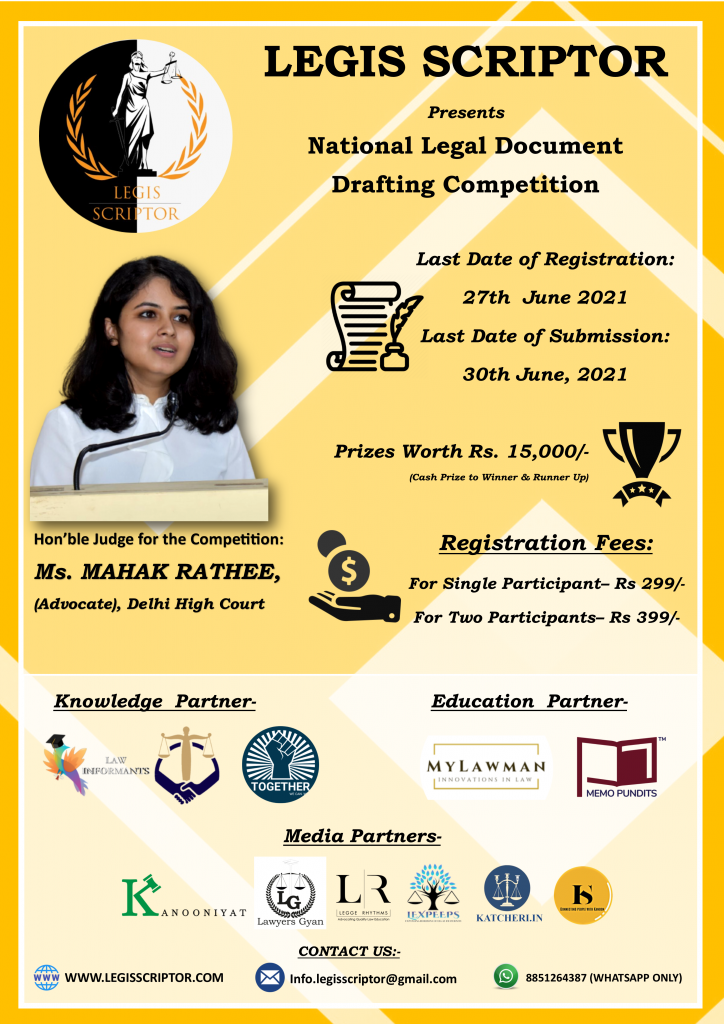
 There shall be a nominal registration fee of Rs. 299/- for Single participant, Rs. 399/- for the team of two individuals.
 Registration Link is given below- https://forms.gle/SYaQD95GkZGQwCYdA
 The registration fee shall be non-refundable and non-transferable in any circumstance.
The last date for registration is 05:00PM IST, 27th June, 2021.
 Only 30 registrations will be allowed to register in the competition on first-come- first serve basis.
Note: No approval from the respective institute of the participants is required for participation.

IMPORTANT DATES:

  • Last date of Registration: 05:00 PM IST, 27 th June, 2021
  • Date of Problem Released: 08:00PM IST, 27 th June, 2021
  • Last date for Document Submission: 30 th June, 2021
  • Date of Result Announcement: 04 th July, 2021

Payment Method:

Paytm UPI ID- 8851267359@paytm
Phone Pe UPI ID- 8851267359@ybl
Google Pay- 8851267359
Paytm- 8851267359
After the payment all participants are required to upload screenshots of the same on Google form given below while registration.
AWARDS: PRIZES WORTH RS. 15,000/-
WINNER – Prize money of Rs. 1500/- + Certificate of Excellence + Free Publication
Opportunity + Rs. 1500/- Voucher of Certificate Course of Memo Pundits.

Runner up- Prize money of Rs. 1000/- + Certificate of Excellence + Free Publication Opportunity + Rs. 1000/- Voucher (Certificate Course of Memo Pundits).
3rd Position – 10 th Position- Certificate of Merit + 50% discount in publication opportunity + Rs. 200/- Voucher (Certificate Course of Memo Pundits).
All the participants who will register for this event, will receive “CERTIFICATE OF PARTICIPATION” + 25% discount in Publication Opportunity.

PERKS:

 All the participants will get publication opportunity.
 The general rules and principles of drafting legal documents.
 How to edit and review documents you have drafted.
 Fundamentals of good legal writing.
 Certificate of participation.
 Learn how to draft notices.
 Invaluable knowledge.

DOCUMENT SUBMISSION GUIDELINES:

Submission of Documents:

  1. Every participant or team registered for the competition would be required to prepare any one of the following documents:
    a.) Bail Application or,
    b.) Anticipatory Bail Application or,
    c.) Consumer Complaint or,
    d.) Application for temporary injunction.
  2. All documents must be submitted through Google Form till 11:59 P.M., till 30 th June, 2021 and the link of the google form for submission is mentioned below:
  3. Any submission made after the deadline specified shall attract a penalty of deduction of 0.50 marks per hour from the aggregate marks.
  4. No submission made after 24 hours of the deadline shall be accepted at any cost.

SAMPLE DOCUMENTS and PROBLEM:

All the participants will receive a sample format for the type of legal document they wish to prepare which will facilitate them in drafting. The respective problems for each document type will be provided to participants after registration.

FORMATTING GUIDELINES:

  1. All the legal documents must be submitted in Microsoft Word Document format (.doc/.docx) or PDF Format (.pdf).
  2. The legal document shall be typed on an A4 size page in Font type: Times New Roman, Font size: 12, 1.5-line spacing & 1-inch margin on each side.
  3. Footnoting is prohibited.

Official Brochure:
For More Information, Click on the link given below-
https://www.legisscriptor.com/
Contact us for any query:
E-mail: info.legisscriptor@gmail.com
WhatsApp number: 8851264387 (WHATSAPP ONLY)
Note: If in case of any query, participant can drop a message on WhatsApp on the number given above and they will receive a call from concerned authority in 24 hours to resolve their query.

For regular updates, join us:

WhatsApp Group:

https://chat.whatsapp.com/CdshAqpiV1FEogy5pBlY43

Telegram:

https://t.me/lexpeeps

LinkedIn:

https://www.linkedin.com/company/lexpeeps-in-lexpeeps-pvt-ltd

Visit us for more such opportunities: http://lexpeeps.in/

About the University:

National Law University, Jodhpur is one of India’s premier law schools, situated in the vibrant and colourful city of Jodhpur, Rajasthan. It was established in 1999 as part of a vision of excellence in legal education through innovative methods of learning and focus on interdisciplinary studies. The University offers two unique five-year integrated undergraduate programs, B.B.A., LL.B.(Hons.) and B.A., LL.B.(Hons.). These integrated programs include highly demanding honors courses in various facets of law such as Constitutional Law, Business Law, International Trade Law, Criminal Law, and Intellectual Property Rights Law.

About the Journal:

The Comparative Constitutional Law and Administrative Law Journal (CALQ) is the flagship journal of the Centre for Constitutional Law and Administrative Law, published under the guidance of Prof. (Dr.) I.P Massey, Dean, Faculty of Law, National Law University Jodhpur. CALQ aims to promote scholarly excellence in the area of comparative constitutional and administrative law with a diligent editorial board, an eminent advisory board and an institution known for its academic excellence. Each issue contains articles, notes, case comments and book reviews based on contemporary issues of comparative constitutional and administrative law.

Theme:

The articles, notes and case comments must relate to the area of comparative constitutional law and administrative law.

Guidelines:

1. General Guidelines:

  1. The Comparative Constitutional Law and Administrative Law Journal [“Journal”] attempts to initiate and foster academic dialogue concerning the subject of Administrative Law and Constitutional Law keeping in mind a global perspective. Please note that all submissions must be topical to the scope and theme of the Journal.
  2. All submitted manuscripts shall be original. Any form of plagiarism would lead to immediate rejection of the submission.
  3. Submission of solicited manuscripts, on invitation from the Journal’s editors, guarantees publication of the same. However, if such solicited manuscript does not meet the Journal’s standards of quality scholarship, final discretion to publish the solicited manuscript vests with the Editorial Board [“Board”]
  4. The author(s) must inform the Board if the manuscript has also been submitted to another journal, website or forum. The Board must be notified immediately if an offer for publication from another journal, website or forum is accepted by the author(s).
  5. After the first publication of a manuscript with the Journal, permission for any subsequent publication in another forum must be obtained from the Board.
  6. All correspondence must be via e-mail, and should be addressed to the Managing Editor at: editorcalq[at]gmail[dot]com

2. Specific Guidelines:

2.1. Author(s)

  1. Each manuscript may have up to two authors, however co-authorship is not permitted for Book Reviews and Case Comments
  2. In case of joint authorship, the author from whom a submission is received by the Board, shall intimate the Board of the name, credentials and contact details of the intended co-author.

2.2. Citations and References

  1. All relevant sources shall be duly acknowledged as footnotes.
  2. Speaking footnotes are allowed
  3. The text and citation styles shall conform to the rules prescribed in The Bluebook: A Uniform System of Citation (20th edition).

Submission Categories:

  1. Articles: Not exceeding 10,00 (Ten Thousand) words.
  2. Notes: Not exceeding 4000 (Four Thousand) words.
  3. Case Comment- Not exceeding 3000 (Three Thousand) words.
  4. Book Reviews- Not Exceeding 2000 (Two Thousand) words.

a) Articles: Articles must deal with issues of interest and relevance and must demonstrate a high-level of analysis. Articles of a purely descriptive nature are not preferred.

b) Notes: Notes should cover a recent development or should be issue specific. A Note functions as a more condensed and succinct Article.

c) Case Comments: Case comments entail a critical analysis of recent case laws and policy developments.

d) Book Reviews: Book Reviews entail providing a critical analysis and review of any book that deals with the subject matter of the Journal.

All manuscripts must necessarily be accompanied by an abstract of not more than 350 words.

Word Count:

Please note that the word limit would be considered excluding the footnotes, except when speaking footnotes are used. The journal may accept shorter or longer submission depending on the quality of the submission.

Formatting Specifications:

  1. The manuscript must be word-processed in Garamond.
  2. The main body text should be in font size 12 and footnotes in size 10.
  3. There should be line spacing of 1.5 between paragraphs and headings in the main body and line space of 1.0 in footnotes.
  4. Verbatim quotes must be put in double quotes and italicized with a 0.5” indent.
  5. The entire document, including footnotes, must be justified.

Language:

The Journal shall follow British English.

Submission Procedure:

  • The Author/s are required to email the manuscript to editorcalq[at]gmail[dot]com
  • The manuscript may be mailed in Microsoft Word (‘.doc’ or ‘.docx’) format.
  • The manuscript shall not contain any details of the author, and anonymity must be maintained.
  • The subject of the mail must clearly mention, ‘Submission for CALQ_Volume 6.1 [Article/Note/Case Comment/Book Review]’.
  • The mail must be addressed to the Managing Editor, providing the name of the author/s with the name of the institution affiliated to and the contact details in the body of the mail.
  • A mail confirming the receipt of the manuscript and subsequently its acceptance for publication would be duly conveyed to the author/s through the email id used by the author/s for correspondence.
  • The last date for submission is 11:59 p.m. (IST) on 15th August 2021

Contact Details:

All correspondence must be via e-mail, and should be addressed to the ‘Board of Editors’ at: editorcalq@gmail.com

For regular updates, join us:

WhatsApp Group:

https://chat.whatsapp.com/CdshAqpiV1FEogy5pBlY43

Telegram:

https://t.me/lexpeeps

LinkedIn:

https://www.linkedin.com/company/lexpeeps-in-lexpeeps-pvt-ltd

Visit us for more such opportunities: http://lexpeeps.in/

About VidhiGyaan:

VIDHIGYAANis a law fest hosted and organised by the students and faculty of M.K.E.S College of Law. VIDHIGYAAN provides an ideal platform for the students of various colleges to showcase their talents. It provides an opportunity for students to come together, interact, and get motivated with the experience gained through Participation & Competition. It endeavors to bring together the creativity, intellect and wackiness of youth.

About M.K.E.S:

Malad Kandivli Education Society’s (MKES College of Law) was established in the academic year 2014-2015. The Institute is affiliated to the University of Mumbai& the Bar Council of India, New Delhi, for conducting LL.B. (3 years) & B.L.S/LL.B. (5 years) Law courses.

Eligibility Criteria:

Competition is restricted to bonafide regular students of Law school/College/University. All participants must be students of 3 years /5 years law course in the academic year 2020-21.

Registration Procedure:

  • Teams must register themselves latest by 20th June 2020.
  • Registration form duly signed by participants and the Principal of the concerned college should be sent to vidhigyaanmkes[at]gmail.com.

Fees:

Local candidates: Rs. 800

Payment Details:

  • Name of Institution: M.K.E.S. College of Law
  • Bank Name: HDFC Bank
  • Bank Branch: Juhu Tara Road
  • Address: Shop No. 1, 2 & 3, Valencia Condominium 11, Juhu Tara Road, Santacruz West, Maharashtra, Mumbai – 400049
  • IFSC Code: HDFC0001800
  • Account Number: 50100246844166

Awards:

Participants get a chance to excel at the Moot Court and to win a cash prize of up to ₹36,000*.

Important Dates:

  • Date of Competition: 3rd and 4th July, 2021
  • Last date for Registration: 20th June 2021
  • Submission of Memorials: 28th June 2021
  • Exchange of Memorials: 30th June 2021

Important Details:

For regular updates, join us:

WhatsApp Group:

https://chat.whatsapp.com/CdshAqpiV1FEogy5pBlY43

Telegram:

https://t.me/lexpeeps

LinkedIn:

https://www.linkedin.com/company/lexpeeps-in-lexpeeps-pvt-ltd

Visit us for more such opportunities: http://lexpeeps.in/

The Supreme Court dismissed the bail application filed by suspended IGP Zahur Haidar Zaidi on Tuesday i.e. on 15 of June 2021, related to the custodial death of an accused in the case of gang rape and murder of a 16-year-old schoolgirl in Shimla in 2017. The Bench of the Supreme Court rejected the bail application of former IGP Zaidi.

Advocate appearing on behalf of the former IGP submitted that there is no case of murder made out against the accused. Only a case of the disappearance of evidence of offence under section 201 IPC is made against him.

The case is related to the custodial death of an accused, who was arrested in a case of alleged gang rape and murder of a sixteen-year-old girl in Shimla in 2017. Haider Zaidi was arrested on 29th August 2017, after CBI probe into the investigation.

-Report by Muskan Chanda

About KIIT (D.U.):

KIIT Deemed to be University is situated in Bhubaneswar and is one of the premier self financing universities of the country. It caters to more than 30,000 students from all across the nation and 50 other countries through more than 100 Academic programs like MBA, Engineering, Law, Bio-Technology, Rural Management etc., in more than 23 World Class Campus comprising of more than 2500 Academic and Research Staff. Established in 1992 with 2 staff and 12 students, it has gained its prominence in the world today and is also categorized as Institute of Eminence since 2019. Other details may be found at www.kiit.ac.in

About the Competition:

In continuation of its seven preceding events, the 8th KIIT National Moot Court Competition in the virtual mode plans to uphold the same ethos and yet ameliorate the standards of intellectual stimulation. This is the first online edition of the KIIT National Moot Court Competition, and hence they are looking towards making it a grand success.

Eligibility:

Students of three-year or five-year integrated law degree courses from any University/Law School/College/Department are eligible to participate in the Competition. However, a maximum of one Team shall be allowed to participate from any one University/Law School/College/Department.

Registration Procedure:

For provisional registration teams are required to send a mail to “kiitmoot2021@kls.ac.in” The teams interested in participating are required to confirm their participation by filling up the Google form. The link of which is: https://forms.gle/yv8bbp74sY2qYTJG6

The last date of final registration and payment is 27th June, 2021, (11:59 PM).

Teams interested in participating will send in the required registration amount of Rs. 3000/- via internet banking or any other mode in the following transaction details:

  • Name: KIIT School of Law
  • Account Number: 20139445354
  • IFSC: IDIB000K717
  • Account Type: Current
  • Bank: Indian Bank, KIIT Branch, Patia, Bhubaneswar

Submission Procedure:

The Written Submission has to be submitted only in soft copy. Each Team shall send a soft copy of the Written Submissions, via electronic mail, on or before July 10, 2021, by 17: 00 hours to: kiitmoot2021@kls.ac.in.

Awards:

  • Winning Team Award: The winning Team will receive a prize worth Rs.1,00,000/- (Rupees One Lakh Only).
  • First Runners-Up Team Award: The first runners-up Team will receive a prize worth Rs.50,000/- (Rupees Fifty Thousand Only).
  • Second Runners up Team Award: The Second runners up Team will receive a prize worth Rs.25,000/- (Rupees Twenty Five Thousand Only).
  • Best Student Advocate/Counsel: The Best Student Advocate/Counsel will receive a prize worth Rs.10,000/- (Rupees Ten Thousand Only).  Best Memorial -The Team submitting the best memorial will receive a prize worth Rs. 10,000/- (Rupees Ten Thousand Only).

Deadlines:

  • Last date for Provisional Registration June 15th, 2021
  • Last Date of Registration June 27th, 2021
  • Last Date for Seeking Clarifications June 27th, 2021
  • Confirmation of Registration & Team code allotment June 30th, 2021
  • Release of Clarifications July 5th, 2021
  • Last date of Soft-copy written submissions July 10th, 2021
  • Dry- Run session in Zoom for participants July 13th, 2021
  • Compendium Submission July 14th, 2021
  • Inaugural function and Orientation of Participants followed by Draw of Lots & Memorial Exchange July 16th, 2021
  • Preliminary Round -1 & Preliminary Round – 2 followed by Draw of Lots & Memorial Exchange for Quarters July 17th, 2021
  • Quarter- Final Rounds followed by Draw of Lots & Memorial Exchange for Semis July 17th, 2021
  • Semi-Final Rounds, Final Rounds & Valedictory Ceremony July 18th, 2021

Contact Details:

Ankita Shaw: Student Convenor at KIIT Law School Moot Court Society: +91 9748274280

Official Links:

For regular updates, join us:

WhatsApp Group:

https://chat.whatsapp.com/CdshAqpiV1FEogy5pBlY43

Telegram:

https://t.me/lexpeeps

LinkedIn:

https://www.linkedin.com/company/lexpeeps-in-lexpeeps-pvt-ltd

Visit us for more such opportunities: http://lexpeeps.in/

The petition filed requesting CBI probe into the case of murder of 2 BJP activists allegedly at the instance of Trinamool Congress leaders during the after poll violence is adjourned to 18th June by Supreme Court on Tuesday i.e. 15 of June 2021. The bench decided to hear the case on June 18th, after a request was made by Solicitor General Tushar Mehta regarding the matter. The Court was hearing a petition filed by Biswajit Sarkar, brother of deceased BJP member Avijit Sarkar who was brutally killed by TMC members during the after-poll violence in West Bengal.

The petition filed by Biswajit Sarkar sought the constitution of a Special Investigation Team(SIT) to investigate under the monitoring of the court the brutal murder of his brother and BJP booth worker Haran Adhikari allegedly at the behest of Trinamool Congress members.

The petition also sought directions for an investigation into the acts of widespread violence which took place in West Bengal after the Trinamool Congress was elected to power for the second consecutive term on 2nd May. A 17 years old girl and a 60 years old lady from West Bengal have also moved the Supreme Court alleging that they were raped by All India Trinamool Congress (TMC) workers for supporting the Bharatiya Janata Party (BJP) in the West Bengal elections 2021.

Both these petitions were filed in a pending case filed by Biswajit Sarkar, the brother of deceased Bengal BJP worker Abhijit Sarkar, who was brutally murdered when violence broke out after the Mamata Banerjee led All India Trinamool Congress secured a victory over the BJP in the 2021 elections.

-Report by Muskan Chanda

-Report by Anuj Dhar

On 28th May, the Supreme Court of India maintained the Trial Court and the High Court’s order and dismissed the appeal of the appellants in the impugned judgment of 28th May 2021. A bench of CJI NV Ramana and Justice Aniruddha Bose found the appellant guilty under Section 304 B but stated that Section 306 could not be proved.

KEY HIGHLIGHTS

  • Satbir Singh, the deceased, and appellant no.1 got married on 1st July 1994.
  • On 31st July 1995, Satbir was found dead after sustaining burn injuries.
  • The prosecution claims that the deceased was subjected to cruelty and harassment on account of bringing less dowry by both the appellants.
  • On 11th December 1997, the appellants were convicted by the Trial Court under offence punishable under Section 304B and 306, IPC.
  • On June 11th, 2008, the High Court upheld the order of the Trial Court and dismissed the appeal filed by the appellants.

Contentions of the Appellants

The legal counsel of the appellants approached the Supreme Court and submitted that the possibility of accidental fire has not been ruled out in the case. The prosecution has failed to prove that there was a demand for dowry. The protection has failed to prove that the demand for dowry if there was one, was made before the death of the deceased victim.

Contentions of the Respondents

The legal counsel of the state submitted that there was no additional material that the appellants showed which would merit the interference of the Supreme Court in the concurrent findings of the courts below. Emphasized upon the fact that the death of the deceased occurred within almost a year of marriage. Witnesses have consistently stated specific instances of the demand for dowry.

The Decision of The Supreme Court

The two issues at hand which required the perusal of the Supreme Court were:

  • If the courts below were correct in convicting the appellants on the charge of Section 304B, IPC?
  • If the courts below were correct in convicting the appellants on the charge of Section 306, IPC?

The court stated that since the death of the victim was due to burn injuries and was within 7 years of marriage, it satisfies the first two ingredients of the offence punishable under Section 304B, IPC. The aforementioned witnesses were also found consistent and reliable and on that basis, it was held that the deceased was subjected to cruelty soon before her death.
A perusal of the provisions under Section 306 indicates that presumptions shall be attracted only if the fact of suicide has been established. The prosecution must also prove that the accused has played an active role in the commission of suicide. This being said, the court further stated that there was insufficient evidence to prove the factum of suicide beyond doubt.

The Supreme Court of India held the appellants guilty of offence punishable under Section 304B, IPC but set aside the conviction and sentence under Section 306, IPC.

Relevant Sections

  • Section 304B, Indian Penal Code.
  • Section 306, Indian Penal Code.
  • Section 113A, Evidence Act.
  • Section 113B, Evidence Act.
  • Dowry Prohibition (Amendment) Act, 1986.

-Report by Saksham Srivastava

The Hon’ble High Court of Judicature, Allahabad, on last Friday, dismissed the anticipatory bail application of Azam Khan, the prominent leader of the Samajwadi Party and the Member of Parliament from his party. His motion was dismissed in kin with the unlawful appointment of more than one thousand clerks, stenographers, and engineers in the Jal Nigam of Uttar Pradesh, as he was the prime accused behind this unlawful act during his term as a minister in the SP government’s rule in the state of Uttar Pradesh.

Petitioner’s Contention

The learned counsel of the applicant moved an application under section 438 of CrPC, i.e.- anticipatory bail, to avail some sort of relief from the Hon’ble High Court, on the account of being arrest arrested, and further taken into judicial custody in kin with the Case Crime No. 02 of 2018, charged under section 409, 420, 120-B, 201 and section 13 (1) (d) of the PC Act, Police Station SIT of Lucknow District. The learned counsel on behalf of the applicant also contended that mereloy6 serving the jail authorities with B-warrant and communicating the same to the accused, nowhere signifies that the applicant has been retained in custody and hence the bail application under section 438 of the CrPC is maintainable. The learned counsel even argued, that even if the issuance of B-warrant has been done and communicated to the accused, yet the accused is entitled to bail as the charge sheet concerning this case was filed after the prescribed period of Ninety Days, by the investigation team.

Respondent’s Contention

The learned counsel on behalf of the state, contended that the F.I.R. was filed on 25.04.2018 on the grounds of the inquiry set up by the Special Investigating Team U.P., Lucknow regarding the felonies of biased enrichment, the disappearance of documents and destroying them, so that it cannot be laid as a piece of evidence against the criminal conspiracy of conspiring 1300 people on the post of Assistant Engineer, Junior Engineer, Clerk, and Stenographer.

It was further perceptible that the present F.I.R. was lodged against the other four by the conducting Investigation Officer. While the applicant was taken into custody concerning another case with F.I.R. No. 980 of 2019, under sections 420, 467, 468, 471, 120-B I.P.C., P.S. Civil Lines, District Rampur, an F.I.R. No. 392 of 2019, under Sections 420, 467, 468, 471, 447, 201, 120-B I.P.C. and Section 3 of Prevention of Damage to Public Property Act, P.S. Azeem Nagar, District Rampur and put in District Jail, Sitapur. There is sheer evidence of a B-warrant issued by the court, which was received by the Jail Authorities and communicated the same to the applicant within a day. The facts and figured were laid down. Given all the facts and analysis, the applicant is considered to be in custody concerning the current F.I.R. No. 2 of 2018 and issued B-Warrant issued by the competent court under the provisions of Section 267(1) CrPC.

The Court’s Order

The division bench of Hon’ble High Court, headed by Justice Rajeev Singh, reject the motion of filing the anticipatory bail application of the accused, Azam Khan, and observed while doing, that the accused is already under detention and a B-warrant has been issued against him by the competent court under the section 267 (1) of the Criminal Procedure Code, 1973, and has also been duly communicated to him. The Court further highlighted the fact that an FIR had already been lodged against the accused on the grounds of preliminary investigation, carried forward by the SIT, Uttar Pradesh, Lucknow. The accused was held liable for the unlawful appointment of more than a thousand engineers, clerks, and stenographers giving them unjust enrichment, doing forgery, conspiracy, and destroying pieces of evidence for the same. The court also stated that “It is also evident that B-warrant was issued by the competent court on 18.11.2020 was received by the Jail Authorities of District Jail Sitapur who communicated the same to the applicant on 19.11.2020”. The division bench of the court also took into consideration, the case of Bobby (Paramveer) and Anr v. State of Uttar Pradesh, in which they highlighted the key feature that while the Criminal Court issues the B-warrant, it has to satisfy the fact that the issuance of the same is just and proper. The issuance of the same means that the accused is already under detention. Hence, the Hon’ble Court held that the application moved by the accused, Azam Khan under section 438 of the CrPC is not maintainable, yet the court opened a way for the accused to move under regular bail if he so desires.

-Report by Riddhi Dubey

The Supreme Court had ordered closure in the fisherman killing case against two Italian marines who were accused of killing the fisherman.

Facts

On 15 February 2012, two Indian fishermen Salvatore Girone and Massimiliano were killed off on the coast of Kerala, India. It was alleged that the two Italian marines aboard the Italian-flagged commercial oil tanker MB Enrics Lexie killed the fishermen. Italian said that they opened fire on the fisherman thinking they were pirates. After the incident, the Indian Navy detained the two Italian marines. There was diplomatic tension between the two nations. When it was found that there are no formal charges for detention, the two Italian marines were released after two and four years.

Petitioner’s Contention

On 23 February 2012, a petition was filed by the Italian Consul General and the two accused Marines to stay in Kerala High Court. The petition submitted that Kerala police had no authority to conduct an investigation in the case and that courts in India had no jurisdiction as the incident had occurred beyond Indian territorial waters. So petitioners were seeking to quash court proceedings.

Judgment

The Supreme Court on Tuesday quashed against all the FIRs two Italian Marines. The bench of Justice Indira Banerjee and M.R Shah said the killing was accidental, as there was an understanding that they considered fishermen as pirates. The beach also, observed that the State of Kerala, the heirs of the deceased as well as the owner of the boat has agreed to accept the compensation amount offered by the Italian government. So, the order that the amount of will is transferred from Supreme Court registry to Kerala High Court. The amount of Rs. 4 crores to be given to each victim’s family and Rs. 2 crores to the owner of the boat.

Key Highlight

  • The case was taken to the Permanent Court of Arbitration in 2015. Where Italy’s said that Indians could not try the marines as a crime. In July 2020, Netherland had ruled that Indians could proceed with it as a crime.

What charges were remanded to judicial custody?

Two Italian corps marines, one class Massimiliano Latoree and another Salvatore Girone, were remanded to judicial custody for interrogation on homicide under section 302 of the Indian Penal Code.

How much compensation is given by the Italian government?

The compensation provided by the Italian government is 10 crores.

Who was included on the bench?

The bench included Justice Indira Banerjee and M.R Sha.

The present article has been written by Sanjana Suman, a student of Amity Law School, Ranchi.

Introduction

The labour movement was the driving force behind the transformation of despair and misery into hope and progress. The economic and social transformation gave rise to unemployment insurance, old-age pensions, government assistance for the poor, and, most importantly, new pay levels that meant more than just survival but a liveable life. The industrialists did not lead this shift; instead, they fought it until they were defeated. When the tide of union organisation crests over the nation in the 1930s, it carries not only itself but the entire society to safe shores.

Trade unions are an important part of any country’s modern industrial relations system, with each having its own set of objectives or goals to attain in accordance with its constitution, as well as its own strategy for achieving those goals. A trade union is a group of workers who band together to protect their interests and better their working circumstances. It is a continuing organisation of wage earners whose goal is to keep and improve working conditions (Dankert, 1948). The right to organise a union and bargain collectively protects workers in developing nations from exploitative and abusive working conditions and puts pressure on companies to share productivity gains with their workers. In order for the working population in emerging countries to realise the advantages of economic growth, basic worker and human rights must be protected (Ghosh & to, 2007).

Why Trade Unions?

There is no definitive response to this question, owing to the fact that each worker’s reasons for joining trade unions are unique. Workers don’t join unions only to receive higher income or better working conditions, according to studies, though these are crucial criteria. According to recent research, the average income for union members was 781 dollars, while the average income for non-union workers was 612 dollars. They also get additional vacation days, sick days, unpaid time off, insurance coverage, and other perks that non-union workers do not. According to studies, the major reasons why workers join unions are employer unfairness and the union’s clout.

The final line is that the desire to join a labour union is frequently motivated by a belief held by workers. They believe that the only way to protect themselves against management is to band together. In practice, low morale, fear of losing one’s job, and arbitrary management decisions all contribute to the growth of unions. A poll of nurses, for example, indicated that trade unions are founded when employees are treated unfairly, as well as being underpaid, hazardous, and unappreciated.

To Employees:

The wages of union members are generally higher than those of non-unionised workers.

In some cases, trade unions can serve as legal advocates for workers.

Employees’ rights are now more safeguarded. They cannot, for example, be fired without cause.

To Employers:

Workers are more motivated because their individual rights are more safeguarded and represented. Higher levels of efficiency and production result as a result of this.

Importance of Trade unions-

The origins of labour unions can be traced back to the 18th century when the fast expansion of industrial civilisation drew in significant numbers of women, children, and immigrants. Toward the close of the nineteenth century, the Catholic Church also encouraged trade unions. Industrial peace necessitates the existence of a powerful and well-recognised trade union. The decisions reached through collective bargaining and talks between employers and unions have a greater impact. Trade unions play a crucial role in facilitating effective communication between workers and management. They offer guidance and help to ensure that disagreements do not escalate into serious disputes. A trade union’s main purpose is to represent individuals at work. They do, however, play a larger role in safeguarding their own interests. They also serve as key educational institutions, hosting classes for their members on a variety of topics. A key component of union activity is the pursuit of a healthy and safe working environment.

  • By helping in the recruitment and selection of workers.
  • By inculcating discipline among the workforce
  • By enabling settlement of industrial disputes in a rational manner
  • By helping social adjustments. Workers have to adjust themselves to the new working conditions, the new rules, and policies. Workers from various backgrounds may become disorganized, dissatisfied, and frustrated as a result of their work environment. Unions assist them in making such adjustments.

Objectives of Trade Union:

(1) To improve employees’ economic circumstances by achieving higher wages.

(2) To provide improved working conditions for employees.

(3) To ensure that the workers receive a bonus from the company’s revenues.

(4) To provide workers with steady employment and to oppose management practices that restrict job prospects.

(5) To provide legal help to workers in the event of a labour dispute or wage payment issue.

(6) To preserve labour positions from retrenchment and layoffs, among other things.

(7) To ensure that workers get provident funds, pensions, and other benefits in accordance with the rules.

(8) To ensure that workers’ safety and health are better protected.

(9) To ensure that workers are involved in management.

(10) To instill in workers discipline, self-respect, and dignity.

Advantages of Trade Union 

  1. Working with a union saves time in pay discussions when compared to dealing with individuals. This is especially important in the case of supervisors and managers, as it aids in the promotion of appropriate remuneration plans and the avoidance of inequity and probable resentment.
  1. Employees can more easily be provided a picture of the organisation’s problems and so gain a better grasp of them through meetings with shop stewards and local union leaders when there is mutual respect, that is when morale is high. As a result, better labour relations should emerge.
  1. Workers recognise the value of unionisation and are able to engage in constructive talks about working practices, disciplinary measures, and other issues with the help of union representatives. Worker dissidents are often contained by the majority of workers when relations are excellent.
  1. Working together with a trade union may make it easier for an organisation to fulfill the requirements imposed on employers by government rules and statutes.
  1. With union cooperation, changes in working habits and necessary redeployment of personnel can be done more quickly. When redundancies are unavoidable, union participation can be very beneficial in securing adequate compensation for individuals who are affected.

Conclusion

In India, trade unionism has come a long way. From having no legal backing to making union “strikes” illegal, to granting them registration and mandatory recognition, to now having full-fledged law and special courts, India’s trade unions have achieved amazing prestige and stature in the labour movement. However, trade unions continue to encounter challenges such as a lack of financial resources and government assistance. As a result, there is still room for trade unionism to grow in India. 

Latest Posts


Archives