The case analysis is written by Nimisha Mishra, a second-year student of NALSAR University of Law. In this case comment, the author has briefly explained the case of Jayalaxmi Salt Words Ltd vs State Of Gujarat.

INTRODUCTION

Tort law is based on the moral foundation that no party can injure or harm other party intentionally or unintentionally. Intention is irrelevant in tort law. This case is a landmark case since it decides when the state could be held liable for its negligent act. The innocence of common citizens was taken into consideration while deciding the case. 

Equivalent Citation

1994 SCC (4) 1, JT 1994 (3) 492

Bench

Hon’ble Justice Sahai, R.M., Hon’ble Justice Kuldip Singh (J)

Date of judgement

4th May, 1994

Relevant Act 

Limitation Act, 1908

Relevant Section

Section 133(1) (a) of the Constitution of India, Article 36 of the Limitation Act, Article 120 of the Constitution of India. 

Facts of the case

In 1954 the State of Gujarat built a dam or Bundh so as to avoid land getting wasted. The project got completed in 1955. The appellant, owner of Jai Laxmi Salt Pvt. Ltd. already wrote many times to the authorities concerned to either divert the location or abandon the project completely, since the dam would directly affect his factory premise. However, his request was not taken into consideration by the concerned authority. On the subsequent year, heavy rainfall started pouring and appellant ran from one authority to another to lessen the water level of the dam, but his appeal was not heard. As a result of which on 4th and 5th July of 1956, the appellant’s factory got flooded. After the flood receded the premise, the appellant approached the court for compensation for a total of four lakh. A committee was formed by which the actual loss of the appellant was calculated which amounted to Rs. 158735 which was unpaid. 

Issues presented before the court

  1. Whether Article 36 of the Limitation Act, 1908 or Article 120 applies in the present case?
  2. Whether the rule of strict liability as derived in Rylands v. Fletcher by the Supreme Court is invoking Article 36 of Limitation Act? 

Ratio of the case

The case revolves around an important question of whether Article 36 of the Limitation Act or will it be covered under Article 121 of the Constitution of India. When the case went to the High Court it was decided in the favour of the state, contending that the suit is barred by time. The court while deciding the case held that the construction of bundh is not a non-natural use of land and its main purpose is the welfare of the public and therefore the state is not liable. Act of God as a defence was cited to the state. Article 36 was also cited by the learned judge contending that the suit should have been filed within 2 years but it was filed after 2 years, 11 months and 15 days, therefore, the suit is barred the time. 

Later the appeal was filed in Supreme Court, where it differentiated malfeasance, non-feasance and misfeasance. All these three words require ill intention and malice on the part of the wrongdoer. But the court was of the opinion that tort as a law should not be restricted within categories. Law of Torts is developing with the circumstances of the society and therefore it should have a wide approach. The negligent act of the state should not be defended and the injury of the common man should not remain uncompensated. The doctrine of just, fair and reasonableness should be taken into consideration. After the findings of the bunch, it’s planning and construction was found to be negligent. The construction of the bundh was a public duty and any loss arising out of it makes state liable under tort for the negligence while keeping in mind the modern and developing society. The basic duty of care is the foundation in which the whole law of torts stands. Injury and damage is the basic ingredient of the tort. In the modern context, the law of tort is not only restricted to injury and damage but it also includes defective planning, mistake and discharge of public duty. The construction of bundh was a duty of the state therefore any injury caused to the common man because it makes the state liable for a public tort which needs to be compensated. By giving tort a broader scope it can be said that Article 120 should apply and the time to file suit should not be restricted to only 2 years period. 

The time taken into consideration to file suit should not be calculated from the date of construction of the bundh but from the date of injury cause to the appellant. The appellant cannot claim damages from the day of construction of bundh because under the tort law damages can be claimed only after the injury is caused. 

Final decision

To gain the confidence of people in law and to do justice it is necessary to make liable for its negligence. After evaluating and observing all the factors, the court came to a conclusion that state is liable for its negligent conduct. The suit of appellant is not time barred since the two years will be calculated after the injury is done. Therefore article 120 is applicable to the case and not Article 36. The appellant was allowed the damages by the court. 

Conclusion

The Law of Tort is a branch of law which is greatly influenced by the socio, economic and political changes of the society. The compensation was necessary to provide to the appellant in this case otherwise it would have caused greater injustice to him. A common man, in a developing country, will find it a huge task to arrange the court fees and not be given justice because the state acted negligently while doing the welfare of the citizens and hence he should be given justice. Therefore it should not be rigidly applied in negligent cases; rather there should be greater scope to include changing society. 

Latest Posts


Archives

This article is written by Samridhi Sachdeva pursuing BBA LLB from Gitarattan International Business School, GGSIPU. This article provides details on the UN-based system that is sustainable energy for all and also discusses its history and objectives in detail.

INTRODUCTION

The Sustainable Energy for All termed as SEforAll, was formed to transform the energy systems of the world. It is an international organisation which works with leaders in government, the private sector and civil society to continue moving. It was also formed to end poverty and try to provide more and more job opportunities in the coming years.

The present CEO and the special representative appointed by the UN Secretary General is Damilola Ogunbiyi. He took hold of his office in January, 2020. He is also the Co-Chair of the UN energy. Previously, she was the Managing Director of Nigerian Rural Electrification Agency (REA), which involved the mobilising stakeholders and finance required to deliver energy access to the people andd communities that need it the most.

It comes with some objectives that needs to be achieved by 2030. It also forms plans to reduce greenhouse gas emissions to limit the climate warming below 2°C, with Paris government.

About the Office

The headquarters are in Vienna and Austria. Their Satellite office is in Washington, DC in US. The initiative Sustainable Energy for All shared closed links with UN. It also has partnership with UN agencies and with the CEO of the Sustainable Energy for All becoming the Special Representative of UN Secretary General for SEforAll and Co-chair of UN-energy. The staff is based on the places Vienna, Austria and US. 

History

This initiative was launched in September, 2011 by the UN Secretary General, Ban ki-moon. The first CEO of the initiative, Kandeh Yumkella  was appointed in 2012 by the UN Secretary General. He was also appointed as the Special Representative of the UN Secretary General.

Also, 2012 is marked as an important year in the history of Sustainable Energy for All. It was declared as the International Year for Sustainable Energy for All, giving clear signal about the end of poverty and climate change assessment. It provides a significant opportunity to share models that work and can help to fill the requirements of existing funding or capacity. It gives chances to ensure that the political momentum on this area is focussed and maintained.

Objectives

The initiative works to achieve the Sustainable Development Goal 7 (SDG7). The main goal is to get universal access to Sustainable Energy by 2030. The objectives are mutually reinforcing and consistent. The objectives are listed below: 

  1. Ensuring universal access to modern energy services.
  2. Doubling the rate of improvement of energy efficiency.
  3. Doubling the share of renewable energy in the global mix.

Now, the affordable renewable energy technologies are coming together to bring the modern energy resources to the rural communities, where extension of the conventional power grid is going to be expensive and impractical. 

The efficiency devices used for lighting and other resources require minimum energy and ultimately decrease the amount of power required to support them. And finally, the alternative unconstrained expansion of modern conventional fossil fuel based energy systems would lock in a long period of infrastructure commitment to an unsustainable emissions path for the climate of the world.

Changes in 2019 Plans

  1. SDG7, 2019 report revealed that the progress was lacking to achieve the objectives. For the record, 840 million people in the world lack electricity access and almost 3 billion people live without clean cooking. Hence, the SEforAll organised event in Amsterdam from June 18-20, 2019 where the charrettes focussed on different issues on the critical path to deliver the goals of SDG7.
  2. SEforAll has done new research under the Energising Finance research series. This series consists in depth knowledge and analysis on the supply and demand for finance among the two key areas of energy access- electricity and clean cooking. 
  3. SEforAll is also a co-lead with the governments of Ethiopia and Denmark and UN Secretary General’s Climate Action Summit team, and organised the Energy Action Forum, a day prior to the summit.
  4. SEforAll launched a Cooling for All Secretariat, in January 2019, which promotes awareness on the need for universal access to cooling and also provide data and knowledge about the same.
  5. A total number of 573 million people in Sub-Saharan Africa have no access to electricity. Therefore, Electricity for All in Africa is an initiative that aims to help countries and regions to develop new strategies for tackling their electricity access problems.

Work plan of 2020

  1. Energy Efficiency First- This will assist leaders to unlock finance and broker relationships.
    1. Cooling for All: Leaders will be engaged by SEforAll to protect the most vulnerable populations from intensifying global heat.
    2. Energy Efficiency Accelerators: The SDG 7.2 goal (doubling the rate of improvement in energy efficiency by 2030) will be achieved with the help of SEforAll.
  2. Leave No One Behind- It will make sure that the energy poor are put on front and centre.
    1. Electricity for All in Africa: The convening power of SEforAll will be used to engage key industry stakeholders, financiers and government to help in the electrification plans that are integrated in nature and reach all populations in the 16 countries in Sub-Saharan Africa.
    2. Big Market for Clean Fuels: It will try to focus on accelerating access to clean cooking solutions, specifically on driving finance and big markets for clean fuel.
    3. Gender and People-Centred Accelerator: SEforAll is the world’s biggest example on gender diversity and women empowerment through its own structure and general work in sustainable energy sector.
    4. Energy and Health: It will try to create systemic changes that are essential to achieve the universal electrification of health facilities by 2030.
  3. Sustainable Energy Diplomacy- To move forward with the action agenda on Sustainable Energy by supporting both global architecture and global movement.
    1. Support to SRSG and UN: The CEO supports the UNSG, DSG and roles of co-chair of UN energy and also the special representative of the UN secretary general and as member of UN climate principals. This will help SRSG to fulfil all of these roles.
    2. Engagement in International FORA: The participation in international and regional events is targeted, to speed up decisions that can influence the key elements of critical path towards SDG7 and energy transitions to meet the agreement with the Paris government.

Conclusion

Social, health, environmental, economic and security benefits will be brought up after achieving the Sustainable Energy for All objectives. Dramatic changes to clean the energy sector that the Sustainable Energy for All objectives imply have the potential to support the global economy by providing growth and job opportunities in rapidly growing industries. 

Latest Posts


Archives

This analysis is written by Ishika Gupta pursuing BBA L.LB from Gitarattan International Business School. This analysis aims to provide all the necessary details about the case in brief.

INTRODUCTION

This case is basically about acquisition of a years old land by the state in order of public welfare. The state is of the view that such destructive land could not be use as a public place and should be under the control of government. However, the respondent did not wanted to giveaway the land even in return of compensation.

Case Number

Appeal (civil) 6969 of 1999 

Equivalent Citation

1995 (5) SCC 587, 2002 (4) SCC 160

Bench

Hon’ble Justice Doraiswamy Raju and Hon’ble Justice D.M. Dharamadhikari

Decided on

2nd December, 2003

Relevant Act/ Section

Land Acquisition Act – Sections 4(1), 6 and 17(4)

Constitution of India- Article 136,226 

Rent Control Act

Rent Control and Eviction Act

Administrative Law

Facts of the Case

This is an appeal preferred by the State of Andhra Pradesh against Division Bench judgment dated 22.07.1999 passed by High Court of Andhra Pradesh in W.P. No. 652 of 1999.  On the basis of facts and circumstances, High Court came to the conclusion that acquisition of school building with its appurtenant land by State in action was liable to be quashed being “malicious in law”.   The school building was in possession of the State as tenant of the respondent herein from year 1954.  In 1977, respondent filed petition before Rent Controller for eviction of State for school building on the ground that it had been dilapidated and required reconstruction.  The petition was dismissed by the Rent Controller.  However, the appeal before the Additional Judge was allowed.  Further, High Court allowed the petition for early eviction.  Thereafter, in breach of the undertaking given by the State for evicting the building, State issued notification u/s 4(1) & 6 of the Land Acquisition Act granting compensation of Rs. 2,60,908.68 to respondent.  This is an appeal preferred by the State against eviction order by the High Court. 

Issues Before the Court

1)  Whether the school building was in dilapidated and dangerous

condition?

2)  Whether continuance of the school in the same building and location would serve public purpose and fulfil educational needs of children in old city?

3)   Whether the order of High Court of Andhra Pradesh was malicious in law?

4)  Whether exercise of statutory power by the State were colourable or mala fide?

5) Whether the new norms whatsoever fixed for setting up of a school building may not be applicable to existing building?

Judgment

Supreme Court after considering all the facts and circumstances and arguments of both the parties, admitted that the school building was 100 years old and it is in dilapidated and dangerous condition.  In the considered opinion of the Supreme Court, public interest in such building was being served from 1954 onwards at the same location.  Supreme Court relied upon cases, “State of Bihar v. Maharajadhiraj Sir Kameshwar Singh of Darbhanga & Ors.” (1952 SCR 889), “State of U.P. & Anr. V. Keshav Prasad Singh” (1995 (5) SCC 587) and “First Land Acquisition Collector & Ors. V. Nirodhi Prakash Gangoli & Anr.” (2002 (4) SCC 160).    It further held that shifting of the school building to alternate site cannot be an alternative to avoid possible collapse of building.  On this ground alone, it cannot be held that the public purpose for acquiring the building cannot be accepted. Supreme Court set aside the order of the High Court and allowed the present appeal.

Ratio of the Case

Ratio decidendi of a case is whether the facts the judge has determined to be material facts of the case, plus the judge’s decision based on those facts of the material facts that the judge creats law.

Thus, Ratio Decidendi = Material Facts + Decision

In this case, the Supreme Court kept in mind the material fact that 

1) the school building was 100 years old.

2) the school building was in the centre of the city.

3) It was in dilapidated and dangerous condition.

4) the building can anytime collapse and can cause a serious disaster taking many lives.

5) That the shifting of the school building to alternate site cannot be an alternative to avoid eviction.

6) Hence the Supreme Court keeping in mind all the material facts and equivalent judgment on the subject, allowed the appeal in favour of the State and granted acquisition of the school building by the State.

Decision of Court

The court allowed the appeal and made the decision in favour of the state and left the parties to bear the cost of this appeal on their own.

Latest Posts


Archives

This article is written by Gaurav Lall pursuing BBA LL.B. (Hons.) at United World School of Law. The article speaks about a brief introduction and kind of negotiable instruments under the Negotiable Instrument Act, 1881.

INTRODUCTION

The aspect of present-day business activities added to the development of more current methods for encouraging financial-based transactions. Already, money was the most widely recognized mode of trading products and services for their value. The introduction of negotiable instruments has acquired, radical changes in business activities nowadays. A Negotiable Instrument is that document which includes a ‘promise to pay’ a certain amount of money to the bearer of the document. It is a mode of transferring a debt from one person to another. These are the documents which carry exchangeable value and have wider acceptability. Through this, it can be concluded that the two most important characteristics of a negotiable instrument has value and are easily exchangeable. In India, the negotiable instruments are governed by the Negotiable Instruments Act which was enacted, in India, in 1881. According, to Section 13 of Negotiable Instruments Act, 1881 a ‘negotiable instrument’ means a promissory note, bill of exchange or cheque payable either to order or to bearer. Before its enactment, the provisions of the NI Act were applicable in India, and the present Act is also based on this act with certain modifications. 

Characteristics of a Negotiable Instrument

Uninhibitedly transferrable: The property in a negotiable instrument gets moved by a straightforward procedure of conveyance in the event that it is payable to conveyor, support and conveyance or payable to order. 

Recuperation: One can sue upon the instrument in his own name. 

Assumption as to consideration: These instruments are dared to have been made, drawn, acknowledged, supported, arranged or moved for thought. 

Payable to request or bearer: It must be payable either to request or bearer. 

Holder’s free from all imperfections: The holder (one who gets the instrument in compliance with common decency and for consideration) at the appointed time gets title free from all deformities. 

Assumption as a holder: Every holder of negotiable instrument is ventured to be holder at the appointed time.

Case Law

Rangachari (N.) v. Bharat Sanchar Nigam Ltd.

The Supreme Court in this case held that the Law merchant must be treated as negotiable instruments. The court further has observed that negotiable instruments are simply instruments of credit that are partially convertible into money and easily acceptable from one hand to another.

Chandrabolu Bhaskara Rao v. Betha Saidi Reddy

The Hon’ble High Court of Andhra Pradesh held that since promissory note is not a compulsorily conclusive document, even if the signatures of the attesters are taken and after its execution it does not amount the material alteration. So it does not get spoiled. Therefore, whether there were attesters or not at the time of its execution is immaterial, more so when its execution is admitted.

Kinds of Negotiable Instruments

1. Promissory Note

The promissory note is a marked record of written guarantee to pay an expressed sum to a specified individual or the bearer at a predefined date or on request. It is a written instrument containing a genuine standard marked by one party to pay a specific entirety of cash just to, or to the request for someone in particular or to the bearer of the instrument. Thus, a promissory note contains a guarantee by the debtor to the creditor to pay a specific amount of cash after a specific date. The debtor is the creator of the instrument.

“Section 4 of the NIA defines promissory note is as an instrument in writing (not being a bank-note or a currency-note) containing an unconditional undertaking signed by the maker, to pay a certain sum of money only to, or to the order of, a certain person, or to the bearer of the instrument.”

2. Bills of Exchange

Bills of Exchanges are similar to promissory notes where one party promises to pay the sum of money to another party or to any other person in his order on a fixed future date. Just like a promissory note, business people use it to provide short-term trade credits to their business partners. The person on whose name it is endorsed (drawee) will have a valid claim on the bill writer (the Drawer) for the amount mentioned on the bill. In case of the urgency of a fund, the drawee can discount his bill before the due date from any bank and get the bill amount from the bank after deducting some discount on it and after that bank will collect the full billing 

“Section 5 of NIA defines bill of exchange as an instrument in writing, containing an unconditional order, signed by the maker, directing a certain person to pay a certain sum of money only to, or to the order of, a certain person or to the bearer of the instrument.”

3. CHEQUES

Cheques are the substitute of the monetary standards and a very safe mode of transfer of payments among the merchants or dealers. It can either be a cheque holder and one who possesses that will get the amount mentioned on it or an account payee cheque endorsed in the name of the particular entity. In contrast to currencies, it generally has a particular expiry date and henceforth can’t be stored for a longer time period. It has no risk of stolen unless, a bearer of cheque. It generally takes time to transfer funds in the accounts of the recipient and hence it is considered as the less liquid form of transfer.

 “Section 6 of the Negotiable Instrument Act (NIA) defines a cheque is a bill of exchange drawn on a specified banker and not expressed to be payable otherwise than on demand.”

CONCLUSION

Today, in the modern business world Negotiable Instrument plays a significant role as well as advantageous mode of settling account. A negotiable instrument is a special type of contract for payment of money which is unconditional and capable of transfer by negotiation. It make the economy goes round. The law identifying to negotiable instrument for instance, negotiable instrument Act 1881 has a tremendous importance as considerable amount of litigation in Indian courts which revolve around this sphere. 

Latest Posts


Archives

About the organization

Team Attorneylex is a newly developed organization which is devoted for the law students of the country and our main purpose is to guide the law students about their legal research and legal writing, how to analyze the case, how to read or understand the judgments passed by the Courts etc. because we believe that these things are the most important part of the legal profession.

We have a team of dedicated professionals who are willingly ready to help the students in everything related to their legal Professional career for free.

Along with the other activities the endeavor is to deliver legal help to the sectors of society that are unable to access existing legal services due to illiteracy and poor economic conditions.

Nature/ type/work of internship

The basic purpose of this internship is to provide the platform to the students of law where they can learn new things like legal writing, legal research, how to analyze a case, how to read the judgment of the courts, etc. We at Team Attorneylex believe that ‘legal research and legal writing’ are the top-notch quality of any legal professional, that’s why we are providing this opportunity to the law students of the country so that they can learn these important things which will help them in their future. 

Number of Interns required – 15 (fifteen)

Internship Location – Work from Home (this is an online internship)

Who can apply – any law student of any recognized university/ college may apply for this internship.

Stipend – No stipend, but we will provide a certificate of internship, and Letter of Recommendation shall also be provided if work found satisfactory.

Duration of Internship – One Month

Application Procedure – Interested Students are required to send their CV at internship.teamattorneylex@gmail.com 

Contact Info – +919616696008, Mr. Gaurav Yadav. Students can also connect with us on teamattorneylex@gmail.com 

Official Link – https://teamattorneylex.in/ 

About the Organizer

LicitElite focuses on providing assistance to Law students in self-grooming while acquiring better knowledge, by generating an exclusive learning platform through activities like law classes, blog writing, competitions etc. It also aims to connect with legal experts to design better learning opportunities.

 About the Program

During this pandemic situation, we are forced to live in the four walls of our homes, but this can in no way stop us growing and fortunately we have applied science to help us grow more through virtual interactions. Webinar is essentially an enthusiastic way to exchange the views, to interact and create interpersonal and humanistic spaces of discourse and deliberation.
With the development of trade worldwide, brand names, trade names, marks, etc, have attained an extensive value that requires uniform minimum standards of protection and efficient procedures for enforcement as were recognised under the TRIPS. In view of the same, we feel the requirement to unroll the expert knowledge about the procedures of court with relation to registration of Trademark and application of the trademark law during infringement of rights related to trademarks, among the students & legal fraternity.
In this interaction with Advocate Sofia, our speaker for the day, we will discuss the procedure involved in registration of trademark in brief and also the stages & requirements in filing the infringement case for trademark with respect to commercial courts act as well.

 Topic :

Trademarks Law: Procedure & Practice in Courts

 Highlights:

• Procedure of registration of a trademark in brief
• The stages & requirements in filing the infringement case for trademark
• The Commercial Courts Act, 2015

 Venue

Google meet on 4th July 2020 from 5:00pm  Onwards

 About the Speaker

Advocate Sofia Bhambhri practices in High court of Delhi and Trademark & Copyright Law is the area of her expertise.

Registration Details

Registration for the Webinar is FREE.

Note: Certificates will be sent only to the registered participants who will fill out the feedback form at the end of the session.

 How to apply
To apply click here:
https://forms.gle/R6gNgiJcy9zsZd3J9
or visit us at
https://www.licitelite.com/event-details/webinar-on-trademarks-law-procedure-practice-in-courts

Whatsapp us at: +91 98107 93800

Email-id: admin@licitelite.com

ABOUT THE HOST

Himachal Pradesh National Law University  (HPNLU Shimla) is a National Law University located at Shimla, Himachal Pradesh, India. It is the 20th National Law University established in India. National Law University, is set up with the vision to provide affordable quality legal education with an aim to educate and cater to the needs of students. NLU Shimla is governed by the High Court of Himachal Pradesh

NAME OF THE EVENT

Call for paper

ABOUT THE EVENT

The Himachal Pradesh National Law University, Shimla, is launching the Third Volume of its annual publication, Shimla Law Review (SLR) (ISSN: 2582-1903). The volume is scheduled to be out in the month of December 2020. In this connection, submissions, under different categories, are invited form interested faculty members, research scholars, judges, and professionals. The volume is not restricted to any particular theme and manuscripts with an interdisciplinary perspective on contemporary socio-legal issues, theories, and developments awaiting scholarly treatment are encouraged. The last date for submission of contributions is September 01, 2020. Selection of entries are based on double-blind peer review. Queries about the submission of papers and related matters may be directed to: editorslr@hpnlu.ac.in.

DATES AND DEADLINES

01 September 2020

THEME OF THE EVENTS

There is no specific or particular theme(s) or topic(s) for the Volume. All submissions, relating to law, directly or otherwise, are welcome.

TERMS AND CONDITIONS OF THE EVENT

  1. The manuscripts should be well researched/ documented following uniform citation method for footnotes given above.
  2. The manuscripts should be the original work of the contributor and not a compilation of pre-existing works on the subject. It should not amount to the violation of others’ copyright. The contributor has to give a declaration as to the originality of the work.
  3. The copyright in all articles, published in the Volume, shall vest in the owner of the Shimla Law Review i.e. HPNLU, Shimla.
  4. The views adopted from other sources and others’ work must be quoted and sufficiently acknowledged.
  5. Paraphrasing another author’s work shall not be considered as original work. The source has to be acknowledged.
  6. The Contributor has to cover the risk of being sued for copyright, defamation or contempt and shall be liable to suffer the losses if caused by violating copyright.

IMPORTANT GUIDELINES

  • All submission in Electronic form: All contributions have to be submitted in electronic form. The manuscript should be typed in MS Office double spaced, with a left margin of one and a half inches, and send to: editorslr@hpnlu.ac.in.
  • Abstract: Abstract of the paper in 250-300 words should be sent along with the electronic submissions.
  • Covering Letter: Author(s) must send a covering letter mentioning the title of the paper, name, designation and details of the author(s) and institutional affiliation. The author(s) are compulsorily required to make a solemn declaration about the originality of the manuscript and that the same has not been published or submitted for publication elsewhere.
  • Communication of Acceptance: The decision on the acceptance of the paper for publication will be that of the Editorial Board (Shimla Law Review), which shall be final. The decision of acceptance will be communicated to the contributor in eight weeks of receiving the submission.

CONTACT DETAILS

MILE, SHIMLA-MANDI NATIONAL HIGHWAY, GHANDAL DISTRICT SHIMLA, HIMACHAL PRADESH-171014. INDIA.

Ph. 0177-2779802, 0177-2779803, Fax:0177-2779802. Email: editorslr@hpnlu.ac.in; Website: CLICK HERE

In this article, Sagnik Chatterjee who is currently in IInd Year pursuing BA.LL.B, from Symbiosis Law School, Pune, discusses about the Corporate Criminal Liability in India.

INTRODUCTION

While determining Corporate Criminal Liabilities the Latin maxim played a huge part which is Actus non facit reum mens sit rea which means that to make a person or any entity liable it must be shown that there is an act or omission which is forbidden by law and with Mens rea which is legally understood as having a guilty mind. Since the concept of Criminal offence or criminal liability evolved throughout the world it has been made pretty clear that for one person to commit a crime and later to be held responsible for the same act it is very important that the two major elements of the crime are present. The first one is Actus Reus which means the actual commission of such act. In other words, for a person to be charged with the liability of committing a criminal act that person has to do the same act in person. And the other essential element is Mens Rea which means the intention to do some act. In other words, this means for a person to be charged with the liability of committing a criminal act not only that person has to do the same act in person but also with the intention of doing the act, that is to say with full knowledge of the kind and circumstances of the act. If these two elements are not found in a particular case the person charged can not be held responsible for a criminal act. Now the main problem was a Company or a Corporation is a separate legal person but a Company or a Corporation can not have a mind of its own and hence it can never have any Mens Rea. So it was very difficult to charge a company with Criminal liability. A Corporation or a Company is also not regarded the same as it’s shareholders or the owners of the company as it has its own separate legal entity.

A corporation is considered as a separate legal entity distinct from its shareholders. It can be described to imply as an association of persons for some common object and it has no strictly any legal or technical meaning. It is understood that criminal liability is attached where there is violation as per criminal law.

Definition

In simple words, Corporate crimes are those crimes which are committed by corporations or members of corporations where liability is imposed for performing any acts or omissions which are punishable by law.

Corporate criminal liability can be defined as a crime which has been committed by individual or association of individuals who for pursuing a common purpose or make a business gain in course of their occupation commit such acts or omission which is forbidden by law and with the guilty mind where it is for the benefit of the corporation or any individual out of the association of individuals.

Development of the concept of Corporate Criminal Liability

However, the initial concept of Corporate Criminal Liability changed over the due course of time and mainly due to this newly evolved doctrine and principles in the field of law. The doctrines and Principles which played a major part in holding the directors or the owners of the company criminally responsible for the criminal acts performed under the name of the company are mentioned hereunder;

The Doctrine of Vicarious Liability

This Doctrine finds it’s origins in the law of torts, it states that in a master-servant relationship, when a master authorizes his/her servant to do a certain act criminal or illegal in nature and then the servant actually performs such act with knowledge and authorization from his master, then the servant who is doing that act will definitely be criminally responsible for the act committed by him/her directly but also the master who authorized or ordered such act will also be held liable criminally for such act vicariously.

Similarly, in the case of Ranger v. The Great Western Railway Company[1] it was held by the court that the company is vicariously liable for the acts committed by its employees as those acts were performed by them during their course of employment which implies the authorization of such act by the Company itself. it is done in the course of its employment.

The Doctrine of Identification

If we follow this particular Doctrine it says that when a senior partner or director or owner of a company in his/her own capacity commits a criminal act but being under the name of the Company, those individual acts are identified with the whole company and not just with the individual person committing the act. Notable part in this Doctrine is that for this doctrine to be applicable in Cases the person committing the cat has to be in the controlling position of the Company to make decisions for it, else this Doctrine won’t apply.

The Doctrine of Collective Blindness

This Doctrine in simple words, means that if it is found that a particular company or a corporation is liable for criminal acts and it is later on found that any particular employee of such company is not at fault where as a considerable amount of the employees of the company is at fault, the company will be regarded as a whole unit and it will be held liable criminally.

The Doctrine of Willful Blindness

This Doctrine states that if the directors or the owners or the people at the controlling position of the company know that a certain illegal or criminal act is committed and still choose not to take any action or measures to prevent such acts then the application of this doctrine of willful blindness will kick in.

The Doctrine of Alter Ego

Doctrine of Alter Ego states about the personality that one has but yet others can not see. In the current scenario this means that although a Company or a Corporation has a separate legal entity than the directors or the owners of the same, but also at the same time a company can not function on it’s own. The directors or the owners of the company are the people who in reality runs the company and makes the decisions under the company’s name and hence when some illegal or criminal act happens under the name of the company these are the people who will be held liable. Although there is one limitation to this principle which is the acts done by the managing partners or the directors of the company can be attributed to the name of the company but not vice versa as this doctrine always works in reverse.

Important Legislations and Case Laws

There has been a lot of case laws in this country by which the concept of Corporate Criminal Liabilities has evolved and is still evolving in this country. Unfortunately, though a several times various proposals and recommendations have been made to the existing laws but in this country the only remedy for Criminal acts under the Company names is still only penalty depending upon the circumstances.

In State of Maharashtra v. Syndicate[2] the High court pronounced that a Company or a Corporation can not be tried for offences that will lead to definitive Corporal punishment or Imprisonment because even if the Company is found to be guilty of the charge they were tried for they can’t be punished with corporal punishment or imprisonment because neither can be done to a Company.

In the case of Zee Tele films Ltd. v. Sahara India Co. Corp. Ltd[3], it was decided that a Company can not be held liable for criminal activities like defaming a person or other such companies as though a company is separate legal person in the eyes of law but it does not have any mind and hence the element of Mens rea is missing.

But as we progressed as a society and faced new problems at our way the laws and concepts also changed to suit the changing needs of the people of the society. Hence, in Iridium v. Motorola[4] a different viewpoint was taken by the court as it that a company could be held liable for statutory offences as well as common law offences including those offences where the mental element or Mens Rea is essentially required.

Limitations

Although the Doctrine of Corporate Criminal Liability has evolved in all these years but there are still certain limitations of the same. The first one being whenever certain crimes are committed for which there is mandatory imprisonment as punishment if found guilty. For example, in case of Fraud under section 447 of the Indian Penal Code, there is mandatory punishment of imprisonment whereas companies are an artificial legal person and thus they cannot be imprisoned, and can be only be punished with fine and not otherwise.

The second limitation of this Doctrine is Mens Rea. As mentioned earlier, for the Commission of the Crime there has to be requisite Mens rea for committing the Crime, however in case of Companies there is absence of Mens rea to hold a Company liable for crime. Although in present cases the court applies the Alter Ego Doctrine to and hold the managing partners or the directors of the company liable for the criminal acts performed under the name of the Company.


[1] [1859] 4 De G & J 74. 33

[2] AIR 1964 Bom 195

[3] (2001) 1 CALLT 262 HC

[4] AIR 2011 SC 20

Latest Posts


Archives

EVENT: Panel Discussion

HOST: Delhi Metropolitan (GGSIPU)

DATES & TIME: Saturday 4th July 2020 between 11:00 am to 12.30 pm.

TOPIC: Macroeconomic Implications of COVID- 19 and the way a

REGISTRATION PROCESS:

Participation is on the base of first come and first served basis.

https://docs.google.com/forms/d/e/1FAIpQLSeL4Ckaux9uCCLwaSkiuxdGExgTniwWZP_LDrhWtFe27W5P8A/viewform

They will also share the YouTube link of the recording on the registered email ids 2 days after the panel discussion.

Mode: Zoom Meeting

Meeting ID: 947 0626 1543

Password: 8QDxXa

Link for Zoom Meeting of the Panel Discussion by DME is here.

https://zoom.us/j/94706261543?pwd=MjlITkxYc2ZGOVNYb3NYcDh6ZnpRUT09#success

CONTACT INFORMATION:

Ganesh Nair: 9968159019 (Student convener, Research Cell DME)

Aashna Aggarwal: 9811043614 (Student convener Research Cell DME)

Rohit Kumar: 7004024218 (Student member Research Cell DME)

EVENT: Call for paper

HOST: NLSIU Bangalore, Karnataka

REGISTRATION FEE: Rs.500

It is to be paid by NEFT/RTGS/IMPS/Demand Draft in favour of DIRECTOR NLSIU SCHEMES AND PROJECTS, payable at Bengaluru, along with the duly filled Registration Form attached. Upon remittance of Course Fees, the participant(s) shall send the Transaction Details along with a duly filled Registration Form to Ms Susheela at susheela@nls.ac.in.

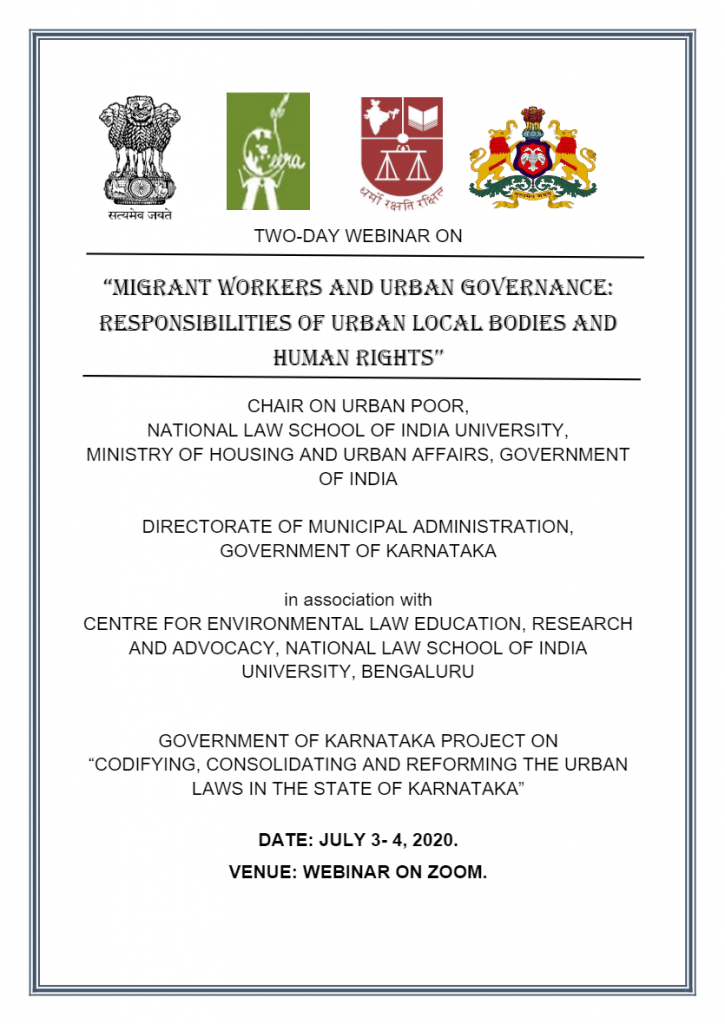
DATES OF SEMINAR:3-4 July 2020

Participants are encouraged to register before June 30th 2020

Submission of Abstracts along with Registration: June 30th 2020

Selected Abstract Communication: July 1st 2020

Submission of Final Paper (After the Webinar): July 30th 2020

TOPIC:  Migrant Workers and Urban Governance: Responsibilities of Urban Local Bodies and Human Rights.

ELIGIBILITY: Academicians, Researchers and PhD/Doctoral Scholars from the field of Urban Planning and Management;

Lawyers and Legal Professionals, Consultants;

Government Officers, Officers of Public Sector Undertakings;

Representatives of Governing and Regulatory Bodies;

Stakeholders from Non-Governmental Organisations, Think-Tank Groups, etc.

Participants will be awarded E-Certificate.