The case analysis is written by Nimisha Mishra, a second-year student of NALSAR University of Law. In this case comment, the author has briefly explained the case of State of Maharashtra v. Mayer Hans George.

INTRODUCTION

The entire criminal law is based on the concept of mens rea or mental element of the offender. Mens rea, of the offender, is a state of mind capable of committing the crime. To commit a crime, there should be the presence of bad or malign intention.  

Case Number

218 of 1963

Equivalent Citation

1965 AIR 722, 1965 SCR (1) 123

Bench

Hon’ble Justice K. Subbarao, Hon’ble Justice N. Rajgopala Ayyangar, Hon’ble R. Mudholkar.

Date of judgement

24th August, 1964

Relevant Act 

Foreign Exchange Regulation Act, 1947

Relevant Section

Section 8(1), Section 23 (1-A) of Foreign Exchange Regulation Act, 1947. Section 168 (8) (1) of the Sea Customs Act.

Facts of the case

The respondent, Mayer Hans George, a German smuggler, left Zurich by plane on 27th November 1962 with 34 kilos of gold concealed on his person to be delivered in Manila. The plane arrived at Bombay on 28th of November. The Customs Authorities, as a part of their duties, inspected to check if any gold was dispatched by any traveller and looked through George, seized his gold and accused him of the offence under sec 8(10) and 23(1-A) of the Foreign Exchange Regulation Act. This section of FRTA is read with a notification dated November 8, 1962, of the RBI which was published in the Gazette of India on 24th of November. George was initially acquitted by the High Court, but the further appeal was made by the state in the court of law.

Issues presented before the court

Whether the respondent is guilty of bringing gold in India under sec 8(1) and 23(1-A) of the FERA which was published in the Gazette of India on 24th November 1962?

Ratio of the case

The state of Maharashtra contended that the act was passed keeping in mind the pirating of gold since it has become the major financial concern of the nation. Moreover looking at the importance of the act it can be inferred that the mens rea is an irrelevant element in assuming the culpability of the offender. The strict adherence of the act refutes such assumptions and demonstrates that mens rea is not a fundamental element of the offence. It was further contended that the warning was already given on 8th November, 1962 by the Board of Revenue; therefore it can be assumed that offender consented to bring old in India. However, in the present case, George did not mention the quantity of gold with him in the Manifest. The respondent that is George has, therefore, contradicted the act and hence his offence should be taken into consideration. 

It is a general provision that any new rule is published in the Official Gazette. The purpose of publishing a new act in official Gazette is to create awareness among the people in large about the passes act. It is to be noted that the particular act was published on 24th November, 1962 and by 25th November, 1962 the said act was deemed to be notified to the concerned citizens by then. 

The notification published on 8th November states that the act is not enforceable on the traveller. But the same notification was overruled by the notification published on 24th November, which makes the act enforceable on travellers as well. Therefore the notification dated on 8th November will not be deemed to be in effect since a new notification has already been published in Gazette. 

However, the respondents were of the view that mens rea is a fundamental element of any criminal offence and George was not aware of the notification published by the Reserve Bank. The notice could be said to be enforceable when it comes to the knowledge of the people who is influenced and affected by it. Another point raised by the responded was that the warning requires exposure was not pertinent to the traveller carrying gold. It was contended that a person who was not aware of the Indian Provision and has no intention to bring gold in India cannot be said to possess the intent to break the law and hence should not be prosecuted under the act.

Final decision

After hearing the arguments from both the sides, judges were of the view that any product which has gold attached to it and the person carrying it will be prosecuted, this whole process seems superfluously cruel and nonsensical. 

However, the court further said that even though mens rea is an essential requirement to commit a crime but regardless of that the statutory provision can exclude the mental element. The express words of the statute can exclude the mens rea as an essential ingredient of the crime. This may be done for various reasons, for instance, to promote public welfare and activities or to eradicate social evils. The statute which complies strict liability helps the offender to assist the state in the enforcement of the law. 

When the provision of the act clearly and explicitly prohibits carrying a certain amount of gold and then if a person chooses to carry gold more than the specified amount without disclosing it in the manifest than he will be held liable. 

The further said that it cannot interfere with the sentenced passed by the lower courts unless they are in violation of the principle or are illegal. But since this case has some unusual characters therefore George was convicted but his years of imprisonment was reduced.  

Conclusion

As it has been inferred from M.H v. George’ case that phraseology of the statute can cover an offense under strict liability and bar the mental element . Therefore the nature of the mischief at which the arrangement is pointed in some cases albeit strict liability is deduced strictly on the facts of the case where is depicted as a grave social malevolence. 

Latest Posts


Archives

This case analysis is written by Anurag Maharaj, a student of law at Lloyd Law College, Greater Noida. I have tried to describe the famous and controversial case Gian Kaur vs The State of Punjab, 1996.

Gian Kaur vs The State of Punjab.

Bench

Justice J.S. Verma, Justice G.N. Ray, Justice N.P. Singh, Justice Faizanuddin and Justice G.T. Nanavati.

Facts of the case

Constitutional provisions involved in this case:-

1. Article 21 is the protection of life and personal freedom No person shall be deprived of his life or personal liberty except as provided for in the law. The Article forbids the deprivation of the aforementioned rights except in compliance with a legal procedure.

2. Indian Penal Code Section 306,  Abetment of suicide:- If any person commits suicide, whoever abets the execution of such suicide, shall be punished with imprisonment of any form for a period which may extend to ten years, and shall also be liable to fine.

3. Indian Penal Code section 309 criminalizes attempted suicide as well as suicide aid.

Section 309 states: Anyone who attempts to commit suicide and acts against the commission of such offence shall be punished with simple imprisonment for a term of up to one year, or with fine, or both.

Gian Kaur, Harbans Singh and Kulwant Singh were all involved in this case. Gian Kaur and her husband Harbans Singh had been charged with abetting their daughter-in-law Kulwant Singh’s suicide. They both wanted their son to re-marry with someone else because of selfish intentions to acquire dowry so they abetted this crime. They had a strong intention of seeing her dead. 

The Trial Court challenged this. It came up before the High Court on appeal. On the ground that Section 306, IPC is unconstitutional, the appellants’ conviction was assailed.

Judgement

It was held that under Article 21 the “right to life” would not include the “right to die” or the “right to be killed”. The ”right to death” is inherently inconsistent with the ‘right to life. ”Right to life is a fundamental right expressed in Article 21, but suicide is an immoral end or termination of life and is inconsistent with the principle of the right to life.

The court, therefore, ruled that Section 309 of the Indian Penal Code (1860), which punishes a person convicted of attempting suicide, is not in violation of Articles 14 and 21 and is therefore not unconstitutional. And this is quite a controversial issue.

Pursuant to Section 306, Indian Penal Code, 1860, appellants Gian Kaur and her husband Harban Singh were convicted by the Trial Court and each sentenced to six years of rigorous imprisonment and fines of Rs. 2,000, or, by default, additional rigorous imprisonment for nine months, for Kulwant Kaur’s commission of suicide.

The conviction of both was upheld on appeal to the High Court but Gian Kaur ‘s sentence alone was reduced to rigorous imprisonment of three years. Those special leave appeals are against their conviction and sentence in accordance with Section 306, IPC.

Latest Posts


Archives

This article is written by Pooja Lakshmi, studying BBA-LLB at Bennett University, Greater Noida. A country like India which promotes every religion and where people have the right to live with his or her religion must also accommodate a typical marriage of two Indians where there is no denial when both the parties are from different religions. The special marriage act was introduced in 1954 to accommodate such marriages where they get authenticity to such relational unions.  This article involves procedures and benefits though THE SPECIAL MARRIAGE ACT 1954 and provides a clear-cut idea of the ritual followed.

INTRODUCTION

It applies to Hindus, Muslims, Christians, Sikhs, Jains, Buddhist marriages, and every Indian state except Jammu and Kashmir. It applies not only to Indian citizens who belong to different caste and religion but also to Indian nationals who live abroad[1]. According to this law, the fundamental requirement for marriage is the consent of both the parties and if both the parties are willing to marry each other, then caste, religion, race, etc. cannot act as a barrier to their union. One has to file a notice to the district marriage registrar stating their intention to marry each other, in which, at least one of the parties to the marriage has left for at least 30 days prior to the date on which such notice is filed. After expiry of 30 days from the date, such notice gets published, the marriage has to be solemnized. The essential requirement for marriage is that the parties must give consent, and there must be at least three witnesses.

Condition to Marriage

  • At the time of marriage, the bride must be at least 18 years of age and groom must be 21 years of age as per the minimum age limit condition for a girl and boy to marry.
  • Both the parties must be monogram and should not have any living spouse at the time of marriage.
  • The parties must be mentally fit and sane at the time of marriage and should be able to decide for themselves.
  • They should not be subjected to a prohibited relationship because if it is found to be a prohibited relationship, it might act as a ground for dissolving the marriage in the future.
  • One should write the application as per the format set out in the second schedule.[2]
  • After filing the application, a public notice should be issued signed by parties to raise objections if any, against the intended marriage.
  • Documents such as proof of age, address, an affidavit concerning the marital status, the known relationship between the parties within the degree of probation, passport size photos, etc. are required at the time of marriage.
  • A copy of the notice must be attached to a marriage notice book that can be inspected by anyone.

Objection to Marriage

Any object can be made regarding consent, capacity, incest, age, etc. Further, it must be communicated to the marriage officer within 30 days of the notice being published. The object requirement was inserted in the SMA to provide an opportunity for the families of the bride or groom to know more about the impending wedding, letting them make items to dissuade the couple. Many inter-faith marriages take place where the life of the couples is at risk, which makes this procedural step dangerous, defeating the entire point of having legislation like SMA. It also specifies that the bride and groom could not stay at the same place at the time of applying, which is not a pre-condition in the assembly, or in any religious marriage law[3].

If the marriage officer believes that the objection she has received is not reasonable, or is not made with a bona fide intention, then the person making the objection may on the receiving end of objection costs up to thousands of rupees and the person under obligation be awarded in the case.[4]

Succession to Property

The succession to the property of individuals married under the Special Marriage Act, including their children, will be governed by the Indian Succession Act. If a party belongs to Hindu, Buddhist, Sikh, or Jain, then the Hindu Succession Act will govern the succession of the property. The Hindu Marriage Act is binding for all the Hindus whereas; the Special Marriage Act is suitable for all the Indians, and it is binding, regardless of their religion having applicability in courts as well.[5]

Benefits

Divorce can be an option if any of the parties is a victim of adultery/ case of desertion, for more than two years after the petition has got filed for the charges of false imprisonment, cruelty, rape, sodomy, or bestiality. If any of the party has a sexually transmitted disease in a communicable form, or leprosy, or is of unsound mind; the party can ask for a divorce.

About alimony, the income of the wife is taken into consideration while null is in a maintenance amount.

It prevents style marriage because of the age restrictions imposed and prevents polygamy. The woman can claim shelter and maintenance too. This act promotes interfaith marriages.[6]

Both the parties are subject to the penalties provided in S. 494 and 495 of the IPC for the offence of remarriage during their lifetime. The marriage so contracted will be void under the law.[7]

Cohabitation

A man may live together with his consort stably if he has gone or is on the go to see, or on small business for the reason that it does not shape the marital bond in any form between them.[8] They may not be living under the same roof yet are not separated. A Husband cannot be considered to leave his wife without reasonable cause, as he is forced to leave a will for her legally.

Restriction on Divorce during the First Year of Marriage

Parties married under the special marriage act cannot file a petition for divorce in the district courts unless and until one year has passed from the date of marriage as registered in the marriage books. As per S. 29 of the special marriage act, in a case where the court is of an opinion that the respondent has shown exceptional depravity on their part, or the petitioner has suffered exceptional hardship; a petition for divorce can be filed, but if any misrepresentation is found on the part of the petitioner while applying for divorce petition before the expiry, then the court may, if any order has been passed, state the order to take effect only after the expiry of 1 year[9].

CONCLUSION

Since Indians believe in marriages with proper rituals, customs, and ceremonies that include pomp and show, and extravagant celebrations, none of that is required under the Special Marriage Act. The fundamental requirement under this Act for a valid marriage is the consent of both parties to the marriage. If both the parties to the marriage are willing to marry each other, that is enough to for a lawful marriage irrespective of the caste, religion, race, etc. of the parties.  For marriage under this Act, the parties must file with the district’s Marriage Registrar, a notice stating their intention to marry each other in which at least one of the parties to the marriage has lived for at least 30 days prior to the date on which such notice is filed. After the expiry of 30 days from the date that such notice was published, the marriage is then said to be solemnized. For a valid marriage, the parties must also give their consent to the marriage before the marriage officer and three witnesses.

BIBLIOGRAPHY

  • Special Marriage Act ,1954
  • The Child Marriage Restraint Act in India
  • The Hindu Marriage Act 1955
  • Kay v. Kay, (1904)
  • All You Need to Know About the Special Marriage Act, 1954, That Facilitates Inter-Faith Marriages, Benefits of the Act, WOMENSWEB
  • Punishment of bigamy,10 THINGS EVERY INDIAN SHOULD KNOW ABOUT THE SPECIAL MARRIAGE ACT, 1954, MYADALAT
  • Diva Rai, Sonali Chauhan, Unreasonable Objections, A Brief Guide to Special Marriage Act, IPLEADERS
  • vakasha sachdev, Confused About Special Marriage Act? Inter-faith Couples Take Heed, THE QUINT
  • Tushar Krishnani, Constitutional Validity of Section 21 of Hindu Succession Act, 1956, youthforum,
  • K. SURESH, A STUDY ON SPECIAL MARRIAGE ACT,1954
  • The schedule and forms of special marriage act, Kerala registration

[1] Diva Rai, Sonali Chauhan, A Brief Guide to Special Marriage Act, IPLEADERS, <https://blog.ipleaders.in/special-marriage-act/#:~:text=In%20India%2C%20all%20marriages%20can,unite%20in%20the%20marriage%20bond >

[2] <http://keralaregistration.gov.in/fileUploads/Spl%20Marriage%20Forms.pdf>    

[3] Vakasha Sachdev, Inter-faith Couples Take Heed, THE QUINT <https://www.thequint.com/explainers/special-marriage-act-specifications>

[4] Diva Rai, Sonali Chauhan, Unreasonable Objections, A Brief Guide to Special Marriage Act, IPLEADERS, <https://blog.ipleaders.in/special-marriage-act/#:~:text=In%20India%2C%20all%20marriages%20can,unite%20in%20the%20marriage%20bond>

[5] Tushar Krishnani, Constitutional Validity of S. 21 of Hindu Succession Act 1956, YOUTHFORUM, <http://youthforum.co.in/constitutional-validity-of-section-21-of-hindu-succession-act-1956/#_edn1 >

[6] All You Need to Know About the Special Marriage Act 1954, WOMENSWEB

 <https://www.womensweb.in/2020/02/all-you-need-to-know-about-indias-special-marriage-act-1954-feb20wk5sr/>

[7] Punishment of Bigamy, MYADALAT, <https://demo.myadalat.com/blog/marriage/10-things-every-indian-should-know-about-the-special-marriage-act-1954/>

[8]  Kay v. Kay, (1904)

[9] < https://acadpubl.eu/hub/2018-120-5/3/247.pdf >

Latest Posts


Archives

This article is written by Mohit Bhardwaj. A 2nd year Law student, currently pursuing BBA-LL.B(Hons.) from Unitedworld School of Law, Karnavati University. In this article, the author discusses the meaning, of wasiyat and its concept under Indian law. To substantiate the concept, reference is made to all the statutes covered by the topic, with relevant illustrations and examples.

INTRODUCTION

Wasiyat has been defined as an instrument by which an individual makes disposition of his property to come into effect after his death.

As per section 2(h) of the Indian succession act, 1925, “Will is a legal declaration of intention of a testator with respect to his property which he desired to be carried out after his death”

Tyabji defines Will as conferment of the right of property in a very specific thing or in an advantage or during a gratuity to come into effect on the death of the testator.

According to Baillie, Will is a device for conferring a right of property in a specific thing, or in a profit or advantage, in the manner of a gratuity, postponed till after the death of the testator. When a Muslim executes a will, then that will is called Wasiyat. Legator/testator is the person who executes the will.  A legatee/testatrix is the person in whose favour will is drawn. Let us study the concept of Wasiyat under Muslim law

The distinguishing feature of a Will is that it becomes effective after the death of the testator and it’s revocable.

Unlike any other disposition (e.g. sale or gift), the testator has full control on the property till he’s alive: the legatee or beneficiary under wasiyat cannot interfere in any manner whatsoever in the testator’s power of enjoyment of the property including its disposal or transfer (in that case wasiyat becomes revoked).

Anyone can make a will in favour of anyone irrespective of sex, religion, state of mind and age. In case of a child in mother’s womb, the child is a competent legatee if he is born within 10 months (in case of Shia Law) and 6 months ( in case of Sunni law).

Essentials of a Valid Will under Muslim Law

For a will to be valid and capable of taking effect in law, the following requirements must be satisfied:

  1. The legator/testator must be competent to make the will
  2. The legatee/testatrix must be competent to acquire the legacy
  3. The property must be bequeathable
  4. Free consent of legator and legatee
  5. The legator must possess the testamentary right

Who can make a will?

For the purpose of Wasiyat under Muslim Law, any Muslim of sound mind and who has attained Majority can make a will. Interestingly under Shia law, if a person executes a will after attempting to commit suicide is deemed to be void. But under the Sunni law, there is no such ruling.

Who can take under Will?

For the purpose of Wasiyat under Muslim Law, any person may be a competent legatee provided that he is alive at the time of the death of legator.  Anyone can make a will in favour of anyone irrespective of sex, religion, state of mind and age. In case of a child in mother’s womb, the child is a competent legatee if he is born within 10 months (in case of Shia Law) and 6 months ( in case of Sunni law).

Legator is disqualified for getting any property under Wasiyat in Muslim Law if he causes or abets the death of legator. However, in the case of Shia law, legator can take his property if he killed legator accidentally or by negligence.

Who is a Legator?

A legator is a person who leaves money or property to another person when they die 

Who is a legatee?

A legatee is someone who receives money or property from a person who has died

Limitations on Testamentary Power

1. Restriction with respect to the property to be bequeathed

A person can bequeath only one-third of his total property. If a person wants to give more than one third than the consent of the heir is necessary. If heirs do not consent to this, then only one-third property will be given and rest is distributed among heirs by intestate succession.

2.  Restriction with respect to the legatee

In Wasiyat under Muslim Law, the second restriction comes when legatee is a legal heir of legator. In Sunni law, property bequeathed to the legatee, who is also a legal heir, is subject to approval by rest to the heirs irrespective of the part of the estate given. However, in Shia law no such distinction is made as long it is within one-third of total property given.

Revocation of Wasiyat under Muslim Law

The testator can revoke Wasiyat anytime expressly or impliedly. Express revocation is by express terms. It can be both oral by written. Implied revocation is inferred from his actions like destroying bequeathed property or transfer ownership rights. 

Muslim law confers on a testator unfettered right to revoke his will. A Muslim testator may revoke, during his lifetime, any Will made by him expressly or impliedly.

Thus, if he sells, makes a gift of the topic of bequest or deals with identical in any other manner like constructing a house on the piece of land bequeathed earlier, would implied revocation.

For example, where the testator gives land to his friend under a Will but a year later gifts identical to his daughter, the bequest in favour of the friend is automatically revoked.

Where a testator makes a Will, and by a subsequent Will gives a similar property to somebody else, the prior bequest is revoked. But a subsequent bequest (though of a similar property) to a different person within the same Will doesn’t operate as a revocation of the prior bequest, and therefore the property will be divided between the 2 legatees in equal shares.

It is not necessary that for revoking an earlier will, another will must be made. A Will are often revoked by an easy and clear declaration thereto effect or by a proper deed of cancellation or revocation of Will.

CONCLUSION

Wasiyat under Muslim Law is one of the Muslim personal laws with very pious intention. For them, it is a divine institute. Unlike other personal laws, they consider it to correct the irregularities of succession laws. Not only it recognizes other relatives who could not get anything under succession act, but also they protect the right of legal heirs by placing some restrictions on part of the estate which can be bequeathed.

ABOUT THE ORGANISER

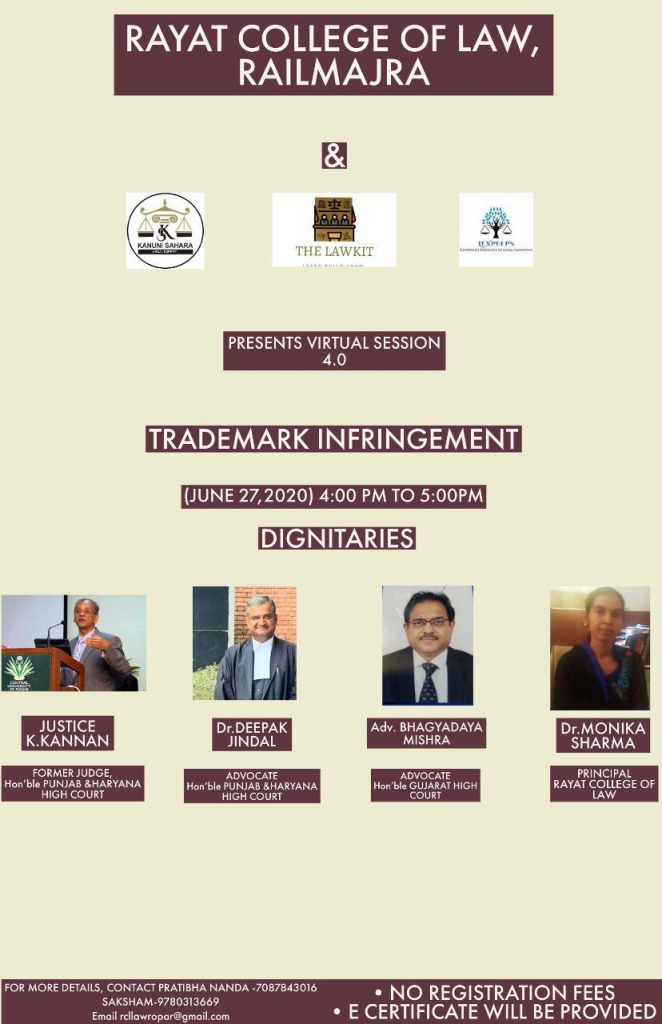
Rayat College of LawRailmajra(Affiliated to Panjab UniversityChandigarh) under the guidance of Dr Monika Sharma(Principal-Rayat College of Law) are geared up to organize yet another illuminating virtual Session 5.0 of 2 days

PERKS

•No registration fees

•E certificates to all the attendees 

REGISTRATION LINK

https://docs.google.com/forms/d/e/1FAIpQLSc383pl6FiNxq7FPMlAr6eyLRpdvherXPFyF0EHW0RIlCntjg/viewform


TOPIC

scope of women in the legal profession 

DATE AND TIME

A two dialogue session Date 1 and 2 July 2020

Time 4 to 5 PM Both days.

SPONS0RS OF THE EVENT

LEXPEEPS.IN, LawKit and Kanuni Sahara


For any queries

contact:-Saksham (9780313669)


ABOUT THE ORGANIZATION

Jus Commune is an online forum that promotes and seeks to maintain various legal competitions. The contests’ platter shall consist of quizzes, article writing, judgment writing, online debates, etc. We strive to stimulate your abilities and encourage you to sharpen your skills. We would showcase the best compositions with pride on Jus Commune. We believe that it’s a competition that ensures the survival of the fittest.

NATURE OF WORK:

Team Jus Commune is looking for passionate, hard-working and sincere members for several different creative and exciting positions available at the moment. A wide range of tasks, be it legal or non-legal, shall provide ample scope for discovering, honing and utilizing skills for a better cause. 

LOCATION

Work from home

WHO CAN APPLY?

Any student who finds himself eligible can apply for the same, though preference shall be given to Law Students currently enrolled in either 5 Year/3 Year Law Course.

Note: One student can apply for one position and no stipend whatsoever shall be paid. 

VACANCIES: 

CONTENT WRITERS REQUIRED

1. Job Description of Legal Content Writers

Jus Commune requires knowledgeable, creative and sincere legal content writers for simplifying the legal complexities and presenting them in a lucid manner before the masses for their perusal. 

2. Vacancies

 6 Content Writer.

3. Responsibilities:

Work includes writing short creative legal posts for Instagram Handle. 

4. How to Apply

Send your CV at hr.communejus@gmail.com 

GRAPHIC DESIGNERS REQUIRED: 

1. Designer Job Description

 Jus Commune requires creative and artistic members for typesetting through to design, print, and production. The work would consist of creating posters and certificates for the events conducted. 

2. Vacancies

  5 Designers required. 

3. Responsibilities:

Work ideally includes designing creative posters on socio-legal issues. 

4. How to apply

Send your CV at hr.communejus@gmail.com along with a poster on “Essay Writing Competition organized by Jus Commune”. Add the required details for the poster as per your imagination. 

VIDEO EDITORS REQUIRED

1. Video Editor Job Description

Jus Commune required Video Editors for editing videos for Social Media Handles which shall be helpful, in promoting legal facets in a creative manner to the masses. 

2. Vacancies

 3 Video Editors required

3. Responsibilities:

Work includes all facets of video editing as and when required by the Organization and prior experience shall be preferred.  

4. How to Apply

Send your CV at  hr.communejus@gmail.com

PUBLIC RELATIONS AND MEDIA REQUIRED

  1. Job Description

Team Jus Commune requires students who are good at handling people and considerably active on various social media handles available herein. 

2. Vacancies

– 8 Members

  1. Responsibilities:

Work Includes assisting in handling or taking the lead (as the case may be) the Instagram and Facebook handle of Jus Commune and helping expand outreach amongst various Law Firms and Law Schools in the country. 

4. How to Apply

Send your CV at hr.communejus@gmail.com

COLLEGE REPRESENTATIVES REQUIRED

1.About the College Representatives Program 

Campus Ambassador program is essentially the campus-based promotion of Jus Commune. It will mostly consist of creating a stronger base of legal enthusiasts in Jus Commune. 

• Social media marketing:  The College Representatives have to circulate the E-posters on WhatsApp, Facebook, and Instagram. They must utilize the official website and spread awareness about it in the students. 

• In college promotion: It includes promotion by displaying banners and other information about Jus Commune on the notice board.

2.Eligibility

• Essential marketing skills are also required. 

• We would accept 1 campus ambassador from each college. 

3 Duration

Sincere availability of the candidates for 2 months 

4. How to apply

Mail us your CV at hr.communejus@gmail.com

PERKS

Position will be permanent in nature 

Outstanding work shall be awarded and recognition shall be assured on social media handle. 

Certificate after the completion of the tenure 

A certificate of appreciation shall be awarded to the ones who perform the best. 

CONTACT US:

Email ID: communejus@gmail.com

Lavanya Rai: 6307317158

Aditi Mishra: 9861723001

DO VISIT:

Website: http://thejuscommune.wordpress.com

Instagram: @juscommune

About Lawschole

From the beginning, Lawschole has been driven by the interests and involvement of our incredible and engaged law students. We are a growing law-student forum focused on improving our collection of law school news and opportunities, and enhancing the forum experience. We are a great resource, offering opportunities for students to be active in a variety of topics and to engage with each other in an interesting and safe online environment. It is a forum where law students can share thoughts, seek opinions and advice, and learn something new from other members of the forum. Found by a final year law student, it is an online platform by law students, for law students. 

About the Blog

Lawschole’s Blog is a collection of work by various law students across the country. Student Editors work involves editing and ensuring quality content on the website. Typically this will involve proofreading articles, checking footnotes, and verifying all sources cited by the authors.

Student Editors gain valuable experience in high-level academic writing in law and develop excellent analytical and legal skills. They also get the opportunity to work with the members and other law students in the forum. The role is totally voluntary. Student Editors are also acknowledged within the publication.

Submission Registration and Application Details

Application Process

Applications for 2020 close at 11:59 PM on 12th July 2020.

If Lawschole gets suitable applicants for all the positions, the call for applications can be closed before the above mentioned last date. Hence individuals are requested to apply as soon as possible.

Your application should consist of

1.    A CV (Not More than Two Pages)

2.    Cover Letter (about 500 words)

3.  Write-Up (Blog Style) (about 1000 words) (Detailed research papers are not accepted)

All applications must only be emailed to lawschole@gmail.com as per the stipulated deadline. The Subject of the emailed application must contain the wording “Application for the position of Student Editor”. Applications must be accompanied by the above-mentioned documents.

Contact Details

Contact Email: lawschole@gmail.com

Website link-https://lawschole.wixsite.com/lawschole

ABOUT US:

Lexpeeps is totally dedicated to the legal fraternity, law professionals get an opportunity to flourish their career in a better way. Lexpeeps organises various events like debates, seminars of its own and also organises the major law school activities on tie-ups with leading law school. Lexpeeps is not only limited to managing the legal events but it also provides internships to law students where the law professionals come in touch with each other and grow by associating with the company.
Lexpeeps is also focussing on several social works like providing information and free legal aid to the poorer section of society.

ABOUT THE EVENT:

Lexpeeps.in is organising a Virtual Summit on “International Maritime Law- Nationality of Ship and Access to Ports in International Law”. Students will get to know about the nationality of ship and maritime contracts. Moreover, it will be a golden chance for the students to explore the unexplored area of law.

EXPERT GUESTS:

  1. Abhimanyu Singh (Academician, Jindal Global Law School)
  2. Mohit Gupta (Academician, Gujrat Maritime University)

Moderator:

Madhur Rathaur (Founder, Director -lexpeeps)

Date and Time:

JUNE 25, 2020 4:30-5:30 PM

Registration Procedure:

Registration Fee: Totally Free

Registration Link:

https://docs.google.com/forms/d/e/1FAIpQLScly_c6qZJTAKvJfhwz7i_zh0_W-2HmvFGYVTiYw1Q2ZaUrnQ/viewform

*Link to join the webinar will be sent through mail after a successful registration

Perks: Free E Certificate

Limited Seats Hurry UP (First Come First Serve Basis)

Contact Us:

Email: lexpeeps.in@gmail.com

Whatsapp:8340132731

INTRODUCTION

In a literal sense, conspiracy can be defined as an immoral, illegitimate, risky or surreptitious scheme developed by two or more individuals in secret. Law recognizes such secretive plotting to achieve malicious intent as Criminal Conspiracy. 

A criminal conspiracy arises when two or more entities decide to commit almost every illegal act, and take some steps to achieve it. The conduct taken does not appear to be a felony in itself, although it does show that those engaged with the plot were aware of the scheme and planned to break the rule. An individual can be accused of fraud even though he never perpetrated the alleged crime.

A crime is an act which is prohibited by law because it violates the public interest. Such a ban is at the possibility of penalty. It means that if the crime were performed a particular sentence will occur. Therefore, to constitute an offence, it is necessary to have actus reus, i.e. an act or action, accompanied by means rea, implying ill will or malicious intent. Such an intentional act shall have certain external consequences that cause harm or injury to the community.

A crime can contain either a positive or negative act. Hence committing an unlawful act may amount to a felony as well as omitting to perform an act that causes the other party harm or damage.

However, unlike other criminal offences that require actus reus and mens rea to occur simultaneously, Criminal Conspiracy is made punishable only at the mens rea stage. Failure to act in support of intention is therefore not an essential aspect of criminal conspiracy.

What constitutes Criminal Conspiracy?

Criminal Conspiracy has been formally explained under Section 120A of the Indian Penal Code. The section defines the offence as:

Agreement between two or more persons to do, or cause the doing of:
a. an illegal act, or,
b. a legal act by illegal means.

The essentials of Criminal Conspiracy, as per Section 120A are as follows:

a. Two or more people should be involved: it is an established principle that conspiracy requires 2 people to be involved and one person alone cannot commit the conspiracy offence.

b. The persons involved must agree with one another

c. This agreement concerns causing or accomplishing: an illegal act; or, an illegal act.

In the case of Rajiv Kumar v State of UP, the court observed, that meeting of two or more people’s minds for committing or inducing unlawful actions or actions through illegal means is sine qua non to criminal activity. It would not be criminal conspiracy merely to discuss or have knowledge or have any ill intent to commit a crime. Committing the offence to be framed is essential for the combination. “Meeting of minds” between all conspirators is absolutely essential for such conspiracy to be committed. Furthermore, the proviso to the clause makes it clear that a mere agreement between the parties to commit an offence is valid and does not allow a transparent act in favour of this crime to be authorized.

Therefore, the essence of the conspiracy crime, as defined in Section 120A, is that there is an unlawful combination, i.e., to do an unlawful act or to do a lawful act by unlawful means, and the offence is complete when the combination is complete. Therefore, criminal conspiracy is considered an inchoate offence as it does not allow any crime to be done to achieve this purpose. Conspiracy is thus punished not because of what the conspirators are doing, but because of what they plan to do. What the parties agree to do is the essence of criminal conspiracy and not the commission of the substantive crime.

For instance: A, B, C and D conspire to kill E. To carry out such task, it is decided that A and B will break into the house of E and commit the act of murder, while C and D stay outside to act as lookouts. In the aforementioned scenario, even though A and B are the ones directly responsible for committing murder, all four of them shall be liable for the offence of criminal conspiracy. The crime of conspiracy also requires for there to be proper knowledge about the object and purpose of crime being committed. 

How can Criminal Conspiracy be proved in court?

The primary evidence for proving a conspiracy charge is hard to adduce because it is still conceived in secrecy. Under this section, only inferences derived from the illegal omissions committed by the conspirators can lead to a conviction. Therefore, it is important to prove the circumstantial facts exists post and prior to the execution of the crime in assessing an individual’s complicity. Inferences may be drawn from the accused person’s conduct and circumstances.
The courts are mandated to inquire into the existence of independence of the persons pursuing the common design. If that is proved then there is no conspiracy. The prosecution does not have the burden of proving that an explicit agreement would be sufficient to entertain conviction under Section 120A between the parties on the common conspiracy design and its implications. 

Punishment for Criminal Conspiracy

Section 120B of the Indian Penal Code gives an insight on provisions of punishment for committing the offence of Criminal Conspiracy. In this section, conspiracy is separated into two categories for punishment purposes. Parties involved in the scheme of the commission of serious offences not specified in the Indian Penal Code shall be prosecuted in the same manner as if the crime had been abetted, wherein these ‘serious offences’ are typically punishable by a death penalty, life imprisonment or stringent imprisonment. In addition, the conspiracy to perpetuate any other offence or unlawful act is also punished with imprisonment that may extend with or without fine for up to six months.

Section 120B punishes any act that did not amount to an offence in furtherance of a criminal conspiracy. Furthermore, if more than two persons are engaged in the design for the commission of an offence or the purpose of the conspiracy, then even if some of the accused persons are exonerated, that does not mean that the remaining persons could not be held guilty under Section 120B.

In the famous Hawala case[18], the Jain brothers allegedly bribed well-known politicians to win preferential contracts and reported those sums of bribes in a diary. The Special Court dismissed the petitions for discharge submitted by two prominent politicians whose names were found in the diary-VC Shukla and LK Advani. On another appeal, the Apex court dismissed the charges levied against the politicians due to lack of prima facie evidence. Under Section 120B, the Jain brothers were held responsible, though.

This article has been submitted by Aaditya Kapoor, a law-aspiring student of Vivekananda Institute of Professional Studies.

Latest Posts


Archives

INTRODUCTION 

An employee who has received an injury during the course of his employment should be given compensation as fast as possible, for him to be able to make good his losses. Motor accidents are also very frequently heard in our daily lives which lead to considerable loss of person and property. 

For the same reason the Employees’ State Insurance Act, 1948 was enacted with the purpose of providing benefit to the victims dealing with the cases of injury during the course of employment or dealing with maternity and sickness. The contribution is not necessarily always made by the employer it can sometimes be made by the employee. For the compensation to be claimed under this act it is necessary that there should pre-exist an employer-employee relationship.

The Motor vehicle Act, enacted in 1988, has a designed “structured formula basis” framework to provide compensation to the injured party. This framework may include the victim’s age, his or her income, previous suffering or injuries, etc. This act was further amended in 2019 to curb the road accident and enhance road safety. This amendment has various new operating standards for both commercial and personal motor vehicle, along with the introduction of fresh penalties and compensation amount.

The Employees’ State Insurance Act was enacted by the legislation subsequent to the Motor Vehicles Act. Therefore is the employee has received compensation from the Employees’ State Insurance Act he cannot further claim from the Motor Vehicle Act. 

For this very reason, the Madras High Court in a popular Mangalamma’s case pronounced the judgment that the primary purpose of Section 53 of Employees’ State Insurance Act is to prevent the employer from the liability of more than one claim in connection to the same injury or accident. 

Cases dealing with the claim of damages

In a very celebrated case of Oriental Insurance Co. Ltd. v. Mohan Kanwar and Ors., the question of whether the victim can claim compensation from both Employees’ State Insurance Act, 1948 and Motor Vehicles Act, 1988 was decided by the court. In this case, the plaintiff, under the course of his employment, met with an accident involving the company’s vehicle. The plaintiff claimed compensation from the Motor Vehicle Act as well as from the Employees’ State Insurance Act. The contention raised here by the insurance company was that the plaintiff, being an employee, was already compensated by the employer under the Employees’ State Insurance Act and therefore he should not be compensated again by the insurance company. The court sited Sec 53 and 61 of the Employees’ State Insurance which reads that if an employee’s claim has been covered by one provision then he cannot claim compensation for the same from other provision which deals with the same issue. Therefore, since the plaintiff was already compensated by the company under the 1948 Act, he cannot again claim compensation under the Motor Vehicle Act, 1988. 

Whenever the cases concerning compensation for the damage come before the court of law, section 53 plays a vital role in determining the maintainability of the claim. This section puts a limit on the claim on compensation for damage from different provisions. Similarly, section 61 also deals with the same issue. 

Another landmark case is a case of Trehan v. Associated Electrical Agencies and Anr. In this case, the employee got injured on his face while performing his duty. Because of the injury, he lost the vision of his left eye. He recovered his compensation amount under the Employees’ State Insurance Act, but still, he further demanded from his employer. In defence, the employer invoked section 53 of the ESI Act, 1948. The court upheld the employer’s claim and denied giving compensation to the employee. 

Even though the Employees’ State Insurance Act is welfare legislation, but the legislature was of the view that if the employee has sustained an injury during his course of employment and has received compensation, then he should be prohibited from claiming compensation from other sources for the same injury. 

The Supreme Court in Sarla Verma v. Delhi Transport Corporation pointed out the fact that different corporation or tribunals use a different mechanism to calculate similar factual scenario, which results in lack of uniformity and consistency while deciding compensation under specified claims.  

Fair Proceedings 

It is the duty of the state and the court to make sure that the legitimate claim of the victim should be heard and should not be defeated on the grounds that he is illiterate or he does not hold sufficient resources. In many a case, it happens that the victim’s case his not produced before the judge or it is not heard and the reason being his poverty n\and illiteracy. 

It is also important to mention that in cases where the victim is very poor that he could not afford the prescribed fees, then in such cases he may remit such fees. And if the case is decided in the favour of the victim, then the commissioner is required to pay the prescribed fees along with the cost of the case.  

Since the Motor Vehicle Act is welfare legislation enacted with the intent to provide maximum benefit to the victim. The court in several cases also stated that the victim can claim compensation of amount excess to the one that he has claimed. Section 168 of the Motor Vehicle Act grants court to provide just and reasonable compensation to the victim. Reasonable compensation can be claimed from the evidence produced. And also there is no time-barred in the Motor Vehicle Act to claim compensation.

Conclusion

After analyzing both the Employees’ State Insurance Act and the Motor Vehicle Act it is reasonable to conclude that both the legislature are designed in such a way that the victim can claim compensation from any one of them and not from both. 

This article has been written by Nimisha Mishra, a second-year student of NALSAR University of Law.

Latest Posts


Archives