ACT OF GOD ( VIS MAJOR) AS A DEFENCE UNDER TORT LAW

This article is written by Preeti Bafna from Unitedworld School of Law, Karnavati University. Black’s Law Dictionary defines an act of God as “An act occasioned exclusively by the violence of nature without the interference of any human agency.” A natural necessity proceeding from physical causes alone without the intervention of man. It is an accident which could not have been occasioned by the human agency but preceded from physical causes alone.”

INTRODUCTION

An act of God is a general defence used in cases of torts when an event over which the defendant has no control over occurs and the damage is caused by the forces of nature. In those cases, the defendant will not be liable in the law of tort for such inadvertent damage. Act of God defined as circumstances which no human foresight can provide against any of which human prudence is not bound to recognize the possibility, and which when they do occur, thus the calamities that do not involve the obligation of paying for the consequences that result from them.

Act of God or Vis Major

The ‘act of God’ defence is based on the tort law principle that liability must be founded on a fault and that a person cannot be penalized where the fault is that of a ‘vis major’ where all precautions were taken, and a casualty still occurred.

Vis major is defined, as “A loss that results immediately from a natural cause without the intervention of man, and could not have been prevented by the exercise of prudence, diligence, and care.”

According to Salmond “an act of God” includes those acts which a man cannot avoid by taking reasonable care. Such accidents are the result of natural forces and are incoherent with the agency of man.

Thus it is an act which “ is due to natural causes directly and exclusively without human intervention, and that it could not have been prevented by any amount of foresight and pains and care reasonably to have been expected from him i.e. the defendant. According to Lord Mansfield, an act of god is defined as “it is something in opposition to the act of man”.

Elements of Act of God

NATURAL CAUSES: An act of God is an uncommon, extraordinary and unforeseen manifestation of the forces of nature, or misfortune or accident arising from inevitable necessity. An act of God cannot prevent by reasonable human foresight and care.

The effect of ordinary causes may be foreseen and avoided by the exercise of human care. For example, the fact that rain will leak through a defective roof is foreseeable by an ordinary man. In the case of foreseeable causes, failure to take the necessary precautions constitutes negligence, and the party injured in the accident may be entitled to damages. An act of God, therefore, is so extraordinary and devoid of human agency that reasonable care would not avoid the consequences. Therefore in such cases, the injured party has no right to damages.

1. An Occurrence not Reasonably Foreseeable

The basic and prime element of an “act of God” is the happening of an unforeseeable event. For this, if the harm or loss was caused by a foreseeable accident that could have been prevented, the party who suffered the injury has the right to compensation. However, the damage caused by an unforeseen and uncontrollable natural event is not compensable as it could not have been prevented or avoided by foresight or prudence of man.

Moreover, courts are of the opinion that the “act of God” defence exists only if the event is so exceptional and could not have been anticipated or expected by the long history of climate variations in the locality. It is constructed by only the memory of man i.e. recorded history. The courts may demand expert testimonies to prove that an event was unforeseeable.

2. Impossible to Prevent by any Reasonable Precautions and Absence of Human Agency Causing the Alleged Damage

It means practically impossible to resist. Negligence constitutes a failure to take the necessary precautions. In an incident where a human factor was present, even though the harm could not be prevented, the fact that the human factor exercised reasonable care and precautions to prevent the harm has to be proved if the defence of “act of God” has to prevail. If negligence is alleged and proved, then the defence of “act of God” will fail. If an owner was negligent in properly maintaining a tree that fell on a passerby, he cannot be exempted from liability by “act of God” principle.

Case Laws

  1. In the case of Nichols v. Marshland [1]the defendant has a number of artificial lakes on his land. Extraordinary rain such as had never been witnessed in living memory caused the banks of the lakes to burst and the escaping water carried away four bridges belonging to the plaintiff. It was held that the plaintiff’s bridges were swept by an act of God and the defendant was not liable.
  2. In the case of Blyth v. Birmingham Water Works Co[2]the defendants had constructed water pipes which were reasonably strong enough to withstand severe frost. There was an unprecedented severe frost that year causing the pipes to burst to result in severe damage to the plaintiff’s property. It was held that though frost is a natural phenomenon, the occurrence of an unforeseen severe frost can be attributed to an act of God, thus the relieving the defendants of any liability.
  3. In the case of Ramalinga Nadar v. Narayana Reddiar[3] the plaintiff had booked goods with the defendant for transportation. The goods were looted by a mob, the prevention of which was beyond the control of the defendant. It was held that event beyond the control of the defendant cannot be said Act of God. It was held that the destructive acts of an unruly mob cannot be considered an Act of God.

CONCLUSION

Although the act of God defence – that a defendant is insulated from liability for personal injury or property damages caused by a natural cause – is rarely used, it may become more common and general in the future if predictions of disastrous weather events caused by global warming prove true. One prediction related to global warming is that catastrophic weather events such as hurricanes, tornados, and torrential rains will occur more often. All of these have the potential for causing extensive personal injury and property damage and consequently mental trauma.


[1] [(1876) 2 ExD1 ]

[2] (1856) 11 Ex Ch 781

[3]  (AIR 1971 Ker 197)

Latest Posts


Archives

This article is written by Darshika Lodha, a BBA.LLB(Hons.) student of Unitedworld School of Law, Karnavati University. This article deals with Domestic violence which is a crime that is often overlooked.

INTRODUCTION

Domestic abuse is not just physical violence. Domestic violence is any action that is intended to obtain power and influence over a spouse, girlfriend, girl/ boy, or an intimate family member. Abuse is a learned behaviour; it is not induced by rage, psychiatric illness, drugs or alcohol, or other traditional excuses.

Victims of Domestic Violence

Women make up the largest group of victims. However, men, children, and elderly people may also be victims of domestic violence. Domestic violence occurs at all levels of society and in all population groups.

Abuse is usually intentional, but not always. For example, often people can no longer cope with family care. The situation can then escalate and lead to abuse.

Facts of Domestic Violence in India

The issue of gender-based violence in India has been on the political agenda for many years. And with substantial data, one thing is clear: rampant domestic violence against women in India is a reality. Every third woman, since she was 15 years of age, has been confronted with domestic violence of various forms in the country, according to the National Family Health Survey (NHFS-4) released by the Union Ministry of Health. Thus, the incubation of a new round of debate on the cultural underpinnings of domestic violence.

According to the survey, 27 percent of women have experienced physical violence in India since the age of 15. This experience of physical violence between women is more common in rural areas than among women in urban areas. Domestic violence cases, where women reported physical abuse in rural and urban areas, were 29 percent and 23 percent respectively.

The Protection of Women from Domestic Violence Act 2005 (PWDVA) sets out a comprehensive definition of domestic violence that encompasses all forms of physical, emotional, verbal, sexual, and economic violence and covers both actual acts of violence and threats of violence. Also, the PWDVA recognizes marital rape and treats harassment in the form of unlawful dowry claims as a form of abuse.

Domestic Violence in COVID 19

Domestic violence has increased globally, driven by mandatory home-stay rules, physical distances, economic uncertainties, and pandemic anxieties. Across the world, countries including China, the United States, Brazil, Tunisia, France, Australia, and others have reported cases of increased domestic violence and intimate partner violence. India, infamous for gender-based violence (and ranked the fourth worst country in terms of gender equality, according to public perception), is showing similar trends.

Types of Abuses

  • Physical abuse may include beating, biting, slapping, beating, shoving, punching, pulling hair, burning, cutting, pinching, etc. (any kind of violent behaviour inflicted on the victim). Physical abuse also includes denying someone medical treatment and forcing someone to use drugs/ alcohol.
  • Sexual abuse occurs when the abuser forces or attempts to force the victim to have sexual contact or sexual behaviour without the consent of the victim. This often takes the form of marital rape, attacks on the sexual parts of the body, physical violence followed by sex, sexual demeaning of the victim, or even sexual jokes at the expense of the victim.
  • Emotional abuse means invalidating or deflating the victim’s sense of self-esteem and/or self-esteem. Emotional abuse frequently takes the form of persistent criticism, name-calling, injury to the victim’s relationship with his / her children, or dissatisfaction with the victim’s abilities.
  • Economic abuse occurs when the abuser makes or tries to make the victim financially dependent. Economic offenders also try to retain absolute leverage of financial resources, to restrict victims access to funds, or to discourage the victim from going to school or work.
  • Psychological abuse is a catchall term for intimidating, threatening, or fear-causing behaviour. This conduct has to be consistent and meaningful. Generally, a one-time event will not be enough to bring domestic violence to bear. Like emotional abuse, psychological abuse may not, on its own, be enough to engage in domestic violence unless it is particularly serious.
  • Technological abuse includes the use of technology to control and hold a partner. Technological abuse may happen to people of all ages, but it is more common among teenagers who use technology and social media to communicate in a way that is often unmonitored by adults.

Steps that Survivors of Domestic Violence should take

In addition to finding help and counselling from services such as Genesis Women’s Shelter and Help or a therapist, Aubrey urges victims and survivors of domestic abuse to take the following steps when they can do so:

  1. Call the cops. If you are physically or sexually assaulted by your spouse, partner, or anyone else, call the police and ask for help immediately.
  2. Take videos of the injuries. “It’s important to preserve any evidence of the assault,” 
  3. Record your voice memo during the assault. “I’ve had clients grab a phone and hit a voice memo record during the assault,”.
  4. Go to the doctor right now. Tell your doctor you were raped and have a rape kit prepared, just as if you were assaulted by a third party or not.
  5. Create safety. Survivors of domestic violence should set up a safety plan for themselves and their children. A safety plan may involve stashing some money, clothing, phones, extra car keys, passports, I.D.s, and other essential documents in a safe place outside the house.

CONCLUSION

Domestic violence is one of the most egregious types of harassment suffered by women in our culture today. Statistics show that 85% of victims of domestic violence are female. Only 15% of the victims are men. Domestic violence can happen to anyone, regardless of race, creed, religion, or standing in the victim’s society. If the issue of domestic violence is not dealt with adequately, this type of abuse will continue to exist in all classes of society without an end. For us, as a society, to eradicate this horrible type of abuse, we need to stand together and make tougher laws to protect the victims of this abuse.

Latest Posts


Archives

This article is written by Pooja Lakshmi, studying BBA-LLB at Bennett University, Greater Noida. In a contract of sale, the parties may take certain statements about the course of trade and stipulation of these relations can either in the form of a warranty or a condition. This article speaks about the provisions of conditions and warranties which are provided in section 11-17 of the Contract Act. Section 12 of the sale of goods act goes on explaining the distinctions between warranties and condition. Moreover, when should a condition be treated as a warranty is also explained in the same.

Keywords: warranty, condition, Indian contract act, sale of goods act.

INTRODUCTION

As every contract of sale contains stimulations or number of terms that define the quality of goods and how well it can fulfil the purpose of the buyer. These terms are called as conditions, and warranty is a written guarantee. These conditions and warranties are put into place. The conditions are made to the product to make it fair for the buyer and seller to make their part clear and not perform any breach when the parties claim a mistake in any part. The whole contract is based upon the condition which is a fundamental precondition and on other hand, warranty is a written guarantee where the seller assures to repair or replace a product which in the case shows any fault in future until a certain period. Due to these reasons, conditions are considered as the foundation of the Indian contract as an integral part of performing the contract. If a seller fails to fulfil a condition, then the buyer has an option of refusing to accept the goods or reject the contract. But in case of an open market, the buyer is responsible for checking the quality and suitability of goods before making the purchase.[1]

History

The use of the word ‘condition’ appears to have originated in the 17th century. The Sale of Goods Act, 1930 defines the term condition under section 12(2). According to it, a condition can be defined as a stipulation which is so Vital to the contract that its complete and exact performance by one party is a condition precedent to the obligation to the other party to perform his part. Opening para of Section 16 makes it clear that there is no implied warranty or condition as to the quality of fitness of goods for any particular purpose, except those specified in Sale of Goods Act or any other special law. This is the basic principle of caveat emptor i.e. Buyer be aware. However, there are certain stipulations which are essential for the main purpose of the contract of sale of goods, which go to the root of contract and non-fulfilment and these cause frustrations of contract. These are termed as conditions.

Types of Conditions

Express condition as a legal agreement states that something must exist in the contract or must be done. They are the conditions which are imperative to the functioning of the contract and are inserted into a contract at the will of both the parties. On the other hand, implied conditions are of many types. They are described in section 14 to 17 of the Sale of Goods Act 1930. Implied contracts are not particular rather they are mere assumptions made by the parties as if they are incorporated in the contract itself.

 For every contract of sale, there is a basic essential implied condition on the part of the seller. The first condition under section 14 is that one must have the title to sell the goods. If he/she has the title to sell the good, then in case of any agreement to sell, he or she will have the right to sell the goods at the time of performing a contract. Whereas, if the seller has no title to sell the given goods then the buyer may refuse or reject those goods and he or she is also entitled to recover the full price paid by him or her. In the case of thievery, the aggrieved party is entitled to recover the money as the seller has no title to sell the stolen object.[2]

Section 15 describes condition based on the description. The section says that the goods should always have a description confirming their various features. A buyer has an option either to accept or to reject a good which do not conform with its description. Section 16(2) of the Sale of Goods Act says that the goods must be of merchantable quality, that is a quality which can be accepted by a reasonable person. According to this section, a buyer has the right to examine the goods before accepting it and also if, during the examination, the defect is not revealed but within a reasonable time if the goods are found to be defective, the buyer can reject the contract even if he or she has approved the goods earlier. Implied conditions in the case of eatables must be wholesome, sound, and reasonably fit for the purpose of which they were purchased and if any problems arise after consuming the purchased item, the person can claim damages. Section 17 of the Sale of Goods Act is about a contract of sale by sample. According to this section, natural products should correspond with the sample with respect to the quality, colour, size, etc. Here the buyer is given a reasonable opportunity to compare the goods with the sample. The goods must be free from any defect rendering them and should be merchantable[3]. The goods which are supplied must always be in accordance with the description as well as the sample they provide.

Types of Warranty

A Written guarantee that is collateral to the main purpose of the contract is called a warranty. This is an additional stipulation. If a warranty is breached, the aggrieved party cannot reject the whole contract, but it can claim for damages that have happened. Whereas in the case of breach of a condition buyer can reject or return good or but in the breach of warranty the buyer cannot reject a good. These types of warranties are called expressed warranty.

Implied warranties are those warranties which are not specifically included in a contract but are assumed to be incorporated with the contract of sale. Some types of implied warranty are warranty to undisturbed possession, freedom from encumbrances, or to disclose the dangerous nature of goods sold. Section 14(2) describes the undisturbed possession that a buyer can enjoy and if later disturb at any point, can sue the seller for the breach of warranty. Freedom from encumbrance is mentioned in section 14(3), it states that the goods are free from any charge or encumbrance that are with favour to any third party which is not in the knowledge of the buyer. And if the buyer knows the fact at the time of entering the contract, he will not be entitled to any claim. Similarly, if the goods sold are inherently dangerous or are likely to be dangerous to the buyer or anyone and if the buyer was not aware of the danger associated with the product, it is the duty of the seller to warn and make the buyer aware of the danger. Any breach regarding this will only make the seller liable for danger.

In a warranty, damages can only be claimed in a case of a breach but in a condition, the whole contract may be treated as rejected. A condition is supposed to be a stipulation forming basis of the contract whereas warranty is an additional stipulation complementary to the main purpose of the contract.

Condition is basic for the formulation of a contract, but a warranty is a written guarantee for sharing the information regarding the clauses in the contract with a party.

Similarities which can be Found

Section 13 states how the breach of condition will become similar to the level of breach of warranty. A condition can be considered as a warranty only if the condition is considered as a warranty by the buyer or the buyer on his will treat the breach of the condition as a breach of warranty. In both cases, the contract cannot be rejected but the damages can be claimed only in the case of warranty.

CONCLUSION

At the time of purchasing or selling a good, seller and buyer must put forward the conditions and the method of payment, quality delivered, and the quantity of the item. This information is necessary and can provide warranty and terms and conditions based on the same. In a warranty only damages can be claimed in case of a breach but in a condition the whole contract may be treated as rejected. A condition is supposed to be a stipulation forming basis of contract whereas warranty is an additional stipulation complementary to the main purpose of the contract. These stipulations are considered as conditions or warranty based on the various cases and their facts. It protects the right of the parties in a case of breach of any contract and it prevents a breach of contract.

BIBLIOGRAPHY

  • J W Carter, C Hodgekiss. Conditions and Warranties: Forebears and Descendants Sydney L. Rev, volume 35, issue 8
  • The Sale of Goods Act
  • The Indian Contract Act
  • Avtar Singh, Law of Sale of Goods
  • Morley v. Attenborough, (1849) 3 Exch 511.
  • Rowland v Divall [1923] 2 KB 500
  • Mark R. Bandsuch, Warranty. Britannica

[1] Morley v. Attenborough, (1849) 3 Exch 511.

[2] Rowland v Divall [1923] 2 KB 500

[3] Mark R. Bandsuch, Warranty. Britannica, <www.britannica.com/topic/warranty> n

Latest Posts


Archives

This article has been written by Parul Sharma, pursuing BBA LLB from Centre for legal studies Gitarattan International Business School GGSIPU. In this article, she has tried to explain Divorce by Mutual Consent under the Hindu Marriage Act. 

INTRODUCTION

Marriages are considered a sacred alliance for life; it is not just a union between two persons but between two families. Nonetheless, it is a relation between two people and since no human is perfect it is highly probable that two people do not feel compatible with each other so as to live together for a whole life. Therefore, it can be seen that the cases of divorce are fast-rising even in countries like India where marriages are considered to be made in heaven. In these circumstances, it is always better that the couple take divorce by mutual consent so as to avoid further disputes, time and money.

This article will entirely focus on the idea of divorce on grounds of mutual consent. There are provisions of divorce on the grounds of mutual consent in Hindu Marriage Act as well as in Special Marriage Act, but in this article, we will only deal with Hindu Marriage Act and analyse the provisions.

Hindu Marriage Act

Section 13 B of the Hindu Marriage Act, 1955 tells the ground of divorce by mutual consent which was inserted in 1976 by an amendment and this was done by adding Section 13B. It states that if the parties decide they do not want to remain married to each other or cannot live with one another they can seek divorce by mutual consent. 

Requirements of divorce by mutual consent

The requirements for divorce by mutual consent under Hindu Marriage Act are as follows:

1. Parties should be living separately

Section 13(B) of the Act prescribes that in order to mutually dissolve a marriage, the spouses should be living separately for a period of at least 1 year before filing the petition. This period of one year where the parties have lived separately must be immediately before the filing of the petition. The phrase “Living Separately” as given under Sec 13B doesn’t mean that the two parties are physically living in distant places. The parties could be living in the same house, sharing the same roof but there can still be a distance between the two. If that is the case then they are not considered to be living as husband and wife, which qualifies as living separately.

The same was held by the Hon’ble Supreme Court in the case of Sureshta Devi v. Om Prakash [1]. Here, in this case, it was made clear that living separately does not necessarily mean living in different places. The parties can be living together but not as spouses.

2. Parties have not been able to live together

After proving the first requirement that the parties are living separately for one year or more, the second requirement that has to be established is that the parties haven’t been able to live together.

In Pradeep Pant & anr v. Govt of NCT Delhi [2], the parties were married and had a daughter from their wedlock. However, due to temperamental differences between them, they were not able to live together and decided to live separately. Despite putting their best efforts, they were unable to reconcile their marriage and could not see themselves living together as husband and wife ever again. A divorce petition was jointly filed and issues such as maintenance and custody of their child were decided and agreed upon by both.

The wife got the custody of their daughter and the husband would reserve visitation rights; it was mutually agreed by both of them and both the parties gave their free consent without any undue influence involved. The court observed that there was no scope of reconciliation and passed a decree of divorce.

After filing a petition for divorce by mutual consent, the parties are given a waiting period of six months, also called a cooling period and it may exceed up to eighteen months. During this time the parties must introspect and think about their decision.

If the parties are still not able to live together after the cooling period, then the divorce petition shall be passed by the district judge.

3. They have mutually agreed that marriage should be resolved

In some situations – the parties may decide to give their marriage one more chance and mutually resolve their marriage. During the waiting period, the parties may sometimes be able to reconcile and make their relationship work.

After the first motion has been passed, the parties have a total of 18 months to file for second motion and if they fail to do so within those 18 months, both parties are deemed to have withdrawn their consent mutually.

Is the six-month waiting period mandatory?

There have been conflicting judgements on this regard that whether the courts should mandatorily wait for a period of six months as given in the sub-section (2) of Section 13B. In the case of Grandhi Venkata Chitti Abbai [3], the court said that if Section 13-B (2) was read as mandatory, the very objective of liberalizing the policy of decree of divorce by mutual consent would be more frustrating if the parties started living separately for a considerable time. Thus, section 13B (2) though is mandatory in form is a directory in substance. Likewise, in the case of Dinesh Kumar Shukla v Neeta [4], it was held that the waiting period is a directory in nature and it can be brought down from 6 months (provided the mandatory requirements of section 13B (1) are fulfilled) when all efforts at reconciliation failed.

But, in the case of Hitesh Narendra Doshi v Jesal Hitesh Joshi [5], it was held that “the provision has a definite purpose and object, i.e. giving time to the parties for introspection and reconciliation. That purpose and object stare at us so clearly by the language expressed in s 13-B (2) of the Act robbing away the right of the court from considering the petition earlier than six months.”

In the case of Ashok Hurra v Rupa Ashok [6], it was held that “in the exercise of its extraordinary powers under Article 142 of the Constitution, the Supreme Court can grant relief to the parties without even waiting for the statutory period of six months stipulated in s. 13-B of the Act. This doctrine of irreversible break-down of marriage isn’t accessible even to the High Courts which don’t have any powers similar to those exercised by the Supreme Court under Article 142 of the Indian Constitution.”

Therefore, the courts have been inclined more towards waiving off this period if the circumstance of the case demands so and where there is no chance of reconciliation between the parties. Also, the Supreme Court by way of its extraordinary powers as provided under Article 142 of the Indian Constitution can grant a divorce without waiting for 6 months if it is satisfied that the marriage is irretrievably broken down. However, this power is restricted only to the Supreme Court. There is still uncertainty whether High Courts and Family Courts have to mandatorily wait for a period of 6 months. But as it is proved with the help of many cases, there is no possibility of reconciliation between the parties and the marriage has been broken down irretrievably, the courts should follow the essence of law more than the precise requirements of the section.

Whether consent can be unilaterally withdrawn?

There have been contrasting judgements on this issue. The controversy is that since under this section both parties have to file a joint petition for divorce how can one party unilaterally withdraw from it. Also, one of the purposes of giving a time period of six months is to allow parties to re-think their decision and if one of the parties decides to withdraw from it, why should it not be allowed to do so.

In Jayashree Ramesh Londhe v Ramesh Bhikaji [7], the court held that once a joint petition by mutual consent was filed, no party could withdraw from it without the consent of both the parties. Similarly, in the case Nachhattar Singh v Harcharan Kaur [8], it was held that- “If both the parties had voluntarily consented to file the petition for dissolving the marriage by mutual consent and all other conditions mentioned in sub-section (1) of section 13-B of the Act are fulfilled, it will not be open to a party to withdraw the consent.”

On the other hand, in Sureshta Devi v Om Prakash [9], the Court has held that petition of divorce can be withdrawn unilaterally. It was held in this case that if one of the parties revoke its consent the Court cannot pass a decree of divorce by mutual consent. The Court also held that if the decree is solely based on the primary petition it contradicts the whole idea of mutuality and consent for divorce. Mutual consent to the divorce is a sine qua non for passing a decree for divorce under Section 13-B. Mutual consent should continue until the divorce decree is passed.

However, in a recent judgement of Supreme Court in the case of Anil Kumar Jain v Maya Jain [10], it was held that- “Under the existing laws, the consent given by the parties during the time they are filing the joint petition for divorce by mutual consent has to subsist until the second stage when the petition comes up for orders and a decree for divorce is finally passed and it is only the Supreme Court, which, in the exercise of its extraordinary powers under Article 142 of the Constitution, can pass a decree to do complete justice to the parties.” The Supreme Court however certainly asserted that they can only use the power under Article 142 only in special circumstances, in normal circumstances the provisions of the statute have to be implemented. 

The law as explained in the Sushreta Devi’s case still holds good that is the parties can revoke the consent unilaterally. But Supreme Court uses its power which is provided under Article 142 of the Constitution and can grant a divorce even if the wife or husband revokes its consent during the proceedings in the lower court and before the passing of the decree.

Conclusion

Divorce is a serious issue and must be used only as a last resort, however, these days people do not think twice before getting divorced. It splits families and the child of the separating couple has to go through serious trauma growing up with separated parents but having higher divorce rates made higher standards of women empowerment. People get to exercise their right to choose to end the marriage if they are not happy. Divorce by mutual consent is the best way of divorce as the parties do not have to bad mouth each other in the courtroom and both parties can mutually settle on all issues and end their marriage.

Citations 

[1] (1992) AIR SC 1904

[2] 2009

[3] AIR 1999 AP 91

[4] AIR 2005 MP 106

[5] AIR 2000 AP 364

[6] AIR 1997 SC

[7] AIR 1984 Bom 302

[8] AIR 1986 P&H

[9] AIR 1992 SC

[10] AIR 2009 SC

References 

  1. https://www.thehindu.com/

Latest Posts


Archives

ABOUT THE ORGANISER

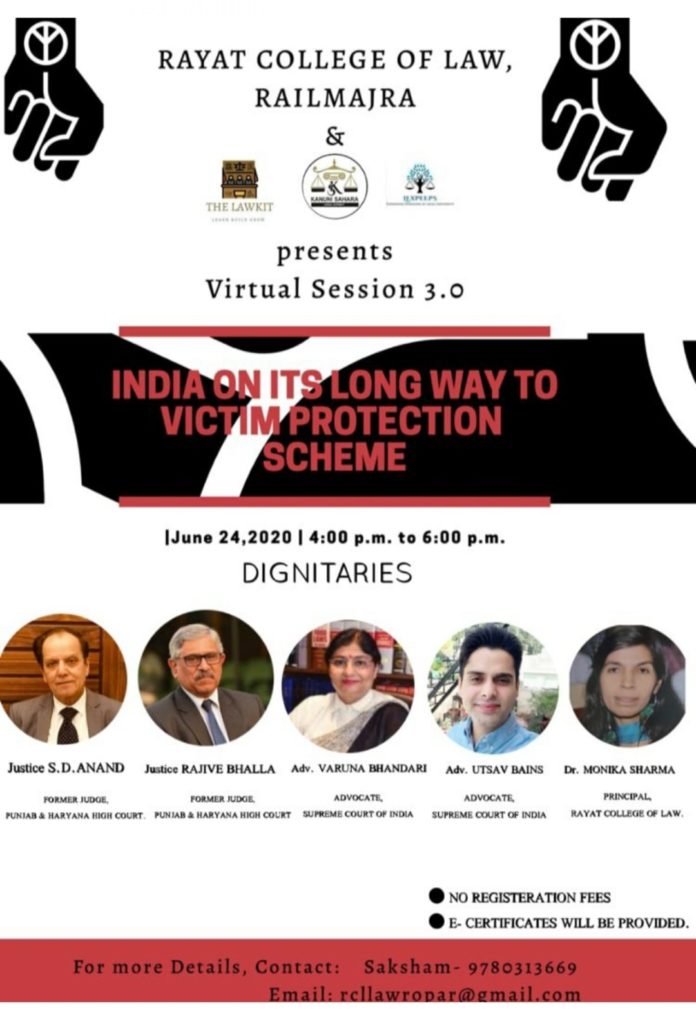
Rayat College of LawRailmajra(Affiliated to Panjab UniversityChandigarh) under the guidance of Dr Monika Sharma(Principal-Rayat College of Law) are geared up to organize yet another illuminating and enriching virtual session for augmenting legal and practical knowledge.

DATE & TIME

24th June 2020 04:00 pm to 06:00 pm

TOPIC

INDIA ON ITS LONG WAY TO VICTIM PROTECTION SCHEME

SPEAKERS

JUSTICE SD ANAND (Former judge)

JUSTICE RAJIVE BHALLA (Former judge)

ADV. VARUNA BHANDARI (Supreme Court Of India)

ADV. UTSAV BAINS (Supreme Court Of India)

DR. MONIKA SHARMA(Principle, Rayat College)

REGISTRATION DETAILS

No Registration Fees

E-Certificate shall be provided

REGISTRATION LINK

https://docs.google.com/forms/d/e/1FAIpQLSeNt5IW6ZPzC6J5BHZM-JA4kDRW6oe-s-i_fCY9tqFYcfGVwQ/viewform

PARTNERS OF THE EVENT

LEXPEEPS.IN, LawKit and Kanuni Sahara

CONTACT DETAILS

For any queries

contact:-Saksham 4th Year (9780313669)


NAME OF THE ORGANISER

Lawshastra in association with Manulegal

NAME OF THE EVENT

Webinar

TOPIC

MURDER AND CULPABLE HOMICIDE FROM THE POINT OF PRACTICAL APPROACH

DATE AND TIME OF THE EVENT

20th June 2020

12:00 to 01:00 p.m

LAST DATE TO REGISTER

19th June 2020

REGISTRATION LINK

https://forms.gle/2XEShm8kW7CdTk729

SPEAKER

Mr.ABHIMANYU SINGH (Founder – Manulegal, Research Scholar University of Rajasthan)

CONTACT DETAILS

Keshav Baheti: 7693038125

1st Lawschole Essay Writing Competition: Participation Certificate to all, Merit Certificates to Top 15; Register by July 10.

About the Organisation

From the beginning, Lawschole has been driven by the interests and involvement of our incredible and engaged law students. We are a growing law-student forum focused on improving our collection of law school news and opportunities, and enhancing the forum experience. We are a great resource, offering opportunities for students to be active in a variety of topics and to engage with each other in an interesting and safe online environment. It is a forum where law students can share thoughts, seek opinions and advice, and learn something new from other members of the forum.

About the Competition

In an effort of improving the creation and dissemination of legal writing, Lawschole is organising 1st Lawschole Essay Writing Competition to bring into light the views of students on varied aspects of day-to-day life. While pursuing our goals, we commit to engaging with law students so as to ensure the involvement of law students.

Themes

  • Authors may select the topic of their choice on any current legal topic.

Guidelines to Authors

  • The word limit is 1500 words, exclusive of footnotes.
  • Co-authorship is allowed to a maximum of 2 authors only.
  • The essay writing competition is open to students enrolled in any graduate or postgraduate course.
  • The submission must be made in .doc or .docx format only.
  • The content should be the original work of the writer and should not have been given to any other competition or for any publication. Plagiarised content shall not be entertained.
  • Judgment shall be based on the quality of the content and uniqueness.
  • No extension in deadline shall be allowed.

The formatting guidelines to be followed are:

  • Font size: 12
  • Font: Times New Roman
  • Alignment: Justified
  • Line spacing: 1.15

Registration

Registration amount is Rs. 100 for Single Author and Rs. 150 for Co-authorship. Co-authorship is allowed to a maximum of 2 authors.

Participants can submit the Registration fee via PayTm UPI Money Transfer, Bhim UPI, or Gpay by scanning the following QR code:

After the payment, all the participant(s) must fill the registration form attached and attach a screenshot of the payment receipt, and mail it at lawschole@gmail.com.

Submission Details

Submission can be made at lawschole@gmail.com

The last date for submission of the essay is 15th July 2020.

Awards and Merit

  • 1st Prize: Rs. 500 + e-Certificate of Achievement + Free Publication of Essay on our website + an opportunity to get an article published in the Lawschole’s E-Magazine for free.
  • 2nd Prize: e-Certificate of Achievement + Free Publication of Essay at our website + an opportunity to get an article published in the Lawschole’s E-Magazine for free.
  • Top 15 Essays will be provided with the e-Merit Certificate and an opportunity to get an article published in the Lawschole’s E-Magazine for free.
  • All participants are entitled to receive e-participation certificates..

Important Dates

  • Deadline for registration: 10th July 2020
  • Deadline for submission: 15th July 2020
  • Declaration of the result: 19th July 2020
  • Issuance of e-certificate: 25th July 2020

Contact Information

For any further queries please feel free to reach us at lawschole@gmail.com.

Website address- https://lawschole.wixsite.com/lawschole


This article has been written by Nimisha Mishra, a second-year student of NALSAR University of Law. In this article, the author has explained the sedition law and has drawn the parallel comparison between the US and India. 

INTRODUCTION

Sedition refers to an act of inciting and invoking violence against the state. Sedition is a serious offence or felony since it involves revolt against the state, which can create a serious law and order situation. The purpose of sedition is that it incited violence against a lawful authority to overthrow or destroy it. Sedition law is punishable to 20 years of imprisonment and fine. 

Brief history of Sedition

Sedition as a law emerged from Elizabethan England, at that time if anyone criticised the king and insight a rebellion it was considered as a crime against the state. When Britishers were ruling India, they had a constant fear of rebellion, especially the Wahhabi rebellion. So as a protective mechanism they introduced sedition law which was applicable to freedom fighters especially. Great leaders like Mahatma Gandhi and Bal Gangadhar Tilak were tried under this law. Originally the sedition law was drafted in 1837 by Thomas Macaulay but it was not included in Indian Penal Code in 1860. Section 124A was later inserted in 1870 through an amendment. 

In recent times, the rise in sedition cases can be seen around the world whether it is US or India. Professions like intellectuals, students, human rights activists, journalists, filmmakers and universities are the common victims of sedition charges. 

Sedition law in India

Sedition law in India is defined under section 124A of the Indian Penal Code. It states that Whoever, by words, either spoken or written, or by signs, or by visible representation, or otherwise, brings or attempts to bring into hatred or contempt, or excites or attempts to excite disaffection towards, the Government established by law in India, shall be punished with imprisonment for life, to which fine may be added, or with imprisonment which may extend to three years, to which fine may be added, or with fine.”

The sedition law in India is broader than the sedition law in the US. In India, the no. of people required to constitute sedition is also not defined, which means that even one person alone can constitute sedition. 

Sedition is an offence since the colonial period; it has existed in the Indian Penal Code. It was so because the Britishers could not tolerate any dissent opinion raised by the people. 

But even after independence, the sedition law was severely criticized on the point that it strictly curbed the freedom of speech and expression and hence free speech. There were proposals made by the then Prime Minister Jawaharlal Nehru to handle the sedition related content through other means. Mahatma Gandhi section 124 is “the price among the political sections of the IPC designed to suppress the liberty of the citizens

Sedition in India is a non-bailable offence. There are other restrictions imposed on a person charged with sedition like he cannot apply for any government job after that. The major restriction was that they have to live the rest of their life without a passport and have to appear in the court of law as and when required. 

Sedition also has the same effect on people as the chilling effect. It deters people from raising any dissent opinion against the ruling government. It has become a tool for the government to terrorise its citizens which is a very serious loophole of democracy. 

The Supreme Court of India interpreted Section 124 and stated the difference as to when sedition is committed and when it is not committed. The court said that sedition is a crime against the state and not the government. So if citizens are criticizing any particular party or a politician, it will not be considered as sedition. For the crime of sedition to be committed a person must insight violence against the state or the Constitution of India which is detrimental to the peace of society. Recently it has been seen that sedition is used to terrorise citizens from raising their voices. And it is necessary for the government to realise the difference of when the sedition is committed and when is not before prosecuting or convicting an individual. 

Sedition law in the US

In the United Nations, the sedition law is defined under Title 18 of the US Code, as engaging two or more people to commit sedition within the jurisdiction of the United States. Sedition includes treason, rebellion and other similar offences. As per the 18th code, sedition is defined as a conspiracy of two or more people to destroy or overthrow the United States government. 

Sedition cases are usually rare in the US because of the First Amendment. Sedition in the US has been illegal since time immemorial. 

During the late 1820s and early 1830s, the rise of slavery was at peak. There were huge protest and movements to abolish slavery, which forced the state to enact sedition law. Even the US Supreme Court was reluctant to help till late 1927. In a popular case of Whitney v. California the court ruled that it is unjustified to deny the freedom of speech and expression only because of the fear of dissent.  

Earlier great leaders of the US such as Wilson regarded sedition as a very essential for the governance of the country. They considered it crucial in order to suppress the dissent for the smooth functioning of the governance. However, the modern legal scholars are of the contrary view as they consider the Sedition Act as against the spirit of the First Amendment of the US Constitution. 

There should be substantial evidence that sedition could be committed before convicting anyone since there are very serious repercussions of it. 

Conclusion

Sedition in democratic countries gives excessive power to the ruling government to suppress the opinion of the citizens and maintain its image. It is high time now for the government of a democratic country to realise that for the citizens to fully enjoy democracy, they should be given protection to exercise their rights.      

Latest Posts


Archives

ABOUT THE ORGANISER 

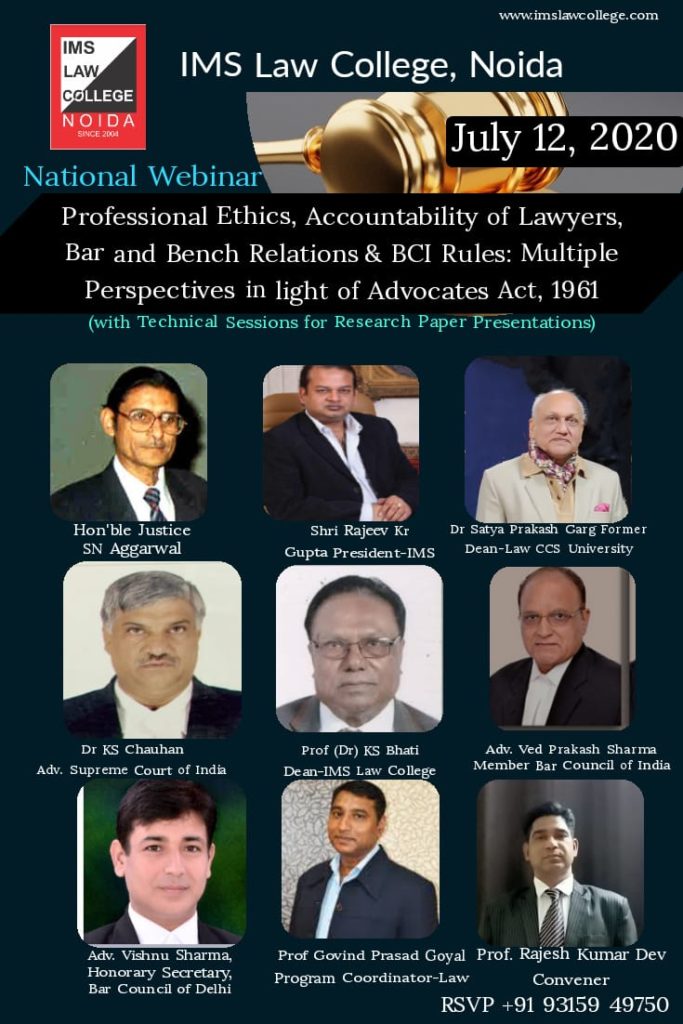
IMS Law College produces the best legal professionals for serving society. This institution is recognized by the University Grants Commission (UGC). This is the First College in Noida to start B.A., LL.B. 5-year integrated degree course followed by LL.B. 3-year degree course and B.Com., LL.B. 5-year integrated course. All courses are approved by the Bar Council of India. This College is committed to providing the best education and training of global exposure to the students in the legal arena. IMS LAW COLLEGE has an affiliation to CCS University, Meerut. 

TOPIC

“Professional Ethics, Accountability of Lawyers, Bar and Bench Relations & BCI Rules: Multiple Perspectives in light of Advocates Act, 1961”

CONTACTS DETAILS

info@imsnoida.com 

A-8B, IMS Campus Sector-62 Noida-201303 

+91-120-4798800-02 

imslawcollege.com 

SPEAKERS 

Hon’ble Guests for Session I (11:00 am) 

  • Hon’ble Justice Sudhir Narain Agarwal “Former Judge, Allahabad High Court”
  • Dr K S Chauhan 
  • Prof. (Dr.) Satya Prakash Garg “Former Dean, Faculty of Law CCS University, Meerut” 
  • Adv. Ved Prakash Sharma “Member, Bar Council of India” 
  • Adv. Vishnu Sharma “Honorary Secretary, Bar Council of Delhi” 

Hon’ble Guests for Session II (02:30 pm) 

  • Hon’ble Mr Justice Sudhir Narain Agarwal, 
  • Dr. K S Chauhan 
  • Prof. (Dr.) Satya Prakash Garg 
  • Adv. Ved Parkash Sharma 
  • Adv. Vishnu Sharma 
  • Hon’ble Justice S N Dhingra “Former Judge, Delhi High Court” 
  • Prof. (Dr.) A K Bansal “Former Dean-Law Delhi University” 
  • Prof. (Dr.) Afzal Wani “GGSIPU” 
  • Adv. Amarjeet Singh Chandhiok “Senior Advocate, Delhi High Court” 
  • Adv. D K Sharma “Member, Bar Council of Delhi”


REGISTRATION FORM

https://forms.gle/KFZkcSXQR9uEkjZo6

(Certificate will be issued to all registered participants.) (Prizes for top 3 paper presenters) 

DEADLINES

Last date of registration 05th July 2020. Webinar link will be shared on 08th July.2020 

93159 49750 Email:- rkdevadvocate@gmail.com

ABOUT THE ORGANISER

Center for legal studies has been set up by Gitarattan International Business School in the year 2016 for imparting legal education. CLS-GIBS has been emerging as one of the prominent law schools of the country providing 5 years integrated programmes in BA LLB and BBA LLB.

Gitarattan International Business School (GIBS) was established in the year 2004. GIBS is affiliated to Guru Gobind Singh Indraprastha University, Delhi and is approved by All India Council for Technical Education (AICTE), Ministry of HRD, Government of India for technical programmes and Bar Council of India for Law programmes.

TOPIC OF THE EVENT

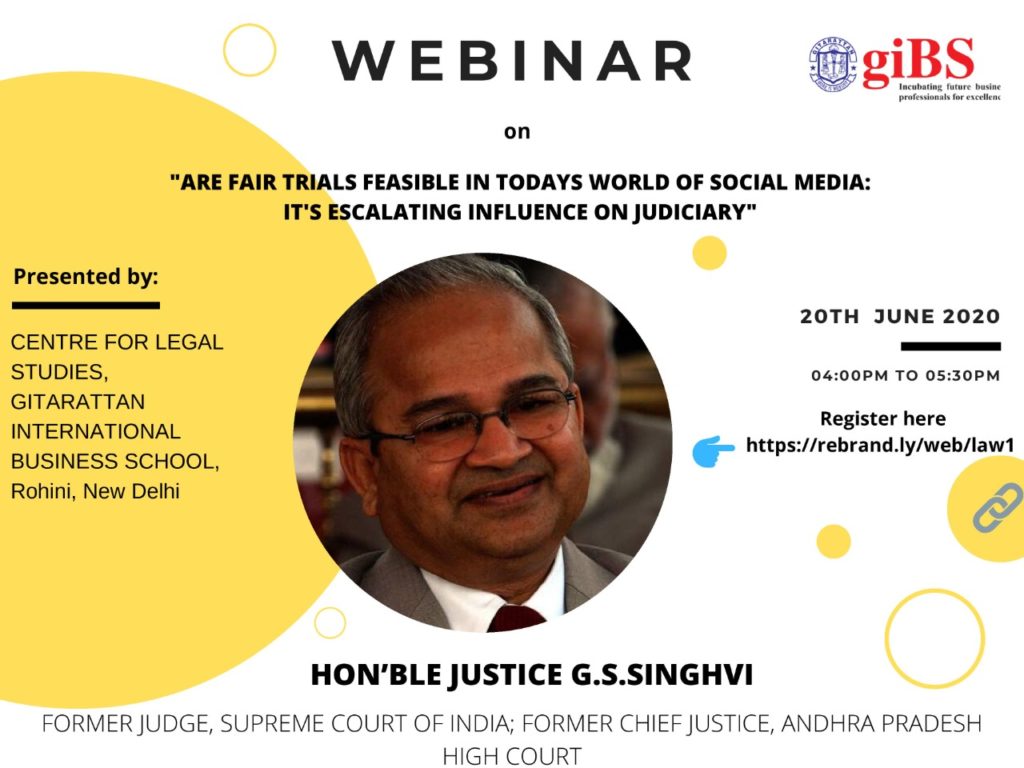
ARE FREE TRAIL FEASIBLE IN TODAYS WORLD OF SOCIAL MEDIA: IT’S ESCALATING INFLUENCE ON JUDICIARY

DATE OF THE EVENT

20th June 2020

TIME OF THE EVENT

04:00 P: M TO 05:30 P: M

SPEAKER

Hon’ble Justice G.S Singhvi (FORMER JUDGE SUPREME COURT OF INDIA)

REGISTRATION LINK

https://event.webinarjam.com/register/9/10zr3tl