ABOUT US

Lexpeeps is totally dedicated to the legal fraternity where to be law professionals will get an opportunity to flourish their career in a better way. Lexpeeps will be organising different events debates seminars of its own and also will organise the major law school activities on tie-ups with leading law school. Lexpeeps is not only limited up to managing the legal events but it also is providing internships to law students where the law professionals will come in touch with each other and can grow by associating with the company.

  NATURE OF INTERNSHIP

Interns will be required to complete the tasks daily during the period of the internship with us.

LOCATION

Work from Home

DURATION

Minimum 1 month

ELIGIBILITY

  • The student pursuing BJMC or has completed BJMC Course and Law students (3 year or 5 years) interested in Journalism; or from any other course.
  • Basic knowledge of Computer Skills
  • Student posses fluent in English with good writing skill

The student with good academic record shall be preferred

INTERNSHIP BENEFITS

  • Certificates on successful completion of the internship
  • Certificate of appreciation for intern of the month

APPLICATION PROCEDURE

Send your CV to lexpeeps.in@gmail.com with ” Stories Internship”as a subject.

CONTACT DETAILS

Feel free to contact us

Email: lexpeeps.in@gmail.com

This article is written by PRANIT BHAGAT pursuing B.A LLB from ILS Law College, Pune. In this article, he has discussed combating cyber obscenity in India and did a comparative analysis with that of the United States of America.  

INTRODUCTION

WITH THE ADVENT of the technological revolution, the concept of cyberspace also became popular with the people. The development of Information Technology is the mother of cyberspace wherein the internet provides many opportunities to the people equally for accessing any data storage and information etc. by use of high technology. New inventions and discoveries have widened the scientific scope as well as brought new challenges for the legal world. The widespread growth of these technologies has to lead to the commission of new types of crimes in cyberspace and has also become a matter of global concern. Cybercrimes are like the attack on secured information of individuals, corporations, or governments, etc. The popularity of social networking sites is increasing day by day. Due to this one can express his or her feelings very well, connect to old friends, and also make new friends. But there is a misuse of these sites by the cybercriminals for fulfilling their illegal purposes. In today’s world, teenagers are in habit of watching live sex, video clip, MMS clip, etc. Side by side the people have started to spend more and more time on networking sites because of the people’s addiction to them. Most of the time the end-users of the internet view, download, transmit, save and take a printout of obscene materials for themselves and also transmit the same to others. In modern times, the development of Information Technology affects the life of people all around the world.

Concept of Obscenity

Cyber obscenity is a very sensitive issue. The concept of obscenity changes with time and place. We cannot judge obscenity in isolation. It needs a broader perspective to understand the notion of obscenity. The obscenity is directly related to morality and decency. We can define obscenity with the help of the historical development of ‘test of obscenity’ in various countries. In Regina v. Hicklin case, the court observed that the material which has the likelihood to corrupt and deprave the minds of those persons whose minds are open to such immoral influences and who may read the publication of this type. The U.S Supreme Court in Miller v. California, given three tests for obscenity. But in Pope v. Illinois, it was held that there should be proper inquiry whether the community whose case is in the hand have serious value in that obscene material or whether a common person would find such values in it if taken as a whole. Thus, it can be said that the standards and factors for obscenity vary greatly depending on the norms and values of the state, town, or city for that matter of foreign countries. The term pornography means to describe or to show sexual acts to cause sexual excitement through obscene websites or obscene material produced by using computers, internet and also includes downloading, transmitting pornographic videos, writings, photos, and pictures, etc. Obscenity in cyberspace may be of various forms. The essential characteristics of pornography are the downloading of obscene material by using a computer and internet through the website so it also includes the hosting of websites that contain prohibited and obscene material. The pornographic material is very harmful to the young generation because it can corrupt and deprave the minds of the future of the country. There is no well-settled definition of obscenity. Material considered as a piece of artistic expression or literature in the United States of America may be considered obscene in India. The Government and law enforcement machinery have been trying to restrict the availability of this type of material but the results have not been satisfactory.

Statutory Provisions in India

Article 19 (2) of the Indian Constitution provides that the state has the power to impose reasonable limitations on freedom of expression to maintain morality and decency. To tackle the problem of obscenity and pornography, we have four major laws. The Indian Penal Code under section 292 comprehensively discusses the circumstances under which ‘obscenity’ may be an offence. In the case of Ranjit D. Udeshi v. the State of Maharastra, Honourable Apex Court interpreted the word “obscene” and stated that obscene may be defined as “offensive to modesty or decency, lewd, filthy and repulsive.” The Court further observed that it constitutes the reasonable limitation on the right of freedom of expression guaranteed by Article 19, clause 2 of the Constitution of India in the interest of morality or decency. Further, the Court in Samaresh Bose v. Amal Mitra held that the standards of morals of the society, the concept of “obscenity” may differ from one country to another country. In this case, the court also differentiated between the term “vulgarity” and “obscenity” by stating that vulgar writing is not always obscene. Indecent Representation of Woman (Prohibition) Act, 1986 prohibits the indecent representation of women by writings, painting, or through publication. It is an offence under this Act and punishable. Indian Parliament enacted The Protection of Children from Sexual Offences Act, 2012. This Act protects the children against offences of pornography, sexual harassment and sexual assault, etc. The case of Kamlesh Vaswani v. Union of India is presently pending in the Indian Supreme Court. The Apex Court has directed State to file a detailed affidavit and posed a question whether the Department of Telecom (DOT hereinafter) or any other department of Indian Government is competent to issue directions to Internet Service Providers Association of India (ISPAI hereinafter) to call off sites showing pornography. In India, the Information Technology Act, 2000 (IT Act hereinafter) contains the issue of online obscenity. Under the Act, storing or a private viewing of obscene material is legal as it does not specifically restrict it. On the other hand, transmitting or publishing obscene material is illegal. Before 2008, section 67 was the only provision of the Information Technology Act which prohibited the publication of obscene information including child pornography and obscenity. Section 67A of the IT Act, 2000 restricts the publication of sexually explicit or obscene material and section 67B of the Act specifically prohibits child pornography. This section only criminalizes the publication and transmission of sexually explicit or obscene material in an electronic form but viewing, downloading, possession, etc. is not an offence as per the provisions of the Act. The main essentials of section 67 of the IT Act are (a) transmission of the information in electronic form and (b) that publication appeals to prurient and lascivious interest. This offence is bailable, cognizable, and triable by the court of Judicial Magistrate of First Class. An explanation clause is also added with this section which states the meaning of the word used in section 67. Section 67-A was added in the Information Technology in the year of 2008. It prohibits publication and transmission of sexually explicit material in electronic form. And this section contains some exceptions on the line of section 292 of the Indian Penal Code, 1860. As we know, India is a signatory to the Convention on the Right of the Child (CRC hereinafter) and ratify the optional protocol on the state of children, child prostitution, and child pornography. So, section 67-B was added to the IT Act, 2000. Section 67-B criminalizes every type of pornography. Section 67A and 67B are the only sections that are non-bailable as per section 77B of the Act, whereas others are bailable. We also have section 69-A of Information Technology Act, 2000 where the Central Government or its officer appointed can issue directions to other government agencies and intermediaries to block such information for public access if it is in the interest of the State.

Obscenity: Under American Laws

The legislative development regarding child pornography in the USA is the Child Pornography Prevention Act, 1996 (CPPA hereinafter), and the Child Online Protection Act, 1998 (COPA hereinafter). In the United States of America, the Act of 1996 banned child pornography material which is produced by the computer technology that is a representation of sexually explicit conduct involving or appearing to involve minors. The latter Act deals with commercial site operators who offer material deemed too harmful to minors to use bonafide methods to establish the identity of visitors to their site. The Communication Decency Act 1996 (CDA hereinafter), was also passed to protect minors from pornography. The CDA states that any person, who knowingly distributes, through the use of interactive computer service or transports obscene material for sale in foreign or interstate commerce shall be liable to imprisonment up to five years for a first offence and up to ten years for each subsequent offence. In reaction to CDA, a case was filed by the American Civil Liberties Union for challenging the validity of the CDA. It was held by the Court that the Communication Decency Act placed the heavy burden on the speech which is protected. Further, in Reno v. ACLU, it was held that CDA suppresses a large amount of speech. The CPPA amended the definition of child pornography as defined under the Child Protection Act, 1984 by stating to include that which depicts the sexual conduct of child and also which appears to be a depiction of children who are engaged in sexual conduct. The depiction may include any kind of photograph, picture, video, film, or computer or computer-generated picture or images. Such depiction may be made or produced by mechanical, electronic, or other means and may be promoted, advertised, described, presented, or distributed in such a manner that conveys the impression that the material is or contains a visual depiction of a minor engaging in sexually explicit conduct. After this, COPA was enacted. It provides that minors have the opportunities for accessing any material by using the web and protects minors physically and psychologically. It imposes the restriction on a minor’s access to harmful materials, prohibits its distribution and also provides protection to children from being exposed by it on the website or internet. Then the Protection of Children from Sexual Predators Act was passed in 1998 with the purpose to expand the liability of those persons who attempts to make use of internet with the intention to spread child pornography on cyberspace. This Act specifically targets and criminalizes the knowing pornography by using the internet for commercial purposes which is harmful to minors. Minors may include children up to 16 years of age and younger. On the very next day of signing COPA, a suit was filed by ACLU in the Court with the purpose to prevent the enforcement of COPA. At last, this case reached the US Supreme Court. It was held by the court that COPA’s dependence on the standards of community with the purpose of identifying harmful material to minors does not itself render the statute substantially overbroad for the purpose of the first amount. The government was enjoined from enforcing COPA. The US judiciary has played an important role to overcome cyber pornography. In the United State v. Kufrovich case, a charge was made against the defendant for knowingly using a means of Interstate Commerce with the intention to instigate a child for engaging in sexual activity under title 18 U.S.C. $ 2422(b) and $ 2423(b). It was found by the court that the Communications Decency Act’s parts violated the First Amendment and were not according to the Constitution. The defendant contended that he had interacted through the internet with the victim as protected in the Constitution. That’s why it could not be taken as evidence against him. But the court by rejecting his contention held that the charges which were made under the statutes don’t impermissibly limit the speech. It was also held that it is a criminal offence of using means of interstate commerce with the intention to lure a child into sexual activities. In the United States v. Hilton case, Hilton was charged by a federal grand jury for violation of 18 U.S.C. $ 2252A (A)(5)(B) for criminal possession of computer disks which contains three or more pictures of child pornography. He challenged the state without denying the charges. He contended to dismiss the charges on grounds that the act was unconstitutional under the First Amendment. The U.S. District Court was also agreed with his contention regarding the vagueness of the definition of child pornography but in this case, the issue was raised whether the CPPA poses substantial problems of overbreadth and it would be sufficient to justify the decision of the lawmaking branches. In US v. Mathews, it was held by the court that under federal law each transfer of child pornographic images by email is a separate offence. The defendant contended that the successive email transmissions were also part of an online conversation that is single by nature. But his contention was rejected by the court. Later on, this decision was affirmed by the Appellate Court. In the case of Davis v. Gracey, the CD-ROMs which were obscene by nature were sold to an undercover officer by the accused. After this, a search was made on his business premises on the basis of a warrant and those CD-ROM files could be accessed by the police officers through the bulletin board and could seize the computer equipment which was used to operate it. Then a case was filed against the officers who made the search by Davis who was the related businessmen of the accused and several other users of email on his bulletin board. In this case, they alleged that there was a violation of constitutional and statutory provisions through a seizure of the email and computer equipment. It was held by the court that the original warrant was not against the constitution and the seizure of bulletin board email user files did not invalidate it. In the case of Hedeemer v. Haun, Utah’s sex offender notification statute was challenged by the plaintiff. This would make available on the internet, the sex offender registry information without any restriction to the general public. In the end, the Hon’ble court held that the registry information on the web site which is available globally will have no risk of encountering the offender and that was not related to the non-punitive goal of preventing additional sex offences with proper grounds. So it is liable to violate both clauses of Double Jeopardy and Ex Post Facto but not the Equal Protection Clause which rationally guards against the sexual offences and the Due Process Clause which contains the “non-private” information. Therefore, no cognizable harm to the reputation of the plaintiff was maintainable. 

Comparative View 

In India, section 292 to 294 of IPC contains the Indian law of obscenity. The IT Act, 2000 was deficient in dealing with obscenity before amendment by IT Amendment Act, 2008. It has improved the Indian law of obscenity to a greater extent. Now, the Information Technology Act, 2000 after amendment provides that storing or a private viewing of obscenity is legal as it does not specifically restrict the same. On the other hand, transmitting or publishing obscene material is illegal. There are some sections of IT Act, 2000 which prohibit cyber obscenity with certain exceptions to Section 67 & 67- A. The combined effect of sections 66E, 67, 67A and 67B is to differentiates between cyber pornography, child pornography, and mainstream pornography and to bring the online pornography within the legal regime. As compared to India, the USA’s first attempt for regulating the pornography on internet was the Communications Decency Act, 1998. Later on, a case was filed by the American Civil Liberties Union (ACLU) in which the legal validity of the provisions of the Act was challenged as against the freedom of speech. In the end, it was held by the US Supreme Court that this Act introduced a heavy burden on protected speech which can’t be accepted. Further, in Reno v. ACLU, it was held that CDA suppresses a large amount of speech, and the Child Online Protection Act, 1998, and the Child Pornography Prevention Act, 1996 contains the child pornography laws. The former Act requires commercial site operators who offer material deemed too harmful to minors to use bonafide methods to establish the identity of visitors to their site and the latter Act makes a prohibition on the knowingly use of computer technology with the intention to make a production of child pornography i.e., to depict sexually explicit conduct which involves or appears to involve minors. The Communication Decency Act, 1996 of the United States of America differentiates between mainstream pornography and child pornography while in India no such difference exists under section 292 of IPC through the IT Act after amendment in 2008 has regarded obscenity as an offence but separately defined child pornography with punishment under section 67B. In the United States of America, mere possession of obscene material is not an offence but publishing or transmission of such obscene material is an offence while in India it is not an offence to merely possess such obscene material. In the United States of America, child accessibility to porn sites is prohibited while in India browsing and downloading child porn images are punishable offences.

Conclusion and Suggestions 

Obscenity is a globally recognized complex issue that has attracted the attention of jurists, lawmakers, and society at large. It can be stated that what is immoral for one may not be so for other or other society. Due to the latest technology people are becoming more power-oriented day-by-day with the full consciousness of their freedom rather than their duties to maintain the moral standards, decency, peace and order and to follow the law in the country. Above all, the judiciary is one among three organs of the government which performs the function of maintaining peace and order in the society and it is left to it for maintenance of the reason as well as a prudent repository of moral standard in the society for dealing with obscenity in cyberspace. The use of new multimedia technology is increasing day-by-day which is misused by the criminals in cyberspace. Cyber obscenity is one of those cybercrimes which is growing every day both at national and international level. United States of America and India have enacted several laws for dealing with cyber obscenity; despite this many complicated legal issues still remain unresolved. There are a number of offenses taking place in both countries but only a few cases are lodged as a complaint. But due to this the cybercriminals are day-by-day more encouraged to get involved in such types of criminal activities. It is suggested that punishment needs to be enhanced for dealing with such crimes and there is a need to adopt a specific and comprehensive definition of cyber obscenity in cyberspace. On a priority basis, there is a need to take concert action to stop all forms of obscenity and child pornography specifically. There is also a need for issuance and determination of uniform guidelines for the internet service providers and cyber cafés which expressly mention their liability and accountability such as there must be the provision for keeping the secrecy of the user’s personal information which is provided on the basis of utmost good faith. For combating the problem of publishing obscene information in cyberspace, there is a pressing need of spreading awareness in government as well as the public. It is also highly demanded that the cyber authorities must be technically trained from time to time. There is a need to inculcate the culture of continuous learning education among law enforcement authorities because present knowledge becomes obsolete in a very short time. Society at large must be aware of the fact that they are also encouraging such activities by searching online obscene/pornographic material with the intention to satisfy him/her mentally. Searching online obscene material results in financially supporting those persons who are uploading such obscene information for gaining profit and such profit increases with an increase in the number of subscribers and viewers. So, firstly, we should check ourselves not to provide financial support to cybercriminals indirectly. Involving ISP’s would be a good strategy and it would restrict the supply and may prove to be more beneficial as compared to simply identifying and prosecuting users of child pornography. As we know that prevention is better than cure. The punishment for cyber obscenity must include all the four theories of punishment, i.e. retributive, deterrent, preventive, and reformative theories.

Latest Posts


Archives


This article is written by Samridhi Sachdeva pursuing BBA LLB from Gitarattan International Business School, GGSIPU. This article tries to explain about one of the major cyber crimes, i.e. cyber stalking, types of cyberstalking and how to avoid being one of the victims. It also lists some laws that give protection from cyber stalking.

INTRODUCTION

Technology, nowadays, is being updated on a regular basis. From taking help from Google to getting jobs online, technology has developed in many ways. It allows one to open up in front of people and share their emotions and keep their opinions in front of others. It has given us all the advantages to get more aware, educated and confident about everything going on around the world. 

But, when you talk about the advantages of one thing, there come the disadvantages attached to it. The technology in today’s world lets people know about each other’s lifestyle, hobbies and much other personal information. And many people, whether known to us or not misuse this and try to threaten or bully us through social media platforms, emails or any websites etc. Such things are known as “cyber crimes” and the Information Technology Act, 2000 and The Indian Penal Code describes these cyber crimes and their punishment. 

One of the most committed cyber crimes is “cyber stalking”. In this, the person or the stalker uses any of the electronic means to harass, stalk or threaten the victim to take revenge from the victim, to control the victim or just because of the anger issues. Further, the article provides a clear view of cyber stalking.

Cyber Stalking 

Cyber stalking, is a crime that is done using the online platform to stalk, harass or threaten the victim in order to get control over the victim, take revenge or for some financial gains as well. It is a continuous process and it often leads to or is accompanied by offline stalking. 

And cyber bullying or cyber trolling is very different from cyber stalking. Cyber trolling and cyber bullying are often taken as jokes or normally. As the celebrities or the semi-celebrities create their social media platforms, they are ready for the negative comments too. But cyber stalking is a repeated process, and the stalker harasses or threatens the victim, in a very negative manner and on a regular basis tries to hack their system or passwords for catfishing.

Catfishing- It is a part of cyber crimes. When a person tries to pose as someone else and create a different profile with those photos and orders something online or copy the existing profiles of the users for all this purpose, then that is known as catfishing. 

Factors

  1. False accusation/victimisation: The stalkers usually put false accusations and play the victim role to commit this crime and harass the original victim for the reasons of money basically.
  2. Attempts to gather information about the victim: The stalker tries to take information about the victim through online resources.
  3. Encouraging others to harass or threaten the victim: The stalkers even try to involve the third person by forcing them to harass the main victim.
  4. Monitoring their online activities and attempting to trace their IP address: The stalkers generally, through some sites or social media monitor the victim’s online activities and try to obtain their IP address to look after what all the victim is doing online.
  5. Hacking the data and equipment: The stalkers use different techniques and try to hack the victim’s computer, laptop etc. and get all the data to threaten the victim.
  6. Orders goods and services: The stalkers after hacking the data and email passwords of the victim, orders some goods and services and delivers to the victim’s address only. This goods and services most of the time include pornographic material only.
  7. Defamation: The stalker defames or spoils the image and reputation of the victim by posting negative and false content online.

Types of Cyber Stalking

  1. Stalking by Stranger: There is no particular definition of a stalker. A stalker may share a former or present relationship but most of the time it is done by a stranger who does not know the victim that much but has only known him through an online portal. 
  2. Intimate partners: The stalker is sometimes your own partner with whom you share an intimate and romantic relationship. It is a type of domestic violence only. The partners may threat or harass the other partner by sending them threatening emails or using their emails. The stalkers do this to get control over their partner.
  3. Celebrities and public persons: The celebrities and public persons become the victim of cyberstalking too soon. The stalkers do this for being in the public eye and getting fame. The stalkers are usually the fans of the celebrities and may make up fake stories about the celebrities and take the risk of cyber stalking just for fame.
  4. Corporate Cyber Stalking: Some individuals or a group of them threatens or harass an organisation or vice versa. This is done for financial gains and controls.

Laws related to Cyber Stalking 

As the stalkers have no particular identity, they have anonymous identities online, so it is sometimes difficult to catch the stalker. Also, the victims should not post any personal information on a public platform. Or else it will be very easy for the stalkers to get control over or defame the victim. The laws on cyber crimes are given under the Indian Penal Code and IT Act, 2000 in India. The laws related to cyber stalking are as follows-

  1. Section 354D, Indian Penal Code: This section deals with stalking and clause(2) of this section talks about cyber stalking. Anyone who commits the crime of cyber stalking fulfilling the conditions under this section shall be punished with an imprisonment of 3 years at first stage and imprisonment of five years at the second stage.
  2. Section 354A, Indian Penal Code: This section provides that if someone comments something fake or negative about the victim, then the person shall be punished with an imprisonment of one year and fine.
  3. Section 354C,.Indian Penal Code: This section provides punishment for voyeurism, when a man posts fake and defaming things about a woman. Cyber stalking is a crime that includes voyeurism too.
  4. Section 66E, IT Act: The guilty person may publish images that can violate the privacy of the victim and is liable to be punished with the punishment of imprisonment for a term of 3 years and with fine of 2 lakhs to 10 lakhs.
  5. Section 67, IT Act: This section particularly deals with cyber crimes and their punishment.

Conclusion

Cyber stalking has laws related to it, which can save the image and reputation of the victims. When the man is harassing or threatening a woman, then the woman can go and report to the National Commission for Women (NCW). Otherwise, they can complain in court. And to avoid stalking, the people should try to keep a low profile online, and maintain their digital hygiene, don’t share your IP address or passwords with anyone and avoid sharing your personal information. If you don’t want to take this to court, then the first step you can do is to block and report the accounts of the stalker.

Latest Posts


Archives

This article is authored by Pankhuri Pankaj, a 3rd-year student pursuing BA-LLB (Hons.) from Vivekananda Institute of Professional Studies, affiliated to GGSIPU. She is currently interning with Lexpeeps. This article summarises certain key provisions of “Emergency Provisions” in the Indian Constitution and is qualified in its entirety by reference to the Constitution of India.

INTRODUCTION

Human right laws are the backbone of any constitution and have been given utmost importance to sustain the essence of humanity in the society and they have been given international relevance through the ¨Universal Declaration of Human Rights¨, 1984. Socio-economic rights of a person which deal with the human right to adequate living conditions including food, housing, and clothing, the right to physical and mental health, right to work, right to education, right to a healthy and clean environment, etcetera, are considered a core part of the human rights laws that developed after the World War II.

Socio-economic laws have played a very important role in the development of countries across the world, especially in the developing countries. These laws ensure the growth of a country not at the cost of the humane rights of its citizens. 

Comparative Study of Judicial Enforcement of Socio-Economic Rights in Developing Countries

To get a better look at judicial enforcement of socio-economic rights in developing countries, one can draw a good picture by examining judicial social-economic rights in India and South Africa. Divergent jurisprudence has been developed by the Constitutional Court of South Africa and the Supreme Court of India regarding socio-economic rights. On one hand, there is the South African Court with the clearer constitutional mandate for judicial enforcement has afforded deference to legislative and executive policy choices within the bounds of reasonableness reflecting the progressive approach adopted by the Constitutional Assembly, while on the other hand, the Indian Court has read the provision for enforcement of Fundamental Rights expansively to enforce socio-economic rights enumerated under the Directive Principles of State Policy, while simultaneously relaxing procedural and standing barriers to enforcement by individual claimants.

INDIA

The expansion of enforceable socio-economic rights by the India Court´s began after Prime Minister Indira Gandhi sought to weaken judicial review during the period of Emergency Rule from 1975 to 1977. Gandhi declared a state of emergency allowing her to rule by executive decree, suspended habeas corpus, and restricted freedom of the press after she was convicted by the Allahabad High Court in 1975 for election fraud in connection with the 1971 general elections. In the landmark case of Keshvananda Bharati v. State of Kerala (1973), it was held by the hon’ble court that any amendments to the Constitution of India are to be held violative of the ¨basic structure¨ of the Constitution. In response to this, the then Prime Minister, Indira Gandhi, appointed her own nominees, who had dissented Kesavananda, as Chief Justice of the Supreme Court, violating tradition, and further, during the emergency period passed four highly controversial Constitutional Amendments which were designed to limit the judicial scrutiny on the actions of the government.

The 42nd Amendment, which was passed during this catastrophe, aimed at overruling the landmark judgement of Kesavananda Bharati Case by prohibiting the Court from reviewing constitutional amendments, adding a provision which required a two-thirds vote of the Court to invalidate statutes as unconstitutional, and declared the 1971 election to be beyond judicial review altogether. This amendment also gave the socio-economic Directive Principles in Part IV of the Indian Constitution precedence over the Fundamental Rights in Part III of the Constitution, authorizing authoritarian socialism which resulted in the detention of political opponents. Following this utter disaster concerted by the arbitrary usage of vital powers democratic procedures were restored with the election of the Janata Party in 1977 and the controversial constitutional amendments were repealed, while the Court decided a number of landmark cases extending judicial review into the realms of socio-economic rights.

Another case which contributes to perfectly exemplify the judicial enforcement of socio-economic rights in a developing country like India is the case of Maneka Gandhi v. Union of India (1978), where the Court held that Ms. Gandhi´s Fundamental right to personal liberty was directly violated by the state’s action to confiscate her passport without any sufficient procedure established in the law. In continuation to the opinion of the court in this case, in the case of Francis Coralie Mullin v. Union Territory of Delhi (1981), the Court decided to expand the Fundamental Rights of life and personal liberty to include the right of a detainee to “live with human dignity,” which also included the bare necessities of life that a human deserves. Finally in the case of Bandhua Mukti Morcha v. Union of India (1993), the Court explicitly associated the right to life with the socioeconomic Directive Principles and further added that the right to live with human dignity, enshrined in Article 21, derives its life breath from the Directive Principles. In furtherance the Court simultaneously decided to relax procedural and standing barriers to public interest litigation and that the Court was of the belief that these reforms were necessary because the very purpose of the law was undergoing a transformation.

These cases stand testimony to the fact that judicial enforcement of the socio-economic rights in a developing country like India has played a major role in keeping the element of humanity alive in the society, and to successfully keep this key element an embedded party of the society, many times the courts have taken it upon themselves to act as a policymaker as well, for example in the  “Right to Food” Litigation (2003), where the court declared a duty on the parts of the states to provide emergency nutrition and issued forty-nine various interim orders between the years 2001 and 2005 implementing its judgment at a detailed level of social policy, touching on everything from school lunches to accountability, altogether taking care of the socio-economic rights of the citizens of the country.

SOUTH AFRICA

The South African courts have given greater discretion to policymakers and demonstrated greater deference to policy choices. The first case the Constitutional Court of South Africa heard was Soobramoney v. Minister of Health where the claimant challenged a hospital policy prioritizing curable cases for publicly-funded dialysis treatment at the expense of terminal cases such as his. It was a case where a private individual sought to enforce constitutional socio-economic rights. It was held by the court that the policy was reasonable in light of the limited resources available for health services, and it did not violate the constitutional right to emergency healthcare, and they further added substantive limits to this deference for reasonable policy choices in the case of  Republic of South Africa v. Grootboom (2000), where the Court required the government to implement a ¨coherent program¨ directed towards the progressive realization of the constitutional right within the state’s available means, the Court held that a government housing project violated this obligation because it failed to prioritize assistance to those living in intolerable conditions or crisis situations. Later in Berea Township v. City of Johannesburg (2008), the court added a procedural dimension to the reasonableness standard of review in Occupiers of 51 Olivia Road requiring the government to engage in good-faith consultations with the community before pursuing evictions, and take resulting homelessness into consideration.

The Constitutional Court of South Africa has created an obligation for the government of South Africa to pursue progressive realization rather than achieving individual entitlements by occasionally granting judgements against the state while refusing to award individual remedies to successful litigants which have helped in reinforcing an understanding of socio-economic rights in the country. This element can be better understood by taking into account cases like that of Grootboom where the Court declared a housing policy unconstitutional and required the government to revise it, but denied immediate or direct relief to claimants, the case of Nokoty ana v. Ekurhuleni Metropolitan Municipality (2009), where the court held that the government’s failure to reach a final decision to improve an informal settlement violated residents’ rights to adequate housing, but deferred to the government’s proposed plan to review and remedy the situation and refused to grant monetary relief to individual claimants, the case of Njongi v. Department of Welfare (Eastern Cape (2008)), where the Court held that the cancellation of a disabled woman’s benefits without notice or explanation was severely devoid of all humanity and it ordered the restoration of her benefits, etcetera.

Time and again the Court of South Africa has taken it on itself to safeguard the socio-economic rights of the citizens of the country implementing judicial enforcement of socio-economic rights in the fairly developing country and maintaining the essence of humanity.

CONCLUSION

To conclude the study of judicial enforcement of socio-economic rights in a developing country, a developing country is a dynamic state with a lot to gain and the most to lose. To keep a growing pace it is important for such a state to maintain a peaceful harmony between the state and its subjects, here socio-economic rights play the role of the backbone of the development in the society by keeping the key element of humanity embedded in the society. In a ruthless state driven by ambitions to achieve big judicial enforcement of these socio-economic rights play the most important role in avoiding unnecessary exploitation of the subjects of the nation and contribute to the rather healthy development of the state.

Latest Posts


Archives

Ms. Mehak Kalra is a partner in a full-service law firm Innov Legum. She has years of working experience in Criminal Corporate Litigation Firm. She is handling pan India Litigation for various corporate clients. She is an external member for Internal Complaints Committee of various Companies. She also has experience in Civil Litigation and has handled Labour Law, Matrimonial matters. 

Q: You are a first-generation young lawyer how would you describe your journey so far?

As far as my journey is concerned, it has been quite Great. I would say so because the moment I joined a reputed firm as a paralegal, I was given an opportunity right away to be an associate in the firm and thereafter the Senior associate and within two years I was made a partner of that firm. I worked there for about 3 to 5 year and then eventually decided to set up something of my own. So now, I am running a firm (Innov Legum)  with one of my partners, it is basically a full-service law firm which focusses on each and every field of law, however, our specialisation is in criminal law but we tend to take all the matters.  Apart from that, I am one of the External Member of Internal Committee which is now amended to internal complaint committee for sexual harassment issues.

Q. Students in law schools are more inclined towards getting good grades. Do Grades really matter in the long run?

I would say that I was myself the University topper so I would definitely not say that the grades don’t matter because whatever you study and whatever effort you put in the colleges, helps you in getting in-depth knowledge of the subject. However, it must also be noted that grades are not the sole criteria to adjudge the intelligence of students.

Q. Being a female associate did you ever face Gender Biasedness in the field of law?

When it comes to me,  I would say never. I would like to tell you that I have experience of working late till night (till 3 am). I had stayed at the police station for a good number of hours. Biasedness only comes in when you are not given opportunity. Females are coming forward and working in the field of law.

It is to be noted that we have a good number of female judges who have a much better understanding of the subject matter. I would not say that biasedness still exists and if it does I never experienced it, maybe I was too lucky in that case.

Q. In the wake of COVID-19 what is the problem faced by the lawyer Nowadays?

Financial turmoil is something that everybody is facing these days. Post- COVID situation is not going to be the same as it is today. After the assumption of the Social or economic orders, there would be a lot of burden on lawyers especially the young generation lawyers. The main thing they would have to focus on is the quality of the services that they would be offering to their clients. Young lawyers are majorly suffering from financial turmoil wherein they have no cases to handle, the urgent matters having been already allotted to the top-notch lawyers or law firms.

Q. Are Virtual Courts a better alternative to the traditional courts? 

Virtual Court is definitely a substitute for the physical court. It has its own advantages like:

1. Transparency in the system 

2. People would get more justice

3. There would be accountability 

4. There would be Intelligence 

5. It would be cheaper for a lot of litigants also

However, it must also be kept in mind that there are a lot of Lawyers who are not aware of how to make use of the technology. So, we have to plan accordingly, we need to train the lawyers about technological know-how. Moreover, there are lawyers who cannot afford the required technological gadgets. We need to find an alternative to it and assist them.

If there had been no virtual hearing then many people would not have been served with justice. The idea here is to give justice to all, including justice and not excluding justice. I feel the physical court is the spine of the constitution which cannot in any circumstance be ignored. Virtual courts can in no way displace the physical courts. However, it is certainly a substitute in the current pandemic.

Q. How to be a better litigator?

To be a good litigator you need to have good communication skills, it helps to engage with your clients and present the case. Apart from the Communication skills, drafting and analytical skills also play an important role. One needs to have a deep knowledge of the concerned subject and should possess great research skills.

8. You have been a non-NLU student, so did you face any problem being a non-NLU student?

There are many private collleges and universities recognised by the Bar Council of India which have left a mark in the legal field, matching the standard of NLU’s. If I talk about litigation, the college you belong to, hardly matters. It is the efforts you put in the case, the presentation of the case that helps you in winning the case. Being an NLU student might have an added advantage in the Corporate sector, but in the log run it’s the hardowrk that matters. 

Q. Do Participation In Extra-Curricular Activity in Law schools like Mooting, debating has any Impact on Carrier in the long-run?

The problems that are given by the colleges are more or less related to the practical situations, that we actually face in courts. In a way, they are making you prepare for the practical system apart from your theoretical system. Debates, Moot courts, Article writing, e.t.c boost up your self-confidence as well as the knowledge about the subject. Academics and Extracurricular activity play an Equal role in the setting of a good Carrier.

Q. What will be your Appeal to a Building Lawyer?

I would suggest the young lawyer’s needs to be clear what field they wish to pursue right after their career like they wish to go for litigation, judiciary or Corporate. They need to focus on drafting skills, your drafting skills really matters in litigation. They should be aware of what’s happening around the world. And last but not least, enjoy the field, the colleagues are really helpful to support you.

In this article, Sagnik Chatterjee who is currently in IInd Year pursuing BA.LL.B, from Symbiosis Law School, Pune, discusses about the Right to Equality in India.

Meaning of Right to Equality

The term Right to Equality is originally taken from the constitution of England and as explained in that test the term means;

I. First and foremost, this means that any person irrespective of gender, religion, caste, or creed will be treated equally in the eyes of law. The legal system will be completely blind and unbiased towards the person standing before it.

II. The legal system or any law will be equally applicable towards all the people entitled to it. That is to say, two persons will be similarly punished in the eyes of law for committing the crime of the same nature.

III. Last but not the least, no person will be above the legal system or the laws in force of the country. From the lawmakers to servants, from rich to poor everyone will be equally entitled to the law in force.

Equity and Equality

There is a thin line of difference between Equality and Equity. Equality means equal treatment to all the people irrespective of any other present factors. Whereas, Equity means treating different people differently based on the other factors present so that everyone can be at the same position at the end.

Illustration

A has Rs. 40, B has Rs. 30, C has Rs. 20

According to the principles of Equality, we will give them each the same amount of money for example Rs. 40.  Now A has Rs. 80, B has Rs. 70 and C has Rs.60.

According to the principle of Equity, we will give A Rs. 10, B Rs.20 and C Rs. 30, and now everyone has Rs. 50.

In reality and in the actual practice of the principle of equality does not mean a similar treatment to everybody. As no two individuals are equal in all regards, a similar treatment to them in each regard would bring about unequal treatment. As no two people are equivalent in all respects, a comparable treatment to them in each respect would achieve inconsistent treatment. For example, a comparative treatment in all views to an adolescent as an adult, or to an incapacitated or genuinely hindered individual with respect to an individual liberated from any medical issues, or to a princely individual as to poor, will realize inconsistent treatment or treatment which nobody will legitimize.

Thus, the essential standard of equality isn’t the consistency of treatment to everything thought about being equivalent, yet rather to give them a comparative treatment in such matters where they are similar and assorted treatment in such matters in which they are not the same. Essentially, it is communicated: Equals are to be managed along these lines while Unequal must be managed in an alternate manner. For genuine utilization of the rule of equity, taking everything into account, we should, thus, segregate between the people who are comparable and the people who are not comparable among each other based on the circumstances and other factors involved.

Right to Equality under the Indian Constitution

Under the Constitution of India, the Right to Equality is embodied under article 14-18 and exactly what rights and liberties these articles provide is stated hereunder.

Under Article 14 of the constitution of India, it is stated that all people shall be equally treated under the law and shall be equally protected by the laws of the country. It means that the State will treat the citizens of this country or even otherwise any person subjected to the laws of this country in the same way if the circumstances and other determining factors are alike and they shall be treated differently if the circumstances and other determining factors are different.

Under Article 15 of the Constitution of India, it is stated that no citizen of India shall be subjected to any sort of discrimination upon their rights under the laws of this country based on religion, race, caste, sex or place of birth. However, this provision does not constrain the State to make any special provision for women or children or any socially or educationally backward class or scheduled castes or scheduled tribes for their own upliftment in the society.

Under Article 16 of the Constitution of India, it is laid down that the State cannot discriminate among the citizens of the country in the matters of employment in Public Sector. However again this provision does not constrain the State to make any special provision to reserve certain posts or job profiles or a certain percentage of jobs in the public sectors for women or children or any socially or educationally backward class or scheduled castes or scheduled tribes for their own upliftment in the society.

Under Article 17 of the constitution, it abolishes the practice of untouchability to be performed anywhere in this country by either the Citizen of this country or any people subjected to the laws of this country. The practise of untouchability is also an offence and anyone doing so is punishable by the provisions laid down under the Untouchability (Offences) Act, 1955.

Under Article 18 of the Constitution of India, it prohibits the State from conferring any titles. It states that Citizens of India cannot accept any titles such as Rai Bahadurs and Khan Bahadurs given by the British during their rule, from a foreign State. However, titles and awards to recognize the excellence in the field of Military force, Academic, Entertainment etc. can be conferred on the citizens of India.

Leading Case Laws

Here is a list of leading cases on the principle of Equality as embodied in the Constitution of India chronologically to also point out the changes happened to the applicability of such principle in modern times according to the changing people and their needs in the society.

In the case of P. Rajendan v. State of Madras[1], the district-wise distribution of seats in state medical colleges on the ground of proportion of the population of a district to the total population of the state was in question. Now any classification will be valid under article 14 if there is a relation between the classification and the object sought to be achieved from that classification. For any selection process of admission, the main goal should be that the best possible candidates get selected, but here due to this rule, a less deserving candidate from one district can get selected whereas a more deserving candidate from the other district will not which is unreasonable and not fair and hence it was declared to be violative of the principle of equality under Article 14.

In the case of Maneka Gandhi v. Union of India[2], Justice P.N.Bhagwati, pronounced the new concept relating to the principle of Equality which states;

“Equality is a dynamic concept with many aspects and dimensions and it cannot be imprisoned within traditional and doctrinaire limits. Article 14 strikes at arbitrariness in State action and ensures fairness and equality of treatment. The principle of reasonableness, which legally as well as philosophically, is an essential element of equality, or non- arbitrariness pervades Article 14 like a brooding omnipresence.”

In Air India v. Nargesh Meerza[3] Regulation 46 of Indian Airlines regulations was in question. The said provision states that an air Hostess will be made to resign by the administration from her position after accomplishing the age of 35 years or on marriage inside 4 years of Service or on first pregnancy and otherwise they could continue their services till the age of 45 years if they are proved to be medically fit.

It was held by the court that compulsory resignation on the ground of pregnancy was totally arbitrary and unreasonable and discretionary, it was the infringement of article 14 under the Constitution of India.

In D.S Nakara v. Union of India[4], in this case, the supreme court said that Rule 34 of the central services( pension) rules, 1972 as unconstitutional on the ground that the classification made by it between pensioners retiring before a certain date and retiring after that date did not depend upon any rational principle it was arbitrary and the infringement of article 14 of Indian constitution law.

Conclusion

From the above-mentioned judgements passed by the Court, it is clear that Article 14 of the Constitution of India ensures equal rights without discrimination of any manner. It also makes sure that everyone is treated equally in the eyes of law and most importantly there is no discrimination on the basis of caste, religion, race or social status.  Being said that, right to equality is indeed one most indispensable rights among the fundamental rights prescribed in the Constitution and a part of the basic structure of the same.  


[1] 1968 AIR 1012

[2] 1978 AIR 597

[3] 1981 AIR 1829

[4] 1983 AIR 130


This article is written by Gaurav Lall pursuing BBA LL.B. (Hons.) at United World School of Law. The article speaks about the concept and ideology of cyberbullying. The laws related to cyberbullying are also specified. 

INTRODUCTION

Cyberbullying is any form of bullying that takes place via internet-connected devices like smartphones, computers, or tablets. It can occur via social networking sites such as Instagram, Snapchat, and Facebook etc. and through email, messaging apps, text messages, forums, games, etc. Any online medium that allows for the sharing of information can become a platform for cyberbullying. Cyberbullying is the use of technology to intimidate, harass, threaten, torment, or humiliate a target person. Examples of cyberbullying include sending false or threat types of texts, posting false information about a person online, or sharing embarrassing photos or videos. It can be particularly damaging and upsetting because it’s usually anonymous or hard to trace the accused. It’s also hard to control, and the victim has no idea how many people have seen the messages or posts. People can be tormented non-stop whenever they check their devices or computers. Most of the times it becomes difficult for the parents and teachers to recognize apparently what the children and teenagers do online. Cyberbullying doesn’t require face-to-face contact and is not limited to just a handful of witnesses at a time. The physical power or strength in numbers is also not required for performing the crime. 

Reasons and Consequences of Cyberbullying

Cyberbullying has been around for a while currently, but people have just recently begun realizing that the problem needs to be addressed. There’s a typical misconception that it’s only children, who suffer from cyberbullying. Of course, the difficulty will affect them. It becomes hard for parents to cope up with what their children do online. However, cyberbullying is an issue that can affect anyone and does affect people of any age from all over the world. The reasons why people decide to bully others online are varied, but this article aims to identify some of the foremost common factors. (i) A lack of empathy the technology enables people to distance themselves from a situation of affairs even whereas they’re in it. Cyberbullies do not see the pain they cause and therefore cannot imagine the uncertainty they put to their victims. (ii) Cyberbullies cannot feel the pain they cause to their victim and thinks they deserve it and insecurities are the major factor in bullying whereas most of the people often try to put their peers down to feel superior. It’s common for people to try and discredit or bully others based on a difference of opinion or a sense of superiority. (iii) Another common cause is the desire for revenge which makes one person want to hurt the other. Because the online platform is easier and more accessible, cyber-bullying often is easier than real-life bullying, making it a common tool in the hands of bullies. 

Cyberbullying can make the persons or children feel overwhelmed which can result in feeling embarrassed that they are going through such a devastating time, and not knowing what support is available to them. Many children feel unable to reveal in an adult because they feel ashamed and wonder whether they will be judged, told to ignore it or close their account. For many cyber bullying effects, their everyday lives become a constant source of distress and worry. With mobile technology being so freely available it is an ongoing issue and which is persistent. It does not only go on after school, college or work, but mostly carries through into the next day and the cycle continues. It has been well documented that cyberbullying has resulted in painful events including suicide and self-harm and clearly, more needs to be done to protect the vulnerable population captured in the zone of cyberbullying.

Cyber Bullying Related Laws in India

Unfortunately, in India, there is no specific law which addresses cyber-bullying. Therefore, we have to rely on the Indian Penal Code (IPC) with particular reference to the following Sections:

i) Section 499: Defamation

ii) Section 292A: Printing, etc. of grossly indecent or scurrilous matter or matter intended for blackmail

iii) Section 354A: Making sexually coloured remarks, guilty of the offence of sexual harassment

iv) Section 354D: Stalking

v) Section 507: Criminal intimidation by an anonymous communication

vi) Section 509: Word, gesture, or act intended to insult the modesty of a woman.

The above provisions of the Indian Penal Code are not considering all aspects, but cyber-bullying can be brought under these provisions of law. Even under the Information Technology Act, 2000, there exists no specific provision concerning cyber-bullying, but the following Sections would be attracted in the event of cyber-bullying:

i) Section 67: Publishing or transmitting obscene material in electronic form

ii) Section 67A: Publishing or transmitting of material containing the sexually explicit act, etc.in electronic form

iii) Section 66E: Punishment for violation of privacy.

In the year 2012, “The Protection of Children from Sexual Offences Act (POCSO)” was enacted protecting the children below the age of 18 years from any form of sexual harassment, sexual assault, and pornography which would include any form of sexual cyber-bullying which would be punishable under the provisions of this Act. 

After examining the laws to address this increasing crime of cyberbullying, there exists a very serious need to have specific legislation. In this regard, it is relevant to mention that the Ministry of Human Resources, have realized the gravity of cyber-bullying and directed all schools and colleges to form Anti-Ragging Committees. Further, the guidelines also specify that educational institutions are indeed to put a check and prevent harassment by cyber-bullies.

CONCLUSION

Cyberbullying is a problem in societies that are advanced enough to have the technology to connect with other people online and is not easily fixable. It can affect anyone but is most prominent in today’s youth. People mainly, teenagers have trouble with cyberbullying and find it hard to communicate with others about the problem they are facing. The people are facing trouble and lives are being lost through long term effects such as depression and anxiety. The elimination of cyberbullying will take a combined effort and won’t be eliminated overnight. The government should accept that cyberbullying is a challenge to be accepted and put some laws for this to help discourage this activity. So schools and parents should be aware of what kids are doing on the internet and their phones and act if they are doing something wrong. 

Latest Posts


Archives

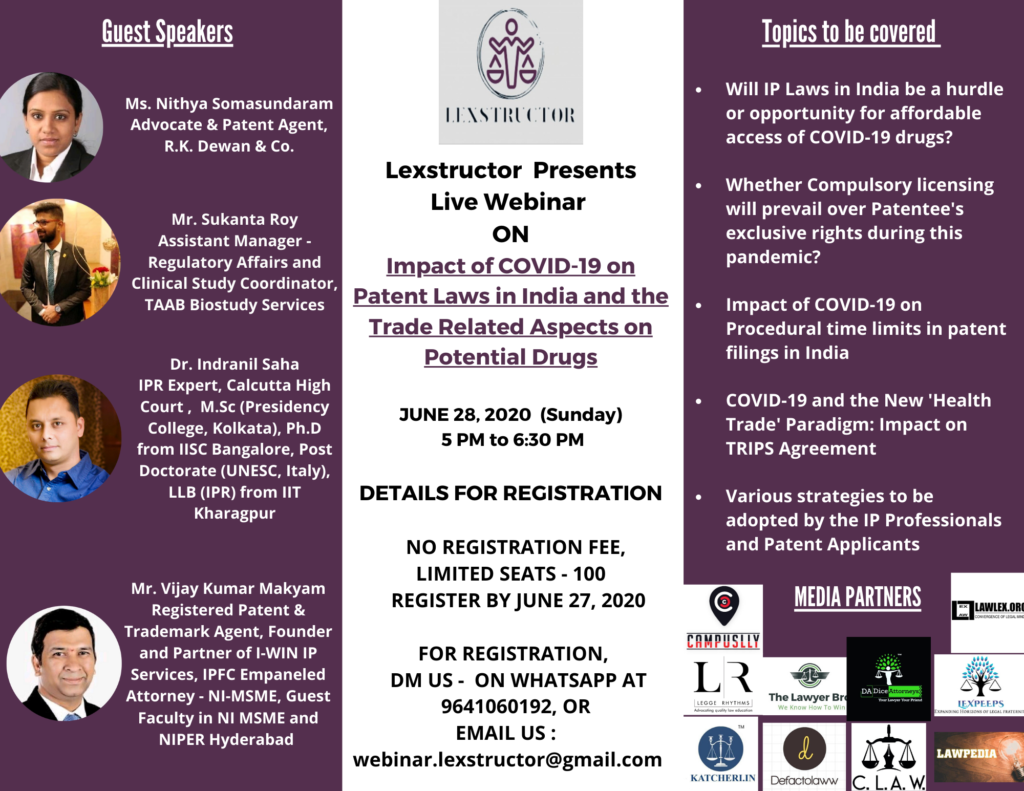
NAME OF THE EVENT

Webinar

NAME OF THE ORGANISER

Lexstructor

REGISTRATION

FREE

Limited seats-100

Register by June 27,2020

DATE AND TIME

June 28th 2020 (Sunday) at (5 pm to 6:30 pm).

 
THEME

“Impact of COVID-19 on Patent Laws in India and the Trade-Related Aspects on Potential Drugs”


The topics to be covered:
1. Will Intellectual Property Laws in India be a hurdle or opportunity for the affordable access of the COVID-19 Potential Drugs in India?
2. Will the provision for Compulsory Licensing prevail over the exclusive rights of the Patent Owner, during the ongoing pandemic?
3. Impact of COVID-19 on procedural time limits in patent filings in India
4. COVID-19 and the New ‘Health Trade’ Paradigm: Impact on TRIPS Agreement 
5. Various strategies to be adopted by the IP Professionals and Patent Applicants

IMPORTANT DETAILS

For Registration Dm on Whatsapp at 964160192 or Email : webinar.lexstructor @gmail.com

This article is written by Mohit Bhardwaj. A 2nd year Law student, currently pursuing BBA-LL.B(Hons.) from Unitedworld School of Law, Karnavati University. In this article, the author discusses the offence of Mischief as mentioned under IPC. To substantiate the concept, reference is made to all the Sections covered by the topic, with relevant illustrations and case laws

INTRODUCTION

According to section 425 of IPC Mischief- Whoever with intent to cause, or knowing that he is likely to cause, wrongful loss or damage to the general public or to a person, causes the destruction of any property, or any such change in any property or within the situation thereof as destroys or diminishes its value or utility, or affects it injuriously, commits “mischief”  

Explanation 1.—It isn’t essential to the offence of mischief that the offender shall intend to cause loss or damage to the owner of the property injured or destroyed. It is sufficient if he intends to cause, or knows that he is likely to cause, wrongful loss or damage to any person by injuring any property, whether it belongs to that person or not. 

Explanation 2.—Mischief could also be committed by an act affecting property belonging to the one that commits the act, or to that person and others jointly.

ILLUSTRATIONS

(a) B voluntarily burns a valuable security belonging to C in­tending to cause wrongful loss to C. B has committed mischief.

(b) B introduces water into an ice-house belonging to C and thus causes the ice to melt, intending wrongful loss to C. B has committed mischief.

(c) B has committed mischief if B voluntarily throws into a river a ring that belongs to C, with the intention of thereby causing wrongful loss to C. 

(d) B has committed mischief if B, knowing that his effects are about to be taken in execution in order to satisfy a debt due from him to C, destroys those effects, with the intention of thereby preventing C from obtaining satisfaction of the debt, and of thus causing damage to C. 

(e) B has committed mischief if B, having insured a ship, voluntarily causes the same to be destroyed, with the intention of causing damage to the under-writers.

(f) B has committed mischief if B causes a ship to be cast away, intending thereby to cause damage to C who has lent money on bottomry on the ship.

(g) B has committed mischief if B, having joint property with C which is a horse and B shoots the horse, intending thereby to cause wrongful loss to C.

(h) B has committed mischief if B causes his/her cattle to enter upon a field belonging to C, intending to cause and knowing that he is likely to cause damage to C’s crop.

Scope of Mischief 

Mischief under Section 425 of IPC covers all those acts that cause any damage or destruction to the property resulting in any wrongful loss or damage. The scope of this section is wide and it applies in the case of both public as well as private damages.

However, the most important point is that it will not have any application in the cases where the element of intention is absent which is further elaborated in this article under the heading of Ingredients of mischief. It is also not essential that the person accused had some valid motive behind or must have been benefited from the act of “mischief”. 

But some other significant questions of consideration are whether this act can be applied in the cases when the accused has damaged his/her own property? Or will it cover situations when the damage caused to the property is a consequence of an illegal act or default in payment?

When accused is the owner of the damaged property 

In the case of Indian Oil Corporation v. NEPC India Ltd. and Ors., the Court held that ownership or possession of the property is not a deciding factor in the matter of the application of section 425 of IPC. Thus, mischief is said to be committed even in cases when the accused is the owner of the property provided all the other essential ingredients mentioned are satisfied.

This is further evident from the illustrations (d) and (e) to Section 425. According to the facts of the above case, the petitioner alleged that the respondent removed the engines of the aircraft diminishing their value and utility. Since the appellants had the right to possess the aircraft it resulted in wrongful loss or injury Hence the Supreme held that the allegations amounted to the offence of mischief as all the essential ingredients of mischief had been satisfied.

Default of Payment or Illegal Act 

In case of disconnection of water supply, sewerage supply, electricity supply, telephone connection, etc., by the concerned departments resulting from the default in payment or an illegal act after following a due process will not come under the ambit of “Mischief”.

Ingredients of Mischief

Essentially there are three key elements to establish Mischief as per the definition laid down in section 425 of IPC which are as follows:

Intention or the knowledge of the act (mens rea);

The act resulting in destruction, damage or change in the property or situation thereof; and (actus rea)

The change must lead to diminishing the value or utility.

Intention or the knowledge of the act may result in wrongful loss or damage (mens rea)

One of the most essential elements of all offences under IPC is that any crime is composed of two parts- Mens Rea & Actus rea. Similarly, “Mens rea” is required to be present in order to establish the offence of Mischief.

The definition of the law of mischief makes it very clear that the only way to prove the act of mischief does not essentially mean that it has to be proved that the accused essentially had any deliberate intention to cause unjustified damage to the property. But rather what can also serve as sufficient proof is the fact that the individual had the knowledge that such action of his/her can result in damage or degradation of the property, causing wrongful loss or damage. 

This can also be understood with a real-life example that if some children while playing street cricket break-up a glass window, it will not amount to mischief but will rather constitute negligence. But if those children deliberately throw the ball to aim at the window resulting in breaking up the glass and causing loss to the owner, then it will amount to mischief.

Similar was the judgement pronounced in the case of Nagendranath Roy v. Dr. Bijoy Kumar Dasburma where the court observed that mere negligence does not constitute mischief. However in certain situations when facts indicate that intention to cause wrongful loss was present along with the negligence causing damage will amount to mischief. 

In the case of Krishna Gopal Singh And Ors. v. the State Of U.P., it was stipulated that if the accused has committed an act without any intent or knowledge that the act in question is likely to cause wrongful loss or damage to any person or the public at large, it will not fall under the ambit of mischief as the element of “Mens rea” is absent. Similarly, if an act is committed without free consent i.e.under some pressure or duress it will also not amount to mischief.

In Arjun Singh v. The State (AIR 1958 Raj 347) it has been observed by this Court:”In order to establish the offence of mischief, it is essential for the prosecution to establish that the accused must have an intention or knowledge of likelihood to cause wrongful loss or damage to the public or any person.”

Punishment for Mischief

The punishment for Mischief is prescribed under Section 426 which states that it attracts imprisonment of a term which may extend up to three months, or with fine, or with both, as the court may deem fit.

Nature of offence: The offence under this Section is non-cognizable, bailable, compoundable, and triable by any Magistrate.

Aggravated forms of Mischief

Though the punishment for the offence of mischief has been laid down as imprisonment until 3 months, or fine, or both in Section 426 of the Indian Penal Code. However, the IPC recognizes and lists down certain aggravated forms of mischief which have been described under Sections 427 to Section 440, IPC.

CONCLUSION

As society advances, new situations also emerge, and new issues are encountered. Similarly, though the offence of Mischief appears to be very exhaustive and inclusive taking up the whole fifteen sections of IPC. It tries to cover all the possible forms of mischief laying down different punishments for each depending on the gravity of the offence.

But despite this, it still fails to lay down proper punishment for many other kinds of mischief that are very common. Further, it does not lay down various situations that may also fall under the ambit of mischief hence leaving this solely to the discretion of Judges to identify and classify it as an act of mischief and to declare the punishment for the same. Due to this, there have been cases, where different levels of punishment can be witnessed in offences having similar nature & gravity.

Thus it is imperative to identify and implement appropriate punishment for the offence of mischief so that the offender can get due punishment and further, more deterrence can be ensured.

Latest Posts


Archives

https://indiankanoon.org/doc/1517318/

This article has been written by Aaditya Kapoor, a law-aspiring student of Vivekananda Institute of Professional Studies. Through his research, Aaditya strived to shed light upon provisions and necessity of Motor Vehicles Act, 1988.

INTRODUCTION

The Motor Vehicles Act was passed by the Indian Parliament in 1988. The Act regulates nearly all aspects of road vehicles, along with providing detailed provisions on driver and driver licensing, motor vehicle registration, permit control provision, traffic regulation, associated insurance, liabilities, and penalties. This act focuses mainly on vulnerable pedestrians on the road who might be harmed by these motor vehicle drivers. The motor vehicle act provides a liability clause for those vulnerable individuals. They are referred to as “Third Party” and the motor vehicle act is about ensuring protection for such third-party persons.

The motor vehicle act makes it mandatory for a driver to hold a valid driving license and no motor vehicle can be driven without the motor vehicle act being licensed. This registration card is valid for the next fifteen years from the date of registration, which can be extended for the next five years.

Offences and their punishment as prescribed under the Motor Vehicles Act

• Under section 3 r/w 181 of the Motor Vehicles Act, a driver without a valid license is liable to pay a fine of INR 500/- and he or she can also face imprisonment of about three months.

• Under section 5 r/w 180 of the Motor Vehicles Act, if a person not having a valid license is found driving, the person authorizing such act shall be fined with a penalty of INR 1000/- with or without three months ‘ imprisonment.

• According to section 130(3) r/w 177 of the Motor Vehicles Act, a person not carrying all the required documents shall be liable to pay an INR 100/- penalty.

• According to section 130 r/w 177 of the Motor Vehicles Act, a person is liable to pay a fine of INR 1000/- if found driving without valid insurance with or without three-month imprisonment.

• According to section 130 r/w 177 of the Motor Vehicles Act, an individual shall be liable to pay a fine of  INR 5000/- if he/she is found without a valid license.

• According to section 39, r/w 192 of the Act, a person not having valid R.C. shall be liable to pay an INR 2000/- fine for his or her car.

• According to section 4 r/w 181 of Motor Vehicles Act, the owner of the vehicle is liable to pay a penalty of INR 500/- for driving of the vehicle by a minor.

• A penalty of INR 1000/- shall be levied According to section 5 r/w 180 Motor Vehicles Act to a person that allows an unauthorized person to drive.

• A person driving without a helmet shall be liable to pay a penalty of INR 100/- According to section 129 r / w 177 Motor Vehicles Act.

• Pursuant to section 138(3) CMVR 177 Motor Vehicles Act, a person driving without fastening his seat belt is liable to pay INR 100/- fine.

• According to section 184 of the Motor Vehicles Act, an individual found to be doing reckless driving shall be liable to pay INR 1000/- fine.

• According to section 112-183 of the Motor Vehicles Act, a rushed or dangerous driver is liable to pay a fine of INR 1000/- with or without imprisonment depending upon the extent of the violation.

• According to section 17(i) RRR 177 of Motor Vehicles Act, a driver shall be liable to pay a fine amounting to INR 100/- if found driving against the one way in one direction. 

Changes to the Motor Vehicles Act, 1988

The 2019 Motor Vehicles (Amendment) Bill is based on State Transport Ministers Committee recommendations. Since the Act wanted to deter individuals from breaking traffic rules, it introduced heavy fines for drunken driving, license-free driving, hazardous driving, over-speeding, etc. As notified by the central government, these penalties will increase by 10 per cent on April 1 each year. The new Act also extended the renewal period from one month to one year after the expiry date for driving licenses. In case the extension is expired by longer than a year, the applicant would be forced to take a skill test. The Act also promises to protect from any civil or criminal liability those persons who render medical or non-medical emergency assistance to a victim of an accident. The limited death or grievous damage insurance due to hit and fall was significantly pushed up.

According to data from the Ministry of Road Transport and Highways, 4.64 lakh accidents occurred in 2017 which claimed the lives of 1.47 lakh people. More than a third of all road accidents involved two-wheelers. Little by little, as all States begin to implement the provisions of the Act with heavier fines and imprisonment for drunken driving, driving without a license and insurance and juvenile offences, people can begin to follow rules and road accidents can actually reduce. It is necessary to have legitimate auto insurance so that the aggrieved parties get coverage in a road accident.

However, State governments are free to make their own laws and regulations, provided that it is just a model statute. Success depends on how well they are following the act’s provisions.

Necessity of Motor Vehicles Act

Not following the rules of traffic and road safety as provided for in the Act can lead to severe monetary compensation. The fine has increased to ₹1,000 for not wearing a helmet, and the liability can also be subject to a three-month license disqualification. The fine is currently around ₹1,000 for not wearing a seatbelt. The penalty has risen from ₹ 500 to ₹5,000 for pace or speeding and from ₹2,000 to ₹10,000 for drunken driving. The new Act also requires incarceration for serious offences, in addition to greater fines. Speed racing can attract three months in prison (with or without a fine); if caught for the second time, this will extend to a period of one year. For minor-related crimes, the vehicle’s parent or owner shall be judged guilty and disciplined with an estimated 25,000-fine and three-year jail sentence. The juvenile would be tried under the Juvenile Justice Act, 2000 and motor vehicle registration will be cancelled for a 12 month period. The owner of a motor vehicle who changes it by retrofitting sections of a motor vehicle in a way not allowed by the Act shall be disciplined with incarceration for a period of up to six months (and/or a fine of up to ₹5,000 for such alteration).

Latest Posts


Archives