ABOUT THE ORGANISER

Center for legal studies has been set up by Gitarattan International Business School in the year 2016 for imparting legal education. CLS-GIBS has been emerging as one of the prominent law schools of the country providing 5 years integrated programmes in BA LLB and BBA LLB.

Gitarattan International Business School (GIBS) was established in the year 2004. GIBS is affiliated to Guru Gobind Singh Indraprastha University, Delhi and is approved by All India Council for Technical Education (AICTE), Ministry of HRD, Government of India for technical programmes and Bar Council of India for Law programmes.

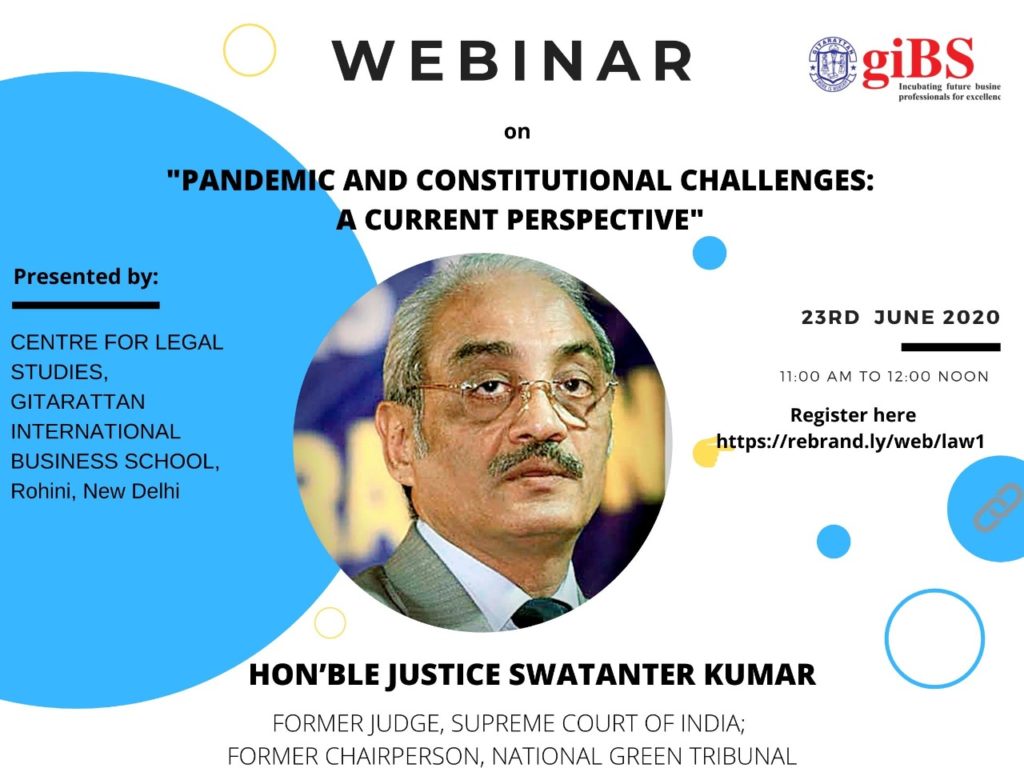
TOPIC OF THE EVENT

PANDEMIC AND CONSTITUTIONAL CHALLENGES: A CURRENT PERSPECTIVE

DATE OF THE EVENT

23 rd June 2020

TIME OF THE EVENT

11:00-12:00 Noon

SPEAKER

Hon’ble justice Swatenter Kumar (FORMER JUDGE SUPREME COURT OF INDIA)

REGISTRATION LINK

https://event.webinarjam.com/register/9/10zr3tl


Hey, this is Pranit Bhagat pursuing III BA LLB from ILS Law College, Pune. In this article, we shall discuss the various dimensions regarding the rights of women and personal laws in India.

INTRODUCTION

The concept of equality, however, requires equity. The history of social development is also a history of inequality. Inequality between nations, religions, ethnicity, class, caste, race, and sexuality. However, the question of women’s rights looms large, cutting through all the layers of social stratification. The feminist struggle for equal rights has been paved through legislation, be it the Suffragette movement and the right to vote, to employment rights, property rights, rights governing divorce and marriage to child-care and medicine – legislation based on equal rights affects the very values of society, impacting not just the way we vote, but the way we work, live and function as a family, the way we access education, healthcare, and justice. In India, the constitutionally guaranteed equality for women is often contradictory to the harsh social reality of the land and its cultural norms. The struggle for women’s equality began in India in the 20th century, during the struggle for Independence. In the fight against the British, western-educated leaders like B.R.Ambedkar, Mahatma Gandhi, Raja Ram Mohan Roy, and Savitribai Phule encouraged women to step away from their homes and hearths and enter the public sphere in the fight for Independence. Indian values, nationalism, and cultural heritage were glorified through the symbolism of ‘Mother India’. Perhaps for the first time in India, the idea that a woman is part of the larger Indian tapestry as a legal citizen took root. The inclusion of the female citizen into the public sphere necessitated citizenship rights and changes in the law such as the right to education, inheritance rights, the abolition of sati and polygamy as well as the allowance for the widow- remarriage. While a struggle for nationalism changed the legal landscape of women’s rights through the colonial era, the post-colonial era in India has been marked by sweeping changes such as globalization, neo-liberal policies, and the leaps and bounds in technological development. This has expanded women’s participation in the public sphere. More Indian women are engaged in business enterprises, international platforms, multi-national careers like advertising and fashion, and have better opportunities than ever because of the free movement of goods, capital, and ideas. Ideas that question the very nature of laws. Has our legal system kept up with social change? Does our constitution have provisions for equality or equity? Do rights guarantee justice? Is citizenship gendered? The following article gives a brief overview of the current spate of women-centric legal reform in India and concludes with a discussion on its socio-cultural impact on the very fabric of Indian citizenship.

Judicial Protection for Women’s Rights

The nation-wide outrage over the brutal gang rape and subsequent death of Jyoti Singh in New Delhi was the driving force behind the promulgation of the Criminal Law (Amendment) Act, 2013 (“Criminal Law Amendment Act“). The Criminal Law Amendment Act, 2013 that came into force on February 3, 2013, amended as well as inserted new sections in the Indian Penal Code concerning sexual offences. Some of the new offences recognized by the Criminal Law Amendment Act are acid attacks, voyeurism, stalking, intentional disrobing of women, and sexual harassment. In 2013, India adopted its first legislation specifically addressing the issue of workplace sexual harassment; the Sexual Harassment of Women at Workplace (Prevention, Prohibition and Redressal) Act, 2013 (“POSH Act“) enacted by the Ministry of Women and Child Development, India. Workplace sexual harassment is a form of gender discrimination that violates a woman’s fundamental right to equality and right to life, guaranteed under Articles 14, 15, and 21 of the Constitution of India. The POSH Act had been enacted to prevent and protect women against workplace sexual harassment (which includes the creation of a hostile work environment) and to address complaints of sexual harassment.

Maternity Benefit (Amendment) Act, 2017 (“Maternity Amendment”)

2017 witnessed the bold amendment to the Maternity Benefit Act, 1961 (“Maternity Act“). The Maternity Amendment extends paid maternity leave for women employees with less than two surviving children, from the original twelve (12) weeks to twenty-six (26) weeks. A maximum of eight (8) weeks can be taken before the expected delivery date and the remaining after childbirth. Women expecting their third child were also provided with the right to take twelve(12) weeks of paid maternity leave—six (6) weeks before childbirth and six after. The Maternity Amendment provided for mothers adopting a child below three months of age, or “commissioning mothers” to take twelve (12) weeks of maternity leave from the date of receiving the child. The Maternity Amendment enables mothers to work from home after completing twenty-six (26) weeks of leave subject to their work profiles and the employer’s consent. The Maternity Amendment also mandates establishments employing 50 or more employees to have a creche which is required to have prescribed facilities and amenities. Women employees have a right to visit the crèche four times a day, including during their rest interval.

Decriminalizing of Adultery

On September 27, 2018, a five-judge bench of the Supreme Court of India (“Supreme Court“) struck down another colonial-era law, Section 497 of the Indian Penal Code that prescribed maximum imprisonment of five years to men for adultery.

Unlike India’s sexual assault laws, which are linked with the consent of the woman, the 158-year-old adultery law did not consider the woman’s will. A husband can prosecute the man who had sexual relations with his wife, even if the wife was a voluntary participant in the act. Though, the women can’t be punished under this provision.

A petition to strike down this law was argued in the Supreme Court. It said that the law discriminated against men by only holding them liable for extra-marital relationships while treating women like objects. All five Supreme Court judges after hearing their case said that the law was archaic, arbitrary, and unconstitutional. However, The Court clarified that adultery will be a ground for divorce.

Dipak Misra, the then Chief Justice of India said that it’s time to say that (a) husband is not the master of (his) wife. Women should be treated equally along with men. Justice R F Nariman wrote a separate judgment to concur with the judgments of Chief Justice Dipak Misra and Justice Khanwilkar, stating that Section 497 was an archaic provision that had lost its rationale. Justice Nariman observed that Ancient notion of man being the perpetrator and woman being a victim of adultery no longer holds good.

Justice Chandrachud in his separate but concurring opinion said that Section 497 was destructive to woman’s dignity and also emphasized that “Respect for sexual autonomy must be emphasized”.”Section 497 perpetrates subordinate nature of woman in a marriage”, were his concluding remarks. Justice Indu Malhotra noted in her judgment that Section institutionalized discrimination.

This was the second colonial-era law struck down by the Supreme Court after it struck down the 157-year-old law which criminalized gay sex in India.

Triple Talaq 

Triple Talaq” or Instant Talaq or “Talaq-e-Biddat” are the different forms of Islamic practices which allow men to divorce their wives immediately by just saying the word “talaq” (divorce) three times before their wives. The Supreme Court, once again in its recent landmark judgment of Sayarabano Vs. Union of India pronounced on August 22, 2017, set aside the practice of “Triple Talaq”. The bench declared Triple Talaq as unconstitutional by a 3:2 majority. The Judgment by the minority bench also further directed the Government of Union of India to lay proper legislation in order to regularize the proceedings of divorce as per Shariat law. Taking into consideration the views of the Supreme Court, the Muslim Women (Protection of Rights on Marriage) Bill, 2018 (“Triple Talaq Bill“) was introduced in Lok Sabha by the Minister of Law and Justice, in December 2018. Better known as the Triple Talaq Bill, the bill makes all declaration of talaq, including in written or electronic form, to be void (i.e. not enforceable in law) and illegal. The Triple Talaq Bill made a declaration of talaq being a cognizable offence, attracting up to three years’ imprisonment and a fine. 

The offence will be considered as a cognizable offence only if information relating to the said offence is given by 

  1. the married woman (against whom talaq has been declared), or 
  2. Any person related to her by blood or marriage.

The Triple Talaq Bill is pending the nod of the Rajya Sabha. In the interim period, an ordinance penalizing the act of triple talaq has been promulgated. The ordinance making the practice of instant triple talaq, a penal offence has been issued for a third time in February 2019.

Sabrimala Issue

The Supreme Court on September 28, 2019, delivered one of the most keenly awaited judgments in the Sabarimala case. The Supreme Court permitted entry of women of all age groups to the Sabarimala temple by a 4:1 majority stating that ‘devotion cannot be subjected to gender discrimination’. The lone woman on the bench, Justice Indu Malhotra, dissented. Then Chief Justice Dipak Misra, Justice R F Nariman, Justice AM Khanwilkar and Justice DY Chandrachud constituted the majority. “Woman is not lesser or inferior to man. Patriarchy of religion cannot be permitted to trump faith. Biological or physiological reasons cannot be accepted in freedom for the faith”, said Chief Justice Dipak Misra while reading portions of the judgment written out for himself and Justice AM Khanwilkar. This stigmatizes and stereotypes women, he analyzed. Justice R F Nariman held that the customs and usages of Sabarimala temple must yield to the fundamental right of women to worship in the temple.

Women’s Reservation Bill 

Women’s Reservation Bill or the Constitution (108th Amendment) Bill proposes to amend the Constitution of India to reserve 33 per cent of all seats in the Lower House Lok Sabha, and in all state legislative assemblies for women. The seats to be reserved in the rotation will be determined by a draw of lots in such a way that a seat shall be reserved only once in three consecutive general elections. The Upper House, Rajya Sabha passed the bill on March 9, 2010. As of today, the Lok Sabha has not yet voted on the bill and the bill still remains in limbo. If Lok Sabha were to approve the bill, it would have to be passed by half of India’s state legislatures and signed by the President.

CONCLUSION

Subsequent to the year 2013 that witnessed the promulgation of the Criminal Law Amendment Act and the POSH Act, there have been several other changes in the law that have been for the welfare, security, and benefit of women as well as with the aim to eliminate gender-based discrimination, one of the fundamentals of the Constitution of India. As we have seen the Supreme Court, has taken several initiatives and in some cases issued directions to the Government as well, but it is the practical implementation of these laws that is required to ensure equality of women.There are a great many difficulties that many Indian women face, which include poverty, female feticide, sexual harassment, lack of education, job skill training. India still ranks 108th among 149 countries in the World Economic Forum’s (WEF) Global Gender Gap Index, 2018. A lot needs to be done to ensure that Indian women have equal rights and we see an India defined by inclusive citizenship rather than exclusive.

This article is written by Ishika Gupta pursuing BBA L.LB from Gitarattan International Business School. This article aims to highlight the basic difference between criminal misappropriation and criminal breach of trust.

INTRODUCTION

The English word ‘embezzlement’ means ‘theft or misappropriation of funds placed in one’s trust or belonging to one’s employer’. The same act has been recognised as an offence under The Indian Penal Code,1860. As per section 405 when a person is entrusted with property or has dominion over it and he dishonestly misappropriates it or converts it for his own use in violation of any direction in which the trust is to be discharged he is liable for criminal breach of trust.

To constitute the offence under section 405 it is necessary that the property must have been entrusted with the accused or the accused must have dominion over the property, without this essential the offence can’t be covered under section 405 as said in Chelloor Mankkal Narayan vs State Of Travancore-Cochin (AIR 1953 SC 478). It must be proved that the person other than the accused had a beneficial interest in the property and the accused represents the property on his behalf. The person who owns the property is the transferor and who holds that property is called transferee. There is an implied relationship between both. The transferor is the legal owner of the property whereas the transferee has the custody for benefit of the transferor only.

For instance, X owns a travel agency and has several drivers under him. He has handed over each driver a car for the business purpose but one of them uses that car as his private taxi also. This way the driver has committed criminal breach of trust. Both requirements are fulfilled i.e. the car was entrusted to him and secondly, he converted it for his own use.

The punishment for criminal breach of trust has been prescribed under section 406. Section 407 talks about the criminal breach of trust by carrier, warehouse-keeper, Section 408 about the criminal breach of trust by clerk or servant, Section 409 about the criminal breach of trust by a public servant, banker etc.

Furthermore, in 1973 an explanation was added to section 405, later in 1975 one more explanation was added to this section. The offence under this section is non-cognizable, bailable, and triable by a magistrate. 

Essential Ingredients

(i) The property must be entrusted with the accused or the accused must have dominion over it.

(ii) The accused must have either dishonestly misappropriated or converted to his own use or dispose of that property or wilfully suffer any other person to do so by violation any legal prescription made by the contract regarding the discharge of the trust or by the violation of any law.

Hence, two main principles are entrustment and dishonest misappropriation. However dishonest misappropriation or conversion to own use is covered under Section 403 also in the form of criminal misappropriation.  

Entrustment

The word entrustment has not been specifically defined under Indian Penal Code, 1860. But in general, the meaning of entrustment is to give to another for care, protection or to commit something trustfully or play trust upon a person i.e. to hand over the property to some other person. Such transfer of property does not result in alienation of ownership or any proprietary other. This is one of the most important parts to constitute an offence of criminal breach of trust. The scope of entrustment under this article is very wide. It covers all kinds of entrustment whether it is to a clerk, banker, wharfinger etc. 

Also, the entrustment can be of any property be it movable or immovable. The Supreme Court in R.K. Dalmia v Delhi Administration said that the word property under Section 405 is not only limited to movable property. It is the court that will decide that the concerned property can be covered under the acts mentioned in the section.

Case Laws

The court has also said in Jairani Devi v Krishna Kumar Jauhari ((1985) Cr LJ 64 (All)) that, mere payment of money by X to Y would not amount to entrustment unless there are desired circumstances. In the case of loan even if the companies are mentioning it as trust it would not amount to criminal breach of trust.

For entrustment to be accounted the accused must be handed over with the property on the behalf of another person and also in this manner he should be a trustee of that property as held in Gul Bahan v W.E. Farquhar (AIR 1950 Cal 35). In simple words, there must be a fiduciary relationship between the two. Such an act should not be accidental but intentional.

The term entrustment comes along with the words ‘dominion over the property’. The word dominion in its general sense means having a position of control over something. In a company a direction is in the position of trustee and hence has the dominion over the company’s assets as mentioned in Shivnatrayan vs State of Maharashtra (AIR 1980 SC 439).

In State of Gujarat vs Jaswantlal Nathalal (AIR 1968 SC 700) the government provided cement to a person to use it for construction however, some part was given to a warehouse. But the court held that there was no fiduciary relationship and hence no entrustment. Mere sale cannot be covered under this section. 

Stridhan is under the ownership of a wife and when she entrusts it to her husband or any other family member and he dishonestly misappropriates he has committed criminal breach of the trust said the court in Rashmi Kumar vs Mahesh Kumar Bhada ((1997) 2 SCC 397).

As per explanation (i) and (ii) when an employer deducts money from the wage of an employee that is to be paid as a provident fund but he fails to pay it the same would amount to criminal breach of trust.

Dishonest Misappropriation

As per section 24 dishonesty is defined as wrongful gain or loss incurred to a person. To constitute the offence not only it has to be proved that property has been misused but also it has to be proved that there was a dishonest intention behind the act. Without proving mala fide intention i.e. mens rea the act cannot be constituted as criminal breach of trust. 

Section 403 and Section 404 talk about dishonest misappropriation and its punishment. However, under these sections, only the movable properties are covered unlike Section 405. When the accused uses the property for his own use or misappropriates with mala fide intention it is called criminal misappropriation.

In Surendra Prasad Verma vs State of Bihar (AIR 1973 SC 488) the accused was the sole person who had the access to keys of the safe and without his permission no one could open the safe. It was held that even a temporary misappropriation is covered under Section 403.

As per explanation (ii) of section 403 says that a finder of goods has kept the goods for a reasonable time period to return it its owner but has not found him, the finder may use them for his own use but if he instantly uses them it will amount to dishonest misappropriation.

In P. Dumgappa v State of Mysore (AIR 1956 Mys 40) the meaning of ‘ appropriate’ was stated as setting apart or assigning the property to oneself or to another by the exclusion of the owner.

CONCLUSION

Hence the crux of the above matter is that there is a basic difference between Section 403 and 405 i.e. between criminal misappropriation and criminal breach of trust. In criminal misappropriation, the property is movable however no such thing is mentioned in the case of criminal breach of trust. 

Another difference is that in criminal breach of trust the accused is entrusted with the property already but not in criminal misappropriation. Under Section 405 there must be a fiduciary relationship between the people.

Latest Posts


Archives


This article is written by Samridhi Sachdeva pursuing BBA LLB from Gitarattan International Business School, GGSIPU. In this article, the author tries to define the judicial and quasi-judicial acts for the readers to understand better and also the distinction between both has been explained.

INTRODUCTION

There are three organs of the government that perform various functions individually. The legislative organ creates or makes changes in the law; the executive ensures that the laws passed by the legislative are enforced accordingly and the function of the judiciary is to make sure that the laws executed are implemented correctly in every situation.

But not always it may happen that the judicial functions are taken by the judiciary body only, the executive or the administrative authority can also play the judicial role. In some situations, these bodies can acquire the ‘quasi-judicial authority’. 

A judicial act is something that bounds the judiciary of any system to take decision with the proper proceedings of the court. And the quasi-judicial acts don’t bound any body but give decisions without the proceedings of the court.

Judicial Acts

The acts that are done by a particular competent authority, by looking upon the facts and the circumstances of the situation are judicial acts. They are done in the manner of court proceedings and impose the liabilities on the guilty and try to save the rights of the other person. They follow a strict procedure to go on. The acts that are done by a particular competent authority, by looking upon the facts and the circumstances of the situation are judicial acts. They are done in the manner of court proceedings and impose the liabilities on the guilty and try to save the rights of the other person. They follow a strict procedure to go on. These acts are done by the judges of the court when they give decisions on any case using the particular laws or the judges may even create laws while passing judgements. The judges are bound by the law to give decisions by following the complete court procedure. 

There is no liability of the judge in trespass for the want of jurisdiction, the burden of proof of the facts lies completely on the plaintiff in every case. And also, no disputes should be filed against any judge, who acts judicially and in good faith. The decisions taken by the judge in every case, when the judge is acting judicially gives no person the right to fight against the decision taken by that judge in a particular case.

This rule of immunity in the judicial acts is also applied to the members of naval and military courts-martial or courts of inquiry constituted in compliance with the military law and usage and not only to the judges of the ordinary civil courts. Also, to a limited extent, it applies to the arbitrators as well and the persons who are appointed in a position like that of the arbitrator. The person, if acting honestly, is not liable for any faults in the decision. He will be liable if any corrupt or partisan exercises are being done in his office. But he can not be made personally liable if he works in utter use of judicial discretion and he can not be questioned upon the correctness and competence of his decision.

Quasi-Judicial Acts

The word ‘quasi’ holds a Latin origin and means ‘similar to but not exactly’. The quasi-judicial acts are not exactly court proceedings. They may seem to derive the powers and functions of some laws, but they are still not considered as courts. They don’t usually follow any procedure of the court. These acts are done by the persons who are not judge of any court or do not hold a judiciary power under certain laws. The institutions may hire a manager or chief who may act as a judge and pass decisions regarding the working of that institution.

These acts are performed by the person who is not a judge and applied to the action and discretion of the public administrative officers and bodies, who are in charge or duty-bound to investigate facts or prove the existence of facts, hold hearings, weigh the evidence and provide the results and decisions accordingly to exercise their power of judicial nature.

The powers of universities over their officers and graduates and the powers of the colleges of the universities over their students are an example of the quasi-judicial acts. The finance commission also holds a quasi-judicial authority. The General Council of Medical Education has power over the registered medical practitioners. These acts depend on the institution of foundation, provisions of which are binding on persons who are benefitted through them. The partners of a company together hold a quasi-judicial authority when they act upon the recruitment or firing of any partner or taking decisions to build or enhance the functions and working of that company. 

The basic rule of the acts to be quasi-judicial is that the persons who exercise them are protected from civil liability, if they observe the rules of natural justice and also the particular statutory rules which may prescribe their course of action.

Difference between Judicial and Quasi-Judicial Acts 

The judicial and quasi-judicial acts differ from each other as the judicial acts require a proper proceeding of the court and the judge is duty-bound whereas the quasi-judicial acts don’t require the courts and decisions taken under them are by the person, who is not a judge.

The judicial acts are bound by the common law precedents to give decisions whereas the quasi-judicial acts are not usually bound.

In absence of any common law precedent, judicial acts may invent new laws but the quasi-judicial is based on the decisions of the existing laws.

Conclusion

So, the above article has clearly mentioned that the judicial acts are the one that involves a proper court proceeding with a proper judiciary system whereas the quasi-judicial acts are those where the court proceedings are not necessary but they have to be used when the authorities of the institution have landed into a great dispute and the person who takes decisions in the quasi-judicial acts is not a judge of the court. The quasi-judicial acts can be performed by the executive or administrative body of any institution. 

Latest Posts


Archives


This article is written by Darshika Lodha, a BBA.LLB(Hons.) student of Unitedworld School of Law, Karnavati University. This article deals with various different definitions of law given by various scholars and the functions of law.

INTRODUCTION

The term “Law” refers to various forms of rules and principles. The law is an instrument that controls human actions and behaviour. Law is justice, Morality, Reason, Order, and Righteous from society. Law includes the Laws, the Acts, the Rules, the Regulations, the Orders, and the Ordinances of the legislature. Law means the rules of law, the decrees, the judgment, Rules of the courts, and decisions from the judges. Law is, therefore, a broader term, which includes the Acts, the Statutes, the Rules of Procedure, Rules, Orders, Orders, Justice, Morality, Reason, Righteous, Rules of Procedure Court, Decrees, Judgment, Orders of Courts, Injunctions, Tort, Jurisprudence, Legal Theory, etc.

Definitions of Law

The definition of the term law is very difficult. Many lawyers tried to identify the terms of fact. Some of the definitions given by jurists for clarity in different periods, they are categorized as follows.

Therefore, many scholars have different definitions of law as follows:

  1. SALMOND: According to Salmond, “the law can be described as the body of principles recognized and applied by the State in the management of justice. 
  2. JOHN CHIPMAN GRAY’S: According to Gray, the “Law of the State or any organized human body is composed of rules governed by the courts, that is the body’s judicial organ sets out the legal rights and responsibilities to be established.
  3. JOHN AUSTIN: John Austin (1790-1859) An English jurist put forward the concept of analytical positivism, making law a sovereign command backed by punishment. Logically he developed a legal system structure in which he gave no place to values, morality, idealism, and justice.

In the strict sense, according to Austin, a rule is the general order of the sovereign person, or sovereign body. Issued in subjectivity to and enforced by the state’s physical strength. According to Austin, “law is an aggregate of rules that are set as a political subject by men who are politically superior or sovereign to men.” Austin says, “A law is a command that obliges a person or persons to behave.

  1. THOMAS ERSKINE HOLLAND: Thomas Erskine Holland, a reputed jurist who followed the concept of the Austin and the nature of the law attempted to define law as law is a general rule of external human action enforced by a sovereign political. Holland also measures or defines law preferably without moral, ethical, or ideal elements which are foreign to law and jurisprudence.
  2. JOHN ERSKINE: Law is the rule of the sovereign, which contains a common rule of life for his subjects, and oblige them to obey.
  3. HANS KELSEN: According to Kelsen, the legal order is the hierarchy of norms, of all norms, derive its validity from the higher norm, and finally there is the highest norm known as the basic norm.
  4. H.L.A HART: According to the Hart Law, there is a combination of primary obligations rules and secondary rules for recognition.
  5. SAVIGNY: Savigny says that the law is not a direct product. Legislation is due, however, to the silent growth of customs or the outcome of unformulated public opinion or professional opinion. It says that the law, not as a body of rules established by a given authority, but as rules, consists partly of a social habitat and part of the experience. He says that the law is found in society, that it is found in custom.
  6. IHERING: Ihering defines the law as ‘the form of the guarantee of the conditions of life’ society, assured by the constraining power of the state. He says that law is a means to an end, and that the end of the law is to serve its social purpose, which is not individual.

However, some more scholars and jurists who define law according to their knowledge.

FUNCTIONS OF LAW

1. SOCIAL CONTROL

The members of society can have various social beliefs, attitudes, and desires. It is necessary to regulate these behaviours and to instil socially acceptable social norms among the members of society. There are informal and formal social controls in place. Law is one of the types of structured social regulation. As for Roscoe Pound, the law is a highly specialized form of social control in a politically organized society. Lawrence M. Freedman discusses the two ways in which the law plays a significant role in social control: First, the legislation explicitly defines the laws and standards that are important to society and punishes deviant behaviour. Secondly, there are other social regulation laws in the legal system. The police arrest the burglars, the prosecutors prosecute them, the courts sentence them, the prison guards watch them, and the probation officers release them.

2. DISPUTE SETTLEMENT

Disputes can not be prevented in the life of society, and it is the task of the law to resolve disputes. Disagreements that are justifiable will, therefore be resolved by law in court or outside the court using alternative dispute settlement mechanisms.

3. SOCIAL CHANGE

Several scholars agree on the role of law in contemporary society as a mechanism for social change. Law helps us to bring about rational, expected, and guided social change. The flexibility of law provides for some measure of discretion in law to make it adaptable to social conditions. If the law is static and unalterable, it does not react spontaneously to changes that may lead to discontent and frustration among subjects and may even lead to violence or revolution. A degree of flexibility is therefore necessary in law

CONCLUSION

Justice, as a central characteristic of the most evolved human societies, has been the focus of philosophic thought since the beginning of Western philosophy in ancient Greece. In the 21st century, the main figures of the modern era — especially Hobbes, Bentham, Hart, and Kelsen — and the schools of realistic jurisprudence continued to shape their concerns. Whether new paradigms in legal theory emerge, marking a break from the trends of the modern age, will ultimately rely on how law and legal institutions change in the future.

Latest Posts


Archives


This article is written by Mohit Bhardwaj. A 2nd year Law student, currently pursuing BBA-LL.B(Hons.) from Unitedworld School of Law, Karnavati University. The objective of this article is to describe The Doctrine of Territorial Nexus which is covered from Article 245 to Article 255 of The Constitution of India.

INTRODUCTION

Article 245, clause 1 of the constitution of India states that, ‘Subject to the provisions of this Constitution, Parliament may make laws for the whole or any part of the territory of India, and the Legislature of a State may make laws for the whole or any part of the State.

Clause 2, states that, ‘No law made by Parliament be held invalid on the ground that it has an extra-territorial operation.’.

The above-mentioned statement implies that State law cannot have extra-territorial jurisdiction. Thus, the Doctrine of Territorial Nexus originates from the Apex Court’s interpretation of this particular provision in context with the extra-territorial operation of a law made by the state government in India.

Explanation: The Doctrine of Territorial Nexus states, that laws that are made by a particular State Legislature are only applicable in that particular State and not outside the territorial boundary of that State, except in scenarios where there is a sufficient nexus between that State and the object. The significance of this can be determined by the Supreme Court’s observation wherein it has stated that ‘Territorial nexus doctrine, thus, plays an important part in the assessment of tax. Tax is imposed on one transaction where the operations which can produce to income may happen partly in one territory and partly in another. The question which might fall for consideration is on whether the income that arises out of the said transaction would be required to be apportioned to each of the territories or not.

Income arising out of operation in more than one jurisdiction would have territorial nexus with each of the jurisdiction on an actual basis. If that be so, it may not be correct to contend that the entire income “accrues or arises” in each of the jurisdiction.”

Judicial Pronouncements

A.H. Wadia vs Income Tax Commissioner, Bombay, 1947

 The Apex Court held, that in the case of a sovereign Legislature question of extraterritoriality of enactment can never be raised in the municipal court as a ground for challenging its validity. Further, the Court stated that legislation may offend the rules of international law, and there are chances that they may not be recognised by foreign courts also, or there might be practical obstacles in enforcing them, but these questions are of policy and domestic tribunals should not be concerned and affected by them. 

GVK Industries Limited vs. Income Tax Officer, 2011

In this case, it was questioned as to whether the Parliament is authorized to enact laws in respect of extra-territorial aspects or in causes that have no nexus with India, and furthermore, if such laws are bereft of any benefit to India?

The Supreme Court held that ‘The clue of the answer to this question also lies in the word for used in article 245(1). The Court derived the responsibility of the Parliament with the help of the word for used in article 245(1) and stated that Parliament of India is to act as the Parliament of India and of no other territory, nation or people.’ The Court derived two related limitations in this regard, which are as follows:

  • The Parliament may only apply its power for the benefit of the Country as per the necessity and the laws framed by the Parliament may strengthen the welfare of the people in other territories too but the benefit to or of India will remain the central and primary purpose.
  • It is also stated that the laws enacted by the Parliament with respect to extra-territorial aspects or causes that do not have any, or maybe expected to not have nexus with India, defy the first condition. The Constitutional Bench headed by Sudershan Reddy J, denied the answer of question logically and stated that the Legislature’s powers to frame laws pursuant to clause (1) of Article 245 might not reach to those extra-territorial aspects or causes that have not any impact on or nexus with India.

State of Bombay vs RMDC

Facts of the case: The respondent was not residing in Bombay (Mumbai) but he conducted competitions with prize money through a newspaper printed and published from Bangalore (Bengaluru) having a wide circulation in Bombay.

All the necessary activities like filling up of the forms, entry fees etc. for the competition took place in Bombay.

The State Government sought to levy a tax on the respondent for carrying on business in the State.

Issue: The question for decision before the Supreme Court was if the respondent, the organizer of the competition, who was outside the state of Bombay, could be validly taxed under the Act.

Judgment: The Supreme Court held that as most of the activities which the competitor is ordinarily expected to undertake took place in Bombay. Thus, it was sufficient to show that there was an existence of territorial nexus and based on this the State Government had the authority to levy a tax on the respondent. 

State of Bihar vs Charusila Dasi:

Facts of the case- The Bihar legislature enacted the Bihar Hindu Religious Trusts Act,1950, for the protection and preservation of properties pertaining to the Hindu religious trusts. The Act was made applicable to all trusts any part of which was situated in the state of Bihar.

The Respondent created a trust deed of the properties of several houses and land in Bihar and Calcutta. The trust is situated in Bihar.

The issue-the main question for decision was whether the Act applies to trust properties which are situated outside the state of Bihar. Can the legislature of Bihar make a law with respect to such a trust situated in Bihar and other properties appertaining to such trust which is situated outside Bihar?

Judgement: The Supreme Court after applying the doctrine of territorial nexus stated that the Act had the scope of affecting the trust property situated outside Bihar, but appertaining to a trust situated in Bihar where the trustees functioned. It further stated that the Act aims to provide for the better administration of Hindu religious trusts in the state of Bihar. Therefore, the trust is situated in Bihar, enables the State to exercise its legislative power over it and also over its trustees or their servants and agents who must be in Bihar to administer the trust.

Conclusion 

By the above interpretation and cases, we can conclude that the Doctrine Territorial Nexus does not debar a State law from having an extra-territorial jurisdiction. It simply lays down that if a State wants to extend its laws beyond its boundary then it will have to satisfy the Court that there is a sufficient nexus between the subject matter concerned and the state making the law. 

This article has been written by Parul Sharma, pursuing BBA LLB from Centre for legal studies Gitarattan International Business School GGSIPU. In this article, she has tried to explain the rule of equity. 

INTRODUCTION

The word “equity” is originated from the Latin word “acquitas” which means ‘levelling’. Equity is the name that we give to the set of rules that traditionally reinforce the common law where the utilization of the common law would have operated too harshly. This was done to obtain what is consistently referred to as natural justice, or more simply speaking, fairness. A Court of Equity, Equity Court or Chancery Court is a court that’s authorized to practice principles of equity, as against the law, to cases brought before it. These courts began with petitions to the Lord Chancellor in England.

The literal definition of equity is “right as founded on the laws of nature, fairness, justice”. Equity, as defined by some of the jurists, may be quoted as under: – 

Aristotle defined equity as the correction of the law where it’s defective on account of its generality. Sir Henry Maine stated that equity is a body of rules existing by the side of the original civil law, founded on distinct principles and claiming incidentally to supersede the civil law by virtue of a superior sanctity inherent in those principles.

Henry Levy Ulman explained equity as a body of rules, the primary source of which, was custom or written law, but the imperative dictates of conscience and which had been set forth and developed within the courts of Chancery. Blackstone quoted equity, in its true and genuine meaning, is the soul and spirit of all law; positive law is construed and natural law is obtained by it. Hence, equity is synonymous with justice, in that, it’s the real and sound interpretation of the rule”. 

The essence is to be given more importance than the form of a legal provision and the essence of equity as defined by the maxim is “equity will not suffer a wrong to be without a remedy”.

Origin

Equity is that system of justice which was administered by the High Court of Chancery in England in the exercise of its extraordinary jurisdiction. Every true definition of equity should be, to a greater or less extent, a history.

William II, who became the new ruler of England, brought a varied number of governmental reforms, and as a result, he also rebuilt the legal setup of England. Previously, the legal system of England constituted of county courts administered by the bishop and the county sheriffs, who exercised both criminal jurisdictions as well as civil jurisdiction. 

William II also introduced the system of Eyre, where 4 judges, who were appointed by the King, performed their main function which was to analyse the activities of the county courts and hear cases of appeals. This system was utilized as a tool to centralize the control over the local courts, this, it provided a base for the development of common law in England. Although, the dawn of this system came with Henry II ascendance to power. He was considered as the portent of a common law system as he created a system of law, which was common to the whole of England. Some of the features of this system are as follows:

A practice was developed of sending judges from his own court i.e. a central court which was established at Westminster, to places around the country in order to decide the cases which were going on in local courts. These cases were decided by the judges, with the help of the local customs.

These cases were recorded and were filed in Westminster, at the permanent court and as time passed, these decided cases were used as a reference in other cases because of having similar facts. This principle of the law came to be known as precedents.

The local customs became the fundamental source of law as they were referred in trials to decide the points of law. A system of the jury was also developed where decided matters of law based on common law knowledge and local customs. Hence the completion of a centralized system of law with the practice of keeping a record of the decided cases for the purpose of future reference, where customs also played an important role to decide refined points of law together which gave birth to what is called “The common law”.

Equity under the Indian Legal System

In India, the doctrine of equity, which is common law, is still followed even after independence in 1947. Thus, the existing Indian legal system can be said to have a contemporaneous existence i.e. with the advent of the English in India. But as common law is based on the principles of equity, natural justice and good conscience, these principles and rules were embodied in the statute law and have been applied to the provisions made therein. The provisions of equity in Indian statute books might have their source in common law or equity or an adjustment between the two, is immaterial. Statutory recognition of the principles of equity are found in:

1. The Indian Contract Act, 1872 

2. The Specific Relief Act, 1877

3. The Indian Trust act, 1882

4. The Transfer of Property Act, 1882 

5. The Indian Succession Act, 1925

During the 1600s, when the enterprising English East India company invaded India for setting the trade interests, little did the Indian masses or even future rulers had the idea that they would change the whole face of the foundation of modern Indian society.

This change happened in various ways but the most crucial of those developments was to set up a new type of judicial system, which was initially based on the common law system which was followed in England. As the East India Company took over the territories which were given to them by the Mughals for the purpose of trading, they were acquired with the powers that governed all the people belonging to the English govt. and the company within these territories according to the English common laws given by the Crown.

But as the company won the battle of Plassey in 1757, the Mughal legal system was replaced by the English legal system. In the seventeenth-century admiralty courts were set up in the three presidency towns of the British i.e. Bombay, Madras, Calcutta.

Thus, these courts started to derive jurisdictions directly from the company rather than the crown to decide civil and criminal matters. In the 18th century, through a royal charter, Mayors were established, who derived authority from the crown. This was the very first step in the process of establishment of a uniform legal system in India. A system of appeals to the Privy Council, which is a body of advisors to the crown, from such courts was also initiated. 

In the late eighteenth century, the mayor’s court was replaced with a supreme court in the presidency towns. This was the first attempt to form a totally separate and independent judicial system in India which was under the direct authority of the King.

The Chief Justice and subsequent Judges were appointed by the King in the court which had jurisdictions over civil, criminal, admiralty and clerical matters and was used to form rules of practice and procedure. Appeals from such courts were laid down to the Privy Council.

This court was expected to be a court of record and to hold jurisdictions as the court of Kings Bench did in England by the common law of England. And the local civil and criminal justice was left under the “Adalat system”. 

Later by the mid-19th century, there was another act i.e. Letter Patents Act of 1862 by the crown, through which the High Courts were established in each of the presidency towns replacing the Supreme Court and were later established in other provinces too. These courts practised the same powers as the Supreme Courts and laid appeals to the Privy Council. The setting up of the Law Commission to review the Indian legal setup directed it to the coding of the laws, like the Indian Penal Code of 1862 which was drafted under the control of T.B Macaulay for the matters regarding crimes. The Evidence Act of 1872 and the Contracts Act of 1872 was anticipated by the same commission. Thus, all these developments helped in the creation of a judicial system in India, which was mostly based on the Common Law system of England.

Conclusion

Equity, in fact, plays an important role in the justice delivery system. In the modern hi-tech society with the digitalization of almost all systems, a computer device would be a nice replacement for a human being from the position of a judge because ‘feed the facts and laws into it and obtain a judgment with all accuracy’ would be a very good idea. But it would never be possible, however developed the digital world may be, for the simple reason that, to decide something, what is required is a mind, and a machine doesn’t have it nor will ever have also. To judge something, it requires conscience and to judge a case, it requires a judicial conscience. No doubt, there are so many things in the name of legal provisions, precedents, rules etc. etc. but what supersedes all is justice, equity and a good conscience which, again, stem from the dictates of conscience and each case is to be decided on its own merits for it is an undeniable cardinal principle of the entire legal system that ‘every case is a new case’

This article has been written by Tanya Gupta, a student pursuing BA LLB from Ideal Institute of Management and Technology and School of Law, affiliated to Guru Gobind Singh Indraprastha University, Delhi. This article focuses on the principle of necessity and related case laws.

INTRODUCTION

Is every act done with the knowledge considered as an offence? An act done with the knowledge but without any criminal intention is not considered as an offence. If the person, doing an act in good faith to prevent or avoid greater harm, then it is not said to be an offence. There are various General defences available to the person.

Necessity: As a Defence

  • Necessity in legal context involves the judgement that the evil of obeying the letter of the law is socially greater in the particular circumstances than the evil of breaking it. As a defence law permits the use of reasonable force to protect one person or property but when there is a situation when the person has to choose between to save the life of a person or to save the property of the person then definitely the person chooses to protect the life of a person first. If the person uses the force which is unnecessary to self -defence then the private defence is not available to that person. This exception is based on the maxim ”salus populi suprema lex”, means that the welfare of the people is the supreme law. If a person chooses between the welfare of the community and individual welfare, then he must first choose the welfare of the community. As in order to prevent a greater harm, slight harm is permitted.

Let’s discuss the concept with an illustration, 

The motorman came to know that there was a problem in a train because it became uncontrollable and there were two tracks before him, the first track on which there were two persons standing on a track and on the second track there were so many people standing on it. Then he chooses, the first track to move the train further. He is not guilty of this because the principle of necessity would be applied. As the action of the motorman prevents the greater ham and he chooses first track instead of second.

Necessity: In Indian Penal Code, 1860

As we all know, that necessity is criminal as well as a civil offence. But in reality, it is not an offence it is considered as a defense. In order to prevent greater harmless harm is permitted. Section 81, Indian Penal Code, 1860 discusses the principle of necessity under Chapter IV, General Exceptions.

Act likely to cause harm, but done without criminal intent, and to prevent other harm.—Nothing is an offence merely by reason of its being done with the knowledge that it is likely to cause harm, if it be done without any criminal intention to cause harm, and in good faith for the purpose of preventing or avoiding other harm to person or property.

 Explanation—It is a question of fact in such a case whether the harm to be prevented or avoided was of such a nature and so imminent as to justify or excuse the risk of doing the act with the knowledge that it was likely to cause harm.

  • It embodies the principle that where the accused chooses lesser evil, in order to avert the bigger. The genesis of this principle emanates from two maxims: “quod necessitas non habet legem” (necessity knows no law) and “necessitas vincit legem” (necessity overcome the law).

Let’s discuss this concept with an illustration,

A, in a great fire, pulls down houses in order to prevent the conflagration from spreading. He does this with the intention in good faith of saving human life or property. Here, if it is found that the harm to be prevented was of such a nature and so imminent as to excuse A’s act, A is not guilty of an offence.

In the above illustration, pulling down a house to prevent the fire from spreading, where pulling down a house is an offence per se. But when it is not done with the intention of destroying the neighbour house but only to prevent a greater harm, then the principle of necessity would be applied.

Essentials: Necessity

  1. The damage caused was less than that would have occurred otherwise. 
  2. the person reasonably believed that his actions were necessary to prevent imminent harm. 
  3.  there was no practical alternative available for avoiding the harm.
  4.  the person died not to cause the threat of harm in the first place

Restrictions: Necessity

 There are some limitations of necessity following as:

  1. In the first place, the defence will not succeed if the necessity is arising out of the negligence act of the defendant himself. 
  2.  there must be a real or imminent danger to the person or property.
  3.   Distinction is maintained between the safety of human life and the safety of property for obvious reasons.

Case Laws: Necessity

Carter v. Thomas, 1976

FACTS: fire accident occurred in the premises of plaintiff where the fire workmen reached and tried to extinguish the fire and at the same time defendant also entered into the plaintiff’s premises in order to extinguish the fire by pouring the water by bucket and at last the fire extinguished.

The plaintiff filed a suit against the defendant that he entered into the premises of the plaintiff without his permission and made a contention that he was liable for trespass.

The defendant took the defence of necessity because it was necessary to extinguish the fire.

OBSERVATION AND HELD: Court observed that in the plaintiff’s premises the fire workmen were already reached and extinguish the fire. So, there was no need for the defendant and he was also entered into the plaintiff ’s premises without his permission. Court held the defendant liable for trespass. 

Olga Tellis v. Bombay Municipal Corporation, 1985 SCC 545 

The Apex Court held that ”under the law of torts necessity is a plausible defence, which enables a person to escape liability on the ground that the act complained of is necessary to prevent a greater harm, inter alia, to himself. So, the trespass on some property cannot be justified always on the basis of necessity.

The defence is available if the act complained of was reasonably demanded by the danger or emergency.”

Dhania Daji, (1868) 5 BHC (CrC) 59

FACTS: a person placed poison in his toddy pots, knowing that if taken by a human being it would cause injury, but with the intention of thereby detecting an unknown thief who was in the habit of stealing the toddy from his pots. The toddy was drunk and caused injury to some soldiers who purchased it from an unknown vendor.

 HELD: It was held by the Court that the person was guilty under section 328 of Indian penal code, 1860(causing hurt by means of poison or any, intoxicating or unwholesome drug or other thing with intent to commit an offence) and that section 81 did not apply.

CONCLUSION

This defence is based on the maxim “salus populi suprema lex’’ which means, the welfare of people is the supreme law. By this maxim, injury to some person is possible for the welfare of the majority of the society. For this, there should be the welfare of the maximum person and injury to the minimum person. It is pertinent to note that the principle of necessity does not specifically discuss the ‘greater evil’ or ‘lesser evil’, it in effect deals with the case of ‘lesser evil’.

Latest Posts


Archives

This case analysis is written by Anurag Maharaj, a student of law at Lloyd Law College, Greater Noida.

Allahabad High Court

Appellant – Lalman Shukla

Respondent – Gauri Dutt

Decided on – 17th April 1913

Bench – Justice Banerji

Facts of the case

In January 1913, a nephew of the defendant ran away from home. So, to find the child, the defendant Gauri Dutt sent all his servants to various parts in search of missing child so that he could be quickly traced. They had come from child Cownpore. The complainant was also a servant who went to look for the missing boy.

After a few days of failed attempts, the defendant released a handbill promising Rs 501 as a reward for the person who finds the missing boy. The servants did not know this reward for finding the boy. At that time they were doing a kind of service and the expenses for transportation and everything else were paid.

 Now, just after the defendant declared the award, one of his servants named Lalman Shukla found the child in Rishikesh and brought him to Cownpore but he did not realize the reward as he was unaware of the same. He was rewarded with two sovereigns for his kind act, and Rs 20.

When the plaintiff was dismissed from his job after 6 months, he brought a suit against his master claiming that he was not given the reward money promised by the defendant to the person who finds the missing child.

Therefore, the lower court ruled that the complainant will not receive the compensation because (1) Offer was made after the plaintiff left, and (2) no subsequent promise was made to pay the reward. 

After that, an appeal was lodged against the order of the subordinate court in Allahabad’s high court in order to give the appellant a claim of the reward. So, this was an application for review against B Shoe Prasad ‘s judgment and order, Cownpore’s court judge of small cases.

Appellants 

The appellants strongly claimed that the task was performed, and the performance of a task would be enough to get a  reward. It is not relevant that the person performing the act should or should not have knowledge of the reward associated with it. Therefore, the plaintiff is entitled to claim the reward for his specific act. 

Respondents

They argued that both approvals of an offer and knowledge of the offer must exist to call it a contract. And the complainant at the time of the performance was unaware of the offer and added reward to it. This is therefore not a legal contract, because the acceptance has not been approved. Therefore, the plaintiff has no right to earn any reward for his performance. 

Judgement

The subordinate court held that the complainant will not receive the compensation because (1) Offer was made after the plaintiff left, and (2) no subsequent promise was made to pay the reward. 

Them, the Allahabad High Court held that the plaintiff was not entitled to any remuneration because

1. To call it a contract, knowledge and consent is required on a proposal.

2. The complainant had been unaware of the reward for the specific act.

3. Since the plaintiff had no idea of the offer at the time of the performance. So, it can not be said that he accepted the offer and therefore, no contract exists.

The appeal was dismissed by the Honorable High Court of Allahabad, and it was held that the complainant was not entitled to any reward for finding the missing child.

Latest Posts


Archives

This article has been written by Nimisha Mishra, a second-year student of NALSAR University of Law. In this article, the author has done the comparative study among the USA, UK and India regarding the defamation law and chilling effect.

INTRODUCTION

Other than life, the thing that man most cares about is his reputation. Men’s reputation is what defines his social position in the society. 

In recent times defamation issues are in limelight because of the active media. Media has freedom of speech and expression under Article 19(1)(a) which empowers it to publish and generate information freely.  The data broadcasted by the media must be factually correct in order to enjoy their right to freedom of speech and expression. 

Defamation

“Defamation is an offence of injuring a person’s character, reputation or fame by false or malicious statement in front of the third person”. Here injury must result in loss of reputation and mere injury to feelings is not an injury. Truth is a defence of defamation. A right-thinking member of the society may avoid him because of the defamatory statement he heard about him.

The aim of defamation law is to protect an individual’s character or feelings from unwarranted or malign attack or statement. Defamation is an internationally recognized ground to restrict freedom of speech and expression. Till the time statement is factually correct it will not be considered as defamation however harsh it may be. 

Origin of Chilling Effect

Origin of the chilling effect is dated back from the age of Stalin. In the initial days, any kind of dissent opinion of the ruling government was strictly condemned and hence the chilling effect was heavily propagated. 

The chilling effect is a legal action taken by the court or the legislature. In this effect, the court discourages the party from exercising his lawful right, say freedom of speech and expression, by threatening legal sanctions. These legal sanctions are generally of such nature which discourages or threatens people from exercising their legitimate right. 

Consequences of Chilling Effect

The chilling effect is a negative deterrence to prohibit from exercising the right to freedom of speech and expression. It is not censoring of free speech by the government, it generally has an impact of self-censorship. People are deterrent of the repercussion that the statement they are publishing may be factually incorrect. To be on the safer side, citizens generally refrain from any kind of engagement from the legal discourse. 

The chilling effect varies from the jurisdiction of different nationalities depending upon the resource and knowledge available. This is done in order to suppress the right of an individual when they are unreasonably exercising their lawful rights. Almost every country has a defamation law, it may be with different names such as slander, lese majeste, libel, insult, calumny and so on. The defamation law in the United States of America, United Kingdom and India vary significantly in some aspects. The challenge of the chilling effect is to provide evidence to prove negative consequences of the particular published content.    

Comparative Study among UK, India and US

United State of America

In the United States (US), defamation law is much less plaintiff-friendly as compared to its European counterpart due to the enforcement of the First Amendment. The concept of the ‘chilling effect’ was developed in First Amendment cases in the US, but has spread to other jurisdictions to describe an illegitimate threat to freedom of expression in defamation cases. 

Chilling effect is in direct violation of the First Amendment of the US constitution and hence rules are being made to discourage the enforcement of this effect. In America, protection from defamation is protected by Libel Law. With the passing decades, the chilling effect in the US is discouraged in order to promote the free flow of public discussion which is in the public interest. 

People in the USA are of the belief that limits on the liability of defamation will make the free flow of information possible. The constitution law of defamation in the USA is hanging between the interest in protecting the victims of defamation and interest in promoting the free flow of ideas and information. 

India

In India, defamation law is punishable under Section 499 of the Indian Penal Code. This law has been further extended to electronic items because of the growing social media; there are larger chances of defaming the public in social media platforms, where there is greater coverage to reach masses. 

Cyber defamation is recently being acknowledged by society. This cyber defamation occurs when an electronic device like a computer or mobile phone connected to the computer is used as a medium or a tool to defame a person. This is a more serious crime because of its mass coverage; there is a high probability that information could reach a large number of people in a very short span of time.

Surprisingly in India, the chilling effect has no foothold. The main reason behind that is the reasoning that the chilling effect may have negative consequences in the way that it can discourage people from entering into a healthy debate. Therefore in India, it is considered more reasonable to consider defamation under civil suits and claim heavy damages for the injury caused to reputation, rather than charging under criminal provisions and thwarting free speech.  

United Kingdom

In the United Kingdom, criminalization of libel is abolished as it was considered as anachronistic. There are reforms being made to abolish the chilling effect since most of the times it results in censorship and restriction in free speech. It is also important to abolish this effect since this process consumes a lot of money of the claimant. This disadvantage provides an edge to the rich party which results in injustice.     

The United Kingdom has decriminalized the defamation law and also set an example to the countries, where defamation is still criminalized, that criminalization of defamation is no longer necessary in the modern world. In many countries where dictatorship is in practice, the ruling party uses force and suppresses the voice of those who try to speak against them. 

The concept of absolute is very prevalent in common law countries. The absolute privilege limits the scope of common law defamation. The concept of absolute privilege applies to any courtroom statement relevant to the subject matter of the proceeding. 

Remedy to Strengthen Defamatory Laws 

Defamation is a serious issue and with the rising acknowledgement of people regarding the reputation, need to be taken into consideration. Some of the measures that could be taken to strengthen the defamation law include protection of published data in academic journals. There should also be the protection of those published reports and materials which is believed to be of public interest. 

The old laws on libel had been criticised for being outdated, costly and unfair – the new law seeks to ensure effective protection for freedom of expression and encourages open and honest public debate, whilst still protecting those whose reputation has been unjustly attacked.

Conclusion 

Greater clarity in research, policymaking and law might be achieved through specificity about what is known as the chilling effect is asserted and ideally, evidence of its existence. If this is properly implemented it will help in the formulation of better laws and legal processes relating to human rights and communication. 

Latest Posts


Archives