INTRODUCTION

The number of states in the international community is not exhaustive as it is a fluctuating affair with the disintegration of existing States resulting in the formation of new States or already existing States uniting to form one amalgamated State etc. Thus, arising the need for State recognition. Recognition of a State is a formal declaration of intent by one State to acknowledge the existence of another power as a State within the meaning of International law.

THEORIES OF RECOGNITION OF STATES 

  1. Constitutive Theory

The main exponents of this theory are Oppenhiem, Hegal and Anziloti. This theory states that it is the already-established-States that recognize the international status of newly formed States and give it the legal personality as a result of such recognition and not the process that actually gave it the independence. As a result, an “unrecognized State” will be devoid of any legal personality and hence would not have any rights or be subject to obligations under international law such as the prohibition on aggression, etc.

For example- Poland and Czechoslovakia were recognized by the Treaty of Versaille.

  1. Declaratory Theory

Chief exponents of this theory are- Brierly, Fisher, etc. This theory is the total opposite of the constitutive theory and is more in harmony with the practical realities of today. It states that the recognition by other States has nothing to do with the existence of the State that establishes by its own legal efforts and circumstances. It describes recognition as a mere formality that does not affect the statehood that exists before and independent of recognition.

For example- Taiwan is a democratic country & is recognized by some but it has business dealings with almost everyone in the country.

CURRENT STATUS

In the current scenario from the past two decades, one can say that the practice has taken somewhat a middle stance of both theories. It may be right to say that recognition is highly political and is given in several cases for purely political reasons. Recognition is constitutive as it is evidence of acceptance of a new entity as a State with its political status by the community of States. But at the same time, it is declaratory as it does not imply that rights and duties arise out of such a recognition. 

For example– the Arab world and Israel, the USA, and certain communist nations do not imply that the other party does not have any rights or are not subject to liabilities under International law, they just do not recognize them as State due to political reasons. The most important criteria for recognition is the fulfillment of elements of Statehood under international law that are listed below. 

Article 1 of Montevideo Conference, 1933, lists down the following essentials that an entity shall have to be recognized as a State under international law.

  • Permanent population
  • Definite territory controlled by it
  • There should be a government
  • The entity should have the capacity to enter into relations with other States.

MODES OF RECOGNITION

  • DE FACTO RECOGNITION

When an existing State recognizes that the new State fulfills the essentials of Statehood under International Law but lacks stability and there are doubts as to its capability to fulfill obligations under International law, it is granted De Facto recognition. It is a temporary and provisional recognition that could be withdrawn in case of non-fulfillment of the requirements of the recognition. The States are vested with only limited power and obligations against other States and cannot enjoy full diplomatic immunities. De Facto recognition is a process of recognition by a non-committal act. De facto recognition can be considered a test of control for newly formed States and paves the way for De Jure recognition once it generates satisfactory results.

States that have De Facto recognition lack eligibility to be members of the United Nations. 

  • DE JURE RECOGNITION

When a recognizing State feels that the recognized State fulfills all the essentials of Statehood and there are no doubts as to the long-term viability of the State, a De Jure recognition is granted. It is permanent and cannot be revoked. The such States have absolute rights and obligations against other States and enjoy full diplomatic immunities. This recognition is either expressly Stated by the recognizing State through a formal order or maybe impliedly communicated like commencing diplomatic relations.

A State doesn’t need to be given De Facto recognition first to be granted De Jure later, it can be directly granted.

An example of De Facto that was transformed to De Jure is- the United Kingdom recognized the Soviet Union (established in 1917) De Facto in 1921 and De Jure in 1924.

TYPES OF RECOGNITION

  • EXPRESS RECOGNITION

Under this type, a public Statement/declaration through a notification is made to announce recognition. For example- In 1963, a declaration was made by the French President to recognize the independence of Algeria.

  • IMPLIED RECOGNITION

Under this, a formal declaration is not made rather it is implied by some act that clearly communicates the intention.

  • PREMATURE RECOGNITION

Premature recognition is recognizing an entity that does not have elements of Statehood completely. For example- Palestine

  • COLLECTIVE RECOGNITION

It means recognition through an international treaty. For example- in 1975, 5 ASEAN countries recognized Cambodia.

  • CONDITIONAL RECOGNITION

In this, recognition is granted subject to conditions to be fulfilled.

LEGAL EFFECTS OF RECOGNITION

As mentioned before, on gaining recognition, a State is endowed with certain rights, immunities and is subject to certain obligations. Some of the legal outcomes of recognition are as follows:-

  • Gains the right to sue and be sued.
  • Acquires the capacity to enter diplomatic relations
  • After recognition, State succession is possible.
  • Can enter into treaties with other States.
  • Can be a part of UN

Kosovo declared its independence from Serbia in February 2008. This caused a ruckus amongst the States. At first, the United Kingdom, United States, and France recognized it as a State, and China and Russia didn’t. Later ICJ declared that the declaration of independence was not violative of the UN’s provisions of Statehood.

CONCLUSION

Recognition is the most important concept of International law as it determines what entities will be State or not. As mentioned before, current practice is somewhat a blend of constitutive and declaratory theory. Recognition is what endows rights and obligations on a State and consequences on both the international plane and within municipal laws. Hence an understanding of the subject is required. Recognition can most of the time be politically motivated and hence can be of any of the types mentioned above like- De Facto, De Jure, express, implied, etc.

The article is written by Munmun Kaur, a law student from Law Centre-I, Faculty of Law, Delhi University.

The article is edited by Shubham Yadav, Pursuing B.com LL.B. (4th Year) from Banasthali Vidyapith.

Latest Posts


Archives

CASE NUMBER

Special Leave Petition (Crl.) No. 6432 Of 2012

EQUIVALENT CITATIONS

(2012) 8 SCC 795, AIR 2012 SC 3316.

BENCH

P. Sathasivam and Ranjan Gogoi.

DECIDED ON

September 12, 2012

RELEVANT ACT/ SECTION

  • The Salt Cess Act, 1953.
  • Section 438 in the Indian Penal Code.
  • The Indian Penal Code.
  • The Special Courts Act, 1979.
  • Article 136 of the Constitution of India.
  • The Scheduled Castes and the Scheduled Tribes (Prevention of Atrocities) Act, 1989.
  • Section 438 in the Code of Criminal Procedure, 1973

BRIEF FACTS AND PROCEDURAL HISTORY

In this case, the complainant was of a lower caste. She lived with her family. On 15.06.2012 they allowed the rain water accumulated in their field to flow to the field of the petitioner. The petitioner then abused on their caste and then assaulted her whole family by using stones, sticks, etc., the reason being that the complainant allowed the rain water to flow on their field. The complainant then on the same day filed an FIR against the petitioner. The petitioner along with the other accused members filed an anticipatory bail under section 438 of CrPC before the Additional Sessions Judge, who rejected their application for anticipatory bail. Then the petitioners moved the anticipatory bail to the High Court. The Hon’ble High Court allowed the anticipatory bail to 13 accused out of 15. The two petitioners moved to the Hon’ble Supreme Court of India. And the SC also rejected the application for anticipatory bail.

ISSUE BEFORE THE COURT

The main issue was that whether an accused charged with various offences under the IPC along with the provisions of the SC/ST Act is entitled for anticipatory bail (also called as pre-arrest bail) under Section 438 of the CrPC or not.

RATIO OF THE CASE

The Hon’ble Supreme Court of India rejected the application for anticipatory bail of the petitioners because the Section 18 of the SC/ST Act creates a bar over Section 438 of CrPC that denies the anticipatory bail for the person against whom the allegations has been filed under this Act and therefore no court can entertain such applications for anticipatory bail unless, the court prima facie finds that the offence made under the SC/ST Act is not made out.

DECISION OF THE COURT

The anticipatory bail is not maintainable in the cases of the offence committed under SC/ST Act as there is a bar under section 18 of this Act. Therefore the Hon’ble SC has held that the petitioners have committed the offence under SC/ST Act, and hence they are not entitled for release on pre-arrest bail.

The case analysis has been done by Priyanka Choudhary, currently pursuing BALLB from Mody University of Science and Technology, Lakshmangarh, Rajasthan.

Latest Posts


Archives

Introduction

The concept of parliamentary privileges was taken from the British Constitution. Article 105 and 194 talk about privileges or advantages to the Member of The Parliament. Such provisions are crucial for the democratic functioning of the country. The main motive of these provisions in the constitution is to uphold the supremacy of The Parliament’s office and its members. But the President, who is an integral part of The Parliament, does not have parliamentary privileges. Initially, the constitution of India provides only two parliamentary privileges. In other privileges, they were to be the same as those of the House of Commons on its commencement date ( 26 January 1950 ) until The Parliament defines. The 44th amendment act, 1978 states that the other privileges of each House of Parliament, its members, and its committees are those which we had on the date of commencement ( 20 June 1979) until The Parliament defines.

The main motive of this amendment was to make verbal changes by dropping a direct reference to the British House of Commons. The Parliament has not made any specific law to codify all the privileges till now.    

History of Parliamentary Privileges in India

The Government of India Act of 1919 takes the first step to regulate parliamentary privileges in the country. The act provided limited Privileges to legislators in India. Freedom of speech for the members of the central legislature under the act. Freedom with so many limitations. Neither were any punitive powers conferred on the legislators nor was Freedom from Arrest provided. The act of 1935 also did not change anything materially. Legislators loudly protested against having no parliamentary privileges. But no attention was paid by the British Government of India. From 1919 to 1947, there was a lot of struggle between Indian legislators and the British Government for parliamentary privileges. But the battle was worth waging. 

 Privileges That Is Provides To Member of House Individually

  • They cannot arrest in civil matters only during the session,40 days before the beginning, and 40 days after the end of the session.
  • They have Freedom of Speech.
  • During the parliament
  • ary session, they can refuse to appear as a witness. And give pieces of evidence in a case that is pending in courts. 
  • House of Parliament

 Provides Privileges Collectively

  • It has the right to publish its debates, reports, and proceedings. Along with it, it also has the right to prohibit others. The 44th amendment allows the press to publish the Report of parliamentary proceedings without prior permission. But in the case of Secret sitting, this amendment is not applicable.
  • It has the right to hold secret sittings to discuss some important matters and can exclude strangers from its proceedings.
  • It can make rules to regulate the conduct of its business and its procedure.
  • It can punish its member for the breach of privileges or its contempt by imprisonment, suspension, expulsion, or reprimand.
  • The court has no right to inquire into the proceedings of a house or its committees.
  • No person can be arrested and no legal process can serve within the boundaries of The Parliament without the permission of the presiding officer.

Breach of Privilege

 When Rights of the House or the members individually are

Ignored or attacked any of the privileges, immunities, is called the Breach of Privilege. Likewise, disobedience to its authority, members, or officers is also punishable as Contempt of the House. Any act or omission that either hinders or obstructs the  House of Parliament in the performance of its functions or hinders any member or officer of such a house in the execution of his duty or which tends to produce such result which is directly or indirectly considered as a Contempt of Parliament.

Landmark Judgments

 In this case, some Members of Parliament take bribes to vote against Prime Minister P.V. Narsimha Rao against a no-confidence motion. Afterward, he was charged under the Prevention of Corruption Act and IPC. The question raised in this case was that under Article 105(2) does any parliament member have any immunity to protect himself in criminal proceedings against him? Thus the court interpreted the “anything” term in the broader sense and did not prosecute P.V. Narsimha Rao and hence dismissed the case.

  • Keshava Singh v. Speaker, Legislative Assembly

In this case, Keshava Singh, a non-legislative member of the assembly, printed and published a pamphlet.  He was criticized for contempt and breach of Privileges by the speaker of the U.P legislative assembly speaker. The same day in the House, Mr. Keshava committed a Breach of Privileges by his conduct. The court held that it does not amount to contempt.

  • Sir John Eliot Case

In this case, the court of King’s Bench convicted Eliot for seditious speeches made in the House of Commons. The House of Lords reversed the decision. Afterward, Bills of Right laid down that the courts or any place outside The Parliament have no right to decide on speeches and debates or proceedings in The Parliament.

  • Tej Kiran Jain and others v. N. Sanjeeva Reddy and others

In this case, plaintiffs were disciples of Jagadguru Shankaracharya. But at the World Hindu Religious Conference, Jagadguru made certain remarks on untouchability. After a discussion takes place in Lok Sabha in which derogatory words are delivered against Jagadguru. His disciples filed a suit against six members. The Supreme Court dismissed the plea by giving reasons. Under Article 105(1), whatever happens in Parliament during sitting or in the course of business was immunized.

Conclusion

As under Article 105(3), The Parliament has powers to codify the privileges. But no laws have been enacted by the Parliament so far. The Judiciary and Legislature must work in cooperation for any democratic constitution. These institutions have an ultimate motive for the smooth functioning of democracy. But the constitutional provisions of the Privileges of Parliament are vague. The easiest way to solve this conflict between Judiciary and Parliament lies in harmonizing the relationship between the two organs by properly codifying the privileges to remove unclear interpretations. 

The article has been written by Megha Patel, a 2nd -year law student at The Mody University of Science and Technology, Laxmangarh, Rajasthan.

Latest Posts


Archives

Introduction

Sustainable Development is defined as “to meet the needs of the present without compromising the ability of Future Generation to meet their own needs”. The concept came into the picture after the International Conference in Stockholm in 1972. It contains three aspects- 1.environment which includes biodiversity, air, land, plants, animals, etc.,2. Economy i.e. income and money employment trade, business, etc., 3.Society, includes education, health, security, peace, and equal opportunities.  To meet this concept this compelled the legislature to make rules, guidelines, and legal provisions on the same. Further, these provisions brought the judiciary to set precedents against such degradation of the environment. The Supreme Court in various landmark cases highlighted the importance of controlling public actions to protect the environment through legal processes, statutes, and punishments. This article explores the legal regime of environment protection through Indian Jurisprudence.

Environment Preservation vis-a-vis  Development

For a Developing country like India, Economic development clashes several times with environmental preservation. Moreover to achieve sustainable development courts follow only the principle to clean the existing pollution and not focus on precautionary principle to preserve the environment by further laying down rules and regulations which may prevent pollution, which can be construed by courts various decisions which focus on the polluter pays principle rather than precautionary principle. 

To support the above contention the landmark case of Narmada Bachao Andolan is apt. In this case, the height of Sardar Sarovar Dam was to be increased which would have affected the local people, their livelihood would have been lost, and a further lot of species of plants and animals would have been submerged. The Supreme Court held that local people should be given a better place of livelihood but construction would take place as it was important for the development of that place. This judgment portrays that Environment Development is important keeping Environment concerns in view.

Sustainable Development Precedents  

In India, the Sustainable development concept came into light with the case of the Vellore Citizens Welfare Forum. In this case, the tanneries in Tamil Nadu were releasing harmful untreated effluents into water bodies, agricultural fields, and roads as well. The river named Palar there was highly polluted due to these effluents making a scarcity of potable water, and not only this it also polluted over thirty thousand hectares of land engaged in agricultural activities. The Supreme Court held Tanneries owners liable and stated that the principle of polluter pay is an integral part of the Constitution.

Supreme Court of India

Taj Trapezium case, in this case, refineries of Mathura’s use of coal and also because of vehicles emissions which lead to the release of SO2 mixing with water in rainy seasons making it an Acid rain resulting in corrosion of Taj, turning white marble yellowish, was banned. A Bhuleral Committee was also set up which recommended the use of CNG. Oleum Gas Leak Case in which Absolute and Public Liability evolved.  Another case was filed by M.C. Mehta in which several polluting tanneries were ordered to be closed to save water of river Ganga. Court-ordered tanneries to come up with a proper set treatment plant.

Through the case of Murli Deora Smoking was banned in public places.

Other Courts

Landmark cases laying precedent on environment protection and maintaining sustainable development. Rural Litigation & Entitlement Kendra cases– also known as Dehradun Mussoorie Hills quarrying Case. The court observed that quarrying of limestone results in excessive soil erosion and therefore, there is a need to maintain a balance between Environmental & Ecological Integrity.  AP pollution control board caseIn this case, the precautionary principle was established. Church of God in India case. In this case, noise Pollution was also given recognition.

Provisions on Environment Protection

Constitution of India

Constitutional guidelines on right to wholesome Environment- Evolution of Application, Relevant provisions are given under Articles 14, 19(1)(g), 21, 48 (A), 51(A)(g) of the Indian Constitution.

42nd Amendment – Article 48(A)- states about Protection & improvement of Environment & safeguarding forests and wildlife.

Article 51(A)(g)- Fundamental duty to protect & improve the natural environment…living creatures.

List III- Concurrent List– provides Indian parliament power to legislate on subjects on man-made an increase of pollution and environment degradation.

Other Legislations

Under Article 253 of the Indian constitution- legislation for giving effect to International Law. Through which certain legislations inspired by an International Conference in Stockholm 1972 were implemented, such as Water Act 1974, Air Act 1981, Environment Protection Act, 1986, Forest Act1927, Wild Life Protection Act, 1972, etc.

Provisions under  Code of Civil proceduresection 91- Reservoir for class action suits against environmental Law. J. C. Galstaun case – one of the earliest cases on environmental pollution in India.  The Case is important because it shows how the common law regulatory system can check polluters in a pre-industrialized society.

Indian Penal Code– There are various sections of the Code related to environment nuisance and its punishments, some of them are-

Section 277– fouling Water of public Spring or Reservoir

Section 278– Making atmosphere noxious to health.

Section 284–  Negligent conduct concerning poisonous substances.

And many more.

Provision under Code of Criminal Proceduresection 133– Conditional order for removal of the nuisance.

National Green Tribunal

It is a body specially designed to deal with the cases of Environment protection. India is the 3rd country in the world to make such a body for robust and effective disposal of cases related to the environment. Landmark cases held by NGT are- recently in 2017 in Delhi NGT imposed a ban on plastic bags containing less than fifty microns. In the 2012 Almirtra H. Patel case, NGT prohibited the open burning of wastes on the land surfaces.

However, NGT faces various challenges like the supremacy of the High Court, criticisms on various judgments of NGT which caused repercussions on the environment, the pendency of cases due to lack of judges and financial assistance, which fails the purpose of establishing such a Tribunal.

International Law

Sustainable Development targets cannot be the same for every country as every country is on a different stage of acquiring it. Some have to achieve more whereas some have to achieve less, according to the altogether vision in view to preserve resources of the world at large. Therefore, to meet such vision internationally major summits held are stated below-

  1. Stockholm conference -focused on biodiversity and environment to secure a healthy environment for humans present as well as the future.
  2. United Nations Commission on Environment and development- plays an important role to protect Environment, in its Brundtland Report defined sustainable development to acquire environmental protection, Economic Growth and social equity.
  3. Rio Declaration- introduced principles on biodiversity, climate change and forest management.
  4. United Nations conference on Sustainable Development 2012- adopted eight Sustainable Development goals to be achieved by 2030.

Article 253 of the Indian Constitution states Legislation for giving effect to International Agreements.

Conclusion

Many times, Economic development wins over Environment Degradation. India is a developing country which makes it concerned to become one of the developed countries concerning the economy, technology, Industry, etc., basically, every such thing which degrades the environment resources. Therefore, in various cases, Economic development supersedes Environment preservation. Independence and accountability are also important aspects to acquire Sustainable Development by Judiciary. Implementing legislation, regulatory authority by a specialized body that is NGT may make the dream of Sustainable Development possible which enhances the environmental law regime in the country. 

The article has been written by Aakrati Thakur, pursuing BBA Ll. B 3rd Year in Delhi Metropolitan Education, Noida, GGSIPU.

Latest Posts


Archives

Introduction:

Considering the history of racial and caste discrimination in the world, the two most prominent names pop in our minds, i.e., United States and India. Unfortunately, India leads ahead of the US in this particular issue. To abolish such discrimination, the government of India, since its independence has been putting efforts through protective discrimination for the welfare of the languishing units of society. 

Since the inception of the Constitution of India, certain provisions have been primarily enshrined under Part III (Fundamental Rights) and Part IV (Fundamental Duties) for empowering the concept of protective discrimination to fill the societal voids. 

Protective discrimination has been adopted as a tool for granting special privileges to the downtrodden and the underprivileged sections of society. These are the affirmative action programs, and also known as positive discrimination. The term “protective discrimination” implies that a certain right or privilege is provided to those who have been oppressed and discriminated against for ages. Discrimination against discrimination is based on the widely known quote “iron cuts iron”.  There’s no ambiguity as history conveys that one type of discrimination is curative and protective in nature whereas the other type is negative and destructive. The society’s most susceptible section includes-

  • Scheduled Caste
  • Scheduled Tribe
  • Women
  • Children
  • Old age people
  • Transgender

Origin:

The first instance of appreciating the need for such discrimination in Indian history, in favor of the underprivileged, could be seen during the Nationalist Movement. Mahatma Gandhi, a devout Hindu and a staunch believer in the caste system was himself the first leader to recognize the significance of this subject and to invoke the sense of right and wrong of the higher castes to this age-old social malady of relegating whole communities and labeling them as “untouchables”. He renamed these untouchables as “Harijans” (people of God). He strived to provide this policy a religious sanction. He was well aware of the political motive of inaugurating this large body of people into the political mainstream to make the freedom movement more broad-based. 

The Indian Constitution largely followed the pattern of the Government of India Act, 1935, and made provisions for positive discrimination in favor of the Scheduled Castes and Scheduled Tribes (SCs & STs) which constituted approximately 23% of the divided Indian population. Besides reservation in parliamentary seats for them, they were also given advantages through jobs in the public sector, admission in schools and colleges, various pecuniary benefits for their overall development, and so on. Besides assuring the fundamental right of equality of all citizens before the law, the Constitution of India categorically laid down that “nothing in the constitution shall prevent the State from making any special provision for the advancement of any socially and educationally backward classes of citizens or the SCs and STs”.

Statutory Provisions:

The following articles of the Constitution of India provide laws in favor of the concept of positive discrimination:

  • Art. 15(5): The aforementioned sub-section was enunciated by the 93rd Constitution Amendment Act, 2006. It provides that nothing in Art. 15 or in sub-clause (g) of Art. 19 shall prevent the State from making any special provision, through regulation, for the advancement of any socially and educationally backward classes of citizens or SC and ST. Such unique provisions relating to admission to an educational institution and are inclusive of non-public educational establishments, whether aided or not by using the state, other than the minority educational establishments referred to in clause (1) of Art. 30
  • Art. 30(1): All minorities, whether based on religion or language, shall have the right to establish and administer educational institutions of their choice.
  • Art. 16(4): The aforementioned article authorizes the State to make provisions for the reservation of posts in government jobs and training in favor of any backward class, which, in the opinion of the State , is not always adequately represented within the State’s services.
  • Art. 16(4-A): The said article was introduced through the 77th Amendment, enabling the State to make any reservation provision in matters of promotions for SC and ST, which, in the State’s opinion, are not competently represented within the State’s services.
  • Art. 330- Said article permits reservation of certain seats in the autonomous district of Assam for the SC and ST.
  • Art. 332- The aforesaid article provides the reservation of seats for the SC and ST in legislative assemblies of all the states except the scheduled tribes that are within the autonomous district of Assam.

Current Scenario:

The issue of reservation has been an all-time favorite issue in India. However, a PIL has been filed recently in the Hon’ble Supreme Court of India by an advocate who is also an MBBS doctor. The petitioner has posed the following questions before the apex court:

  • Are caste-based reservations in education for eternity in this country or is there a time beyond which they would be rolled back or at least to start rollback?
  • Isn’t there any other affirmative action than to provide reservations in education like giving the weaker sections special education, coaching, financial aid, etc. to enable them to compete in the open?
  • Shouldn’t we empower the weaker sections by making them more competitive rather than depowering them by eternal crutches of reservation?
  • Would eternal reservations in education not divide and fracture the society permanently, promote inequality, and ignite hatred, ill-will, and resentment not only against the reserved class but also against the system?
  • Being the protector of fundamental rights, is it not the bounden duty of the Supreme Court under Art. 14, to put a halt to the reserve discrimination being met to the unreserved class by the eternal reservations?

As of now, a division bench of Justice Nageshwara Rao and Justice Hemant Gupta on June 28th had adjourned the plea for a week, after a letter seeking adjournment was circulated by the petitioner in person.

Petitioner failed to acknowledge that the communities which have been treated as slaves in our history for ages can’t be revived in a snap. The damage done in centuries cannot be restored in a few decades. The objective of reservation seems nowhere near as instances of atrocities and societal exclusion of a person belonging to a lower caste in the society are not unfamiliar yet. A few from weaker sections might have grown financially strong with independence but people often, relying on half information, tend to hate the element of reservation, and fail to appreciate that our constitution provides reservation to those sections of society who are “socially” and “educationally” backward. The ground reality is itself illustrated by the petitioner’s second issue that the weaker sections still need affirmative actions for enabling them to compete naturally. Even after 74 years of independence and reservation provisions, there’s a long way ahead to achieve a non- discriminate nation for global development.

However, my conscience tends to partially agree with the petitioner here. Reservation in jobs, educational institutions, etc. cannot go till eternity. It will divide and fracture society if followed for an indefinite period. As excess of anything causes harm. Therefore, for eradicating both discrimination and reservation, all of us primarily need to end discrimination from our minds and help society to grow unitedly thereby leading to no requirement of reservation.

Conclusion:

Competition must be fair by all means and all the competitors must be treated equally, but only if they come from a similar social and educational background. A country must aim to progress within itself before competing in the world and that is exactly what our constitution aims to do. Coronavirus sees no caste and creed before attacking and has been haunting the whole world for the last one-n-half year. All it needs for its development are human beings, though ill. Similarly, we too need to unearth these fallacies as soon as possible for the overall development of our nation. Appropriate actions must be taken for a steady improvement. Lastly, protective discrimination is a boon, but a bane if followed till eternity.

The article has been written by Shikha Sagar, a third-year BA LLB student of Vivekananda Institute of Professional Studies, Delhi.

Latest Posts


Archives

Introduction

Novus actus interveniens is a Latin phrase that, when translated, amounts to ‘new intervening act.’ It is a principle of Tort law. 

Novus actus interveniens, in relation to a tortious action for negligence, can be defined as any intervening act that can separate or break off the legal connection between a defendant’s conduct and the final injury incurred by the plaintiff, thus preventing the defendant from being held legally liable for the plaintiff’s harm. For an act to be considered as Novus actus, it must be reasonably unpredictable. If the second and subsequent act could be apprehended or stemmed from the first act itself, then this principle will not be applicable, and the legal burden will not be waived off the defendant. Attributed to this principle is a general rule of measuring the remoteness of damage. If any outside force (Act of God or intervention by a third party) or the plaintiff himself causes interventions subsequent damage to the injury already caused, then it will amount to the remoteness of damage. 

Case Of Martin V Isbard (1947)

For understanding this concept better, let us consider the case of Martin Vs. Isbard, a 1947 English case. In this case, Martin, the plaintiff, was traveling in a taxi which met with an accident because of the negligence of the driver. The plaintiff had experienced a concussion as a result of this accident and, when taken to the hospital, was told that she suffered a major fracture in her skull. After recovering from the initial shock, although she returned to work, she would occasionally feel dizzy and experience headaches. For this reason, she stopped working and went to Melbourne with her parents. However, after a few weeks, she was told that a review of the X-ray showed that she had no skull fracture. After this, she went under another X-ray examination which again said that she did suffer a skull fracture. But a review of this report also resulted in the finding of an erroneous medical report falsely stating that she suffered from a skull fracture. Before this case went into a trial, the plaintiff had another X-ray done, revealing she never suffered any injury in her skull. It was also determined that the occasional periods of dizziness that she faced were more related to the stress induced from the wrong X-ray reports. Now the question put before the Court was to determine the gravity of responsibility the taxi driver ought to bear. Had he not been negligent in the first place, the accident would not have taken place and resulted in the misleading X-ray reports. The judge drew a conclusion that the anxiety caused to Miss Martin was a result of negligence on the part of the doctors. Thus, the Court opined that the two wrong X-rays were ‘Novus actus interveniens’ or a ‘new intervening act’ which cut off the direct link between the final injury suffered and the initial negligence contributed by the defendant.

Test Of Isolation

The test of isolation is a new method that has gained importance while deciding if the defendant can be made liable for the final injury caused to a plaintiff constituting one or more causes of harm. According to this test, if the relation to the illegal conduct (an omission or commission) which resulted in causing damage to the plaintiff is regarded to have been snapped when it is separated from its repercussions, then the defendant is no longer accountable for any consequences that may follow. When the chain of causation is broken in the eyes of the law, making the former act exhausting itself, the wrongdoer can no longer be held liable for any further upshot. This might be the result of an intervention of a third party or an act of God resulting in the second act of violation.

Exceptions To The Rule Of Novus Actus Interveniens:

The exceptions to the rule of Novus actus interveniens are listed as follows:

  1. If the defendant has intentionally undertaken the intervening act in question
  2. If the intervening actor cannot be made fully responsible for the outcome
  3. If the intervening act was reasonably foreseeable
  4. If the intervening acts in question are some involuntary action or a bare reflex

 Relevant Case Laws:

VOSBURG V PUTNEY, 1891 (Defendant made liable even when the injury was not foreseeable.)

In this case, a boy kicked another in the classroom from across the aisle. It turned out that the victim was suffering from an inflamed microbiological infection, which caused him to lose all use of his leg. Undoubtedly no one could have foreseen the severity of the injuries. Despite this, the Wisconsin Supreme court determined that the kicking was illegal because it breached the “order and decorum of the classroom.” Hence, the perpetrator was held entirely responsible for the injuries.

SMITH V LEECH BRAIN & CO, 1962 (Defendant made liable as the initial injury was foreseeable.)

 In the English case of Smith v Leech Brain & Co (1962), molten metal was splashed on an employee. It resulted in a burn on his lips. The tissue which got burned happened to be premalignant. Later, after three years, he died of cancer, which was initially triggered by this injury. The Court held that since the initial damage was foreseeable, the defendant was liable for all the harm.

HABER V WALKER, 1962 (Intervening act in question when combined with the initial wrong does not point towards a mere coincidence.)

In Haber v Walker, the Court arrived at the judgment that a plaintiff cannot be held accountable for a Novus actus interveniens ( a new intervening act) if the chain of causes is broken by a deliberate, human act or an external incident that, which when combined with the wrongful act, is so rare as to be deemed as happenstance.

NADER V URBAN TRANSIT AUTHORITY OF NSW, 1985 (Victim must be considered, including his mental, social, physical, and economic attributes.)

This is an Australian case where the plaintiff, a 10-year-old kid, was struck in the head by a bus stop pole while exiting a slow-moving bus. This injury led him to develop Ganser syndrome, one of the rarest psychological diseases. In response to this, the defendant claimed that the child had developed this illness due to his family’s reaction to the mishap. Judge McHugh, in this case, however, concluded that the plaintiff should be considered with all his weaknesses, beliefs as well as reactions. All of his social, economic, and physical attributes must be considered. Since this accident resulted in a ten-year-old boy reacting to his parent’s apprehension regarding the accident and developing a hysterical condition, the victim must be duly compensated by the defendant.

MAHONEY V KRUSCHICH DEMOLITIONS, 1985(Intervening actor cannot be made fully liable)

The plaintiff, Glogovic, while working on the demolition of a powerhouse for the respondent, had suffered some injuries. When he was being treated by the appellant Mahony due to medical negligence, his injuries were aggravated. The Court held that medical treatment of injuries caused by the defendant’s negligence did not result in Novus actus since it was not inexcusably terrible or utterly outside the confines of what a credible medical practitioner might prescribe.

Conclusion

In conclusion, one can say any act which severs or cuts off the direct link between the defendant and the final injury caused is termed as Novus actus interveniens (a new intervening act). In such a case, the defendant can be made liable only to the extent of the initial negligence caused by him and not for the final injury. For example: If person A suffers an injury on his leg because of B and is then shot by person C on the injured leg, B will only be held liable for the initial negligence and not the gunshot injury.

The article has been written by Debasmita Nandi, a first-year law student of CHRIST (DEEMED TO BE UNIVERSITY), LAVASA.

Latest Posts


Archives

Introduction

Plea bargaining is a pre-trial practice, wherein the accused pleads guilty in exchange for a lesser punishment or even some of the charges being dropped. This is where negotiation takes place between the accused and the prosecutor on initiation made by the accused only. 

Ever heard of the Salem witch trials? In 1692, in the US, the Salem Magistrates to uncover more witches made the accused witches testify against the others. The deal was they would be left to live in exchange for their confessions and executed otherwise. Salem witch trials are one of the oldest illustrations of the practice of plea bargaining. Plea bargaining as a practice is common in the US and it struggled a long time, from being considered unethical at the least and illegal at its worst. Since the 1920s, there were cases in the US that acknowledged plea bargaining providing the solution to expensive litigation both in terms of time and money. In 1967, the President’s Commission on Law Enforcement and Administration of Justice documented the practice of plea bargaining and recommended the practice to be put in use and since then, it has made its place.

Plea Bargaining In India

Before 2005, India didn’t formally recognize plea bargaining. Courts disapproved of it for the longest time calling the practice to be contrary to public policy, unfair, unconstitutional, illegal, and as something that promotes corruption, collusion, eventually threatening the justice system.  Indian criminal law always had this provision for the accused to plead guilty in place of a trial but that couldn’t possibly be understood as plea bargaining. The 142nd report of the Law Commission of India (1991) recommended giving “concessional treatment” to those who plead guilty on their own accord but didn’t recommend including plea bargaining in its form. Later, in its 154th report (1996), a recommendation was made to include plea bargaining in its experimental form followed by a similar recommendation in the 177th report (2001). This recommendation later found its support in the Malimath Committee Report.

Plea bargaining was officially introduced in India in 2006, when Chapter XXI-A was inserted by Act 2 of 2006, containing Sections from 265A to 265L. 

Plea bargaining is allowed only in limited cases. 

  • Offenses punishable with imprisonment for a term, not more than 7 years.
  • Offenses that do not affect the socio-economic conditions of the country.
  • Offenses that are not against a woman or a child below 14 years.
  • Available in private complaints in which a Criminal Court has taken cognizance.

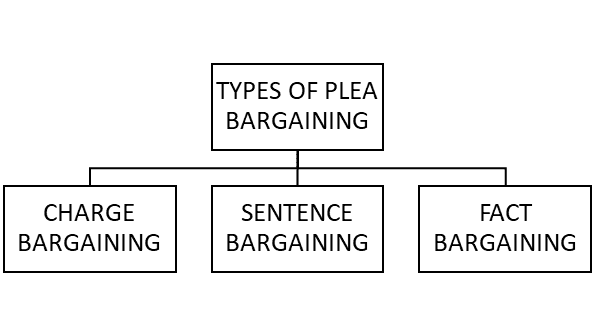
Charge Bargaining- Negotiating for dropping a charge in multiple charges or settling for a lesser charge.

Sentence Bargaining-  Admission of guilt and settling for a lesser sentence.

Fact Bargaining- Bargaining as to admission to some facts in exchange for an agreement to not introduce some other facts.

In 2020, the practice of plea bargaining came under the spotlight when foreigners who were members of Tablighi Jamaat attended the religious congregation Nizamuddin Markaz, amid the pandemic and were released through plea bargaining. The charges were a violation of visa conditions and guidelines given by the Government in the wake of the pandemic, etc. They accepted milder charges and paid fines under plea bargaining.

Procedure Of Plea Bargaining Under CrPC, 1973 (Sections 265A TO 265L)

  • Application for plea bargaining is filed by the accused containing a description of the case with the offense along with an affidavit sworn by the accused that he voluntarily applied for plea bargaining, understands the nature of the offense and its punishment, and that he has not been convicted of the same offense in any case previously. 

Note- Use of the statements or facts mentioned by the accused in this application are to be used in plea bargaining only and not for any other purpose.

  • After this, the Court issues notice to the Public Prosecutor/complainant and the accused to appear on a specific date when the accused is examined by the Court in-camera to the satisfaction that the application has been filed by the accused voluntarily. 
  • On satisfaction, both the parties are given time to work out a mutually satisfactory disposition of the case (accused giving compensation, etc to the victim) setting the date for further hearing. A report is then prepared by the Court signed by the parties and the presiding officer of the Court.
  • If the application is found to be involuntarily filed or that the accused has been previously convicted of the same offense earlier, the Court will proceed as per provisions under CrPC from the stage of filing application.
  • After a satisfactory disposition is reached by the parties, a report is then prepared by the Court, signed by the parties and the presiding officer of the Court. The case is then disposed of by awarding compensation to the victim as per the disposition and then a decision upon the quantum of punishment for the accused is made. 
  • If Probation of Offenders Act, 1958 or Section 360, CrPC, or any other law time being in force applies to the case, the accused may be released on probation or provided a benefit of any other law.
  • After hearing this, if minimum punishment for the offense committed is given under law, sentence- ½ of such minimum punishment.
  • But if the accused is not covered in any of the 2 provisions given above, sentence- ¼ of the punishment provided or extendable.

Judgment regarding disposal of the case is given in open court and is signed by the presiding officer.

Benefits Of Plea Bargaining

  • Speedy Trial- Trials are time-consuming and India, having an insurmountable number of pending cases, faces an ardent need for speedy trials. Plea bargaining provides just that.
  • End the anxiety of uncertain outcomes- Trials could be tricky most of the time, where it could turn in any possible direction. With plea bargaining in practice, one did an offense, that one pleaded guilty of it too. Hence, it removes the possibility of being anxious over the unpredictable nature of trials.
  • Saves litigation costs- It wouldn’t come as a surprise to you that going to trial is expensive. If one gets to negotiate pre-trial, it saves huge bucks that would otherwise have gone to the advocates, etc.
  • Impact on conviction rates- Imagine the conviction rates, when it is possible to have speedy disposal of cases. Why do you think the US does so great in this department?
  • Lesser sentence- In exchange for accepting a plea deal, the accused may be given a lesser sentence or even a reduced charge like that of a misdemeanor instead of a felony. 
  • An opportunity for a fresh start- There is a possibility under plea bargaining that an accused gets convicted for a lesser sentence. This allows the convicted to make a change in his life and start afresh.
  • A solution for the problem of overcrowding of jails- Accused awaiting trial are kept in jails that work just as a holding center with little or no scope for rehabilitation or correction. The delay in trials and conviction leads to overcrowding of the jails. With plea bargaining in the picture, faster disposal of cases is possible.

Criticism Of Plea Bargaining

  • May be made under coercion- It is a possibility that plea deals are made under coercion from the prosecutor or are bad in faith.  Hence, the accused might feel threatened and accept the plea deal even when he/she is innocent.
  • Criminal record- When one pleads guilty under plea bargaining, that does not mean that he would escape the conviction somehow. As a consequence, one would always have a criminal record.
  • Misguidance from the counsel itself- Sometimes, plea bargaining comes as a piece of bad advice from the counsel of the accused itself, agenda behind could be to get rid of the case sooner, lack of legal experience, inability to fight the case on its merits, etc.
  • Role of Judges in plea bargaining- Even though both parties agree to plea bargaining, a Judge may declare it void. A judge can even set aside the plea deal and move the case to trial if he feels like it is made in bad faith.
  •  No opportunity to appeal- In a trial, if the accused is not satisfied with the decision of his conviction, in almost all cases he appeals to a higher court against the judgment. But, once an accused pleads guilty, there is no scope for him to appeal against the conviction except special leave petition under Article 136 and writ petition under Article 226 and 227 of the Constitution.
  • Not the most moral practice in the book- Concessional punishments under plea bargains seem unfair to victims of the offenses committed by the accused for which he pleads guilty on the record.
  • Right to free and fair trial threatened- There are arguments that plea bargaining is unconstitutional in the sense that it violates the right to free and fair trial of the accused. If the plea deal is the outcome of coercion, incapacity of the defense attorney, etc. then the possible conclusion makes this practice bad in law. 

Even the justice system suffers because of this practice because plea deals are all about the negotiation skills of the counsels for both the parties and not winning the case on its merits in the trial.

Conclusion

It’s been more than a decade since plea bargaining was inserted in CrPC, but one would observe that it is uncommon in India since its inception. There have been doubts and worries to put the practice in full motion. As mentioned above it has various disadvantages but what one tends to forget is the benefits of it. To conclude a careful and balanced analysis of both the advantages and disadvantages has to be done since It is not justified to exclude something solely based on its demerits. Lack of awareness of the masses about their rights, coercive confessions, etc is the reason for the restricted scope of plea bargaining in India. As per statistics given by GOI in 2015, the plea bargaining rate in India was a mere 0.045% (last available statistics on the subject), pending cases were over 2 crores across the nation and undertrial prisoners were 2.8 Lakhs. If you are wondering what’s the current status, so at present, there are over 4 Crore pending cases all over India. If the future is the same as the present with an insurmountable number of pending cases in Indian Courts, which honestly will be, then the need of the hour is to give plea bargaining the space it needs.

The article has been written by Munmun Kaur, a law student from Law Centre-I, Faculty of Law, Delhi University.

Latest Posts


Archives

Marriage- an age-old institution that is considered as a sacramental union is infested with a tradition that took the color of greed over the years and has agonized many- Dowry

What Is Dowry?

“Dowry” in simple terms means giving or agreeing to give any property (could be anything from gold, home appliances like fridge, etc., cash, to something as basic as utensils.) by one party to the marriage to another. This exchange could be made before, at, or even after the marriage. Sec-2 of The Dowry Prohibition Act, 1961, excludes dower or mahr from the ambit of dowry in the case of persons to whom Muslim Personal Law (Shariat) applies.

While the definition of dowry as given by The Dowry Prohibition Act, 1961, suggests dowry given by “one party to a marriage” (not specifying which), it is always the bride’s family who gives the dowry. This is a dominant example of the prevalent system of patriarchy. A girl child is considered a burden from her birth by her parents because they would have to give dowry in the future to make her somebody’s wife someday. Hence it is not far-fetched to say that dowry has led to offenses like female feticide, female child trafficking, etc. 

The amount of dowry depends on multiple factors (likely to be offensive) like education of the groom, education of the bride, caste-subcaste, bride’s skills, her beauty, the family status of both the parties in the society, family’s negotiation skills, and the list is inexhaustive.

Current Status 

It may come as a surprise to many, but in earlier times, dowry was given to the bride by her family as means to maintain her independence after marriage. Over the years, it developed as a means to satisfy the greed of her in-laws. Acknowledging the mounting cases of dowry harassment and death, the Indian Parliament enacted The Dowry Prohibition Act, 1961, declaring dowry illegal in India followed by Section 498A, 304B, Indian Penal Code-1860.

Statutory Provisions

  1.  THE DOWRY PROHIBITION ACT, 1961

This act aims at prohibiting giving and taking of dowry. 

  • Section 3, states the penalty of giving or taking of dowry or abetting of giving and taking dowry. 

Penalty- imprisonment for a term not less than 5 years and with a fine not less than 15,000/-, or the amount of the value of such dowry, whichever is more.

Proviso- For adequate and special reasons, to be recorded in the judgment, imprisonment for less than 5 years can be imposed.

{Before the 1984 amendment, the penalty under this section was- imprisonment which may extend to 6 months, OR with fine which may extend to 5000/- OR with both.}

EXCEPTIONS: – Presents, (given without any demand being made for them) at the time of marriage, to the bride or bridegroom. Conditioned on the fact that they are to be entered in a list maintained as per the rules made under this Act.

Provided such presents, when given from the bride’s side are customary and their value is not excessive having regard to the financial status of the person giving.

  • Section 4, states the penalty for demanding dowry. Demanding dowry-directly or indirectly, from parents/relatives/guardians of bride or bridegroom.

Penalty-  Imprisonment for a term which shall not be less than six months, but which may extend to 2 years and with a fine which may extend to 10000/-

Proviso- For adequate and special reasons, to be recorded in the judgment, imprisonment for less than 6 months can be imposed.

  • Section 8 makes every offence under this Act, non-cognizable, non-bailable, and non-compoundable.

{Before the 1984 amendment, the offenses under this Act were non-cognizable, bailable, and non-compoundable.}

  1. CRUELTY BY HUSBAND OR RELATIVE OF HUSBAND, SECTION 498A OF INDIAN PENAL CODE, 1860

In 1983, Chapter XXA was inserted that had only one section i.e., Section 498A.

Section 498A deals with all cases of cruelty towards and harassment of a woman by her husband or his relatives.  

Essential ingredients of this section are: –

  • The victim was a married lady (may also be a widow)
  • She has been subjected to cruelty by her husband or the relatives of her husband.
  • That such cruelty consisted of either

– harassment of a woman to coerce her meeting demand of dowry, or 

– willful conduct by the husband or the relative of her husband of such a nature is likely to lead the lady to commit suicide or cause grave injury to her life, limb, or health.

  • Such injury inflicted is either physical or mental.
  1. DOWRY DEATH, SECTION 304B, INDIAN PENAL CODE, 1860

“Section 304B has been inserted in the IPC by Dowry Prohibition (Amendment) Act, 1986 to combat the increasing menace of dowry deaths.”

Essential ingredients of this section are: –

  • The death of a woman was caused by burns or bodily injury or otherwise than under normal circumstances
  • Such deaths must occur within a period of 7 years of marriage.
  • She must have been subjected to cruelty or harassment by her husband or any of his relatives.
  • Such cruelty should be for or in connection with demand of dowry; and
  • Such cruelty or harassment is shown to have been meted out to the woman soon before her death

Punishment: – Imprisonment for a term which shall not be less than 7 years but which may extend to imprisonment for life.

Section 498A and Section 304B, Indian Penal Code, 1860 are not mutually exclusive. They deal with two distinct offenses. Even if cruelty defined in Section 498A will be the same for Section 304B, yet under 498A cruelty itself is punishable. But under 304B, Dowry Death is punishable that should have occurred within 7 years of marriage and no such period is mentioned in 498A.

Venugopal v. State of Karnataka (1999)- Constant demand of dowry leading to ill-treatment, harassment, and torture of the wife at the hands of the husband soon before her death, led her to take the extreme step of ending her life. The Supreme Court held the husband liable for dowry death u/s 304B, IPC for creating a situation whereby the wife committed suicide within 2 years of the marriage.

The state of Rajasthan v. Jaggu Ram (2009)- The death of the deceased wife took place after one and a half years of her marriage due to head injuries. Cruel treatment and harassment meted out to her immediately after her marriage till her death for bringing insufficient dowry. The Supreme Court held Section 304B to be applicable in the case. 

  1. SECTION 113B OF INDIAN EVIDENCE ACT,1872

To ascertain, whether a person has committed the dowry death of a woman, If soon before her death, she has been subjected to cruelty or harassment related to any dowry demand by that person, the Court will presume it to be a case of dowry death.

Also “dowry death” here has the same meaning as that given in Section 304B of the Indian Penal Code, 1860.

Kailash v. State of Madhya Pradesh (2007) SC- In this case, it was held that the words “soon before” in Section 113B cannot be limited by fixing time limit, it is to be determined by the Courts, depending upon the facts and circumstances of the case.

The combined effect of Section 304B of the Indian Penal Code, 1860 and Section 113B of Indian Evidence Act, 1872- If the prosecution proves the ingredients of Section 304B, then the presumption under Section 113B will operate. This is a rebuttable presumption and the onus to rebut shifts on the accused. 

Misuse Of Dowry Law

Like there are two sides of a coin, law related to dowry has two facets too. On one hand, we advocate that even after so many years of dowry law coming to life, our system has failed to eradicate dowry. On the other hand, there are cases of capturing the soul of these laws in the wrong way. 

Section 498A, Indian Penal Code, 1860 criminalizes cruelty towards a wife and makes it cognizable, non-bailable, and non-compoundable offenses. This section authorizes police to make an immediate arrest of the accused (husband and his relatives) based solely on the victim’s testimony and no other evidence. The flawed crafting of this section provides an opportunity for wrongful incarceration by vindictive women and at the same time makes this provision less effective for the ones actually in need. 

Structuring of this section is such that almost in all cases all the accused (husband as well as his relatives) receive the punishment of life imprisonment, as a result of not taking account of factors like physical or relationship proximity to comprehend whether the accused could actually be a part of such a commission. Due to this lack of clarity, many are undergoing punishment even without having any role in the act in question.

To overcome this shortcoming, in 2014, the Supreme Court in Arnesh Kumar v. the State of Bihar, ordered the police to follow a nine-point checklist before arresting anyone on a dowry complaint to avoid misuse of this section. This too faced backlash, one of the reasons being that it jeopardized the expediency in dowry cases.

Conclusion

Dowry is one of those social evils that has been fought against for a long time now, still, it persists. A problem was recognized and laws against it were drafted. But does it really matter if we have them written on paper only but not completely in practice? The biggest hurdle is the cases being unreported. From the very beginning, we as a society have motivated this tradition to prevail by giving, taking dowry, and watching others do the same. We have breathed life into this tradition time and time again. And today, when some of us advocate against it, most of us have accepted this as a totally normal act. Need of the hour is awareness & courage to put a stop to dahej pratha, acknowledge the anomalies in the laws drafted and look for their proper execution. One needs to realize the gravity of offenses committed in the name of this tradition and that it even leads to the death of the victim. Does it not make you wonder if it is dowry death or a well-thought dowry murder? 

The article has been written by Munmun Kaur, a law student from Law Centre-I, Faculty of Law, Delhi University.

Latest Posts


Archives

EQUIVALENT CITATION


(1860) 8 HLC 268


BENCH


LORD CRANWORTH & LORD WENSLEYDALE


RELEVANT ACT/ SECTION


The Indian Partnership Act, 1932


BRIEF FACTS AND PROCEDURAL HISTORY


Under the name of B Smith & Son, Benjamin Smith and Josiah Timmis Smith carried on a business of iron and maize traders. They owed large amounts of money to the creditors of the company. A meeting was held between S & S and the creditors that included Cox and Wheatcroft. They executed a deed of arrangement in favor of the creditors. The party to the first part of the deed was S & S; to the second part were five creditors including Cox and Wheatcroft. The party to the third part of the deed were the general body creditors of S & S. The party to the second part was to carry the business under the name of The Stanton Iron Company as a trustee. This deed also contained a provision that stated that they would not sue Smiths for their debts. Cox never acted as a trustee; Wheatcroft had resigned six weeks later after the deed. No other trustees were appointed in place of Cox and Wheatcroft.


Hickman – a businessman, drew three bills of exchange for the goods supplied to him after Wheatcroft had resigned. These bills were received on behalf of the Stanton Iron Company by one of the three creditors. Hickman sued Cox and Wheatcroft and stated that they both were liable because they were the original parties to the second part of the deed.
The case was tried before Lord Jervis, who ruled it in favor of the defendants. The action went to the Exchequer Chamber, where three judges wanted to reverse the decision, whereas the other three judges asked to uphold the judgment.


ISSUES BEFORE THE COURT


Is there any partnership between the merchants who were in the essence of the creditors of the company?


RATIO OF THE CASE


The argument that mere sharing of the profits constitutes the partnership is a misconception. The right to share the profits does not cause liability for the debts of the business.
The fact that the business was carried on by the person acting on his behalf is the actual ground for the liability.


DECISION OF THE COURT


The execution of the deed did not make the creditors partners in the Stanton Iron Company. The deed is only an arrangement to pay debts out of the existing and future profits. The creditors were given special powers as per the deed. To make rules to carry out the trade and to decide whether to continue the business. The creditors let the trustees carry out the trade instead of them. This act of the creditors did not make them partners. The trustees would not have accepted the bills of exchange if the creditors had chosen to carry out the trade. The agreement did not constitute the relations of partners between the creditors and trustees. Therefore, the creditors are not liable because they are not the principals of the trustees. However, the trustees are liable because they are the agent of the contract.
Hence, the defendants are not held liable and overturned the decision of the Court of Common Pleas.

The case analysis has been done by Gracy Singh, a student of 2nd Year BA.LLB (Hons.) from Mody University of Science and Technology, Lakshmangarh, Rajasthan.

Latest Posts


Archives

INTRODUCTION


Bhopal is famous for its historical records, lakes, and green plants, but more importantly, the city is famous for the worst industrial accidents in the world. At midnight on December 3, 1984, the poison gas that leaked from the Union Carbide plant in Bhopal, the capital of Madhya Pradesh, directly caused thousands of deaths. This event is now called the Bhopal Disaster or the Bhopal Gas Tragedy. According to official records, the Bhopal gas accident caused 3,787 deaths. The Madhya Pradesh government updated these figures later, as officials immediately estimated 2,259 deaths due to gas leaks from the Union Carbide plant. However, activists fighting for justice for the victims of the Bhopal gas tragedy estimate the death toll at between 8,000 and 10,000. In an affidavit filed in 2006, the government stated that 5,58,125 people were injured by the Bhopal gas leak, of whom about 3,900 were seriously and permanently disabled.


HOW IT HAPPENED?


The gas leak at Union Carbide (now known as The Dow Chemical Company) was reported after midnight on December 2-3. The incident occurred at Plant C of the Bhopal Union Carbide Plant. The breeze quickened the pace and carried poisonous gas leaked from the Union Carbide factory to other parts of the city, killing people awake and asleep. According to the government affidavit, some 3,000 people died from the poison gas within hours of the incident. It is estimated that approximately 40 tons of methyl isocyanate gas (MIC) and other chemicals leaked from the Union Carbide plant. Methyl isocyanate is highly toxic, if its concentration in the air reaches 21 ppm (parts per million), it will cause death within a few minutes of inhaling the gas. In Bhopal, this level is several times higher.


IMMEDIATE EFFECTS OF TRAGEDY


Methyl Isocyanate is highly toxic. The American Conference of Government Industrial Hygienists stated that the level up to which a worker could be exposed to MIC without any harmful effects is 0.02ppm. As soon as the level is 0.4ppm it is toxic by inhalation, or by ingestion. At 5ppm, most people cannot detect it but because of symptoms, they get a warning. 

The symptoms of exposure include:

Chest pain

Irritation in the eyes

Breathing problem

Irritation in the nose and throat

Burning of skin 

Coughing

Therefore, storing methyl isocyanate requires proper care and caution, and especially when it comes to water extra precautions must be taken. Methyl Isocyanate is very sensitive to water. It can be stored in glass or stainless steel, and the temperature should be below 40-degree Celsius or 104-degree Fahrenheit.


COMPENSATION FOR TRAGEDY

After the accident, many people filed cases for the victims, and there were problems with their claims. Many people, especially low-income earners, we’re unable to fight for a long time. These cases were filed against UCC in Bhopal and the United States. He also tried to resolve the matter out of court but was unsuccessful. After some time, the Indian Parliament passed the Bhopal Natural Gas Spill Disaster (Claim Processing) Act in 1985. According to section 3 of the Act, the Indian government has the right to bring cases on behalf of all citizens with rights and Claim compensation for them. The government introduced the “1985 Bhopal Gas Spill (Claims Recording and Processing) Plan” by Section 9 of the Act. The Indian government filed a lawsuit against UCC in the United States District Court of New York. However, UCC argues that it is inconvenient to file a suit in a US court. They argued based on an inconvenient venue (meaning that when the parties have a more convenient venue, the court may deny jurisdiction). UCC said that since the accident happened in Bhopal, all the evidence is there, so it is more convenient to try in the Indian courts. Keenon J. subsequently accepted UCC’s plea and filed a new case with the Bhopal District Court. The district court ordered UCC to pay the victims 350 million rupees. UCC subsequently appealed to the Madhya Pradesh High Court against the decision of the Bhopal District Court. This resulted in the reduction of “temporary compensation” from 3.5 billion rupees to 2.5 billion rupees. At the same time, UCC tried to resolve the matter directly with the gas victims outside the court. However, Deo J. of the M.W. Bhopal District Court ordered UCC not to make any arrangements with any victims until the court issued a new order. Finally, after the spread of the absolute liability rule, the court held that UCC was responsible for the Bhopal tragedy. Although it is suspected that the Indian judiciary cannot handle this situation. They believed that under strict liability rules, violators would shirk liability, but this did not happen. The Indian judiciary provides justice to the victims. From February 14-15, 1989, the Supreme Court ordered UCC to pay victims $ 470 million (Rs. 75 billion).


CONCEPT OF ABSOLUTE LIABILITY


Absolute liability means that the defendant must bear liability without any exception of getting excused from the liability. Normally, a person will be held accountable only if he has criminal intent (criminal mentality), but in the case of absolute liability, even if a person has no intention of committing a crime, he may be held accountable. The principle of absolute liability is similar to strict liability. In a strict liability case, a person carries dangerous items with him, knowing that even the smallest mistake can cause the item to be released and cause human death. Therefore, even if you have taken proper care and precautions, but things escaped and resulted in death, you can still be held liable under strict liability. There is only one difference between the principle of strict and absolute liability. On the one hand, under strict liability, one can choose to avoid the resulting liability, but on the other hand, under absolute liability, one has no such choice.


CONCLUSION


No matter how many years have passed, the aftermath of the Bhopal tragedy is still visible today. Even after the UCC is held accountable, the loss of those who have lost their lives and those who still suffer cannot be measured. While governments need to promote globalization, they must ensure that there are no risks involved. In addition, the best way to implement the enacted laws is also a necessity now, because nothing is more important than the lives of people.

The article has been written by Aanya Gupta pursuing BBA LL.B. from Vips, GGSIPU, New Delhi.

Latest Posts


Archives