The name “federalism” comes from the Latin word Foedus, which means “accord” or “treaty.” As a result, a federation is a political structure created by a treaty or agreement between the various units. It is a political organization concept or ideology that combines the principles of centralization, non-centralization, and power-sharing. In a country like India, ties between the Centre and the States, as well as between the States and Panchayati Raj Institutions and Urban Local Bodies, should be guided by the spirit of cooperative federalism. 

History 

Kingdoms or empires have dominated the Indian subcontinent by a federal policy of non-intervention in local matters from the ancient period. Because the natural diversities of the people of the subcontinent were so enormous, they could only be constituted a part of a unified empire if no or very little attempt was made to impose a common set of practices and beliefs. The centralized tendencies of rulers like Jahangir and Aurangzeb contributed to the further dissolution of the Mauryas and Mughals. Furthermore, following the Revolt of 1857, when the British opted to withdraw interventionist policies such as the Doctrine of Lapse and the ban on the use of greased cartridges of animal fat, they were only following an age-old pattern of government. The Regulating Act of 1773, which established a system in which the British Government supervised the East India Company’s activities but did not acquire authority for itself, sowed the seeds of cooperative federalism. By envisaging a dual form of governance known as “dyarchy,” the Government of India Act 1919 provided for a federal India, albeit a flimsy one. The same goal was being pursued by the Government of India Act, 1935. 

Indian Constitution

Sardar Patel, a powerful leader at the time of the adoption of the Constitution in 1950, was a strong supporter of the federal system and played a key role in the drafting of a federal constitution. The horizontal relationship between the union and the states is known as cooperative federalism, and it demonstrates that neither is above the other. The Indian constitution includes measures to ensure collaboration between the center and the states, which is vital for the country’s proper development. As a result, there are only a few provisions in the Indian constitution that portray the core relationship between state and center.  The notion of subsidiarity is used to distinguish between central, state, and concurrent lists. The center has retained residuary power. Article 249[5] empowers the parliament to make decisions on matters that fall under state jurisdiction if the resolution is approved by a two-thirds majority in the state council. 

Challenges faced by Cooperative Federalism 

The increasing issues that face federalism in the twenty-first century have increased the necessity for cooperative federalism, making its practice as a form of government even more essential. Connectivity and accessibility, both physical and electronic, have greatly improved as a result of technological advancements. Climate change, for example, is a worldwide environmental concern that transcends national borders. Pollution and conservation challenges highlight the uneasy friction that exists between the decision-making processes of governments at the national, state and local levels. Globalization has emphasized the importance of inter-and intra-state agreements on geographical, climatic, environmental, and technical diversity in order to integrate with global processes for viable and sustainable development and growth. What is happening on a global scale is also being felt on a local scale. Because the globe has become a global village, the country’s internal security and political issues are vulnerable to outside interference. Individual states can now engage in bilateral negotiations with the union, circumventing the ineffectual institutionalized structures of collective policy drafting, giving our federalism a platform for negotiation. However, this should be taken with a grain of salt, as power-sharing among states at the national level has failed to reduce regionalists’ and sub-regional parties’ localism, parochialism, and chauvinism. Increased negotiating power will only improve cooperative federalism if the alleged disadvantages of centralism are addressed. The federal structure’s political and social fabric has been vitiated by rising voices of autonomy and secession. States are increasingly feeling deprived and alienated, and they have begun to view all problems through a limited parochial lens. Furthermore, their strategy is growing more violent and confrontational. Terrorism, militancy, organized crime, the problem of internally displaced persons, and refugees are all issues that require the country as a whole to join together, and institutional structures under state governments to assist the center by pooling knowledge and resources. The need to come together now is not just a result of the new issues that the country is facing, but it will also act as an antidote to avoid similar challenges from occurring again in the future. Because of its intrinsic resilience and malleability, cooperative federalism alone strengthens the nation from within, allowing it to survive adversities and obstacles.

Conclusion

The relationship between the center, the states, and the local levels is important to India’s concept of nationhood and is a prerequisite for the country’s progress. It does, however, have a strong political undercurrent. Every center-state and inter-state conflict is, at its core, a political conflict. The difficult nature of center-state interactions stems from this. A quarrel of this nature develops into an economic one over time. Poor politics inevitably leads to poor economics. Integration and unity in the federal structure will not be full unless economic stagnation and imbalanced regional growth are addressed. The issue of safeguarding our nationhood through constructive cooperative federalism, which necessitates the participation of both the federal and state governments, must be addressed by both the federal and state governments. India is a fascinating blending pot of cultures. The same must be treasured and valued. There is no better way to do this than through cooperative federalism. People from various states sink or swim together, and that success and salvation are found in invention, not division; mutuality, not conflict; cooperation, not rivalry, in the long term.

This article is written by Vanshika Samir,  a first-year student at the Rajiv Gandhi National University of Law, Punjab. 

LATEST POSTS


ARCHIVES

Report by RIDDHI DUBEY

In the matter, Supreme Court states that the verdict should not be uninfluenced by the verdict of the High Court.

FACTS

In the present case, A Journalist from Bangalore Gauri Lankesh who had turned into an activist had been shot down outside her place on 5th September 2017. At least 19 people are been accused of her murder out of which 9 people’s bail plea was rejected back then. It is been assumed that her murder is one of the many attacks that are been made on such activists and writers to shut their voices. She has been a very vocal journalist and used to speak the truth and it’s one of the reasons. Recently Karnataka High Court has quashed organized crime charges against one of her accused named Mohan Nayak and passed the bail plea. On being aggrieved by the judgment of the Karnataka High Court Kavita Lankesh sister of Gauri Lankesh has Filed Special Leave Petition in Supreme Court challenging this Judgment.

PETITIONER’S CONTENTION

Petitioner submits in the petition that Karnataka High Court had failed to evident from Special Investigation Team that the accused was involved in “organized crime syndicate”, different murder cases, had given settler to few criminals and other unlawful activities. Karnataka High Court has failed to go through Section 24 of KCOCA as well. So the Petitioner requests The Apex Court to not get influenced by Karnataka High Court’s Judgment.

JUDGEMENT

On Tuesday Supreme Court bench comprising of Justice Am Kahnwilkar, Dinesh Maheshwari and Aniruddha Bose responding to the Special Leave Petition of Petitioner challenging the order of Karnataka High Court stated that the decision on the bail plea cannot be uninfluenced by the order passed by Karnataka High Court.

KEY HIGHLIGHTS

  • Senior Office who has been investigating the case has stated that it is one of the toughest cases he has investigated.
  • There are a total of 19 accuses in the case and all of them are in Judicial Custody.
  • The first charge sheet of the case was filed in May this year.

What is KCOCA?

Karnataka Control of Organized Crimes Act, 2000 (KCOCA) is a law enacted by Karnataka state in India in 2000 to combat organized crime and terrorism.

What does Section 24 of KCOCA?

Criminal syndicates are often known to commit acts of vigilantism by enforcing laws, investigating certain criminal acts, and punishing those who violate such rules.

When is the special leave petition filed?

SLP can be filed against any judgment of the High Court within 90 days from the date of judgment, or SLP can be filed within 60 days against the order of the High Court refusing to grant the certificate of fitness for appeal to Supreme Court.

Justice Sanjay Yadav took oath as Chief Justice of Allahabad High Court on 13th June demitted office on Friday. It was the shortest tenure of Chief Justice in the history of the High Court. He discharged his duty as head of the state judiciary for 13 days. Earlier to Justice Yadav Justice Kamal Narain Singh had the shortest tenure of 17 days, from November 25 to December 12, 1991, and Justice Y V Chandrachud had the longest tenure as CJI.

The reason behind his short tenure is that according to the rule a Chief Justice can serve only up to the age of 62 years and as Justice Sanjay Yadav had turned 62 years he had retired. Before being appointed as Chief Justice of Allahabad High Court he used to serve in Madhya Pradesh High Court. He has also served as Judge of the Allahabad High Court and Madhya Pradesh High Court.

During his tenure in the biggest High Court in India the duties and growth made by him in the matters such as Suo motu COVID-19 proceedings, the dignified burial of unidentified bodies near Ganga, Petitions challenging the validity of anti-conversion law.

-Report by RIDDHI DUBEY

Introduction

Human Rights are the most basic rights and are to be exercised by all human beings irrespective of the place they belong. However, emigrates are denied the most democratic right – the right to vote. The right to vote encourage political participation and enables the citizens to keep a check on the government. Also, the right to vote empowers to influence governmental decisions and policies. The UDHR (Universal Declaration of Human Rights) provides that everyone has the right to take part in governing his country. The ICCPR (International Covenant on Civil and Political Rights) provides that every citizen has the right and the opportunity to participate without any unreasonable restrictions in the conduct of public affairs to vote. The election shall be held by secret ballot guaranteeing the free expression of the voter’s will.

An NRI elector is a person who is a citizen of India and resides outside India due to education or employment but has not acquired citizenship in any other country. He is eligible to be registered as a voter in the constituency of his native place in India. Now, who is eligible to be registered as a voter? A person who has attained 18 years of age on first January of the year in which revision of the electoral roll published finally. 

Voting Rights of NRI

Until 2010, NRIs were not allowed to cast their vote during the general elections if they reside outside India for six months under Section 19 of the Representation of People Act, 1950. To crystallize voting rights for the NRIs, the government brought the Representation of People (Amendment) Act, 2010, and Section 20 (A) was inserted. The section states that if an NRI deemed to an ordinary resident, he is allowed to join the electoral rolls. However, an NRI voter needs to be physically present in the constituency to vote according to this Act.

Background

The Election Commission began to look for options to permit NRIs to vote from abroad after receiving lots of requests including, the Ministry of Overseas Affairs and Naveen Jindal (Industrialist, former Rajya Sabha MP). Three writ petitions from NRIs were filed in the Supreme Court by NRIs in 2013-2014. After the Lok Sabha election in 2014, a 12-member committee established to study primarily three options:- 

  1. Voting by post
  2. Online voting
  3. Voting at an Indian mission abroad

Online Voting was averted by the committee as this could compromise the secrecy of voting. Lack of adequate resources led to the proposal to vote at Indian Mission abroad to shut down. In 2015, the panel recommended NRIs the options for proxy voting and e-postal ballot apart from voting in person. The Ministry of law accepted the advice on proxy voting. 

About the Proxy Voting 

In 2017, the Union Cabinet passed the proposal on the proxy voting right. The government introduced a bill amending the Representation of the People Act, 1950. Lok Sabha passed the Bill; however, approval from Rajya Sabha was still pending when the Bill lapsed due to the dissolution of the 16th Lok Sabha. 

Now, the Election Commission suggested postal voting rights for NRIs where consent of the Parliament was not necessary. The postal voting facility can extend to the NRIs elector by amending the Conduct of Election Rules 1961. Parliaments consent is not necessary for this. 

Current Strength of NRI Voters

In 2015, the UN reported that India has the largest diaspora population of 16 million people. In comparison to the population, registration of NRI voters is very low; according to the Election Commission, approx 1 lakh NRIs registered as voters in India. About 25,000 NRIs only flew to India during the 2019 Lok Sabha Election.

Kerala (89,000) reported a large number of NRI voters. The second-largest registered NRI voters were documented in Andhra Pradesh (7,500), followed by Maharashtra approx 5,500, Karnataka about 4,500, Tamil Nadu (3,200), and 2,500 in Telangana.

Postal Voting on a Pilot Basis

In December 2020, the Ministry of External Affairs and the Election Commission held a meeting where the Election Commission mentioned the countries to the government where the postal voting will introduce on a pilot basis. In this pilot, gulf countries are excluded for now as the commission does not have any facilities against the NRIs residing in the Gulf countries like the UAE, Oman, Kuwait, Saudi Arabia, and Qatar. The postal ballot pilot will carry out at first for voters settled in the United States, Australia, New Zealand, South Africa, France, Japan and Germany. 

Working of Postal Ballot

The Election Commission has presented the process for postal voting for NRI. Interested voters will have to inform the Returning Officer (RO) within five days after the notification for the election. The RO will send the ballot paper electronically on receiving information. In the Indian Mission, an assigned officer will download the ballot paper on behalf of the voters and give it to the NRI electors. The NRI voters can now mark the preference at the mission and give it back with a declarations form attested by the assigned officer in a sealed envelope.

Conclusion

The people residing abroad are also entitled to human rights including, the right to vote, as available to other citizens. Migration cannot be considered a ground to restrict any person to exercise this right. The right to vote instills a sense of responsibility and belongingness towards one’s nation. The Amendment brought in the Representation of People Act ensured the voting rights for NRIs still to enroll and vote a person needs to be physically present. Due to which a few numbers of NRI voters got registered, as a large number of people do not have enough time and money to travel back to India to cast their vote. However, the postal ballot system introduced by the government to ensure that NRIs could exercise their right to vote is a positive step towards ensuring the participation of NRIs in the elections and public affairs of the country. 

This article is written by Gracy Singh, a 2nd-year student pursuing a BA.LLB (Hons.) from Mody University of Science and Technology, Lakshmangarh, Rajasthan.

LATEST POSTS


ARCHIVES

Lakshadweep Administration had issued a notice to two residents of Kavarratti Island stating that their dwelling houses are to be demolished as it is not a legal construction as its constructed with diversion certificate as per Laccadive Minicoy and Amini Islands Land Revenue and Tenancy Regulation. Being aggrieved by such order of administrative authority the two residents have filed a Petition in Kerala High Court It was submitted in the Petition that such act of authorities is not in due process of law.

The Respondent stated that the dwelling houses are within 20km from the High Tide line which is a non-development zone. Replying to which petitioner stated that the area sometimes differs during high tide so no straitjacket formula could hence be applied to identify the distance of building from high tide.

During the hearing, the petitioner states that the “diversion certificate” is only applicable to the lands where the government has an absolute title and the petitioners dwelling houses were constructed by their ancestors in 1960 and 1963 and not an allotted land so asking for a diversion certificate is beside the point. Petitioner also points out a similar act done by the administration in which such notice was issued to the fisherman and demolished that area and they trying to do the same with the petitioners as well.

Currently, the high court bench comprising of Justice Raja Vijayaraghavan has put a stay on the notice issued by the Lakshadweep Administration to demolish the Dwelling of Traditional Coastal Communities.

-Report by RIDDHI DUBEY

The Bombay High Court upheld the constitutional validity of a tariff order passed by the Telecom Regulatory Authority of India (TRAI) in January 2020 which had prescribed price celling’s on the charged by television channels but struck down one condition which said the price of a single channel cannot be more than one-third of the highest priced channel in that bouquet.

A bench of Justices Amjad Sayyed and Anuja Prabhudessai passed the judgment on a bunch of petitions filed by several broadcasters, like the Indian Broadcasting Foundation, a representative body of TV broadcasters, the Film and Television Producers Union of India, Zee Entertainment Limited, and Sony Pictures Network India.

On January 1st, 2020, the Telecom Regulatory Authority of India(TRAI) Act, 1997 issued new tariff rules by which the Network Capacity Fee (NCF) price was lowered, benefitting consumers. Previously, a sum of Rs 130 was applicable for all free-to-air channels, and consumers needed to pay more to watch additional channels. After the amendments to the broadcast sector tariffs, consumers will pay Rs 130 as Network Capacity Fee (NCF) charge, however, they will be entitled to get Two Hundred channels. Changes were additionally mandated to be made within the price of individual channels.

The petitions said that the new laws were arbitrary, unreasonable and Offensive of their fundamental right. The High Court disposed of the petitions and said that The challenge to the constitutional validity of the 2020 rules and regulations of TRAI fails. One condition regarding the average pricing of a channel in a bouquet is arbitrary and hence is struck down, the court said in its judgment. As per this condition, the rates of every pay channel (MRP), forming part of a bouquet, shall in no case exceed 3 times the average rate of a pay channel of that bouquet. The petitioners requested the court to extend its earlier orders of August and October last year directing the TRAI to not take any steps against the stakeholders a few times, so that they may study the judgment and then decide their future course of action.

The court then sought to know if the other stakeholders, who have not approached the HC in a challenge, have implemented the new regulations. Senior counsel Venkatesh Dhond and advocate Ashish Pyasi, appearing for TRAI, said that the other stakeholders have already implemented the rules. Therefore, the order passed earlier asking that the TRAI not to take any coercive steps is extended for six weeks, the court said. The Telecom Regulatory Authority of India(TRAI) Act, 1997 had defended its regulation, saying it was a consumer-friendly measure and aimed at ensuring ensure transparency and non-discrimination in channel rates.

-Report by RAVINUTHALA VAMSI KRISHNA

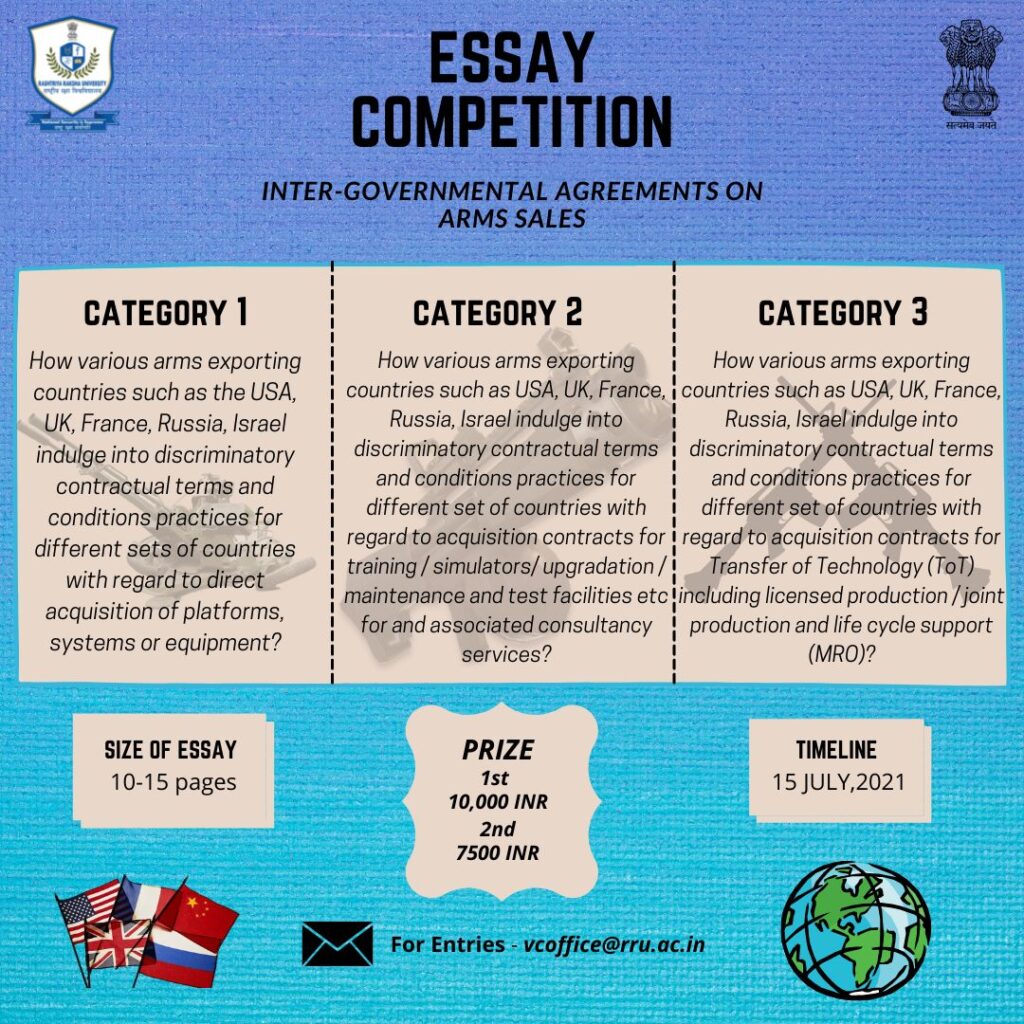
Inter-Governmental Agreements on Arms Sales – Essay Competition

Arms sales to developing countries remain one of the most controversial topics and yet little research is being carried out by arms recipient countries, especially developing countries. Inter-Governmental Agreement / Foreign Arms Sales / Direct Arms Sales are the standard instruments utilized by the arm exporting countries. Large arms supplier countries such as USA, UK, France, Russia, Israel indulge into preferential / favourable treatment while selling their systems, services and test facilities etc. to different developing countries including India. School of Military Affairs, Strategies and Logistics, RRU invites essays on the following topics.

Category 1: How various arms exporting countries such as the USA, UK, France, Russia, Israel indulge into discriminatory contractual terms and conditions practices for different sets of countries with regard to direct acquisition of platforms, systems or equipment?

Category 2: How various arms exporting countries such as USA, UK, France, Russia, Israel indulge into discriminatory contractual terms and conditions practices for different set of countries with regard to acquisition contracts for training / simulators/ upgradation / maintenance and test facilities etc for and associated consultancy services?

Category 3: How various arms exporting countries such as USA, UK, France, Russia, Israel indulge into discriminatory contractual terms and conditions practices for different set of countries with regard to acquisition contracts for Transfer of Technology (ToT) including licensed production / joint production and life cycle support (MRO)?

Size of essay: 

10-15 pages

Timeline: 

15 July 2021

Prizes: 

First and second prize 10,000 INR and 7,500 INR for each category of essay

Entries shall contain name, address and contact details.

Entries shall be sent to vcoffice@rru.ac.in, Rashtriya Raksha University, Lavad-Dehgam

For regular updates, join us:

WhatsApp Group:

https://chat.whatsapp.com/BKRZpHyuzA46mTWlaFqdjq

Telegram:

https://t.me/lexpeeps

LinkedIn:

https://www.linkedin.com/company/lexpeeps-in-lexpeeps-pvt-ltd

Visit us for more such opportunities: http://lexpeeps.in/

Accepting applications for internship from 4-5th year students who are interested in corporate legal practice.

THIS IS AN ONLINE INTERNSHIP OPPORTUNITY

Requirements:

Social Media – Intern : 2
[Tasks would include legal research and drafting of posts handling the social media pages]

Legal research and contract drafting – Intern: 2
[Tasks would include legal research and assistance in drafting agreements and memos]

Students with prior experience in corporate internships at law firms would be preferred.

Duration

The positions are open for the above candidates for the month of July and August 2021.

How to Appkly?

Interested students can send their CV at lawssistancebymira@gmail.com

Perks:

A certificate shall be given at the end of the internship period.

For regular updates, join us:

WhatsApp Group:

https://chat.whatsapp.com/BKRZpHyuzA46mTWlaFqdjq

Telegram:

https://t.me/lexpeeps

LinkedIn:

https://www.linkedin.com/company/lexpeeps-in-lexpeeps-pvt-ltd

Visit us for more such opportunities: http://lexpeeps.in/

About ALSA INDIA:

Asian Law Students Association is an International Consortium of around 14,000 law students and alumni located in 17 countries all over the Asian region. ALSA has been a consistent progressive organization and has been successful in establishing itself across various countries of Asia including Malaysia, the Philippines, Hong Kong, Indonesia, etc. Officially recognized as National Chapter in 2020, ALSA’s India’s main goal is to develop the skills and talents of the Indian legal wizards to help them in various aspects of their professional careers. ALSA India gives a platform to the young wizards of the legal fraternity to share their beautiful and creative legal thoughts and thereby allowing them to broadcast their ability and skill in legal/ constitutional drafting.

About the Competition

The Indian Constitution is the world’s longest written constitution which provides an excellent framework for governing the world’s largest democracy. It nurtures the aspirations of its citizens and is a true living Constitution in as much as it gives the widest possible amplitude for the realization of both individual liberties and desires and at the same time enforces the need for collective growth and development.

ALSA INDIA brings forward its Quiz Competition to enhance and amplify the skills and knowledge of keen learners. The format of this Quiz Competition shall set a standard for the students to participate and learn from an extraordinary perspective.

THEME: The Constitution of India

Eligibility: The Competition is open for all students. 

Competition Format:

§  The quiz will contain Multiple Choice Questions (MCQs) only, from which a participant must choose one option.

§  The total number of questions will be 50; The first 30 questions will be Base Level; the next 10 questions will be Intermediate Level and the last 10 questions will be of Advance level; all questions will carry a 01 mark each.

§  There shall be no negative marking.

§  The Total Time to attempt these questions will be 60 minutes.

§  The aggregate will be evaluated from a total of 50Marks.

Registration Process

§  The participants can register themselves by filling this Registration Form: https://forms.gle/oKjmdyXSfz2ypoNi6

§ The participation fee is Rs 100/- INR.

§  The participants must pay the registration fee in the manner hereinafter provided.

Details of ALSA INDIA TREASURY ACCOUNT

Bank Account-PAYTM Payments Bank

Account Number- 917979001462

IFSC CODE: PYTM0123456

UPI Id: 7979001462@paytm

§  The payment screenshot must be attached to the registration form.

IMPORTANT DATES

S. No.EventDate
1.Registration Opens18th June 2021
2.Registration Closes30th June 2021
3.Day of Competition3rd July 2021
4.Declaration of results5th July 2021

Awards

  • E-certificates for all Participants.
  • Opportunities to participate in the International Activities of ALSA.
  • Top 3 Winners will get a chance to publish their Blog on Lexpeeps.
  • Winners will get a Research Internship Opportunity at Lexpeeps.

Contact Details:

Name: Mr. Abhishek Mishra

Designation: VP Academic Activities

Contact No- (+91) 8085989498

Email Id: vpacademicsalsaindia07@gmail.com

Social Media Handles

INSTAGRAM: https://instagram.com/alsa.india?igshid=y4b14pt215os

FACEBOOK: https://www.facebook.com/alsaindianationalchapter/

Official Brochure:

For regular updates, join us:

WhatsApp Group:

https://chat.whatsapp.com/BKRZpHyuzA46mTWlaFqdjq

Telegram:

https://t.me/lexpeeps

LinkedIn:

https://www.linkedin.com/company/lexpeeps-in-lexpeeps-pvt-ltd

Visit us for more such opportunities: http://lexpeeps.in/

Introduction

The new coronavirus (COVID-19) prompted the Indian government to develop a public-health approach based on existing national laws and regulations. The government was forced to enact the Epidemic Diseases Act of 1897 due to the high incidence and prevalence of COVID-19. Quarantine enforcement under Sections 188, 269, 270, and 271 of the Indian Penal Code, 1860, as well as Section 133 of the Criminal Procedure Code, 1973, has been criticized. The potential and hazards of the 160-year-old Indian Penal Code, 1860, and the 123-year-old Epidemic Diseases Act, 1897, in regulating the terrifying dimensions of novel COVID-19 were thoroughly examined. It finally led to Lockdowns-I across the country. The devastating COVID-19 epidemic was designated a disaster, judging it to be beyond the community’s coping capabilities and necessitating emergency measures. In epidemic-pandemic syndrome, it offered an unprecedented challenge to the public health system and apparatus, putting a slew of public health regulations to the test.

How is Covid-19 tackled by India?

India is the fifth-worst affected COVID-19 country in the world. To begin, COVID-19 is the country’s first epidemic to be addressed by legal institutions. To meet the problems faced by COVID-19, three major laws were enacted: the Disaster Management Act (2005), the Epidemic Diseases Act (1897), and the India Penal Code (1860).

The Disaster Management Act’s legislative goal is to “provide for the effective management of disasters.” The National Disaster Management Authority, which is chaired by the Prime Minister and operates as the apex body at the national level, sets guidelines for state bodies and is established by the Disaster Management Act. As a result, disaster management authorities at the state, district, and local levels were established.

The Central Government has the jurisdiction to make directives to any authority within India, regardless of the law, to aid in disaster relief efforts. The National and State Executive Committees were formed to assist the National and State Authorities, and they oversee implementing the National Authority’s policies and programs, as well as monitoring their implementation. Under the Disaster Management Act, a nationwide lockdown was implemented to ensure social separation and prevent the spread of the coronavirus.

The National Disaster Management Authority drafted the Guidelines on Biological Disaster Management in 2008. It defines biological disasters as scenarios that result in widespread disease, impairment, or death among humans, animals, and plants because of toxins or disease caused by live organisms or their products. Food, clean water, and minimum standards of cleanliness and sanitation are all guaranteed under the plan, with a special focus on the most vulnerable groups to enable and emancipate them to respond to and recover from the effects of the biological calamity.

The National Disaster Management Plan 2019 was created by the government to cope with “Biological and Public Health Emergency” in a broad sense. According to this plan of action, the state is responsible for assessing the risk of vulnerable and marginalized groups and incorporating adaptive measures into social protection systems for the vulnerable.

The Epidemic Diseases Act of 1897 was enacted to better control the virus’s spread. The Act is divided into four sections. The State Government has the authority to enact special laws and regulations to inspect passengers on trains and those suspected of being infected by investigative officers. The Ministry of Health and Family Welfare’s directives can be implemented under Section 2 of the Act. The government has the authority to check any ship coming or departing from any port, as well as detain anyone seeking to sail or enter the country.

After healthcare professionals were subjected to workplace violence, the President issued a new regulation, the Epidemic Diseases (Amendment) Ordinance, 2020. Any attack against healthcare personnel and their property is a cognizable and non-bailable offense under the Act.

Kerala is the only state to have passed the “Kerala Epidemic Diseases Ordinance, 2020” by using legislative power under State List Entry 6 (Public Health and Sanitation). The Act’s goal is to harmonize and consolidate laws about epidemic illness control and prevention. The Kerala Government can devise additional measures and regulations to combat the virus under Section 4 of the Ordinance. The Ordinance gives the state government vast powers, such as restricting critical services, prohibiting public meetings or events, inspecting visitors to the state, securing the borders, and restricting transportation and the operations of both government and private offices.  The Ordinance authorizes a two-year imprisonment penalty with or without a fine of 10,000 Rupees.

State-specific public health legislation has been passed by several state governments. Tamil Nadu, for example, has enacted the “Tamil Nadu Public Health Act, 1939” to combat the infection. Maharashtra has passed the “Maharashtra COVID-19 Regulations, 2020,” which directs all government and private hospitals to provide separate places and screening processes to identify cases, medical officers, and district administrations to work in coordination with state-integrated diseases surveillance program offices, and no person, institution, or organization can disseminate any infectious disease. The Delhi Government has passed Delhi Epidemic Diseases, COVID-19 Regulations, 2020 which is similar to the Maharashtra regulations.

Conclusion

To address the virus’s challenges, a new, advanced, and powerful epidemic law should be drafted. A new law should be drafted that establishes a nodal authority that is represented by both the center and the state and is responsible for planning and implementing the necessary actions such as isolation, quarantine, surveillance, testing, and so on. The Act shall provide the states with sufficient authority and powers to develop and implement actions at the district, block, and gram panchayat levels. The Act should also include provisions for financial support to local governments, farmers, healthcare providers, businesses, and vulnerable groups, as well as details on how money is allocated to various sectors of society. In the event of a violation of a council’s direction or order, the Act should include both civil and criminal penalties. The act should also handle migratory workers, food availability, access to statutory minimum relief, and securing daily wage laborers’ livelihoods.

A coronavirus outbreak, for example, necessitates unusual measures and actions. Only when the government is transparent and accountable can the public have faith in it. India has an excessive number of laws and acts. It is pointless to pass legislation if it is not enforced. If a new law is enacted to address the pandemic’s impacts, it must be efficiently implemented and carried out to accomplish the desired result.

This article is written by Shrey Hasija student of 1st-year LLB at Vivekananda Institute of Professional Studies, GGSIPU.

LATEST POSTS


ARCHIVES