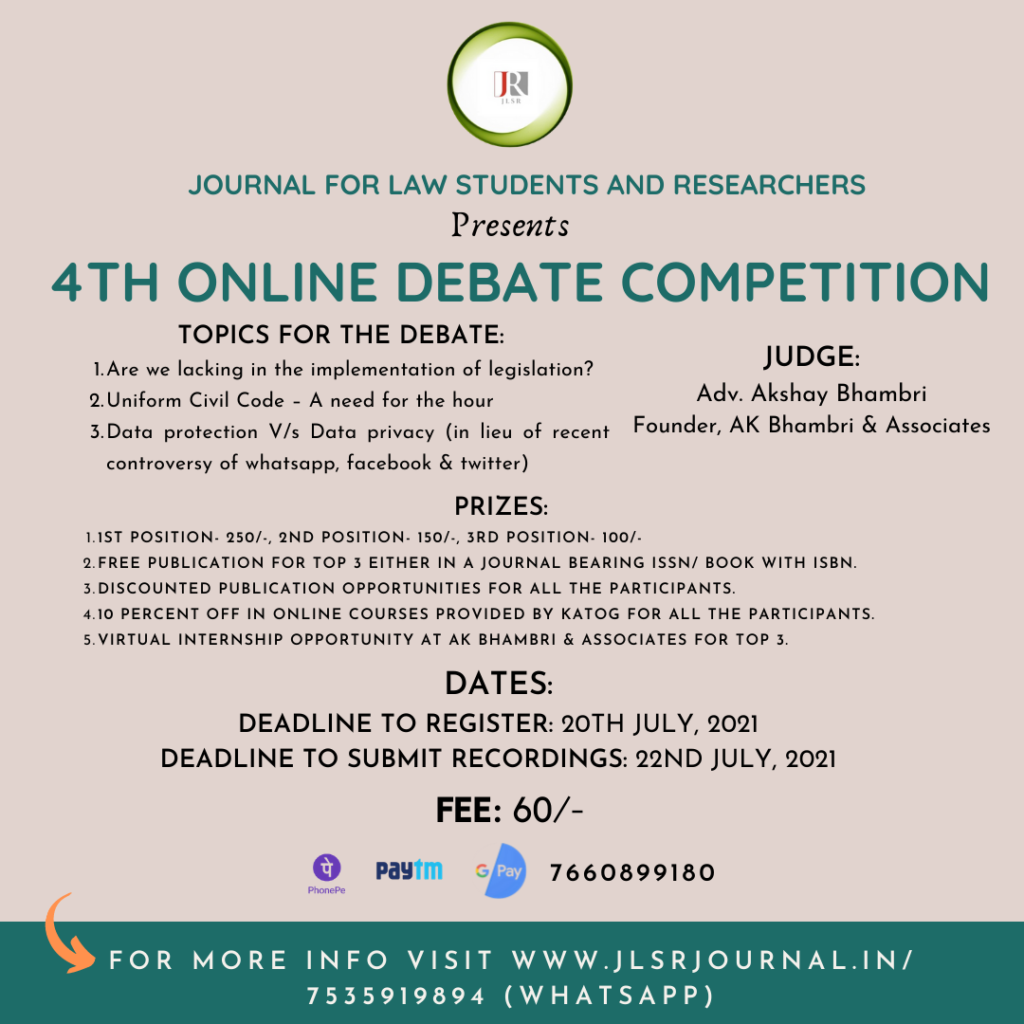
ABOUT:

Journal for Law Students and Researchers [JLSR]  is an Online Journal with ISSN[O]: 2582-306X and 9 indexings, which is quarterly, Peer-Reviewed, published online and JLSR seeks to provide an interactive platform for the publication of Short Articles, Long Articles, Book Reviews, Case Comments, Research Papers, Essays in the field of Law.

JLSR welcomes contributions from all legal branches, as long as the work is original, unpublished, unplagiarized and is in consonance with the submission guidelines.

TOPICS :

1.Are we lacking in the implementation of legislation?

2.Uniform Civil Code – A need for the hour

3.Data protection V/s Data privacy (in lieu of recent controversy of whatsapp, facebook & twitter)

Note : Video/Audio recording should be either for or against one of the topics

LANGUAGE :

English/Hindi

WHO CAN PARTICIPATE

Anyone pursuing undergraduate or post-graduate courses from recognized University or College.

JUDGE

Adv. Akshay Bhambri, Founder at AK Bhambri & Associates

REGISTRATION DETAILS

Fee- Rs.60/-

Link- https://docs.google.com/forms/d/1ukUiFK8RDGsK75zWwbO7neNDNnCc61mkCEqS7g_YsXA/edit

PAYMENT DETAILS :

Googlepay/Paytm/Phonepe at 7660899180

IMPORTANT DATES

Deadline to register : July 20, 2020

Deadline to submit audio/video recording : July 22, 2020

Note : Participant can either mail( jflsrjournal@gmail.com) their recording after registration or else upload in the googleform while registering.

GUIDELINES

  • MAKE A VIDEO THROUGH CAMERA(MAKE SURE YOUR GESTURE AND VOICE ARE CLEAR) OR AUDIO.
  • VIDEO/AUDIO RECORDING SHOULD NOT BE LESS THAN 1 MINUTE AND MORE THAN 10 MINUTES.
  • DROP YOUR VIDEOS/AUDIOS IN THE MENTIONED SECTION OF THE GOOGLE FORM OR ELSE MAIL AT jflsrjournal@gmail.com AFTER REGISTERING.

PERKS

  • Cash Prizes : 1st position-  200, 2nd position- 150, 3rd position- 100
  • Free publication for Top 3 either in a journal bearing ISSN/ Book with ISBN.
  • Certificate of Participation to all successfully registered candidates.
  • Online internship opportunity at AK Bhambri & Associates for top 3.
  • Publication opportunity in JLSR(Discounted) for all the participants.
  • 10 percent off in KATOG (A unit of KATOG EDU LLP) courses for all the participants.

FOR ANY QUERY

Write to us at-jflsrjournal@gmail.com

Or contact 9389658270 (Hemant)

Note : Participant will be added in a Whatsapp group within 24 hours once he/she registers.

WEBSITE : www.jlsrjournal.in

For regular updates, join us:

WhatsApp Group:

https://chat.whatsapp.com/BKRZpHyuzA46mTWlaFqdjq

Telegram:

https://t.me/lexpeeps

LinkedIn:

https://www.linkedin.com/company/lexpeeps-in-lexpeeps-pvt-ltd

Visit us for more such opportunities: http://lexpeeps.in/

Gujarat Maritime University has been established under the Gujarat Private Universities Act, 2009. The prime objective of Gujarat Maritime University is to be a global center of excellence in maritime education, research and development, professional training and it aims to enhance and increase the human capital and capacity of maritime industry both in India and across the globe. The aspiration is to serve the global maritime community by producing educated and
well-trained professionals in the maritime domain. On the lines of maritime hubs like Singapore, Hong Kong and China, India’s first arbitration and mediation centre focusing on disputes related to the shipping sector, The Gujarat International Maritime Arbitration Centre (GIMAC) is being built under the aegis of Gujarat Maritime
University and is a key part of the Gujarat Maritime Cluster that will be housed in GIFT City.

Number of Vacancies

01 (One): Contractual for a period of 5 years

Roles and Responsibilities

Role: The candidate would be required to assist the President/Member Secretary of GIMAC or any other senior official of the University or its associate or promoting organizations.

Eligibility Criteria (Educational Background, Skills and Abilities Required, etc)

  • Qualification: LLM or any Master’s Degree in Shipping and Logistics.
  • Work Experience: Candidate should have atleast 10 Years of relevant work experience for business development in Educational Institute / Arbitration Centre / Maritime sector.
  • Age Limit: 40 Years

Last date to Apply:

July 8th, 2021 by 6:00 PM

Official Notification:

https://gmu.edu.in/wp-content/uploads/2021/06/GIMAC_Recruitment_new_1-1.pdf

For regular updates, join us:

WhatsApp Group:

https://chat.whatsapp.com/BKRZpHyuzA46mTWlaFqdjq

Telegram:

https://t.me/lexpeeps

LinkedIn:

https://www.linkedin.com/company/lexpeeps-in-lexpeeps-pvt-ltd

Visit us for more such opportunities: http://lexpeeps.in/

About the Competition:

With an objective to raise the standards of Clinical Legal Education in India, the GD Goenka University, School of Law announces 2ndGDGU International Virtual Law and Technology Moot Court Competition, 2021 in association with Cyber Law University, on 28th& 29th August, 2021.
Moot Court Competitions, which is a mandatory part of law curriculum in our law school offers a practical and application-based approach to learning of law. It gives the law students, the necessary free space to interpret and analyse legal provisions in the context of a given legal regime, while trying to solve a practical problem. The GDGU School of Law is dedicated to promote this aspect of legal training for ensuring a wholesome legal education and the GD Goenka Virtual moot Competition is an endeavour of the School of Law in this direction.

2ndGDGU International Virtual Law and Technology Moot Court Competition, 2021 in association with Cyber Law University is about technology law. Technology law focuses on intellectual property rights, a complex branch of the legal system that deals with disputes over who ‘owns’ intangible ‘property’, such as creative works, patents, copyrights, and trade secrets. Technology law helps protect the creatives who come up with these ideas and also ensures rights concerning the distribution of their work.

Eligibility:

  • Students duly enrolled and pursuing full time 5 years or 3 years undergraduate law course from India or from a foreign university with law as major may apply to participate in 2nd GDGU International Virtual Law and Technology Moot Court Competition, 2021 in association with Cyber Law University.
  • Students enrolled and pursuing post-graduate diploma or short-term certificate courses in law is not eligible to apply.

Registration Details:

  • Each team shall register to 2nd GDGU International Virtual Law and Technology Moot Court Competition, 2021 in association with Cyber Law University by filing registration form, in the prescribed manner by 21st August, 2021.
  • Registration form: https://forms.gle/QhoHXhsUnN1yW9gw7
  • On receipt of the duly filled registration form the institute shall respond to the participating team, acknowledging the receipt.
  • The registration fee for the competition is Rs. 999/- for Indian Teams and 11$ for International Teams.

Rules and Regulations:

https://drive.google.com/file/d/12fd2Eoyf4EvGVpLtSdX23lKpywCekDi8/view

Moot Proposition:

https://drive.google.com/file/d/1euzPoDWCMvjD1Pn9eXUd3BX5iy4X24Z5/view

Important Dates:

Registration opening from30th June, 2021
Final date of Registration21st August, 2021
Clarification questions to be submitted by10th August, 2021
Clarifications released by 15th August, 2021
Memorial Submission 21st August, 2021
Competition Dates 28th& 29th August, 2021

Official Website:

http://www.gdgoenkamootcourt.com/

Contact Information

Faculty Advisor

  • Shreyas Vyas: +91-7693015323
  • Abhinav Kumar: +91-8840993730

Student Coordinator

  • Ayush Gupta: +91-7017183604
  • Shrishti Bansal: +91-8433191400

For any query you can also drop a mail on mootcourt@gdgoenka.ac.in

For regular updates, join us:

WhatsApp Group:

https://chat.whatsapp.com/BKRZpHyuzA46mTWlaFqdjq

Telegram:

https://t.me/lexpeeps

LinkedIn:

https://www.linkedin.com/company/lexpeeps-in-lexpeeps-pvt-ltd

Visit us for more such opportunities: http://lexpeeps.in/

NITI Aayog, Government of India had initiated an Internship Scheme in 2015. Based on the experience in the past years a review was made. Now in supersession of all the previous guidelines in this regard, The NITI Aayog announces the revised Internship Scheme. This Scheme seeks to engage students pursuing Under Graduate/Graduate/Post Graduate Degrees or are Research Scholars enrolled in recognized University/Institution within India or abroad, as “Interns”.

 Internship Scheme

The interns shall be given exposure to various Verticals/Divisions/Units within NITI Aayog and would be expected to supplement the process of analysis within NITI Aayog through empirical collection and collation of in-house and other information.

The online application link will be open from 1st to 10th of every month.

Please Note: The applications open now for the internship starting from the month of September.

Duration of Internship

  • At least 6 (Six) weeks but not exceeding 6 (Six) months.
  • Interns not completing the requisite period will not be issued any certificate.

Eligibility

Bonafide students of any recognized University/ Institution within India or abroad, fulfilling the following conditions are eligible to apply for the internship:

  • UG students, having completed/appeared in the term-end exams of second year/4th semester of the bachelor degree course and secured not less than 85% or equivalent marks in 12th class.
  • Graduate students having completed/ appeared in the term-end exams of first-year/2nd semester of their post-graduate program or persuing research/Ph.D. and secured not less than 70% or equivalent marks in Graduation.
  • The students who have appeared in the final exam or just completed Graduation/PG and waiting for admission for higher studies may also be considered for internship provided that they have secured 70% or more cumulative marks in all the years/semesters of their graduation/ post-graduation till the date of application.
  • The period between the month of declaration of result of the final exam and the desired month of the internship should not exceed 6 (Six) months e.g. if the result is declared in the month of June then he/she can apply for the internship beginning till the month of December.

How to Apply?

  • The interested applicants may apply online only on the website of NITI Aayog by the 10th of July
  • The application can only be made six months in advance but not later than 2 months before the month in which the internship is desired.
  • Applicants must also clearly indicate the area of interest.
  • Please Note: A candidate can apply for an internship only once during a financial year.
  • The selected applicant has to produce original mark sheets and NOC from the college/institution at the time of joining, failing which his/her candidature shall be canceled. (Format given in Annexure ‘C’ of the official notification).

Official Notification:

http://niti.gov.in/sites/default/files/2018-12/NITI_Internship_Guidelines.pdf

Official Website:

http://niti.gov.in/internship

For regular updates, join us:

WhatsApp Group:

https://chat.whatsapp.com/BKRZpHyuzA46mTWlaFqdjq

Telegram:

https://t.me/lexpeeps

LinkedIn:

https://www.linkedin.com/company/lexpeeps-in-lexpeeps-pvt-ltd

Visit us for more such opportunities: http://lexpeeps.in/

About National Law Institute University, Bhopal and Centre for Labour Laws

The National Law Institute University, Bhopal (NLIU), was established by the Rashtriya Vidhi Sansthan Vishwavidyalaya Adhiniyam, by an Act No. 41 of 1997, enacted by the Madhya Pradesh State Legislature. NLIU is recognized by the University Grants Commission and the Bar Council of India. National Law Institute University’s important rock pillar- Centre for Labour Laws (CLL) was established in 2019. Although born in one of the most uncertain times mankind has ever seen; i.e., Covid-19 Pandemic, CLL is destined to grow as a bearer of light and empathy. The Centre is one of its kind and serves as an embodiment of labour rights for the brick bearers of the nation- our labourers & workmen. One of the aims of the Centre is to provide a platform for research on policy, institutional, legal and regulatory issues and act as a platform for exchanging ideas amongst Govt. Authorities, Lawyers, Policymakers, Regulators and Academia.

About the Labour and Employment Law Blog

Labour and Employment law is a niche area, and has a plethora of opportunities and potential in terms of research. CLL strives to provide a forum for exchange of ideas in this field. The Labour and Employment Law Blog has been established to stimulate academic research and discussion to help develop accessible understanding of contemporary labour and employment law issues.

Submission Guidelines:

We request you to read the Submission Guidelines carefully before sending your work.
1. Submissions are invited on a rolling basis.
2. Submissions can be made to centreforlabourlaw.nliu@gmail.com with the subject: “Blog submission: *title of your blog*”.3. The blog post must be submitted in a .docx or .doc file attached to the email sent. PDFs or blog posts in the body of the email will not be accepted.
4. Co-authorship is permitted up to 2 authors.
5. The submission must be between 800-1500 words. Posts falling below or beyond this range will be considered depending upon the discretion of Editors.
6. Font: Times New Roman, 12. Alignment: Justified. Line Spacing: 1.5.
7. Posts must include hyperlinks to relevant legal sources and references made, including any judgments, laws, treaties or other legal texts which are mentioned. If the author(s)
are using Endnotes, then they must be used only for offline sources complying with Bluebook 20th edition.
8. Posts should reflect authentic, original and unpublished work of the author(s).
9. The author(s) must not mention their name(s), college/firm, address or any other information that may indicate their identity, in the document submitted.
10. Cross-publishing is not permitted.

For any updates, please follow our Social Media Handles.
In case of any queries mail us at centreforlabourlaw.nliu@gmail.com.

Contact:

Ravi Sharma (Editor-in-Chief)
+91 | 8285744702   (WhatsApp Only)

Rounak Doshi (Managerial Head)
+91 | 9644755530   (WhatsApp Only)

You can access the blog website by clicking here.

For regular updates, join us:

WhatsApp Group:

https://chat.whatsapp.com/BKRZpHyuzA46mTWlaFqdjq

Telegram:

https://t.me/lexpeeps

LinkedIn:

https://www.linkedin.com/company/lexpeeps-in-lexpeeps-pvt-ltd

Visit us for more such opportunities: http://lexpeeps.in/

The Department for Promotion of Industries and Internal Trade (DPIIT) under the Ministry of Industry and Commerce, officially selected Gujarat National Law University for establishment of DPIIT IPR Chair, under the Scheme for Pedagogy & Research in IPRs for Holistic Education & Academia (SPRIHA). National Intellectual Property Rights (IPR) Policy ,2016, a vision document promotes a holistic and conducive ecosystem to catalyze the full potential of intellectual property for India’s economic growth and socio-cultural development. One of the several objectives of the Policy is to strengthen IP Chairs in educational institutes of higher learning to provide quality teaching and research, develop teaching capacity and curricula and evaluate their work on performance-based criteria.

About the Internship Scheme

The internship program aims to foster research in IPR and to set up a productive IP ecosystem in India. The Internship program will provide an excellent opportunity to familiarise with the activities of DPIIT IPR Chair. The interns will be required to provide high-quality research and are also expected to facilitate and coordinate the programs conducted by the DPIIT IPR Chair. Towards the completion of Internship, Interns have to submit the research work assigned to them in the form of papers, presentations or reports.

Eligibility

Applications are invited from students from recognized Law Institutions and Universities and having a strong interest in IP law.  Candidates are expected to be proficient in legal research and writing, and should be willing to learn.

Application process

Interested candidates are required to send their application along with the following requisite to dpiitchair@gnlu.ac.in 

  • Cover letter (in the body of the e-mail)
  • Curriculum vitae; and
  • A writing sample either published or unpublished on Intellectual Property Law (between 1000-1500 words including footnotes)
  • The subject line of the email should be “Application for Internship with DPIIT -IPR Chair”.

The last date to apply for an online Internship is July 20, 2021.

Duration

The duration of the internship would be for six (6) to eight (8) weeks.

Mode of Internship

The Internship will be online. All the reporting and dissemination of information will take place through the Mail. Every task allocated to the interns will have specific guidelines to be followed.

Certificate of Internship

Certificate will be awarded to the interns upon satisfactory completion of all the mandatory requirements of their internships and on submission of their Report/Paper and its evaluation by the DPIIT -IPR Chair.

Terms & Conditions

  • No stipend shall be provided for the Internship.
  • We reserve the right to terminate the internship at any time, if a selected candidate is found to not diligently fulfil his/her obligations during the internship period.
  • If the internship is so terminated, the candidate will not be provided with the certificate.

After the selection process, information will be sent to selected Interns via mail.

For regular updates, join us:

WhatsApp Group:

https://chat.whatsapp.com/BKRZpHyuzA46mTWlaFqdjq

Telegram:

https://t.me/lexpeeps

LinkedIn:

https://www.linkedin.com/company/lexpeeps-in-lexpeeps-pvt-ltd

Visit us for more such opportunities: http://lexpeeps.in/

Introduction

The Constitution is not a mere lawyer’s document, it is a vehicle of life, and its spirit is always the spirit of the age.

Dr. B.R. Ambedkar

As the mitochondria in biology are referred to as the powerhouse of the cell, the Indian Constitution can be said to be the powerhouse for the working system of the nation. It is an instrument of control for the three arms of the nation namely Legislature, Executive & Judiciary. It helps in the systematic separation of power between the three arms of the government, safeguarding the rights & providing the limitations for the inhabitants. 

Basic structure doctrine & its evolution

As article 368 power to the parliament (legislature) to amend the constitution when the necessity arises, the article also lays the fundamental rules & procedure for amending the constitution.    

Parliament’s amending powers are absolute and they incorporate all parts of the constitution. Although, the Supreme Court has functioned as decelerate to the legislative ardor of Parliament since India’s independence. With the focal intent on safeguarding the beliefs of the constitution-makers, the Supreme Court articulated that Parliament could not contort; detriment, or reorient the fundamental characteristics of the Constitution under the plea of amending it.  

It was the case of Indra Nehru Gandhi case in which the faith of the doctrine of basic structure was established & reaffirmed. The petitioner had filed an appeal against the ruling of the Allahabad High Court refusing her win in the election as the Prime Minister. While the appeal was unsettled or in reserve at the Supreme Court, the 39th Amendment was legislated and upheld which affirmed that no court has its jurisdiction over the election of the Prime Minister. Certain other features were also added like the Rule of Law & Power of Judicial Review to the basic structure.

In the case of Minerva Mills, the Supreme Court gave lucidity to the doctrine and set out that the power of amendment under Article 368 is restricted and execution of such power cannot be absolute. A restricted amending power was important for the basic structure doctrine of the Constitution. Further, the congruence and harmony between fundamental rights and directive principles are additionally essential for the basic structure, and anything annihilating the equilibrium is an ipso facto infringement of the doctrine. 

The case of L. Chandra Kumar, again expressed that the power of judicial review under Article 32 of the Supreme Court and Article 226 The High Court is essential for the basic structure doctrine and these powers cannot be attenuated by moving them to administrative tribunals.

Golak Nath Era

The Constitution of India was amended in 1951, which set forth the much-discussed Article 31A and 31B to it. Article 31B instituted the ninth Schedule which asserted that any law gave under it could not be tested for the infringement of Fundamental Rights according to Article 13(2) of the Constitution. Article 13(2) states that the Parliament will not draft any law which abbreviates the rights given under Part III and to that degree it will be void.

An appeal was documented in the Supreme Court of India testing Article 31A and 31B on the ground that they curtail or detract rights ensured under Part III of the Constitution which is against the pneuma of Article 13(2) and thus ought to be pronounced void. In the case of Shankari PrasadThe, Hon’ble Supreme Court held that the power to amend the Constitution including the Fundamental Rights is presented under Article 368, and the word “Law” as referenced under Article 13(2) does exclude an amendment of the Constitution. There is a dissimilitude between Parliament’s law-making power, that is, the legislative power and Parliament’s power to amend or integral power.

After this, few amendments were brought to the Constitution and indeed the extent of amendments was tested in the Sajjan Singh case. The five-judge bench in Sajjan Singh dispensed the legitimacy of the 17th amendment which had added 44 regulations to the 9th schedule. However the entirety of the judges concurred with the verdict of Shankari Prasad yet without precedent for the agreeing belief by Hidyatullah and Mudholkar JJ, questions were raised on the liberating power of Parliament to amend the Constitution and reduce the fundamental rights of the residents.

The Golak Nath verdict

In 1967 an eleven-judge bench of the Supreme Court, passing its 6:5 majority judgment in the Golak Nath case, Chief Justice Subba Rao set forth the inquisitive position that Article 368, which contained provisions associated with the amendment of the Constitution, simply set out the amending procedure. Article 368 did not present upon Parliament the power to amend the Constitution. The amending power (constituent force) of Parliament emerged from different provisions contained in the Constitution (Articles 245, 246, 248) which enabled it to make laws i.e. plenary legislative power.

Consequently, the Supreme Court held that the amending power and legislative power of Parliament were basically something similar. Hence, any amendment of the Constitution should be account law as perceived in Article 13 (2).

The judgment summoned the idea of inferred constraints on Parliament’s power to amend the Constitution. Article 13, as per the majority view of judgment, manifested this constraint on the power of Parliament. Parliament could not change, limit or hinder fundamental rights because of this very plan of the Constitution and the idea of the rights allowed under it. The judges expressed that the fundamental rights were so sacred and supernatural insignificance that they could not be limited regardless of whether such a move was to get the consistent endorsement of the two houses of Parliament. They saw that a Constituent Assembly together might be invoked by Parliament to amend the fundamental rights if vital.

Kesavananda Bharati Era

This case was at first filed to challenge the legitimacy of the Kerala Land Reforms Act, 1963. However, the 29th Amendment of the Constitution set it under the 10th schedule. The appellant was allowed to challenge the 29th Amendment as well as the legitimacy of the 24th and 25th Amendments. 

  • The Kesavananda Bharati Judgement

The notable judgment was given by a 13 judge bench and with a 7:6 majority; they overruled the Golak Nath case. It was held that the power of Parliament to amend the Constitution is all over and reaches out to every one of the Articles yet it’s anything but limitless to a degree that it annihilates certain fundamental features or structure of the Constitution.

The Hon’ble Supreme Court, although, held that the 24th Amendment was legitimate as it just states what was available before certainly. It does not augment the powers of Parliament; Article 368 consistently incorporated the power and way to amend the Constitution.

Basic features of constitution according to Kesavananda verdict

Each judge set down independently, what he thought were the primary or fundamental elements of the Constitution. There was no unanimity of assessment inside the majority view. 

The majority view of the verdict, Chief Justice Sikri, clarified that the idea of basic structure incorporates:

  • Primacy of the Constitution 
  • Conservative and elected based of government 
  • Secular nature of the Constitution 
  • Separation of powers between the legislature, executive and the judiciary
  • Federal nature of the Constitution

Justice Shelat & Grover added two more essential characteristics to the list: 

  • The command to assemble a government assistance state contained in the Directive Principles of State Policy
  • Solidarity and probity of the country

Justice Hegde & Mukherjea recognized a different and more limited list of fundamental characteristics: 

  • Supremacy of India 
  • Parliamentary based feature of the country 
  • Solidarity of the country 
  • Fundamental characteristic of the individual freedom got to the residents 
  • Command to construct a government assistance state

Justice Jaganmohan Reddy expressed that components of the fundamental highlights were to be found in the Introduction of the Constitution and the arrangements into which they interpreted, for example: 

  • Sovereign elected republic 
  • Parliamentary democracy 
  • Three organs of the State

The minority view of the verdict given by Justice A.N. Ray, M.H. Beg, K.K. Mathew and S.O.N. Dwivedi additionally concurred that the Golaknath verdict had been wrongly interpreted. They maintained the legitimacy of every one of the three amendments tested under the eye of the court. Justice Ray held that all pieces of the Constitution were fundamental and no qualification could be made between its fundamental and unimportant parts. Every one of them concurred that Parliament could enact fundamental amendments in the Constitution by practicing its power under Article 368.

Conclusion

One of the most favorable attributes of the Indian Constitution is that it can be amended as per the needs of society. The basic structure doctrine gives the fine harmony among adaptability and inflexibility that ought to be there for amending the power of any Constitution. In today’s time, we can say that there is no quarrel concerning the doctrine but, the only trouble that emerges time & again is the content of the same. 

Still, the sovereign, parliamentary based and secular character of the nation, rule of law, judicial independence, fundamental rights of residents, and so forth are a portion of the fundamental characteristics of the Constitution that have seemed consistently in the Supreme Court’s pronouncements.

The article has been written by Ajay Kataria, from Dr. B.R. Ambedkar National Law University, Sonepat, Haryana.

Latest Posts


Archives

INTRODUCTION

Jurisprudence is defined as the science or philosophy of law. The origin of this term can be traced back to a Latin term, ‘Jurisprudential,’ translated to the ‘study, knowledge or science of law.’ There are five primary schools of thought in jurisprudence. They are:

  • Philosophical School.
  • Historical School.
  • Realist School.
  • Sociological School.
  • Analytical School.

This article attempts to explain the analytical positivism of the analytical school of thought. The analytical school of thought is also known as the positivist law or the positive school. This is mainly because the proponents of this theory focused on what the law is rather than what it should be. For example, if there is a law that punishes anyone murdering with a death sentence, then according to the positivist law, people must follow this rule without questioning if anyone should be given a death sentence. Analytical positivism calls for consideration of empirical facts, rejecting any moral or value-based theories.   

ORIGIN

Through the 18th century, the natural law theory was more prominent in practice. According to the natural law theory, there are some laws common to all societies irrespective of their cultural or ethnic backgrounds. Natural law theory is based on the premise of the human conscience of what is good and what is evil. Anything morally wrong is considered to conflict with the law according to this theory. It was only around the beginning of the 19th century when the positivist school of thought emerged, rejecting the unclear assumptions of the natural law school. 

As proposed by Jeremy Bentham and John Austin, the theory of utility and analytical positivism contributes majorly to the analytical school of thought. Analytical positivism also found support in the works or ideas of philosophers like Salmond, Hart, and Holland. Auguste Comte, a French thinker, was the first one to coin the term positivism. The term ‘positivism’ has five meanings:

  1. Law commands.
  2.  Legal concept analysis differs from social and historical investigations and critical evaluation.
  3. Decisions can be made based on predetermined guidelines.
  4. Moral judgments cannot be accepted or defended by rational arguments.
  5. Law, as it is, must be kept separate from the law that ought to be.

JEREMY BENTHAM’S CONTRIBUTION

In England, Jeremy Bentham became the flag-bearer of a new era of history in legal thought. His theories on positivism later led to the establishment of a new school of thought (Analytical School of thought). Around the late 18th century, the law that existed in England was mainly developed through customs. The then prevailing English legal system lacked organization. At this point, Bentham, with his robust positivist approach, gave a new direction for legal research and lawmaking. His ideas laid the building blocks for a phase of transformation from Blackstone’s Natural Law Theory to the Analytical School of thought.

In Bentham’s belief, every law must be considered concerning eight aspects, namely:

  1. The source of the law
  2. The subject of the law could be either persons or things.
  3. The object for the enactment of the law.
  4. The extent of the applicability of the law
  5. The aspect of the law, i.e., whether it is directive or sanctioned.
  6. Force
  7. Expression and
  8. Remedial State Appendages

This was a first-of-its-kind proposition and further laid the foundations of a new approach. Bentham’s theory might have some shortcomings, but no one can deny his importance in shaping the positivist approach of the Modern English law and laying the bedrock for the emergence of new schools of thought, the Analytical school being one of the most important of them. Needless to say, John Austin also owed much to Jeremy Bentham for his works on Analytical Positivism.

JOHN AUSTIN’S CONTRIBUTION

English legal theorist John Austin has extensively used the analytical method in his works, and hence the analytical school founded by him became famous with different names like positivism or analytical-positivism. For his significant contribution in this field, he came to be known as the father of the analytical school of thought (the law of positivism). Austin believed the law to be the command of the sovereign (imperative concept of law), imposed by politically superior to politically inferior. Austin was the first one who had set out to differentiate between positive law and positive morality through his works. A positive morality, according to him, is a law by analogy and hence not an appropriate subject matter to be discussed under jurisprudence. In his theory, Austin did not include laws of inanimate objects or improper laws. 

He had a firm idea of law being rules set by men for men. He divided law into two parts:

  1. Human law
  2. Laws of God

Human law can be further divided into two kinds:

  1. Positive law – Laws set by persons acting as political superiors in pursuance of legal rights. (According to Austin, positive law was the proper subject matter to be dealt with under jurisprudence.)
  2. Other laws – Several rules or opinions which have moral and sentimental undertones. (International law is classified under this category by John Austin.)

Austin’s theory was clear, simple, and consistent in regards to what it wanted to explain.

This made his proposed school of thought quite famous, and many other jurists and schools of thought have followed after it. However, many theorists have later classified John Austin’s school as the Imperative school. This is because positivism is a term that failed to define the idea of Austin’s school single-handedly. Similarly, the word ‘analysis’ was not confined to this school and hence could create confusion.

Austin is given the credits for opening a new era of approach to law. Even the flaws of his theory paved the way for new ideas to follow. Later many jurists and philosophers such as Salmond and Gray took inspiration from his thoughts and improved upon his approach.

CONCLUSION

In conclusion, we can say, the analytical school of jurisprudence believes that the most significant feature of the law is its relationship to the state. As a result, the school is also known as the obligatory school. In the United States, prominent jurists like Gray, Hohfeld, and Kocourek supported the school, as did Kelson, Korkunov, and others in the Continent. Analytical Jurisprudence is a methodological approach to law that views law as a collection of actual interlinked principles rather than a random collection of rules intrinsically linked to the transcendental Law of Nature. It aims to describe, classify, identify the key characteristics, and establish a yardstick by which all laws may be judged.

The article has been written by Debasmita Nandi, a first-year law student of Christ (Deemed to be) University Lavasa.

Latest Posts


Archives

Case Number 

Civil Appeals Nos. 292 and 312 of 1950

Civil Appeals Nos. 120 and 121 of 1357F

Equivalent Citation 

1954 AIR 364, 1955 SCR 393

Bench

The Hon’ble Justice Sudhi Ranjan Das

The Hon’ble Justice N.H Bhagwati

The Hon’ble Justice b. Jagannadhadas

Decided on 

01/04/1954

Relevant Act/ Section  

Clause 6 of the Company’s Memorandum of Association Article 116,

 Section 13 of the Hyderabad Excess Profits Tax Regulation, Article 116 of the Articles of Association 

Clause 3, Section 2 clause 4 of the Excess Profits Tax Regulation

 Section 2 clause (4) of the Excess Profits Regulation

 Section 39 para-C of the Finance (No. 2) Act, 1915 

Article 115 of the Articles of Association

 Section 4 of the Indian Partnership Act

 Section 5 of the Indian Companies Act

Brief Facts 

On February 14, 1920, a mill firm was established in Hyderabad. The appellant’s corporation was also established on March 1, 1920. The following month, both firms reached an agreement under which the appellant was designated as the other company’s agent for a period of 30 years, subject to the terms and conditions set forth at the time of the agreement. The corporation paid the appellant the same sum as a form of salary for the Flash Years 1351 to 1352. The appellant received a notice from the officer of Excess Profit Tax to pay the tax on the obtained payment. The appellant responded by stating that the remuneration does not fall under the category of taxable income. This claim was rejected, and an order was issued to examine the appellant’s records and income and assess the tax appropriately.

Issues before the Court

  • Is the petitioner firm a partnership or a registered corporation?
  • Is the petitioner an employee of the Mills Company or a business owner under the terms of the agreement?
  • Is the money received from the Mills for services rendered or for business?
  • Does the Company fall within the personal qualification principle referred to in Section 2(4) of the Excess Profits Regulation?

Decision of the Court

When the matter was handed over to the Supreme Court, it issued a ruling that addressed the four issues presented by the high court. Question 1 and 4 were answered in light of section 14 of the Indian Partnership Act, which states that a partnership is a relationship in which partners agree to share all profits and losses. The decision was based on the case of “Indercchand Hari Ram Vs. Commissioner of Income Tax.”

Regarding issues 2 and 3, the court made several observations. The subject matter of an incorporated corporation, as defined in the Memorandum of Association, appears to be ambiguous as to whether the company’s operations amounted to carrying on or undertaking. They are, nonetheless, critical in identifying the type and scope of such actions.

After considering all the relevant factors, including the agents’ agreement and the appellant’s terms, the court concluded that everything the appellant does for the company is a form of business, and the remuneration and other benefits that the agents receive from the contracting party are a portion of the profits and gains that he receives under the contract’s terms. As a result, he cannot claim that payment is not taxable income, and so his appeal was dismissed by the Supreme Court.

This case analysis is written by Shrey Hasija, 1st-year a law student at Vivekananda Institute of Professional Studies, GGSIPU.

LATEST POSTS


ARCHIVES

Assistant Professor Jobs in Shimla: HPNLU announced job notification for the post of Assistant Professor has been released officially. Candidates who meet the eligibility criteria alone can apply on the official website hpnlu.ac.in. The application process ends on 08.07.2021.

Post Name: Assistant Professor
No of Posts: 01
Salary: 15,600 – 39,100 (Per Month)
Experience: 3 – 7 years
Education: N/A
Location: Shimla

Last Date

08-07-2021

Selection Procedure:

Stringent criteria may be applied for short-listing the candidates to be called for interview.

How To Apply?

The Completed application form may be sent to, The Registrar, Himachal Pradesh National Law University, Shimla; 16 Mile, Shimla-Mandi National Highway, Ghandal, District-Shimla, Himachal Pradesh-171014, latest by 5.00 PM, 8th July, 2021.

  • Opening date for submission of Application Form: 15-06-2021
  • Closing date for submission of Application Form: 08-07-2021 (5.00 PM)

General Conditions

  • The application form must be accompanied by additional sheets (wherever required) and enclosures giving details of academic qualifications, experience, published works etc.
  • No TA/DA shall be paid to the candidates for attending the interview.
  • The University reserves its right to place reasonable limit on the total number of candidates to be called for interview.
  • In-service candidates shall route their applications through proper channel. However, candidates are advised to submit an advance copy of the application form well before the last date. They will, however, be considered for interview only after their applications through proper channel are received by the University.
  • Applications forms not accompanied by necessary supporting documents, self-attested copies of degree certificates/ marks sheets/experience certificate/category certificate/reprints (if applicable) issued by the competent authority and the incomplete application forms shall be rejected summarily.
  • The eligibility of candidates will be determined as on the last date fixed for receipt of appli5cation Forms.
  • Any change of address given in the application form should at once be communicated to the University.
  • Before applying for a post, candidates are advised to satisfy themselves about their eligibility. No enquiry in this regard will be entertained.
  • The prescribed qualifications and experience are minimum and the mere possession of the same will not entitle a candidate for being called for interview.
  • The University shall verify the antecedents or documents submitted at any time at the time of appointment or during the tenure of the service. In case, it is detected that the documents submitted are fake or the candidate has a clandestine antecedents/background and has suppressed the said information, his/her services shall be terminated forthwith.
  • Stringent criteria may be applied for short-listing the candidates to be called for interview.
  • The process of selection may be by a presentation/ Interview or a combination thereof.
  • Application should be accompanied with a non-refundable demand draft of Rs. 1000/- for all categories drawn in favour of the Registrar, Himachal Pradesh National Law University, Shimla, Payable at Shimla. Incomplete application forms or application forms received after the last date will be summarily rejected.
  • The University shall not be responsible for postal delay, if any.
  • In case of any inadvertent mistake in the process of selection, which may be detected at any stage even after the issue of appointment order, the University reserves the right to modify / withdraw/ cancel any communication made to the candidates.
  • All further communications related to the above recruitments shall be through letter/ notices displayed on the University website i.e. www.hpnlu.ac.in
  • The prescribed Application Format is available on the University website.

Other Terms And Conditions

  • For the Teaching Posts, the qualifications/eligibility and other terms and conditions of the appointment and service shall be as prescribed by the UGC Regulations and Regulations of Himachal Pradesh National Law University, Shimla.
  • Application Form should be accompanied with experience certificate, wherever required, from appropriate institution/authority clearly specifying duration of service, pay scale and last (Gross) salary drawn.

For regular updates, join us:

WhatsApp Group:

https://chat.whatsapp.com/BKRZpHyuzA46mTWlaFqdjq

Telegram:

https://t.me/lexpeeps

LinkedIn:

https://www.linkedin.com/company/lexpeeps-in-lexpeeps-pvt-ltd

Visit us for more such opportunities: http://lexpeeps.in/