About the job

The School of Law (SoL), Mahindra University (MU) invites applications for faculty positions from candidates with a passion to teach and research the legal and socio-legal subjects. Interested candidates may please send their CV before 18th July 2021 to Brainard.Chandrahas@mahindrauniversity.edu.in with subject as Application for faculty position in SoL.

Under the Mahindra University (MU) umbrella, the School of Law (SoL) will be commencing academic activities (Subject to the approval of BCI) in Fall 2021, with Integrated 5 Years program in B.B.A., LL.B. (Hons.), and Integrated 5 Years program in B.A., LL.B. (Hons.)

Location: Hyderabad

Candidates who can teach the following subjects may apply:

Law of Torts, Legal Methods, ADR, Law of Property, Constitutional law, Law of Contracts, Criminal Law, Criminal Procedure, Family Law, Jurisprudence, Interpretation of statues, Public & Private International Law, Company Law, Intellectual Property Law, Civil Procedure Code, Labor Law, Administrative Law, Environmental Law, Banking, Insurance and Insolvency Law, Competition Law, Tax Law, Law of Evidence, Human Rights Law, Cyber Law.

Social Sciences Subjects:

Political Science, Law & Economics, Sociology, History (including Legal & Constitutional History)

Management Course:

Principles & Practices of Management, Marketing Management, Business Accounting, Human Resource Management, International Business Management, Financial Management & Strategic Management, Economics.

Qualification:

  • The candidate must have Ph.D. The candidates who are pursuing Ph.D Degree holders may also be considered.
  • A Master‘s Degree with at least 55% marks (or an equivalent grade on a point scale, wherever the grading system is followed). 

For regular updates, join us:

WhatsApp Group:

https://chat.whatsapp.com/CdshAqpiV1FEogy5pBlY43

Telegram:

https://t.me/lexpeeps

LinkedIn:

https://www.linkedin.com/company/lexpeeps-in-lexpeeps-pvt-ltd

Visit us for more such opportunities: http://lexpeeps.in/

About the job

IILM University invites applications for faculty positions at the IILM Law School

Job Requirements: Faculty members must demonstrate excellence in teaching and would be expected to teach undergraduate / graduate courses, mentor students and engage in Institutional activities. Faculty members will also be required to oversee internship programs. All faculty members must maintain an active research career, resulting in two or more publications per year in professional peer-reviewed journal(s).

Qualification:

A Ph.D. Degree with first class or equivalent grade at the preceding degree in an appropriate branch / discipline with a consistently good academic record throughout. Post Ph.D. publications and guiding Ph.D. students are highly desirable. Applicants currently completing their Ph.D. will also be considered provided they are able to demonstrate a strong potential for excellence as a teacher.

Adjunct Professor will be appointed on the basis of outstanding professional experience as the sole criterion. Adjunct Professors will deliver subjects in collaboration with the core faculty members.

Areas:

Business/Corporate Law, Contracts and Commercial Law, Tax Laws, Constitutional Law, Cyber Law, Intellectual Property, Alternate Dispute Resolution.

How to Apply?

Candidate may apply to lawschool@iilm.edu

Contact the job poster

HR Manager IILM

For regular updates, join us:

WhatsApp Group:

https://chat.whatsapp.com/CdshAqpiV1FEogy5pBlY43

Telegram:

https://t.me/lexpeeps

LinkedIn:

https://www.linkedin.com/company/lexpeeps-in-lexpeeps-pvt-ltd

Visit us for more such opportunities: http://lexpeeps.in/

Introduction:

Considering the history of racial and caste discrimination in the world, the two most prominent names pop in our minds, i.e., United States and India. Unfortunately, India leads ahead of the US in this particular issue. To abolish such discrimination, the government of India, since its independence has been putting efforts through protective discrimination for the welfare of the languishing units of society. 

Since the inception of the Constitution of India, certain provisions have been primarily enshrined under Part III (Fundamental Rights) and Part IV (Fundamental Duties) for empowering the concept of protective discrimination to fill the societal voids. 

Protective discrimination has been adopted as a tool for granting special privileges to the downtrodden and the underprivileged sections of society. These are the affirmative action programs, and also known as positive discrimination. The term “protective discrimination” implies that a certain right or privilege is provided to those who have been oppressed and discriminated against for ages. Discrimination against discrimination is based on the widely known quote “iron cuts iron”.  There’s no ambiguity as history conveys that one type of discrimination is curative and protective in nature whereas the other type is negative and destructive. The society’s most susceptible section includes-

  • Scheduled Caste
  • Scheduled Tribe
  • Women
  • Children
  • Old age people
  • Transgender

Origin:

The first instance of appreciating the need for such discrimination in Indian history, in favor of the underprivileged, could be seen during the Nationalist Movement. Mahatma Gandhi, a devout Hindu and a staunch believer in the caste system was himself the first leader to recognize the significance of this subject and to invoke the sense of right and wrong of the higher castes to this age-old social malady of relegating whole communities and labeling them as “untouchables”. He renamed these untouchables as “Harijans” (people of God). He strived to provide this policy a religious sanction. He was well aware of the political motive of inaugurating this large body of people into the political mainstream to make the freedom movement more broad-based. 

The Indian Constitution largely followed the pattern of the Government of India Act, 1935, and made provisions for positive discrimination in favor of the Scheduled Castes and Scheduled Tribes (SCs & STs) which constituted approximately 23% of the divided Indian population. Besides reservation in parliamentary seats for them, they were also given advantages through jobs in the public sector, admission in schools and colleges, various pecuniary benefits for their overall development, and so on. Besides assuring the fundamental right of equality of all citizens before the law, the Constitution of India categorically laid down that “nothing in the constitution shall prevent the State from making any special provision for the advancement of any socially and educationally backward classes of citizens or the SCs and STs”.

Statutory Provisions:

The following articles of the Constitution of India provide laws in favor of the concept of positive discrimination:

  • Art. 15(5): The aforementioned sub-section was enunciated by the 93rd Constitution Amendment Act, 2006. It provides that nothing in Art. 15 or in sub-clause (g) of Art. 19 shall prevent the State from making any special provision, through regulation, for the advancement of any socially and educationally backward classes of citizens or SC and ST. Such unique provisions relating to admission to an educational institution and are inclusive of non-public educational establishments, whether aided or not by using the state, other than the minority educational establishments referred to in clause (1) of Art. 30
  • Art. 30(1): All minorities, whether based on religion or language, shall have the right to establish and administer educational institutions of their choice.
  • Art. 16(4): The aforementioned article authorizes the State to make provisions for the reservation of posts in government jobs and training in favor of any backward class, which, in the opinion of the State , is not always adequately represented within the State’s services.
  • Art. 16(4-A): The said article was introduced through the 77th Amendment, enabling the State to make any reservation provision in matters of promotions for SC and ST, which, in the State’s opinion, are not competently represented within the State’s services.
  • Art. 330- Said article permits reservation of certain seats in the autonomous district of Assam for the SC and ST.
  • Art. 332- The aforesaid article provides the reservation of seats for the SC and ST in legislative assemblies of all the states except the scheduled tribes that are within the autonomous district of Assam.

Current Scenario:

The issue of reservation has been an all-time favorite issue in India. However, a PIL has been filed recently in the Hon’ble Supreme Court of India by an advocate who is also an MBBS doctor. The petitioner has posed the following questions before the apex court:

  • Are caste-based reservations in education for eternity in this country or is there a time beyond which they would be rolled back or at least to start rollback?
  • Isn’t there any other affirmative action than to provide reservations in education like giving the weaker sections special education, coaching, financial aid, etc. to enable them to compete in the open?
  • Shouldn’t we empower the weaker sections by making them more competitive rather than depowering them by eternal crutches of reservation?
  • Would eternal reservations in education not divide and fracture the society permanently, promote inequality, and ignite hatred, ill-will, and resentment not only against the reserved class but also against the system?
  • Being the protector of fundamental rights, is it not the bounden duty of the Supreme Court under Art. 14, to put a halt to the reserve discrimination being met to the unreserved class by the eternal reservations?

As of now, a division bench of Justice Nageshwara Rao and Justice Hemant Gupta on June 28th had adjourned the plea for a week, after a letter seeking adjournment was circulated by the petitioner in person.

Petitioner failed to acknowledge that the communities which have been treated as slaves in our history for ages can’t be revived in a snap. The damage done in centuries cannot be restored in a few decades. The objective of reservation seems nowhere near as instances of atrocities and societal exclusion of a person belonging to a lower caste in the society are not unfamiliar yet. A few from weaker sections might have grown financially strong with independence but people often, relying on half information, tend to hate the element of reservation, and fail to appreciate that our constitution provides reservation to those sections of society who are “socially” and “educationally” backward. The ground reality is itself illustrated by the petitioner’s second issue that the weaker sections still need affirmative actions for enabling them to compete naturally. Even after 74 years of independence and reservation provisions, there’s a long way ahead to achieve a non- discriminate nation for global development.

However, my conscience tends to partially agree with the petitioner here. Reservation in jobs, educational institutions, etc. cannot go till eternity. It will divide and fracture society if followed for an indefinite period. As excess of anything causes harm. Therefore, for eradicating both discrimination and reservation, all of us primarily need to end discrimination from our minds and help society to grow unitedly thereby leading to no requirement of reservation.

Conclusion:

Competition must be fair by all means and all the competitors must be treated equally, but only if they come from a similar social and educational background. A country must aim to progress within itself before competing in the world and that is exactly what our constitution aims to do. Coronavirus sees no caste and creed before attacking and has been haunting the whole world for the last one-n-half year. All it needs for its development are human beings, though ill. Similarly, we too need to unearth these fallacies as soon as possible for the overall development of our nation. Appropriate actions must be taken for a steady improvement. Lastly, protective discrimination is a boon, but a bane if followed till eternity.

The article has been written by Shikha Sagar, a third-year BA LLB student of Vivekananda Institute of Professional Studies, Delhi.

Latest Posts


Archives

Introduction

Novus actus interveniens is a Latin phrase that, when translated, amounts to ‘new intervening act.’ It is a principle of Tort law. 

Novus actus interveniens, in relation to a tortious action for negligence, can be defined as any intervening act that can separate or break off the legal connection between a defendant’s conduct and the final injury incurred by the plaintiff, thus preventing the defendant from being held legally liable for the plaintiff’s harm. For an act to be considered as Novus actus, it must be reasonably unpredictable. If the second and subsequent act could be apprehended or stemmed from the first act itself, then this principle will not be applicable, and the legal burden will not be waived off the defendant. Attributed to this principle is a general rule of measuring the remoteness of damage. If any outside force (Act of God or intervention by a third party) or the plaintiff himself causes interventions subsequent damage to the injury already caused, then it will amount to the remoteness of damage. 

Case Of Martin V Isbard (1947)

For understanding this concept better, let us consider the case of Martin Vs. Isbard, a 1947 English case. In this case, Martin, the plaintiff, was traveling in a taxi which met with an accident because of the negligence of the driver. The plaintiff had experienced a concussion as a result of this accident and, when taken to the hospital, was told that she suffered a major fracture in her skull. After recovering from the initial shock, although she returned to work, she would occasionally feel dizzy and experience headaches. For this reason, she stopped working and went to Melbourne with her parents. However, after a few weeks, she was told that a review of the X-ray showed that she had no skull fracture. After this, she went under another X-ray examination which again said that she did suffer a skull fracture. But a review of this report also resulted in the finding of an erroneous medical report falsely stating that she suffered from a skull fracture. Before this case went into a trial, the plaintiff had another X-ray done, revealing she never suffered any injury in her skull. It was also determined that the occasional periods of dizziness that she faced were more related to the stress induced from the wrong X-ray reports. Now the question put before the Court was to determine the gravity of responsibility the taxi driver ought to bear. Had he not been negligent in the first place, the accident would not have taken place and resulted in the misleading X-ray reports. The judge drew a conclusion that the anxiety caused to Miss Martin was a result of negligence on the part of the doctors. Thus, the Court opined that the two wrong X-rays were ‘Novus actus interveniens’ or a ‘new intervening act’ which cut off the direct link between the final injury suffered and the initial negligence contributed by the defendant.

Test Of Isolation

The test of isolation is a new method that has gained importance while deciding if the defendant can be made liable for the final injury caused to a plaintiff constituting one or more causes of harm. According to this test, if the relation to the illegal conduct (an omission or commission) which resulted in causing damage to the plaintiff is regarded to have been snapped when it is separated from its repercussions, then the defendant is no longer accountable for any consequences that may follow. When the chain of causation is broken in the eyes of the law, making the former act exhausting itself, the wrongdoer can no longer be held liable for any further upshot. This might be the result of an intervention of a third party or an act of God resulting in the second act of violation.

Exceptions To The Rule Of Novus Actus Interveniens:

The exceptions to the rule of Novus actus interveniens are listed as follows:

  1. If the defendant has intentionally undertaken the intervening act in question
  2. If the intervening actor cannot be made fully responsible for the outcome
  3. If the intervening act was reasonably foreseeable
  4. If the intervening acts in question are some involuntary action or a bare reflex

 Relevant Case Laws:

VOSBURG V PUTNEY, 1891 (Defendant made liable even when the injury was not foreseeable.)

In this case, a boy kicked another in the classroom from across the aisle. It turned out that the victim was suffering from an inflamed microbiological infection, which caused him to lose all use of his leg. Undoubtedly no one could have foreseen the severity of the injuries. Despite this, the Wisconsin Supreme court determined that the kicking was illegal because it breached the “order and decorum of the classroom.” Hence, the perpetrator was held entirely responsible for the injuries.

SMITH V LEECH BRAIN & CO, 1962 (Defendant made liable as the initial injury was foreseeable.)

 In the English case of Smith v Leech Brain & Co (1962), molten metal was splashed on an employee. It resulted in a burn on his lips. The tissue which got burned happened to be premalignant. Later, after three years, he died of cancer, which was initially triggered by this injury. The Court held that since the initial damage was foreseeable, the defendant was liable for all the harm.

HABER V WALKER, 1962 (Intervening act in question when combined with the initial wrong does not point towards a mere coincidence.)

In Haber v Walker, the Court arrived at the judgment that a plaintiff cannot be held accountable for a Novus actus interveniens ( a new intervening act) if the chain of causes is broken by a deliberate, human act or an external incident that, which when combined with the wrongful act, is so rare as to be deemed as happenstance.

NADER V URBAN TRANSIT AUTHORITY OF NSW, 1985 (Victim must be considered, including his mental, social, physical, and economic attributes.)

This is an Australian case where the plaintiff, a 10-year-old kid, was struck in the head by a bus stop pole while exiting a slow-moving bus. This injury led him to develop Ganser syndrome, one of the rarest psychological diseases. In response to this, the defendant claimed that the child had developed this illness due to his family’s reaction to the mishap. Judge McHugh, in this case, however, concluded that the plaintiff should be considered with all his weaknesses, beliefs as well as reactions. All of his social, economic, and physical attributes must be considered. Since this accident resulted in a ten-year-old boy reacting to his parent’s apprehension regarding the accident and developing a hysterical condition, the victim must be duly compensated by the defendant.

MAHONEY V KRUSCHICH DEMOLITIONS, 1985(Intervening actor cannot be made fully liable)

The plaintiff, Glogovic, while working on the demolition of a powerhouse for the respondent, had suffered some injuries. When he was being treated by the appellant Mahony due to medical negligence, his injuries were aggravated. The Court held that medical treatment of injuries caused by the defendant’s negligence did not result in Novus actus since it was not inexcusably terrible or utterly outside the confines of what a credible medical practitioner might prescribe.

Conclusion

In conclusion, one can say any act which severs or cuts off the direct link between the defendant and the final injury caused is termed as Novus actus interveniens (a new intervening act). In such a case, the defendant can be made liable only to the extent of the initial negligence caused by him and not for the final injury. For example: If person A suffers an injury on his leg because of B and is then shot by person C on the injured leg, B will only be held liable for the initial negligence and not the gunshot injury.

The article has been written by Debasmita Nandi, a first-year law student of CHRIST (DEEMED TO BE UNIVERSITY), LAVASA.

Latest Posts


Archives

Introduction

Plea bargaining is a pre-trial practice, wherein the accused pleads guilty in exchange for a lesser punishment or even some of the charges being dropped. This is where negotiation takes place between the accused and the prosecutor on initiation made by the accused only. 

Ever heard of the Salem witch trials? In 1692, in the US, the Salem Magistrates to uncover more witches made the accused witches testify against the others. The deal was they would be left to live in exchange for their confessions and executed otherwise. Salem witch trials are one of the oldest illustrations of the practice of plea bargaining. Plea bargaining as a practice is common in the US and it struggled a long time, from being considered unethical at the least and illegal at its worst. Since the 1920s, there were cases in the US that acknowledged plea bargaining providing the solution to expensive litigation both in terms of time and money. In 1967, the President’s Commission on Law Enforcement and Administration of Justice documented the practice of plea bargaining and recommended the practice to be put in use and since then, it has made its place.

Plea Bargaining In India

Before 2005, India didn’t formally recognize plea bargaining. Courts disapproved of it for the longest time calling the practice to be contrary to public policy, unfair, unconstitutional, illegal, and as something that promotes corruption, collusion, eventually threatening the justice system.  Indian criminal law always had this provision for the accused to plead guilty in place of a trial but that couldn’t possibly be understood as plea bargaining. The 142nd report of the Law Commission of India (1991) recommended giving “concessional treatment” to those who plead guilty on their own accord but didn’t recommend including plea bargaining in its form. Later, in its 154th report (1996), a recommendation was made to include plea bargaining in its experimental form followed by a similar recommendation in the 177th report (2001). This recommendation later found its support in the Malimath Committee Report.

Plea bargaining was officially introduced in India in 2006, when Chapter XXI-A was inserted by Act 2 of 2006, containing Sections from 265A to 265L. 

Plea bargaining is allowed only in limited cases. 

  • Offenses punishable with imprisonment for a term, not more than 7 years.
  • Offenses that do not affect the socio-economic conditions of the country.
  • Offenses that are not against a woman or a child below 14 years.
  • Available in private complaints in which a Criminal Court has taken cognizance.

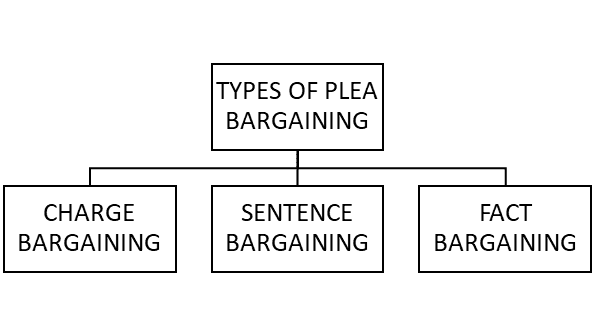
Charge Bargaining- Negotiating for dropping a charge in multiple charges or settling for a lesser charge.

Sentence Bargaining-  Admission of guilt and settling for a lesser sentence.

Fact Bargaining- Bargaining as to admission to some facts in exchange for an agreement to not introduce some other facts.

In 2020, the practice of plea bargaining came under the spotlight when foreigners who were members of Tablighi Jamaat attended the religious congregation Nizamuddin Markaz, amid the pandemic and were released through plea bargaining. The charges were a violation of visa conditions and guidelines given by the Government in the wake of the pandemic, etc. They accepted milder charges and paid fines under plea bargaining.

Procedure Of Plea Bargaining Under CrPC, 1973 (Sections 265A TO 265L)

  • Application for plea bargaining is filed by the accused containing a description of the case with the offense along with an affidavit sworn by the accused that he voluntarily applied for plea bargaining, understands the nature of the offense and its punishment, and that he has not been convicted of the same offense in any case previously. 

Note- Use of the statements or facts mentioned by the accused in this application are to be used in plea bargaining only and not for any other purpose.

  • After this, the Court issues notice to the Public Prosecutor/complainant and the accused to appear on a specific date when the accused is examined by the Court in-camera to the satisfaction that the application has been filed by the accused voluntarily. 
  • On satisfaction, both the parties are given time to work out a mutually satisfactory disposition of the case (accused giving compensation, etc to the victim) setting the date for further hearing. A report is then prepared by the Court signed by the parties and the presiding officer of the Court.
  • If the application is found to be involuntarily filed or that the accused has been previously convicted of the same offense earlier, the Court will proceed as per provisions under CrPC from the stage of filing application.
  • After a satisfactory disposition is reached by the parties, a report is then prepared by the Court, signed by the parties and the presiding officer of the Court. The case is then disposed of by awarding compensation to the victim as per the disposition and then a decision upon the quantum of punishment for the accused is made. 
  • If Probation of Offenders Act, 1958 or Section 360, CrPC, or any other law time being in force applies to the case, the accused may be released on probation or provided a benefit of any other law.
  • After hearing this, if minimum punishment for the offense committed is given under law, sentence- ½ of such minimum punishment.
  • But if the accused is not covered in any of the 2 provisions given above, sentence- ¼ of the punishment provided or extendable.

Judgment regarding disposal of the case is given in open court and is signed by the presiding officer.

Benefits Of Plea Bargaining

  • Speedy Trial- Trials are time-consuming and India, having an insurmountable number of pending cases, faces an ardent need for speedy trials. Plea bargaining provides just that.
  • End the anxiety of uncertain outcomes- Trials could be tricky most of the time, where it could turn in any possible direction. With plea bargaining in practice, one did an offense, that one pleaded guilty of it too. Hence, it removes the possibility of being anxious over the unpredictable nature of trials.
  • Saves litigation costs- It wouldn’t come as a surprise to you that going to trial is expensive. If one gets to negotiate pre-trial, it saves huge bucks that would otherwise have gone to the advocates, etc.
  • Impact on conviction rates- Imagine the conviction rates, when it is possible to have speedy disposal of cases. Why do you think the US does so great in this department?
  • Lesser sentence- In exchange for accepting a plea deal, the accused may be given a lesser sentence or even a reduced charge like that of a misdemeanor instead of a felony. 
  • An opportunity for a fresh start- There is a possibility under plea bargaining that an accused gets convicted for a lesser sentence. This allows the convicted to make a change in his life and start afresh.
  • A solution for the problem of overcrowding of jails- Accused awaiting trial are kept in jails that work just as a holding center with little or no scope for rehabilitation or correction. The delay in trials and conviction leads to overcrowding of the jails. With plea bargaining in the picture, faster disposal of cases is possible.

Criticism Of Plea Bargaining

  • May be made under coercion- It is a possibility that plea deals are made under coercion from the prosecutor or are bad in faith.  Hence, the accused might feel threatened and accept the plea deal even when he/she is innocent.
  • Criminal record- When one pleads guilty under plea bargaining, that does not mean that he would escape the conviction somehow. As a consequence, one would always have a criminal record.
  • Misguidance from the counsel itself- Sometimes, plea bargaining comes as a piece of bad advice from the counsel of the accused itself, agenda behind could be to get rid of the case sooner, lack of legal experience, inability to fight the case on its merits, etc.
  • Role of Judges in plea bargaining- Even though both parties agree to plea bargaining, a Judge may declare it void. A judge can even set aside the plea deal and move the case to trial if he feels like it is made in bad faith.
  •  No opportunity to appeal- In a trial, if the accused is not satisfied with the decision of his conviction, in almost all cases he appeals to a higher court against the judgment. But, once an accused pleads guilty, there is no scope for him to appeal against the conviction except special leave petition under Article 136 and writ petition under Article 226 and 227 of the Constitution.
  • Not the most moral practice in the book- Concessional punishments under plea bargains seem unfair to victims of the offenses committed by the accused for which he pleads guilty on the record.
  • Right to free and fair trial threatened- There are arguments that plea bargaining is unconstitutional in the sense that it violates the right to free and fair trial of the accused. If the plea deal is the outcome of coercion, incapacity of the defense attorney, etc. then the possible conclusion makes this practice bad in law. 

Even the justice system suffers because of this practice because plea deals are all about the negotiation skills of the counsels for both the parties and not winning the case on its merits in the trial.

Conclusion

It’s been more than a decade since plea bargaining was inserted in CrPC, but one would observe that it is uncommon in India since its inception. There have been doubts and worries to put the practice in full motion. As mentioned above it has various disadvantages but what one tends to forget is the benefits of it. To conclude a careful and balanced analysis of both the advantages and disadvantages has to be done since It is not justified to exclude something solely based on its demerits. Lack of awareness of the masses about their rights, coercive confessions, etc is the reason for the restricted scope of plea bargaining in India. As per statistics given by GOI in 2015, the plea bargaining rate in India was a mere 0.045% (last available statistics on the subject), pending cases were over 2 crores across the nation and undertrial prisoners were 2.8 Lakhs. If you are wondering what’s the current status, so at present, there are over 4 Crore pending cases all over India. If the future is the same as the present with an insurmountable number of pending cases in Indian Courts, which honestly will be, then the need of the hour is to give plea bargaining the space it needs.

The article has been written by Munmun Kaur, a law student from Law Centre-I, Faculty of Law, Delhi University.

Latest Posts


Archives

About GLC Mumbai:

Founded in 1855, the Government Law College, Mumbai, is the oldest and one the most prestigious law schools in Asia. Tapering over the entire legal education system, its illustrious alumni have dominated the list of legal professionals in India for over a century and a half.

About the Competition:

The National Leadership Summit’21, an initiative by the Government Law College is a pan India leadership conclave among the best student debaters, policymakers, and opinion-makers. 

As a part of the Discourse Segment of the National Leadership Summit’21, we are organising “The 2nd Freedom Fighter Late Shri Prem Nidhi Agrawal Memorial Article Writing Competition.”

Eligibility:

The Article Writing competition is open for any student pursuing their Undergraduate or Postgraduate degree, in any distinct field, from any recognized University/College in India.

Registration Fees:

No registration fee would be charged for participating in this Competition.

Prize:

Cash Prizes for the winners of the competition are as follows:

  • 1st Prize: Rs. 6000/-
  • 2nd Prize: Rs. 4000/-
  • 3rd Prize: Rs. 2,000/-

In addition, the articles of the First and the Second prize winners shall be published in the First issue of a GLC Journal – “La Politique” and they will be awarded a Publication Certificate as well. All participants would be awarded a Participation Certificate.

Submission Guidelines:

The submission guidelines for the competition are:

  • The Article must be in the English language only and the submission shall be in Microsoft Word (.doc or .docx format).
  • Co-authorship allowed up to a maximum of two authors.
  • Only one submission is allowed per author/team. Submissions, both as co-author and single author, will be treated as multiple submissions and will be disqualified as an entry to the competition. 
  • There should not be any form of identification mark such as the name of the author, University/College name, etc. on the article. Any form of identification will lead to disqualification.
  • The article must contain an abstract of not more than 300 words including keywords.
  • The word limit of the article should be 2000-3000 words, excluding footnotes and abstract.
  • The write-ups shall have no plagiarism and only original works that have not been published elsewhere and have not been submitted to any other organization are to be submitted. 
  • The Articles shall be sent to glcleadershipsummit@gmail.com with the Subject “2nd P. N. Agrawal AWC_Submission”  on or before 11:59 pm, 17th July 2021.

Official Details:

For regular updates, join us:

WhatsApp Group:

https://chat.whatsapp.com/BKRZpHyuzA46mTWlaFqdjq

Telegram:

https://t.me/lexpeeps

LinkedIn:

https://www.linkedin.com/company/lexpeeps-in-lexpeeps-pvt-ltd

Visit us for more such opportunities: http://lexpeeps.in/

About the GNLU Centre for Criminal Justice Sciences:

Recognizing that a comprehensive appreciation of the technicalities, complexities and patterns of criminal law are indispensable for realizing the goals of the law, the University established the Centre for Research in Criminal Justice Sciences, as a centre of excellence to carry on research in the niche area of Criminal Law. 

The centre provides a platform for a holistic research environment and aims to further knowledge and academic discussions about the multifaceted dimensions of criminal science.

About the Competition:

To encourage legal research and writing in the area of Criminal Law, essays are invited from the law students (both UG and PG) of the country on the following themes:

  • Sentencing policies in India: Change is need of hour.
  • Independent police organization in India.
  • Miscarriage of justice: Challenges & remedies.
  • Social Media and Crime

Submission Guidelines for the Essay:

Word limit for the essay is 3500-5000 words.

  • The essay must have a title.
  • It has to be original, unpublished and should not be plagiarised.
  • Co-authorship is not allowed.
  • Formatting Guidelines: for the body: Times New Roman, size 12, justified, 1.5 line spacing
  • For Footnotes: Times New Roman, size 10, justified, 1 line spacing
  • Citation style: 20th edition bluebook.
  • The essays will be checked through the anti-plagiarism software for screening purpose.
  • Submission deadline: 30th July 2021, before 5 PM. 
  • There is no participation fee.

Submission should be made to: gcrcjs@gnlu.ac.in with cc to atomar@gnlu.ac.in with subject of the mail being “Submission of Essay”.

There is no registration requirement prior to the submission. The entries require photo proof from students of their association to their law college/university.  The essays will be accepted with a declaration about the originality of work. Apart from the ID Proof and declaration, the Author must mention the following in the body of the mail while submitting the essay:

  • Name of the Author
  • Name of the University
  • Course enrolled in
  • Current Year of Study (as of 30th July 2021)
  • Title of the essay
  • Contact details of the Author

Prizes:

  • First prize: 5000 INR with certificate
  • Second prize: 2500 INR with certificate.
  • Third Prize: 1000 INR with certificate
  • Merit Certificate for top 10 essays.

Every participant will get the certificate of participation (Plagiarised submissions shall be disqualified and hence, no certificate). 

If the reviewers recommend, the articles will be published in form of a book with a reputed publishing house.

Evaluation Method:

The essays will be evaluated /reviewed by external examiners (from other institute than GNLU) through a process of blind review. The decision of the evaluators shall be final and binding.

Contact Details:

Coordinator: Mr. Nihal Deo

E-mail ID: gcrcjs@gnlu.ac.in

For any query, you may contact us via Email or call/text Nihal on +91-9631222159.

For regular updates, join us:

WhatsApp Group:

https://chat.whatsapp.com/BKRZpHyuzA46mTWlaFqdjq

Telegram:

https://t.me/lexpeeps

LinkedIn:

https://www.linkedin.com/company/lexpeeps-in-lexpeeps-pvt-ltd

Visit us for more such opportunities: http://lexpeeps.in/

On Monday Madras HC passed an order based on no new public buildings should be constructed without being disabled-friendly. The buildings should be able to access by persons with disabilities.

The court observed that whether public buildings and including court has a facility to be accessed by persons with disabilities. And the toilets must also be installed in public buildings which may be used by persons with disabilities, the court added. The respondents are reminded that no new public buildings may be constructed or sanctioned or planned without providing access for persons with disabilities without ensuring toilets and other facilities for such persons, the court’s order stated.

This was held by the bench of Chief Justice Sanjib Banerjee and Justice Senthilkumar Ramamoorthy who was dealing with the public interest litigation, petition moved by M Karpagam. Earlier, the court asked the state to file a report on how far public buildings are accessible for differently-abled persons. The court asked the state to create a list of buildings with the facilities including toilets for the different persons, let the matter stand over for two months for a more detailed report to be filed. The bench further emphasized that the concerned authorities, particularly the public works department and its officials, should be acquainted with the governing statute (rights of persons with disabilities Act 2016) and the national building code to ensure that all instructions contained in the same are adhered to without any exception.

During hearing the Chief Justice Banerjee admitted that when he visited two of the lower courts there were no such facilities made for the differently-abled persons and this to be taken into consideration. He added that he has instructed the principal district judges to ensure that the court gets ramps installed. The courts should have at least one toilet close to the entrance on the ground floor that is disabled-friendly. Concerning this, the new transport buses should also be termed to be disabled-friendly was the court recalled that this has to be directed by the transportation department. Take the comprehensive measures to make all public buildings, particularly where citizens are likely to come they must be disabled friendly, said the Chief Justice to the State.

Advocate R Prabhakaran appeared for the petitioner. The case was adjourned by eight weeks and will be taken up on September 13. This is in the light that every human has to be treated equally. Though they have some defects in their body they shouldn’t feel the way they are different from others. So this has been kept in consideration by the court and working on this serious issue.

-Report by AJISHA

About the Institute:

GITAM School of Law a private law school is one of the constituent institutions of GITAM (Deemed to be University), situated at Rushikonda in Visakhapatnam in the Indian state of Andhra Pradesh. The law school offers 5 Year Integrated BA.LLB (Hons), BBA.LLB (Hons) and One Year LL.M programmes with specialization in IPR & Cyber Law, Corporate Law and International Law & WTO approved by the Bar Council of India (BCI), New Delhi.

This School of Law was established in 2012 by the Gandhi Institute of Technology and Management, commonly known as GITAM Deemed to be University, Main Campus at Visakhapatnam, Andhra Pradesh.

About the Competition:

GITAM, School Law, Visakhapatnam is organizing the Dr. MVVS Murthi Virtual National Moot Competition,2021. The event is scheduled to be held from 27th to 29th August 2021 at GITAM, Visakhapatnam. GITAM Moot & Advocacy Committee (GMAC) has been set up in 2019. The objective of this Committee is to provide the students with an opportunity to develop their interpersonal & Advocacy skills.

Participation in Moot Court Competition enhances the art of researching and the oratory skills of a student while prepping the student to face the reality of a courtroom. It also aids in confidence-building. Mooting gives a practical courtroom experience to a law student. The Committee successfully conducted the GITAM Regional Moot Court Competition in July 2019. The School of Law, GITAM (Deemed to be University) Visakhapatnam is organizing the DR. M.V.V.S MURTHI, 2nd National Virtual Moot Court Competition, 2021, scheduled to be held from 27th August to 29th August 2021. 

Eligibility:

  • Law schools/Colleges/ Institutes/ Universities, recognized by the Bar Council of India, are eligible to participate. The participants should currently be pursuing their degree in law i.e., 3-Year/5-Year Law/LLM Courses. Students who have completed their law courses are not eligible to participate in the competition.
  • Only one team can register from a particular law school/College/ Institution/ University to participate.
  • There shall be two speakers and one researcher designated for each team. In case of illness of the designated speaker, the researcher may be allowed to argue for the team with the prior permission of the Committee.

Registration:

Click here to register for the competition: https://lawc.to/RuvNr

Payment Details:

The wire transfer/NEFT must be made to:

  • Name of Account: M/s Seminars and Workshops School of Law
  • Union Bank Account No: 761302010000486 
  • IFSC Code: UBIN0576131 
  • Branch: GIMSR Branch, Rushikonda, Visakhapatnam-530045

Mode of payment

Online Bank transfer in favour of M/s Seminars and Workshops School of Law

Last Date for Registration: 31st July 2021

Registration Fee: INR 2500/-

Contact Info:

  • All queries relating to the Moot Problem may be clarified by sending an email to mcc.schooloflaw@gitam.edu on or before 20th July 2021.
  • Any dispute about the Moot Court Competition shall be referred to the GMNMC Committee before the end of the competition. In all matters of complaints or disputes, the decision of the Committee shall be final.

Important Note: For the Moot Proposition, Rules & Regulations, and other relevant information, refer to the official information.

Official details:

For regular updates, join us:

WhatsApp Group:

https://chat.whatsapp.com/BKRZpHyuzA46mTWlaFqdjq

Telegram:

https://t.me/lexpeeps

LinkedIn:

https://www.linkedin.com/company/lexpeeps-in-lexpeeps-pvt-ltd

Visit us for more such opportunities: http://lexpeeps.in/

In the matter, the applicant had applied for bail in Allahabad High Court which was denied by the court on 5th July. The case is relating to the Honor killing where victim Jyoti and Rahul got married o against their family members’ consent. Their families were against their marriage as they belong to a different caste.

It is been alleged that due to the caste difference they still got married which has hurt their family honor that’s the reason the Applicant who is the brother of Jyoti and her other family members had eliminated her and killed shot her husband Rohit.

During the argument, the Applicants Counsel stated that the role of assaulting was done by another family member of the applicants but not by the Applicant himself. The people who are accused to be involved are Jyoti’s father, Jyoti’s Uncle, and her brother.

Justice J.J.Munir of Allahabad High Court while hearing the plea of bail application states that “there is no place for those citizens in the society who go to the extent of eliminating a family member for choosing a life partner of his/her choice”. Court also stated that it is the case of brazen of honor killing where family members of Jyoti have prima facie sought to redeem through this crime. So the court has refused his bail.

-Report by RIDDHI DUBEY