About the Organisation

Jus imperator is a Double Blinded Peer Review E-Journal with ISSN: 2456-9666 that provide platform to professors, scholars, academicians, professionals and students, for publishing paper in the field of law and management. We uses technology to enhance and cultivate the writers and their talents with a mission to develop writing as A PEN IS MIGHTER THAN A SWORD. The main objective of the journal is to encourage research publication.

Theme 

Author can select any topic related to law or management.

Registration fee

Rs 250 per author 

Procedure for Registration

  1. Author must send the email on jusimperator@gmail.com including their Name, Institution name and contact number.
  2. Author must attach the screenshot of the Payment
  3. TOP 10 blogs will get publish on the website in blog coloumn. 

Perks

1st Prize: – Rs 2100 + Certificate of merit

2nd Prize: – Rs 1100+ Certificate of merit 

3rd Prize: – Rs 700 + Certificate of merit 

TOP 3 blogs will get oppurtunity to take part in the competition of Jus Team in the next event.  

Payment Procedure 

  1. Paytm :- 8349076187
  2. Phone Pay:- 8349076187
  3. Bank Account details  :- 

Account Number: – 3489199960

Account Name: – Rajat Godha

Bank: – Central Bank of India

IFSC Code: – CBIN0284707

Submission procedure

Authors have to send their Manuscript on jusimperator@gmail.com 

For more details Whatsapp us on 8349076187 or mail us on jusimperator@gmail.com 

ABOUT 

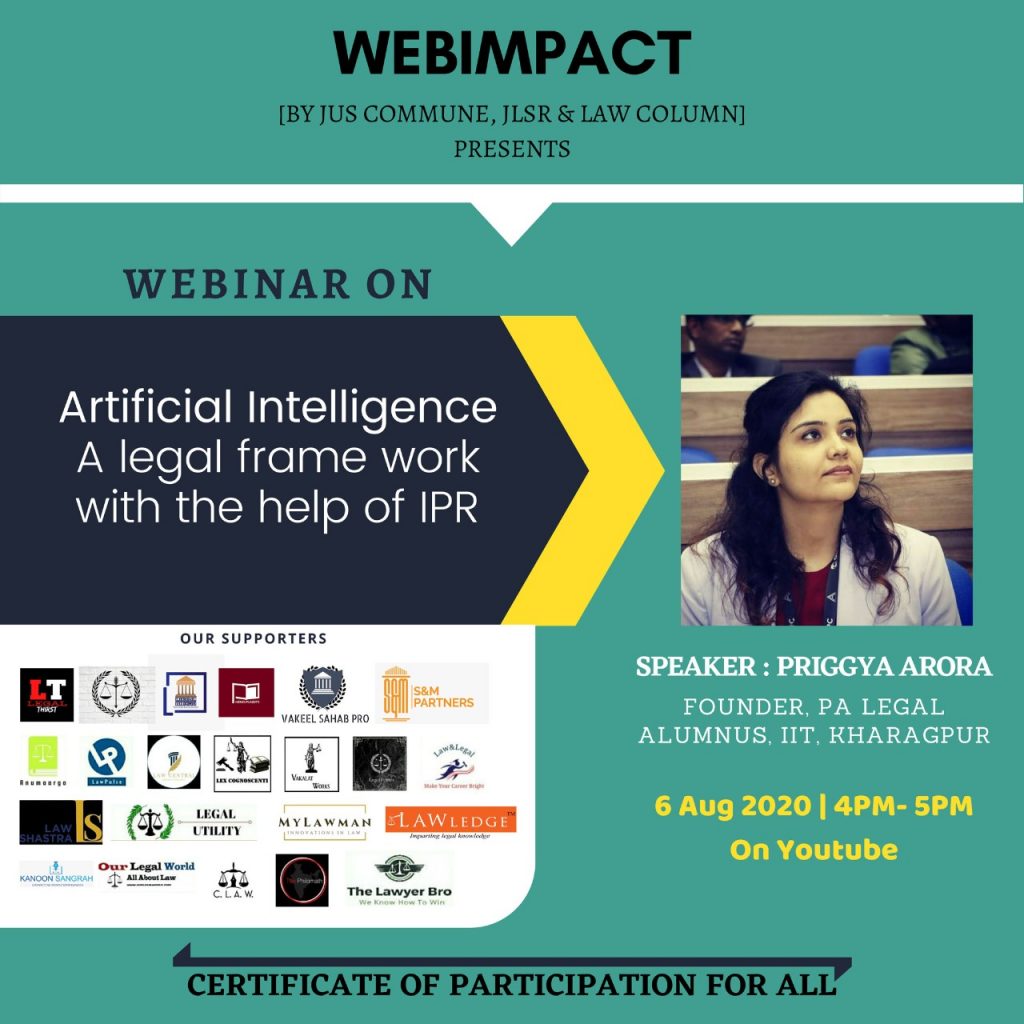
WEBIMPACT is an initiave by JLSR, JUS COMMUNE AND LAW COLUMN. It was started to educate law students through webinars.

WEBINAR DETAILS :

TOPIC: Artificial Intelligence A Legal Frame Work With The Help Of IPR
SPEAKER: Priggya Arora, Founder at PA LEGAL
DATE: 6 TH AUGUST, 2020
TIMINGS
: 4 PM- 5 PM

REGISTRATION LINK :

https://docs.google.com/forms/d/1qRRGSggAuOuwi1Wyy7IgelQtKyiYRa4MjuYylsEWj8/ed

NOTE: CERTIFICATE OF PARTICIPATION FOR ALL FOR ANY QUERY

Write to us at- communejus@gmail.com
jflsrjournal@gmail.com
site.lawportal@gmail.com

WEBSITES :

https://thejuscommune.wordpress.com/
 www.jlsrjournal.in
https://lawcolumn.in/

ABOUT US:

ANUMAARGA is a innovative-novel legal platform that aims to provide ‘LEGAL-AID’ and ‘LEGAL-EDUCATION’ over a single platform. Team ANUMAARGA is lead by its visionary leader Mr. Deepanshu Raj ideas to democratize the way India learns and simplify the first step towards justice (legal-aid).It provides a different portal for lawyers to communicate within its community or with people in need of Justice with intent to increase the quality of legal aid while keeping in check the costs involved. In short, It tries to serve the vision of uniting lawyers willing to provide legal aid with people in need of it. Also, this application is designed for passionate learners to explore and monitor the strategic landscape of legal field.

Students can browse through high-quality articles, news, recent judgements, reports and research papers to better understand the topics driving transformational change. It also provides internship opportunities to students.

STUDENT EDITORS JOB DESCRIPTION

Editing is an intricate business. We are looking for student editors with strong grip on language and detail-oriented outlook. 

VACANCIES

 5 student editors required.

ELIGIBILITY

  • Focused undergraduate students of law- 5 years program ( BA LLB/ BBA LLB) and also 3 years program (LLB).
  • Coherent writing skills are sought for in the candidates.

HOW TO APPLY?

Send your CV to submission.anumaarga@gmail.com.

CALL FOR SOCIAL MEDIA HANDLER

JOB DESCRIPTION

The Social Media Project Manager may also be called a social media manager, social media project lead or community manager.

The Social Media Project Manager determines which strategy to deploy on social networks in keeping with the overall communication strategy: which presence, what form, how often, which communities, who at the company will participate, best practices, etc.

The Social Media Project Manager is responsible for implementing the defined strategy. Each day he coordinates the team interactions via social media and, more broadly, manages its e-reputation.

VACANCIES

 2 student required.

ELIGIBILITY

  • Focused undergraduate students of law- 5 years program ( BA LLB/ BBA LLB) and also 3 years program (LLB).
  • Coherent writing skills are sought for in the candidates.

HOW TO APPLY?

Send your CV to submission.anumaarga@gmail.com.

FOR ANY QUERY CONTACT- Ms. Saman Rizwan: 6306936025

This article is authored by Kirti Bhushan, a student of Campus Law Centre, University of Delhi. The article’s major focus is to discuss Section 377 of the Indian Penal Code, 1860 in reference to its historical background which ultimately led to it being partially struck down in 2018.

INTRODUCTION

Section 377 of the IPC, 1860 states: “Whoever voluntarily has carnal intercourse against the order of nature with any man, woman or animal shall be punished with imprisonment for life, or with imprisonment of either description for a term which may extend to ten years, and shall also be liable to fine. 

Explanation: Penetration is sufficient to constitute the carnal intercourse necessary to the offence described in this section.”

By a simple reading of this section, one can see that this colonial law which was incorporated in chapter XVI of IPC, 1860 has certainly criminalised homosexuality as they failed to realise that the sexual orientation is natural and people do not have any control over the same. The same law was in force till 2018 when it was partially struck down by the Supreme Court of India in its historic judgment Navtej Singh Johar v. Union of India.

Journey from Prejudice to Pride: Celebrating Pride

The journey from prejudice to pride has been a lengthy one from year 1860 to 6th September 2018 when the Supreme Court decriminalised the same sex relationships. The movement for scrapping down section 377 began nearly three decades ago i.e. during the 1990s and then subsequently the LGBTQ community made their demand vigorously for giving them the same rights as any other citizen of India as no one can regulate their sexual orientation.

It all started on August 11, 1992 when the AIDS Bhedbhav Virodhi Andolan (‘ABVA’) documented a report in which it was explained how the gays were being discriminated against and the ill-treatment they received at the hands of police authorities. It demanded the legislature to repeal the discriminatory section 377 of the IPC, 1860.

Subsequently, the ABVA gained momentum when the then Inspector-General Kiran Bedi of Tihar Jail refused to provide condoms to the prisoners as, in her opinion, it would have led to increase in homosexuality amongst prisoners. Then the ABVA filed a petition in Delhi High Court in the year 1994 to challenge the constitutionality of Section 377 which was subsequently dismissed in 2001 due to lack of support to the petition.

Then in December 2001, the NAZ foundation which was a sexual health NGO filed a public interest litigation (‘PIL’) in the Delhi High Court to challenge the constitutionality of section 377 and decriminalising homosexuality. It was dismissed as it was considered by the Court to have no cause of action and the review petition filed by the NGO later on was also dismissed. Then in February, 2006 a Special Leave Petition (‘SLP’) was filed in the Supreme Court by the Naz Foundation and the Apex Court returned it to the Delhi High Court by holding that it has an issue of public interest.

Then the Delhi High Court in July, 2009 gave a landmark decision when it gave the judgment to strike down Section 377 as it violates the fundamental rights to life, liberty and equality of the people concerned. This judgment was challenged by Suresh Kumar Koushal, a famous astrologer, in the Supreme Court.

The Supreme Court, in December 2013, overturned the Delhi High Court’s judgment stating that section 377 “does not suffer from the vice of unconstitutionality and the declaration made by the division bench of the high court is legally unsustainable.” This came as a significant blow to the hopes of the LGBTQ community.

In June 2016, Navtej Singh Johar who is an award-winning Bharatanatyam dancer, filed a writ petition in the Supreme Court challenging section 377, along with four other petitioners. In August 2017, a nine-judge bench of the Supreme Court gave the judgment where it upheld that the right to privacy is a fundamental right and further explained: “Sexual orientation is an essential attribute of privacy. Discrimination against an individual on the basis of sexual orientation is deeply offensive to the dignity and self-worth of the individual.” Thus, it strengthened the hopes of the people and the various NGOs who were protesting to decriminalise homosexuality.

The decades-long struggle culminated on 6th September 2018 when the Supreme Court unanimously held that section 377 of the IPC, 1860 was unconstitutional and the then Chief Justice Deepak Misra described it as “irrational, indefensible and manifestly arbitrary.”

This has been a welcome step in Indian law as the time has arrived to abolish repressive colonial laws. This judgment has served to be a first step in normalizing the LGBTQ movement in India. The struggle of this community has been tiresome as they have always been discriminated against as well as faced judgments in the eyes of the society. It was indeed necessary to decriminalise homosexuality as the same has now led to the LGBTQ community to live a dignified life since the right to live with dignity is a fundamental right and all the citizens of India can exercise the same.

CONCLUSION

The section 377 of IPC, 1860 has been partially struck down i.e. to say that the consensual sexual acts (oral or anal) of heterosexual couples are still treated as unnatural and are punishable under section 377. Moreover, the personal and secular laws still provide for the marriages between heterosexual couples and not the homosexual couples. The right to adoption is also not available to homosexual couples. Thus, the judgment has led to provide some relief from criminal prosecution to the LGBTQ community yet the Civil Law needs to be amended by the Parliament to help the LGBTQ community to truly help them exercise their right to live a dignified life. 

Merely a judgment will not succeed in changing the mentality of people and there is need to instil the concepts of inclusion and acceptance of diversity in people as well as to teach them not to be discriminatory because the nation is already polarized on various cultural, social or religious grounds.

As the Supreme court has rightly commented its verdict as: “This is the beginning of the end of Prejudice” and therefore, the concept of people being in same-sex relationships should be normalized and the LGBTQ community should be treated at par with other people and we have to normalize same-sex couples and marriages to truly “celebrate the pride.”

Latest Posts


Archives

This article is authored by Kirti Bhushan, a student of Campus Law Centre, University of Delhi. The article explains the phase of a criminal trial in India. There are various types of trials carried on under the Criminal Procedure Code, 1973 and the article focuses to explain all those briefly.

INTRODUCTION

The trial stage commences when the pre-trial procedure i.e. First Information Report and investigation has been completed. The Criminal Procedure Code, 1973 (hereinafter referred to as “CrPC, 1973”), Indian Penal Code, 1860 and the Indian Evidence Act, 1872 govern the procedure, punishment as well as the facts or evidence of a particular case respectively. The procedure regarding a criminal trial and the various forms of trial are prescribed in the CrPC, 1973. According to CrPC, 1973, there are three kinds of trial:

  1. Trial in Warrant cases.
  2. Trial in Summons cases.
  3. Summary trials.

A brief account regarding the procedure of all these trials is explained below.

Warrant Cases

According to section 2 (x) of CrPC, 1973, “warrant-case” means a case relating to an offence punishable with death, imprisonment for life or imprisonment for a term exceeding two years.” Thus, any offence whose punishment exceeds more than two years up to death sentence are called warrant cases and their procedural formalities are explained in sections 238-250 of chapter IX under the CrPC, 1973.

Generally, a warrant case is initiated either on a First Information Report i.e. F.I.R. filed in the police station or a complaint made before a Magistrate. If the Magistrate is of the opinion that he has the jurisdiction to try the case then he can proceed with the same under sections 238-250 else he can commit the case to the Sessions Court if he does not have the jurisdiction to try the same. Then the procedure is as follows:

  1. The Magistrate has to satisfy himself that the provisions of fair trial mentioned under section 207 of the CrPC, 1973 are complied with and the object of this section 238 of the CrPC, 1973 is to apprise the accused regarding the charges framed against him so that he can prepare to cross-examine the witnesses against him as well as a case to defend himself.
  2. Then the Magistrate under section 239 of the CrPC, 1973 may either discharge the accused if, after considering all the material on record as well as giving an opportunity of being heard to prosecution and the accused, he is of the opinion that the case is groundless and he has to record his reasons for the same or he can frame a charge against the accused if he considers that the material available on record prima facie discloses a case against the accused.
  3. If the accused pleads guilty under section 241 of the CrPC, 1973 then he can be convicted by the Magistrate if he has the jurisdiction to do so or else by the Sessions Court under their discretion. If the accused does not plead guilty then the Magistrate can fix a date for examination of witnesses under section 242 of CrPC, 1973.
  4. Then the Magistrate will fix a date for cross-examination under section 242 (1) of CrPC, 1973 but by virtue of the Criminal Procedure Code Amendment Act, 2009 there is a proviso added specifying Magistrate’s duty to supply a copy of statements of witnesses recorded during the police investigation as the objective of such amendment was clearly laid down in the Supreme Court judgment viz. Superintendent v. Satyen Bhowmick And Ors

“an accused was undoubtedly entitled to have copies of the statements of witnesses recorded by the police. This is a very valuable right because without having the statements recorded by the police in his possession, it would be difficult, if not impossible, for an accused to defend himself effectively. It is well settled that fouler the crime the higher should be the proof. If an accused is not supplied either the statements recorded by the police or the statement of witnesses recorded at the inquiry or the trial, how can he possibly defend himself and instruct his lawyer to cross-examine the witnesses successfully and effectively so as to disprove the prosecution case.” 

  1. The Magistrate may summon any of the witnesses or direct them to produce any documents etc. to be produced on the fixed date and the same shall be attested as prosecution evidence under section 242 (3) of CrPC, 1973. Once the prosecution evidence has been recorded then the oral arguments of the prosecution and examination of witnesses under section 313 (1) (b) of CrPC, 1973 follow. The prosecution in a criminal trial presents its case first and adduces all the evidence on record to prove that the accused is guilty beyond reasonable doubt. 
  2. Then under section 313 of the CrPC, 1973 the accused gets an opportunity to be heard and to explain the facts and circumstances of the case. And then comes the stage where the defense gives evidence whereby the defense cross-examines the prosecution witnesses and the defense can also give both oral and documentary evidence.
  3. The parties before closing their evidence have to submit their arguments. Thereafter, the trial ends in either the acquittal or conviction of the accused after the Magistrate records his reason for the same and the judgment is given.

Summons Cases

According to section 2 (w) of the CrPC, 1973: “‘summons- case’ means a case relating to an offence, and not being a warrant- case.” Thus, any case in which the term of imprisonment is less than two years then its trial will be as per the summons trial procedure. These are less serious in nature and thus, their trial differs from that of the warrant cases. Their procedure is laid down under sections 251- 259 under Chapter XX of the CrPC, 1973. A summons case can be transformed into a warrant case if the Magistrate deems it fit to do so. The accused does not have to be present in the Court during such trial and no formal i.e. written charges are required to proceed with the trial. Oral charges are sufficient.

The case can be tried once it is initiated through a F.I.R. Then the procedure is as follows:

  1. The Magistrate gives the accused the substance of the accusations made along with the other particulars of the offence and he will ask the accused if he pleads guilty or not.
  2. In case the accused pleads guilty, he will be convicted after recording his plea under section 252 of the CrPC, 1973. In case the accused pleads guilty but is absent in a petty case, then he has to send Rs. 1000 along with a letter pleading guilty to the Magistrate’s Court and the amount will be adjusted towards the fine charged to him, if any, by the Magistrate.
  3. In case the accused does not plead guilty, then the Magistrate shall hear the complainant and his witnesses and only then give a decision. The accused can also examine the witnesses and the Magistrate has no discretion regarding refusal to the accused’s application to examine witnesses and he is duty bound to summon such witnesses and give decision only after such examination of witnesses is done by both complainant and accused.
  4. Then the Magistrate may pronounce his judgment regarding all such evidence and witnesses on record. The parties can then appeal against such a decision.

SUMMARY TRIALS:

Sections 261-265 under chapter XXI of the CrPC, 1973 provides the procedure of summary trials. The objective of summary trials is the same as that of Summons trial procedure i.e. to save the time of the Court as well as parties in less serious matters. Such matters which are generally settled under one or two hearings come under the purview of Summary Trials. The accused can be sentenced to imprisonment for up to three months only. Section 260 lists the various offences which can be tried summarily. The Magistrate should use his discretion cautiously while deciding to try any case summarily and he should avoid doing it when the facts of the circumstances are complex. In section 262(1) of the CrPC, 1973 the procedure of summons case is to be followed except when a longer sentence than three months is considered fit by the Magistrate to meet the ends of the justice. Then the Magistrate shall make a record of the proceedings as specified under section 263 of the CrPC, 1973.  Section 264 of the CrPC, 1973 provides that “In every case tried summarily in which the accused does not plead guilty, the Magistrate shall record the substance of the evidence and a judgment containing a brief statement of the reasons for the finding.” and section 265 of the CrPC, 1973 specifies the language of record and judgment to be followed.

CONCLUSION

The purpose of division between warrant, summons and summary trials is to distinguish more serious crimes from lesser serious ones. The trial procedure in India is a lengthy one so this division of trial procedures is appropriate to follow. The division is mostly on the basis of punishments prescribed for each type and thus it speeds up the procedure for crimes which are less heinous in nature and thus, it saves the valuable time of the Courts, as well as the parties grievances, are addressed in a timely manner. Sometimes, when any party does not comply with any procedure then it can have lethal effects on that party’s case and sometimes if it is a mere irregularity, then it can be regulated by the permission of the Court.

Latest Posts


Archives

This article is written by Shambhavi Shree, a student of KIIT School of Law, Bhubaneswar (4th year).

INTRODUCTION

Molestation includes involving a woman or child in any sexual activity without their proper consent which violates our Indian law system. It includes sexual assault, child sexual abuse, sexual harassment, sexual abuse, stalking, elder abuse. Molestation may lead to depression, phobias, fear, nightmares, anger, pain, anxiety, injury, stress, personality disorder, lack of sleep, suicide. India has the world’s second-largest child population, therefore it is found mostly to the younger generation when a child is inappropriately touched, forced to perform any kind of sex including, oral, vaginal, or anal sexual activity, pornography, or any sexual conduct which is harmful to the emotional and mental health of the child. According to the recent amendment, anyone having consensual sex with a below eighteen years of age child can be punished with a rape charge. It is often termed as child sexual abuse when the force is of a shorter period it is called sexual assault. Types of child sexual abuse include:

1. Sexual assault: In this case, an adult uses a minor child without the consent for their sexual interest.
2. Sexual exploitation: Exploitation of a minor child for some personal benefit, sexual gratification, financial gain, or advantage. It includes recording and viewing another person’s video, audio, or images of sexual activity and distributing them among others.
3. Sexual grooming: It involves grooming up of a child for sexual abuse by convincing and building a trust relationship.

Indian Laws for Molestation

1. The Protection of Children from Sexual Offences (POCSO) Act, 2012
2. Section 294, 350, 351, 354, 375, 376, 377, 509 of Indian Penal Code, 1860
3. Juvenile Justice (Care and Protection of Children) Act, 2015
4. Protection of Child Rights Act, 2005
5. Section 357C of Criminal Procedural Code, 1973
6. Convention on the Rights of the Child, 1992


Protection of Children from Sexual Offences (POCSO) Act, 2012


According to this Act, child marriage is prohibited and considered illegal. POCSO Act is gender-neutral and protects all children under the age of 18 years. The main objective of this act is to provide protection from sexual assault, sexual harassment, trafficking of children, and pornography. Compensation is given to the child victims for their medical treatment and rehabilitation. The medical treatment of the female victim is to be done by a female medical practitioner stated under section 27(2) of the POCSO Act, 2012. To provide speedy justice special courts and judges are appointed by this act, and a maximum of 1 year provided for the completion of the case.

Barriers

1. Delayed reporting of allegations
2. The untrained and unqualified medical practitioner
3. Cases take a long time in Indian courts
4. Lack of trust in the judicial system
5. Evidence collection and preservation

Case Analysis


‱ Bhojibhai Hirfibhai V. State of Gujarat 1983 A 1983 S.C. 753
Supreme Court ordered that not to act in a serious case of sexual assault leads to the insult of our Indian legal system. Whenever there is a case of rape or sexual molestation, there should be no doubt, disbelief, or suspicion.
‱ Kammanahalli molestation case, 2017
This incident was captured on a CCTV footage were six men in a motorbike was following women inside a dimly lit alley. One of the six started groping and robbing when the girl was returning home with her friend. Police arrested four of them and FIR was filed under section 341, 354A, 354B of the Indian Penal Code, 1860.
‱ The State of Maharashtra and Another V. Madhukar Narayan Mardikar (1991)
In this case, the Supreme Court held that a woman has equal right for the protection of the law, and it is not justifiable for her being thrown out without the trial.
‱ Rao Harnarain Singh Sheo Ji Singh V. The State AIR 1958 Punj 123
Rao Harnarain Singh called his tenant, Kalu Ram, and asked him to send his wife Mrs. Surti aged 19 years, for the sexual pleasure of himself and his guests. Due to the pressure by her husband she was forced to agree. The defense stated before the court that the girl consented by willingly agreeing to engage in sexual activity. The court stated that the submission of the body under the influence of fear is not consent. There is a difference between consent and submission, every consent involves a submission. A woman is said to consent only when she freely and voluntarily participates in the sexual act and is in an unconstrained possession of her mental, and physical power to act in a manner she wanted.


Punishment for Molestation


If a person knowing about the abuse fails to admit then he shall be liable for the imprisonment of 6 months or with fine or both. In the case of assault or rape, the treatment should be done free of cost, and if a medical practitioner or hospital staff is involved in rape, then he shall be liable for imprisonment of a minimum period of 7 years. The punishment for molestation ranges from one year to a maximum of 7 years or with fine or both. Aggravated penetrative sexual assault involves punishment up to 10 years to life and fine.


Conclusion


In India, many women and children are unaware of the laws, and regulations performed to protect them from illegal practices. If in case police denied registering the case of molestation than one can file a separate complaint against the magistrate under section 200 reading with Section 156(3) of the Criminal Procedural Code, 1973. Section 12(c) of the Legal Services Authorities Act, 1987, states that any child who has filed a case is entitled to get legal aid. The central, or state governments are requested to consider adopting suitable measures including legislation to ensure the well-being of the society at large. Currently, more than 150 organizations in India are working for the empowerment, justice, safety, gender equality, and welfare of women

REFERENCE 

  • https://www.ncbi.nlm.nih.gov/pmc/articles/PMC4557243/
  • http://wbsc.gov.in/ngo/table.htm
  • https://heinonline.org/HOL/Page?collection=journals&handle=hein.journals/solestu4&id=263&men_tab=srchresults
  • http://www.legalservicesindia.com/forum/topic91-maharashtra-v-madhukar-narayan-mardikar-merely-because-a-woman-is-of-easy-virtue-her-evidence-cannot-be-thrown-overboard.html
  • https://www.newindianexpress.com/states/karnataka/2017/jan/05/4-arrested-in-kammanahalli-case-all-are-neighborhood-boys-say-cops-1556454.html
  • https://www.rainn.org/types-sexual-violence
  • https://www.ohchr.org/en/professionalinterest/pages/crc.aspx

Latest Posts


Archives

This case analysis has been written by Tanya Gupta, a student pursuing BA LLB from Ideal Institute of Management and Technology and School of Law, affiliated to Guru Gobind Singh Indraprastha University, Delhi. 

INTRODUCTION

This is a landmark English tort law case related to nervous shock. 

Equivalent Citation

 [1992] 1 AC 310

Bench

 Lord Keith of Kinkel

 Lord Ackner

 Lord Oliver of Aylmerton

Lord Jauncey of Tullichettle

 Lord Lowry

DECIDED ON

28 December, 1991

Court

House of Lords

Relevant Law

Law of Torts

Concept

Negligence

Facts

On 15 April 1989, a semi-final of the F.A. Cup of a football match was arranged between two teams Liverpool and the Nottingham Forest football clubs at Hillsborough Stadium, Sheffield.  On that day, the disaster occurred the South Yorkshire police force, which was responsible for crowd control at the match, allowed an excessively large number of spectators to enter the ground at the Leepings Lane end, an area reserved for Liverpool supporters. They cramped into pens 3 and 4, below the West Stand, and in the resulting crush 95 people were killed and over 400 persons were physically injured. The disaster was broadcast on live television and recordings were broadcast later. The Chief Constable of South Yorkshire has admitted liability in negligence in respect of the deaths and physical injuries, as he permitted too many supporters to crowd in one part of the stadium. Sixteen separate actions were brought against him by persons none of whom were present in the area where the disaster was occurred, although four of them were elsewhere in the ground. All of them were connected in various ways with the persons, who were present in that area, being related to such persons or, in one case being a fiancé. Sixteen claims were brought against the defendant for nervous shock resulting in psychiatric injury. At trial ten of the claims were successful. The defendant appealed against the findings in nine and unsuccessful claimants appealed. The Court of Appeal found for the defendants in all of the claims. Ten appeals were made to the House of Lords.

All the plaintiffs claimed damages for nervous shock resulting in psychiatric illness which they alleged was caused by the experiences inflicted on them by the disaster. A joined action was brought by Alcock and several other claimants against the head of the South Yorkshire Police.

Issues Before the Court

The issue raised before the House of Lords was to determine those who suffered psychiatric harm from seeing an event at which they were not physically harmed, nor present was sufficiently proximate for a duty to be owed. 

Ratio of the Case

Lord Oliver made a distinction between primary and secondary victims. A primary victim one who involved mediately or immediately as a participant and a secondary victim one who is no more than a passive and unwilling witness of injury to others. The claimants were all classed as secondary victims since they were not in the physical zone of danger.

The secondary victims must meet the following criteria:

  1. A close tie of love and affection to primary victim
  2. Witness the event with their own unaided senses
  3. Proximity to the event or its immediate aftermath
  4. The psychiatric injury must be caused by a shocking event

Decision

The House of Lords, in finding for Defendant, held that in cases of purely psychiatric damage caused by negligence, a distinction between primary and secondary victim. A primary victim one who was present as a participant in the event. A secondary victim must meet the following criteria:

  1. A close tie of love and affection to primary victims
  2. Witness the event with their own unaided senses
  3. Proximity to the event or its immediate aftermath
  4. The psychiatric injury must be caused by a shocking event

Neither Alcock nor the other claimants could meet the above following situations, therefore the appeal was dismissed.

Latest Posts


Archives

This article is written by Bhavna Arul, a fourth-year law student from Symbiosis Law School.

INTRODUCTION

International Humanitarian Law (IHL) is that part of international law which takes its basis from considerations of humanity. It aims to minimize the suffering of those who do not believe in war or believe in fighting in a more humane manner by restricting the use of barbaric weapons. Complex disasters bring together many organizations. Each has its own institutional history and culture, often indeed its own jargon. The International Red Cross and Red Crescent movement dates back to the middle of the last century and, over intervening years, has witnessed numerous changes both on the world scene and within its own fabric. Wars, civil unrest and national emergencies; floods, famines and earthquakes; epidemics of malaria, cholera and AIDS; industrial disasters and transport crashes; hostage-taking crises; rural and urban catastrophes—numerous such situations have been responded to by national and international missions, under the aegis of the Red Cross and Red Crescent. 

The International Red Cross and Red Crescent movement encompasses a family of 169 national societies (1998), hinged with the International Committee of the Red Cross (ICRC) and the International Federation of Red Cross and Red Crescent Societies (IFRC). The national societies vary enormously in scale, program responsibilities, and depth of human and material resources. The movement is committed to seven fundamental principles and pursuit of the Geneva Convention. 

The IFRC focuses largely on natural disasters, rehabilitation, community development, health programs, etc. In many respects the IFRC is a support secretariat for the national societies. Both the ICRC and the IFRC are located in Geneva, with regional delegations. There are numerous occasions when the ICRC and IFRC reinforce each other at planning and operational levels, given the frequent overlap of functions in complex post war and revolutionary situations, including the support of refugees. 

History and Origin

The Red Cross movement traces its origins to Henry Dunant, a Swiss businessman, whose book, Un souvenir de Solferino (1862), led to the formation of the “International Committee for Relief to Wounded Military Personnel”, to the calling of a diplomatic conference in Geneva and to the consequent “Geneva Convention for the Amelioration of the Condition of the Wounded in Armies in the Field” . The Swiss flag in reverse was adopted as the emblem of the new movement and an international symbol of humanitarianism. In Muslim countries, the red crescent on a white background became the equally respected emblem of the same movement.

The values of the Geneva Convention both as entry points and as foundations for international humanitarian law and also a dynamic body of “principles and rules”, acted as a guide and measure of support for the movement.

The Red Cross initially was only working on war related issues, but over time it has extended services to other humanitarian causes as well. The earlier post-World War II era not only saw expansion in the numbers of national Red Cross and Red Crescent societies (and their branches), the period also witnessed significant changes in the priorities of the Red Cross. These included a growing interest in, and influence of, developing-country concerns such as child nutrition, primary health care, the meeting of basic needs, and natural disaster reduction. Today, the Red Cross and the Red Crescent are seen as internationally respected emblems of humanitarian service, neutrality and non-aggression. What started off as a movement, has today been established as a globally accepted institution.

Position Today

Today, the most important problem faced by the world is the lack of global peace. Unstable governments, political tension and ongoing wars are not only some issues, but also causes of other humanitarian issues such as hunger, poverty, diseases, natural disasters, etc. Climate change is another important issue that is of global concern. The nature of crises is changing, with violence increasingly happening in urban areas and against civilian populations, and the consequences of armed conflict and natural disasters have become more protracted. In some contexts, humanitarian actors have been on the ground for decades, dealing with the complex aftermath of crises, resurging violence, or protracted crises. Camps for refugees and internally displaced persons have become long-term temporary solutions. The United Nations High Commissioner for Refugees (UNHCR) estimates that the average duration of the thirty-two protracted refugee situations at the end of 2015 was twenty-six years.  Three of the four camps that constitute Kenya’s Dadaab complex, for example, were established in 1991 and 1992, and the complex today hosts over 230,000 refugees and asylum seekers. Sudden or recurring natural disasters often lead to protracted crises in countries with insufficient capacity to respond to the ensuing impacts on their population and infrastructure. 

Responding to the humanitarian needs of those affected by conflict and disaster is not a short-term endeavour. There is recognition within the humanitarian community, as reflected in the outcome of the 2016 World Humanitarian Summit, that there is a need to rethink the linkages between humanitarian action, development, and peace and security. Humanitarian actors increasingly perceive a responsibility to work toward bridging what has been described as the “humanitarian-development divide”3 and not to overlook the nexus between addressing and reducing humanitarian needs and building the foundations for sustaining peace. This issue briefly aims to explore how principled humanitarian action, in synergy with other types of responses and initiatives, can contribute to creating the conditions for self-sustaining peace. 

CONCLUSION

The UN sustaining peace resolutions recognize the role that humanitarian action can play in safeguarding or strengthening the preconditions for peace. Indeed, when possible, conflict-sensitive, localized, and sustainable humanitarian action can have a positive impact on communities’ resilience and capacities for peace. Institutions working towards humanitarian acts should keep the following in mind in order to engage in complementary efforts that contribute to sustaining peace: 

  1.  Humanitarian action must remain guided by the principles of neutrality and independence. Political objectives should not be mixed into humanitarian interventions. The linkages identified between humanitarian action and peace efforts do not suggest that they should be intertwined. Peacebuilding efforts or processes should be developed in parallel to humanitarian activities. 
  2. Policies that address the humanitarian-development divide will help ensure humanitarian action that helps build sustainable services and resilient communities. Given the prevalence of protracted crises, achieving a meaningful and sustainable impact requires that humanitarian actors engage in longer-term planning to find more durable solutions.
  3. Humanitarian and peacebuilding actors should more closely interact. Respecting humanitarian principles and interacting more closely with peacebuilding actors are not necessarily mutually exclusive. There should be more coordination between the two spheres to ensure not only a good understanding of their respective mandates and objectives, but also complementarity in their efforts. This would help in particular when it comes to developing a shared understanding of the context.
  4. Both humanitarian and peacebuilding actors would benefit from exploring further how humanitarian action can contribute to creating the conditions necessary for sustaining peace. A good example to follow would be the ICRC’s initiative on international humanitarian law (IHL) and peacebuilding, which aims to explore whether respect for IHL during a conflict strengthens the foundations on which peace can be built.

Latest Posts


Archives

This article is written by Shreya Shanu, a student of Sardar Patel Subharti Institute of Law, Meerut.

INTRODUCTION

In this era of world a “global village,” even small firms must master cross-border tax issues to serve their clients well.

 Companies face a number of domestic tax challenges throughout all stages of their business cycle (i.e. entry, operation and exit). It is important that companies are also aware of the various international tax and cross-border impacts of their activities.

India is considered to be the fastest growing economy in the world, India is now the third largest economy globally and the recent mega initiatives of Make in India and Digital India certainly make India an exciting market for global business community.India has the world largest democracy which has seen smooth shift of power 15 times over the past 6 decades and independent judiciary.

Cross Border Taxation 

Companies with employees who visit or reside in the US and multinational groups have tax authorities from both sides of the border playing a tug-of-war to tax the same dollars of corporate profit.

One of the challenges and greatest areas of opportunity for a multinational company today is effectively managing local and foreign taxes in a way that aligns with its overall business objectives and operations.While business considerations primarily drive overseas investment decisions, tax and regulatory aspects also play an important role in the decision-making process. Optimising overall tax burden and aligning tax functions to the business strategy has become more crucial than ever for businesses. We, at Block Development Office in India, strongly believe that entrepreneurs should focus on their businesses, without having to worry about the repercussions under the tax and regulatory framework in the chosen investment destination.

At Block Development Office India, our approach is to first understand the business rationale behind an investment decision and provide solutions that are tailored to the needs of the business, sector and time sensitive requirements. It helps multinationals reduce taxes on earnings, enhance margins, and grow their business. We provide customised cross border tax services under the following broad categories:

  • Cross Border Structuring
  • Inbound / outbound investment
  • Transaction & Income Structuring
  • Tax Risk Management

Here the latest income tax slabs and rates

The Finance Minister introduced a new tax regime in Union Budget, 2020 wherein there is an option for individuals and HUF to pay taxes at lower rates without claiming deduction under various sections. This new tax system has been made optional and continues to co-exist with the old one that comprises three tax rates and various tax exemptions and deductions available to a taxpayer. New tax regimes slab rates are not differentiated based on the age group.

The new income tax slabs and rates HAVE come into effect from April 1, 2020.


Structure of tax rates under new tax regime for FY 2020-21(Rs)

  • If the income of the people is upto 25 lakh per year, then it will have to pay nil income tax.
  • If the income of the people is from 2,50,000 to 5,00,000,then it will have to pay 5% tax.
  • If the income of the people is from  5,00,000 to 7,50,000,then it will have to pay 10% tax.
  • If the income of the people is from 7,50,000 to 10,00,000 ,then it will have to pay 15% tax.
  • If the income of the people is from 10,00,000 to 12,50,000,then it will have to pay 20% tax.
  • If the income of the people is from 12,50,000 to 15,00,000,then it will have to pay 20% tax.
  • Above 15,00,000 then it will have to pay 30% tax.

Individuals with a net taxable income of up to Rs 5 lakh in a financial year will be able to avail tax rebate of Rs 12,500 under section 87A in both the existing and new tax regimes. Effectively, this means that individual taxpayers with net taxable income of up to Rs 5 lakh will continue to pay zero tax in both the tax regimes.

Inbound / Outbound Investment

The permission granted by the Indian Regulations to permit inbound and outbound investments from India into overseas companies, Government Bonds, Branch Offices, joint ventures, etc. The overseas business entities to settle in India and overseas need to understand the concept of cross-border taxes and Regulatory challenges. The Government in almost all sectors provides tax benefits to attract foreign investors for the development of our economy. The business and legal environment in India differs from the environment overseas. The reform process has deregulated the economy and encouraged domestic and foreign investment destinations.

  • Under the existing tax regime, the basic tax exemption limit for an individual depends on their age and residential status. According to their age, resident individual taxpayers are divided into three categories:

    1.Resident individuals below the age of 60 years
    2. Resident senior citizens above 60 years but below 80 years
    3. Resident super senior citizens above the age of 80 years

EU Taxpayers and Cross-border Tax Issues

It is likely that EU citizens buying or investing or working or moving frequently across borders will have to pay taxes and make tax declarations in two or more countries. This is often the case for:

  • People living in one country and working in another (cross-border commuters or frontier workers)
  • Workers posted abroad
  • Retired persons abroad 

Latest Posts


Archives

This article is written by Akanksha Chawdhary, a student of Amity University.

INTRODUCTION

This act was enacted in 1986 to protect the interests of consumers in India however it was replaced by the Consumer Protection,2019. Almost daily consumers are duped by sellers, however previously there were no proper laws that helped these consumers only cases could be filed under the law of torts. This act was regarded as the ‘Magna Carta’ in the field of consumer protection for keeping a watch the no unfair trade practices take place. Another important term that was developed within this act was ‘Caveat Emptor’ which means let buyers beware so basically this term says that the buyers should also be cautious before buying any kinds of product therefore whenever a buyer is buying something he should make sure of the product and ask all the relevant questions as if it is, later on, found that the buyer had put very little efforts on knowing about the product then even if the product is defective no compensation can be received by him. [1]However, as we know the seller knows a lot more than the buyer usually does so if he intentionally hides any fact then he will be liable to pay the compensation.

For example – Suppose A goes to a shop to buy a car and he does not bother to ask anything about the car and later finds it to be defective then he cannot get the compensation however if A asks everything that he wanted to know and despite that some problem or deject is found then he will be entitled to damages.[2]

We should also keep in mind about another term known as Caveat Vendor which means ‘Let Sellers Beware’, this means that whenever a seller is selling something he should let the consumers know about it properly and should not conceal any facts as if it is found later on that he had intentionally hidden some fact then he has to pay compensation. Also, there might be a huge chance that he might get deceived by the consumer so he should be careful. 

Let us understand who a consumer is under the Consumer Protection Act, 1986 – 

>Any person who buys good for consideration which is either paid or partly paid or is under any kind of deferred payment and includes the use of such goods other than the person who buys it.[3]

>Any services for a consideration which has been either paid or partly paid or under any system of deferred payment and includes a beneficiary of such services if it is availed with the approval of the hirer. 

Under the Consumer Protection Act, 1986 complainant can be defined under section 2b they are the following people – 

1. Any Consumer 

2. Voluntary consumer association 

3. Central or state government 

4. One or more than one consumer if there are a lot of consumers

5. If a consumer dies then his legal heir or representative can also file a complaint.

Various Forums under Consumer Protection Act

Talking about the forums, there are three important Forums which are governed under the consumer protection act. These forums are as follows:

1. District Consumer Redressal Forum:

This forum consists of a president who is qualified as a District Judge appointed by the State Government. It also consists of two other members, one of the members should be a woman who should not be more than 35 years of age and should also possess a reputable bachelors degree from a well- known university.[4] Along with this, the members should have experience of at least 10 years and also should have the ability, capability, and knowledge of solving the disputes and solving all such matters based on economy, law, commerce, accounts, industry, or public affairs. The term of office for such members is 5 years or 65 years of age, whichever comes first. In a district forum, a consumer files complaint regarding the goods, the value of which should not exceed more than 20 lakh rupees. 

2. State Consumer Redressal Forum: –

This forum consists of a president who is qualified as a High Court Judge appointed by the State Government. It also consists of two other members, one of the members should be a woman who should not be more than 35 years of age and should also possess a reputable bachelor’s degree from a well- known university. Along with this, the members should have experience of at least 10 years and also should have the ability, capability, and knowledge of solving the disputes and solving all such matters based on economy, law, commerce, accounts, industry, or public affairs. [5]The term of office for such members is 5 years or 67 years of age, whichever comes first. In a State Forum, a consumer files complaint regarding the goods, the value of which can exceed 20 lakhs but cannot exceed 1 crore. 

3. National Consumer Redressal Forum: –

This forum consists of a president who is qualified as a Supreme Court Judge appointed by the Central Government. It also consists of four other members, one of the members should be a woman who should not be more than 35 years of age and should also possess a reputable bachelor’s degree from a well- known university. Along with this, the members should have experience of at least 10 years and also should have the ability, capability, and knowledge of solving the disputes and solving all such matters based on economy, law, commerce, accounts, industry, or public affairs. The term of office for such members is 5 years or 70 years of age, whichever comes first. In a National Forum, a consumer files complaint regarding the goods, the value of which can exceed 1 Crore

There are three important procedures which has to be kept in mind while filing a consumer complaint. These procedures are enumerated as follows:

1. District Forum to State Forum

2. State Forum to National Forum

3. National Forum to Supreme Court

Case Laws – 

Karnataka Power Transmission Corporation vs Ashoka Iron Works Private Limited – 

So basically, in this case, the respondent happened that the complaint was not maintainable as a company or corporate body is not considered as a person under the consumer protection act. Also, it was said that disputes related to sale and supply of electricity was also not included under ‘service’ however the court took into consideration the case of Dilworth vs Commissioner of Stamps and certain other cases such as Southern Petrochemical Industries where it was held that supply also included the sale and thus the supply of electricity will be included in section 2 of this act and they also decided that in this particular case the corporate body was included in the meaning of persons in the consumer protection act. Therefore the complaint was allowed and then the case was 

Indian Medical Association vs V.P. Shantha and others 

In this case, a writ petition was filed by the Indian Medical Association which said that the Supreme Court should declare that the word medical profession does not apply to the consumer protection act. However, the court held that all the services that are rendered by a medical professional will fall under services, it also rejected the fact that a medical practitioner being a professional and falling under the scope of the Indian Medical Council Act stands excluded from the Consumer Protection Act. 

Springs Meadows Hospital and Anr vs Harjol Ahluwalia  

This appeal was filed before the Supreme Court by a hospital defending the negligence of its nurse and a doctor which had put a minor in a permanent vegetative state, the question was whether the parents could ask for compensation as they were not the patients, the court held that definition of services in Consumer Protection Act was wide enough to include the child and the parents and thus the child was paid compensation for the cost of equipment’s and expenses that he has to bear for his vegetative state. 

Sehgal School of Competition vs Dalbir Singh   

In this landmark judgment concerning educational institutions which dates back to 2005, a student was asked to deposit a fee of Rs 18,734 as fees for the coaching of medical entrance for the next two years however after paying the money he found out that the coaching institute was not up to the mark due to which he demanded back however the institute refused him to pay back the money. 

The commission held that all educational institutions which charge lump sum fees for the whole duration or should refund the fees services are deficient therefore anyone saying fees once paid is not refundable is not enforceable and this view is maintained by all the forums. 

Conclusion

As is clear from the study, consumer protection has social, ethical, and economic dimensions. Each country has had a movement for providing consumer justice peculiar to their historical, social, economic, and legal background. The United Nations has played a very important role in laying down the guidelines which serve as a consensus on minimum standards for all countries, where consumer protection is concerned. The countries all over the world are required to incorporate the same in their local consumer laws taking into consideration their specific needs and requirements. In India, consumer protection can be traced to ancient India where the unscrupulous traders were required to keep restraint and if they failed, the punishment was prescribed. In modem India the sacred documents, the Constitution envisaged social and economic justice, of which consumer justice is a part. To fulfill the pious objectives a large number of laws were enacted by the Parliament for the protection of consumers. However, many of them had become either outdated or needed suitable amendments to make them more effective. These laws provided relief or inadequate relief to aggrieved consumers.

  [1] http://ncdrc.nic.in/bare_acts/Consumer%20Protection%20Act-1986.html. (last viewed 31st July, 21:12)

[2] http://chdslsa.gov.in/right_menu/act/pdf/consumer.pdf. (last viewed 31st July, 21:30)

[3] https://www.toppr.com/guides/business-studies/consumer-protection/consumer-protection-act/. (last viewed 31st July, 21:52)

[4] https://www.mondaq.com/india/consumer-trading-unfair-trading/624830/the-consumer-protection-law-in-india. (last viewed 1st August, 18:28)

[5] https://blog.finology.in/Legal-news/Overview-of-Consumer-Protection-Act-1986. (last viewed 1st August, 18:58

Latest Posts


Arhives