
About RMLNLU:

Dr. Ram Manohar Lohiya National Law University, formerly Dr. Ram Manohar Lohiya National Law Institute, is an institute for law in Lucknow, Uttar Pradesh, India. Dr, RMLNLU was established in 2005, and since then, has been providing undergraduate and postgraduate legal education.

About the Journal:

RMLNLU Law Review (‘Journal’) is an annual peer-reviewed Journal published by the Journal Committee of Dr. Ram Manohar Lohiya National Law University, Lucknow which seeks to provide numerous insights and views into contemporary legal issues and encourage conversations about the same. The RMLNLU Law Review runs parallel to the RMLNLU Law Journal on CMET (Communications, Media, Entertainment, and Technology).

After having celebrated eleven years of immense success and acclaim as a reputed Journal, we are pleased to announce the call for papers for Volume XII of the RMLNLU Law Review. The expertise and experience of the diversely composed Advisory Board which has representation in the form of professors, advocates, and legal professionals, is to provide a holistic review of each article and uphold the standard of the articles that finally get accepted for publication; with there being a great emphasis on quality research, relevancy of topic and novel contributions in the scrutiny phase of review.

Call for Papers:

The Journal accepts submissions from law students and professionals all over the country and abroad in the form of:

  • Articles: 5000-7000words
  • Essays: 4000-5000words
  • Case notes/comments: 2000-3000words
  • Book Reviews: 2000-3000words

The submissions may be on any contemporary legal issue. The authors are expected to adhere to the prescribed word limit (excluding footnotes and abstract), as indicated above.

Each of these entries shall be required to conform to the set of guidelines that follow.

Submission Guidelines:

The formatting shall be as per the following:

Content:

  • Font – Times NewRoman
  • Font size – 12pts.
  • Line spacing –1.5
  • Margin – 1” from allsides
  • Alignment – Justified

Footnotes:

  • Font – Times NewRoman
  • Font size – 10pts
  • Line Spacing –1.0
  • All the sources in the footnotes must be properly cited strictly in accordance with the latest OSCOLA (4th edition) format. No endnotes or speaking footnotes (descriptive footnotes) areallowed.

General Instructions:

  • An abstract of about 250-300 words and 5 keywords should be mandatorily included in the same word document as a part of thesubmission.
  • The title should be Bold, Underlined, in Capitals, Size 16, and CentreAligned.
  • Headings should be Bold, in Capitals, Size 14, and leftaligned.
  • The contents should in no way, directly or indirectly, indicate or reference the identity of theauthor(s).
  • The submission should be original and non-plagiarized. They should exhibit originality in thought, critical evaluation, and careful interpretations. Submission of a paper shall be taken to imply that it is an unpublished work and is not being considered for publication elsewhere.
  • The author(s) must send in the cover letter in the body of the mail, which must contain all the relevant biographical details (Name of the author(s), their degrees, Designation, Name of College/University/Institution, Postal Address, Phone Number and Email ID). A separate attachment as a cover letter will not beentertained.
  • The mail bearing the manuscript must indicate the category that the submission is intended for, i.e. Article/ Essay/ Case Comment/ BookReview.
  • Co-Authorship to a maximum of two members is allowed. However, co-authorship is not allowed in “book reviews” and “casenotes/comments”.
  • Editors’ decision shall be final and binding. They reserve the sole rights to the publication of the selected articles in addition to; inter alia, any edits/amends/reproduction.
  • The contributions presented to and accepted for publication and the copyrights therein shall be the intellectual property of the Journal Committee,RMLNLU.

How to Submit?

The submissions may be emailed to lawreview.rmlnlu[at]gmail.com in Microsoft Word (.doc or .docx) format. The attached submission in the email, i.e., the name of the document must be the name(s) of theauthor(s).

The subject title for the mail must be ‘Article/Essay/Case Comment/Book Review for Volume XII’. Please note that only one submission per author or a team of co-authors is permissible. In case of more than one submission, only the one received first would be considered forreview.

Submission Deadline And Review:

The deadline for submission of the manuscript is 26 September 2021.

There shall be a rigorous review process comprising 3 stages. Members of the Advisory Board will be closely involved in the review process. This would ensure a greater standard of review and identification of quality academic writing. The authors shall be intimated about the status of their manuscript at every stage.

Contact Info:

Email: lawreview.rmlnlu@gmail.com

For regular updates, join us:

WhatsApp Group:

https://chat.whatsapp.com/BKRZpHyuzA46mTWlaFqdjq

Telegram:

https://t.me/lexpeeps

LinkedIn:

https://www.linkedin.com/company/lexpeeps-in-lexpeeps-pvt-ltd
Visit us for more such opportunities: http://lexpeeps.in/

About Manipal University, Jaipur:

Manipal University Jaipur (MUJ), India is a co-educational, residential, private research university located in Jaipur, Rajasthan. It is the fifth university established by Manipal Global Education Services. Courses and programs offered by the university are in the fields of Engineering, Architecture, Interior Design, Fashion Design, Fine Arts, Hospitality, Humanities, Journalism and Mass Communication, Basic Sciences, Law, Commerce, Computer Applications, and Management.

About the Competition:

Mooting is one of the most essential skills for any law professional. Moots Courts or Mock Trials are usually based on hypothetical cases, involving emerging or unsettled areas of law. Law students, who participate in these activities, are given the opportunity to develop their research, legal writing, and oral advocacy skills in a mock courtroom setting. Additionally, moot court presentation includes professional legal etiquettes in the students which equip them to adapt to courtroom practices.

The 1st LMLRO National Moot Court Competition, 2021 has been introduced to students pursuing the law course during these times, to try and enhance the research and advocacy skills among the coming generation of the legal fraternity. This moot will enrich the students with their research as well as mooting skill and our endeavor would be to carry forward the chain of law learning process even during this time of the pandemic.

Eligibility:

All the students are currently enrolled in either a three-year LL.B or five-year BA.LLB programme are eligible for competing in this Competition.

Important Dates:

  • Clarification of doubts- July 23, 2021
  • Memorial Submission – August 3, 2021
  • Submission of recorded video for Preliminary rounds- August 5, 2021
  • Quarter Finals and Semi Finals – August 7, 2021
  • Final Round – August 8, 2021
  • Valedictory Ceremony- August 8, 2021

Registration fees:

Registration fees – 1200/ INR per team
Early birds – 800/INR per team

Payment details:

Name: RAHUL KUMAR RAY
Account Number: 919582850331
IFSC Code: PYTM0123456
UPI ID: 9582850331@paytm
Paytm/GPay/Phonepe- 9582850331
Contact Information:

Email- mootcourtsociety.lawmaven@gmail.com
Ph No- 9582850331

Registration Link:

https://forms.gle/pRrWHzJZ41cAjzpR6

Official Deatails:

For regular updates, join us:

WhatsApp Group:

https://chat.whatsapp.com/BKRZpHyuzA46mTWlaFqdjq

Telegram:

https://t.me/lexpeeps

LinkedIn:

https://www.linkedin.com/company/lexpeeps-in-lexpeeps-pvt-ltd

Visit us for more such opportunities: http://lexpeeps.in/

Job Description :

  • Providing support for wind turbine business units during bid and proposal, contract formation and execution phases. The Candidate must thoroughly review and negotiate complex terms and conditions with client and obtain management approval of deviations in accordance with risk assessment guidelines.
  • Provide legal support to the sales and business organizations through drafting EPC agreement, amendments, renewals, service agreements, memorandum of understanding, non-disclosure agreements, consortium agreements, shareholder agreements, share purchase agreements, terminations, settlements & dispute resolution and other types of agreements as required. Negotiate complex project or service contracts developing strategy, ploys and the tactics required to protect and support Company?s reputation for fair business practices and ethics.
  • Assisting the business in compliance with all various legal requirements. Advising on minimal liability and legal exposure for the business and ensuring that the legal documents and other contractual documents are effectively drafted, reviewed, interpreted, and vetted.
  • Representing the company in ensuring the efficient handling and winning resolution of all negotiations and disputes.
  • Anticipate contracting issues and initiate appropriate actions to ensure contractual documents are processed efficiently and in accordance with business unit practices and company policies and guidelines.
  • Exercise reasonable judgment within generally defined practices and policies in selecting methods and techniques for obtaining contracting solutions.
  • Interface with various internal business units (Sales, BD, Finance, Technical, Regulatory, Intellectual Property, etc.) to ensure contractual documents are drafted correctly to ensure revenue can be recognized appropriately.
  • Assist on legal issues related to general corporate matters
  • Assist on regulatory issues related to the renewable industry in India
  • Assist on compliance matters and compliance training for India

Qualifications :

LLB/ LLM

How to Apply?

https://www.suzlon.com/in-en/careers/job-opportunity/164/Corporate%20&%20Contract%20-%20Legal

For regular updates, join us:

WhatsApp Group:

https://chat.whatsapp.com/CdshAqpiV1FEogy5pBlY43

Telegram:

https://t.me/lexpeeps

LinkedIn:

https://www.linkedin.com/company/lexpeeps-in-lexpeeps-pvt-ltd

Visit us for more such opportunities: http://lexpeeps.in/

About the job

The School of Law (SoL), Mahindra University (MU) invites applications for faculty positions from candidates with a passion to teach and research the legal and socio-legal subjects. Interested candidates may please send their CV before 18th July 2021 to Brainard.Chandrahas@mahindrauniversity.edu.in with subject as Application for faculty position in SoL.

Under the Mahindra University (MU) umbrella, the School of Law (SoL) will be commencing academic activities (Subject to the approval of BCI) in Fall 2021, with Integrated 5 Years program in B.B.A., LL.B. (Hons.), and Integrated 5 Years program in B.A., LL.B. (Hons.)

Location: Hyderabad

Candidates who can teach the following subjects may apply:

Law of Torts, Legal Methods, ADR, Law of Property, Constitutional law, Law of Contracts, Criminal Law, Criminal Procedure, Family Law, Jurisprudence, Interpretation of statues, Public & Private International Law, Company Law, Intellectual Property Law, Civil Procedure Code, Labor Law, Administrative Law, Environmental Law, Banking, Insurance and Insolvency Law, Competition Law, Tax Law, Law of Evidence, Human Rights Law, Cyber Law.

Social Sciences Subjects:

Political Science, Law & Economics, Sociology, History (including Legal & Constitutional History)

Management Course:

Principles & Practices of Management, Marketing Management, Business Accounting, Human Resource Management, International Business Management, Financial Management & Strategic Management, Economics.

Qualification:

  • The candidate must have Ph.D. The candidates who are pursuing Ph.D Degree holders may also be considered.
  • A Master‘s Degree with at least 55% marks (or an equivalent grade on a point scale, wherever the grading system is followed). 

For regular updates, join us:

WhatsApp Group:

https://chat.whatsapp.com/CdshAqpiV1FEogy5pBlY43

Telegram:

https://t.me/lexpeeps

LinkedIn:

https://www.linkedin.com/company/lexpeeps-in-lexpeeps-pvt-ltd

Visit us for more such opportunities: http://lexpeeps.in/

About the job

IILM University invites applications for faculty positions at the IILM Law School

Job Requirements: Faculty members must demonstrate excellence in teaching and would be expected to teach undergraduate / graduate courses, mentor students and engage in Institutional activities. Faculty members will also be required to oversee internship programs. All faculty members must maintain an active research career, resulting in two or more publications per year in professional peer-reviewed journal(s).

Qualification:

A Ph.D. Degree with first class or equivalent grade at the preceding degree in an appropriate branch / discipline with a consistently good academic record throughout. Post Ph.D. publications and guiding Ph.D. students are highly desirable. Applicants currently completing their Ph.D. will also be considered provided they are able to demonstrate a strong potential for excellence as a teacher.

Adjunct Professor will be appointed on the basis of outstanding professional experience as the sole criterion. Adjunct Professors will deliver subjects in collaboration with the core faculty members.

Areas:

Business/Corporate Law, Contracts and Commercial Law, Tax Laws, Constitutional Law, Cyber Law, Intellectual Property, Alternate Dispute Resolution.

How to Apply?

Candidate may apply to lawschool@iilm.edu

Contact the job poster

HR Manager IILM

For regular updates, join us:

WhatsApp Group:

https://chat.whatsapp.com/CdshAqpiV1FEogy5pBlY43

Telegram:

https://t.me/lexpeeps

LinkedIn:

https://www.linkedin.com/company/lexpeeps-in-lexpeeps-pvt-ltd

Visit us for more such opportunities: http://lexpeeps.in/

Introduction:

Considering the history of racial and caste discrimination in the world, the two most prominent names pop in our minds, i.e., United States and India. Unfortunately, India leads ahead of the US in this particular issue. To abolish such discrimination, the government of India, since its independence has been putting efforts through protective discrimination for the welfare of the languishing units of society. 

Since the inception of the Constitution of India, certain provisions have been primarily enshrined under Part III (Fundamental Rights) and Part IV (Fundamental Duties) for empowering the concept of protective discrimination to fill the societal voids. 

Protective discrimination has been adopted as a tool for granting special privileges to the downtrodden and the underprivileged sections of society. These are the affirmative action programs, and also known as positive discrimination. The term “protective discrimination” implies that a certain right or privilege is provided to those who have been oppressed and discriminated against for ages. Discrimination against discrimination is based on the widely known quote “iron cuts iron”.  There’s no ambiguity as history conveys that one type of discrimination is curative and protective in nature whereas the other type is negative and destructive. The society’s most susceptible section includes-

  • Scheduled Caste
  • Scheduled Tribe
  • Women
  • Children
  • Old age people
  • Transgender

Origin:

The first instance of appreciating the need for such discrimination in Indian history, in favor of the underprivileged, could be seen during the Nationalist Movement. Mahatma Gandhi, a devout Hindu and a staunch believer in the caste system was himself the first leader to recognize the significance of this subject and to invoke the sense of right and wrong of the higher castes to this age-old social malady of relegating whole communities and labeling them as “untouchables”. He renamed these untouchables as “Harijans” (people of God). He strived to provide this policy a religious sanction. He was well aware of the political motive of inaugurating this large body of people into the political mainstream to make the freedom movement more broad-based. 

The Indian Constitution largely followed the pattern of the Government of India Act, 1935, and made provisions for positive discrimination in favor of the Scheduled Castes and Scheduled Tribes (SCs & STs) which constituted approximately 23% of the divided Indian population. Besides reservation in parliamentary seats for them, they were also given advantages through jobs in the public sector, admission in schools and colleges, various pecuniary benefits for their overall development, and so on. Besides assuring the fundamental right of equality of all citizens before the law, the Constitution of India categorically laid down that “nothing in the constitution shall prevent the State from making any special provision for the advancement of any socially and educationally backward classes of citizens or the SCs and STs”.

Statutory Provisions:

The following articles of the Constitution of India provide laws in favor of the concept of positive discrimination:

  • Art. 15(5): The aforementioned sub-section was enunciated by the 93rd Constitution Amendment Act, 2006. It provides that nothing in Art. 15 or in sub-clause (g) of Art. 19 shall prevent the State from making any special provision, through regulation, for the advancement of any socially and educationally backward classes of citizens or SC and ST. Such unique provisions relating to admission to an educational institution and are inclusive of non-public educational establishments, whether aided or not by using the state, other than the minority educational establishments referred to in clause (1) of Art. 30
  • Art. 30(1): All minorities, whether based on religion or language, shall have the right to establish and administer educational institutions of their choice.
  • Art. 16(4): The aforementioned article authorizes the State to make provisions for the reservation of posts in government jobs and training in favor of any backward class, which, in the opinion of the State , is not always adequately represented within the State’s services.
  • Art. 16(4-A): The said article was introduced through the 77th Amendment, enabling the State to make any reservation provision in matters of promotions for SC and ST, which, in the State’s opinion, are not competently represented within the State’s services.
  • Art. 330- Said article permits reservation of certain seats in the autonomous district of Assam for the SC and ST.
  • Art. 332- The aforesaid article provides the reservation of seats for the SC and ST in legislative assemblies of all the states except the scheduled tribes that are within the autonomous district of Assam.

Current Scenario:

The issue of reservation has been an all-time favorite issue in India. However, a PIL has been filed recently in the Hon’ble Supreme Court of India by an advocate who is also an MBBS doctor. The petitioner has posed the following questions before the apex court:

  • Are caste-based reservations in education for eternity in this country or is there a time beyond which they would be rolled back or at least to start rollback?
  • Isn’t there any other affirmative action than to provide reservations in education like giving the weaker sections special education, coaching, financial aid, etc. to enable them to compete in the open?
  • Shouldn’t we empower the weaker sections by making them more competitive rather than depowering them by eternal crutches of reservation?
  • Would eternal reservations in education not divide and fracture the society permanently, promote inequality, and ignite hatred, ill-will, and resentment not only against the reserved class but also against the system?
  • Being the protector of fundamental rights, is it not the bounden duty of the Supreme Court under Art. 14, to put a halt to the reserve discrimination being met to the unreserved class by the eternal reservations?

As of now, a division bench of Justice Nageshwara Rao and Justice Hemant Gupta on June 28th had adjourned the plea for a week, after a letter seeking adjournment was circulated by the petitioner in person.

Petitioner failed to acknowledge that the communities which have been treated as slaves in our history for ages can’t be revived in a snap. The damage done in centuries cannot be restored in a few decades. The objective of reservation seems nowhere near as instances of atrocities and societal exclusion of a person belonging to a lower caste in the society are not unfamiliar yet. A few from weaker sections might have grown financially strong with independence but people often, relying on half information, tend to hate the element of reservation, and fail to appreciate that our constitution provides reservation to those sections of society who are “socially” and “educationally” backward. The ground reality is itself illustrated by the petitioner’s second issue that the weaker sections still need affirmative actions for enabling them to compete naturally. Even after 74 years of independence and reservation provisions, there’s a long way ahead to achieve a non- discriminate nation for global development.

However, my conscience tends to partially agree with the petitioner here. Reservation in jobs, educational institutions, etc. cannot go till eternity. It will divide and fracture society if followed for an indefinite period. As excess of anything causes harm. Therefore, for eradicating both discrimination and reservation, all of us primarily need to end discrimination from our minds and help society to grow unitedly thereby leading to no requirement of reservation.

Conclusion:

Competition must be fair by all means and all the competitors must be treated equally, but only if they come from a similar social and educational background. A country must aim to progress within itself before competing in the world and that is exactly what our constitution aims to do. Coronavirus sees no caste and creed before attacking and has been haunting the whole world for the last one-n-half year. All it needs for its development are human beings, though ill. Similarly, we too need to unearth these fallacies as soon as possible for the overall development of our nation. Appropriate actions must be taken for a steady improvement. Lastly, protective discrimination is a boon, but a bane if followed till eternity.

The article has been written by Shikha Sagar, a third-year BA LLB student of Vivekananda Institute of Professional Studies, Delhi.

Latest Posts


Archives

Introduction

Novus actus interveniens is a Latin phrase that, when translated, amounts to ‘new intervening act.’ It is a principle of Tort law. 

Novus actus interveniens, in relation to a tortious action for negligence, can be defined as any intervening act that can separate or break off the legal connection between a defendant’s conduct and the final injury incurred by the plaintiff, thus preventing the defendant from being held legally liable for the plaintiff’s harm. For an act to be considered as Novus actus, it must be reasonably unpredictable. If the second and subsequent act could be apprehended or stemmed from the first act itself, then this principle will not be applicable, and the legal burden will not be waived off the defendant. Attributed to this principle is a general rule of measuring the remoteness of damage. If any outside force (Act of God or intervention by a third party) or the plaintiff himself causes interventions subsequent damage to the injury already caused, then it will amount to the remoteness of damage. 

Case Of Martin V Isbard (1947)

For understanding this concept better, let us consider the case of Martin Vs. Isbard, a 1947 English case. In this case, Martin, the plaintiff, was traveling in a taxi which met with an accident because of the negligence of the driver. The plaintiff had experienced a concussion as a result of this accident and, when taken to the hospital, was told that she suffered a major fracture in her skull. After recovering from the initial shock, although she returned to work, she would occasionally feel dizzy and experience headaches. For this reason, she stopped working and went to Melbourne with her parents. However, after a few weeks, she was told that a review of the X-ray showed that she had no skull fracture. After this, she went under another X-ray examination which again said that she did suffer a skull fracture. But a review of this report also resulted in the finding of an erroneous medical report falsely stating that she suffered from a skull fracture. Before this case went into a trial, the plaintiff had another X-ray done, revealing she never suffered any injury in her skull. It was also determined that the occasional periods of dizziness that she faced were more related to the stress induced from the wrong X-ray reports. Now the question put before the Court was to determine the gravity of responsibility the taxi driver ought to bear. Had he not been negligent in the first place, the accident would not have taken place and resulted in the misleading X-ray reports. The judge drew a conclusion that the anxiety caused to Miss Martin was a result of negligence on the part of the doctors. Thus, the Court opined that the two wrong X-rays were ‘Novus actus interveniens’ or a ‘new intervening act’ which cut off the direct link between the final injury suffered and the initial negligence contributed by the defendant.

Test Of Isolation

The test of isolation is a new method that has gained importance while deciding if the defendant can be made liable for the final injury caused to a plaintiff constituting one or more causes of harm. According to this test, if the relation to the illegal conduct (an omission or commission) which resulted in causing damage to the plaintiff is regarded to have been snapped when it is separated from its repercussions, then the defendant is no longer accountable for any consequences that may follow. When the chain of causation is broken in the eyes of the law, making the former act exhausting itself, the wrongdoer can no longer be held liable for any further upshot. This might be the result of an intervention of a third party or an act of God resulting in the second act of violation.

Exceptions To The Rule Of Novus Actus Interveniens:

The exceptions to the rule of Novus actus interveniens are listed as follows:

  1. If the defendant has intentionally undertaken the intervening act in question
  2. If the intervening actor cannot be made fully responsible for the outcome
  3. If the intervening act was reasonably foreseeable
  4. If the intervening acts in question are some involuntary action or a bare reflex

 Relevant Case Laws:

VOSBURG V PUTNEY, 1891 (Defendant made liable even when the injury was not foreseeable.)

In this case, a boy kicked another in the classroom from across the aisle. It turned out that the victim was suffering from an inflamed microbiological infection, which caused him to lose all use of his leg. Undoubtedly no one could have foreseen the severity of the injuries. Despite this, the Wisconsin Supreme court determined that the kicking was illegal because it breached the “order and decorum of the classroom.” Hence, the perpetrator was held entirely responsible for the injuries.

SMITH V LEECH BRAIN & CO, 1962 (Defendant made liable as the initial injury was foreseeable.)

 In the English case of Smith v Leech Brain & Co (1962), molten metal was splashed on an employee. It resulted in a burn on his lips. The tissue which got burned happened to be premalignant. Later, after three years, he died of cancer, which was initially triggered by this injury. The Court held that since the initial damage was foreseeable, the defendant was liable for all the harm.

HABER V WALKER, 1962 (Intervening act in question when combined with the initial wrong does not point towards a mere coincidence.)

In Haber v Walker, the Court arrived at the judgment that a plaintiff cannot be held accountable for a Novus actus interveniens ( a new intervening act) if the chain of causes is broken by a deliberate, human act or an external incident that, which when combined with the wrongful act, is so rare as to be deemed as happenstance.

NADER V URBAN TRANSIT AUTHORITY OF NSW, 1985 (Victim must be considered, including his mental, social, physical, and economic attributes.)

This is an Australian case where the plaintiff, a 10-year-old kid, was struck in the head by a bus stop pole while exiting a slow-moving bus. This injury led him to develop Ganser syndrome, one of the rarest psychological diseases. In response to this, the defendant claimed that the child had developed this illness due to his family’s reaction to the mishap. Judge McHugh, in this case, however, concluded that the plaintiff should be considered with all his weaknesses, beliefs as well as reactions. All of his social, economic, and physical attributes must be considered. Since this accident resulted in a ten-year-old boy reacting to his parent’s apprehension regarding the accident and developing a hysterical condition, the victim must be duly compensated by the defendant.

MAHONEY V KRUSCHICH DEMOLITIONS, 1985(Intervening actor cannot be made fully liable)

The plaintiff, Glogovic, while working on the demolition of a powerhouse for the respondent, had suffered some injuries. When he was being treated by the appellant Mahony due to medical negligence, his injuries were aggravated. The Court held that medical treatment of injuries caused by the defendant’s negligence did not result in Novus actus since it was not inexcusably terrible or utterly outside the confines of what a credible medical practitioner might prescribe.

Conclusion

In conclusion, one can say any act which severs or cuts off the direct link between the defendant and the final injury caused is termed as Novus actus interveniens (a new intervening act). In such a case, the defendant can be made liable only to the extent of the initial negligence caused by him and not for the final injury. For example: If person A suffers an injury on his leg because of B and is then shot by person C on the injured leg, B will only be held liable for the initial negligence and not the gunshot injury.

The article has been written by Debasmita Nandi, a first-year law student of CHRIST (DEEMED TO BE UNIVERSITY), LAVASA.

Latest Posts


Archives

Introduction

Plea bargaining is a pre-trial practice, wherein the accused pleads guilty in exchange for a lesser punishment or even some of the charges being dropped. This is where negotiation takes place between the accused and the prosecutor on initiation made by the accused only. 

Ever heard of the Salem witch trials? In 1692, in the US, the Salem Magistrates to uncover more witches made the accused witches testify against the others. The deal was they would be left to live in exchange for their confessions and executed otherwise. Salem witch trials are one of the oldest illustrations of the practice of plea bargaining. Plea bargaining as a practice is common in the US and it struggled a long time, from being considered unethical at the least and illegal at its worst. Since the 1920s, there were cases in the US that acknowledged plea bargaining providing the solution to expensive litigation both in terms of time and money. In 1967, the President’s Commission on Law Enforcement and Administration of Justice documented the practice of plea bargaining and recommended the practice to be put in use and since then, it has made its place.

Plea Bargaining In India

Before 2005, India didn’t formally recognize plea bargaining. Courts disapproved of it for the longest time calling the practice to be contrary to public policy, unfair, unconstitutional, illegal, and as something that promotes corruption, collusion, eventually threatening the justice system.  Indian criminal law always had this provision for the accused to plead guilty in place of a trial but that couldn’t possibly be understood as plea bargaining. The 142nd report of the Law Commission of India (1991) recommended giving “concessional treatment” to those who plead guilty on their own accord but didn’t recommend including plea bargaining in its form. Later, in its 154th report (1996), a recommendation was made to include plea bargaining in its experimental form followed by a similar recommendation in the 177th report (2001). This recommendation later found its support in the Malimath Committee Report.

Plea bargaining was officially introduced in India in 2006, when Chapter XXI-A was inserted by Act 2 of 2006, containing Sections from 265A to 265L. 

Plea bargaining is allowed only in limited cases. 

  • Offenses punishable with imprisonment for a term, not more than 7 years.
  • Offenses that do not affect the socio-economic conditions of the country.
  • Offenses that are not against a woman or a child below 14 years.
  • Available in private complaints in which a Criminal Court has taken cognizance.

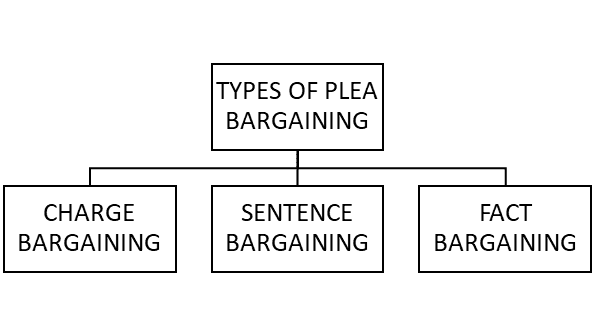
Charge Bargaining- Negotiating for dropping a charge in multiple charges or settling for a lesser charge.

Sentence Bargaining-  Admission of guilt and settling for a lesser sentence.

Fact Bargaining- Bargaining as to admission to some facts in exchange for an agreement to not introduce some other facts.

In 2020, the practice of plea bargaining came under the spotlight when foreigners who were members of Tablighi Jamaat attended the religious congregation Nizamuddin Markaz, amid the pandemic and were released through plea bargaining. The charges were a violation of visa conditions and guidelines given by the Government in the wake of the pandemic, etc. They accepted milder charges and paid fines under plea bargaining.

Procedure Of Plea Bargaining Under CrPC, 1973 (Sections 265A TO 265L)

  • Application for plea bargaining is filed by the accused containing a description of the case with the offense along with an affidavit sworn by the accused that he voluntarily applied for plea bargaining, understands the nature of the offense and its punishment, and that he has not been convicted of the same offense in any case previously. 

Note- Use of the statements or facts mentioned by the accused in this application are to be used in plea bargaining only and not for any other purpose.

  • After this, the Court issues notice to the Public Prosecutor/complainant and the accused to appear on a specific date when the accused is examined by the Court in-camera to the satisfaction that the application has been filed by the accused voluntarily. 
  • On satisfaction, both the parties are given time to work out a mutually satisfactory disposition of the case (accused giving compensation, etc to the victim) setting the date for further hearing. A report is then prepared by the Court signed by the parties and the presiding officer of the Court.
  • If the application is found to be involuntarily filed or that the accused has been previously convicted of the same offense earlier, the Court will proceed as per provisions under CrPC from the stage of filing application.
  • After a satisfactory disposition is reached by the parties, a report is then prepared by the Court, signed by the parties and the presiding officer of the Court. The case is then disposed of by awarding compensation to the victim as per the disposition and then a decision upon the quantum of punishment for the accused is made. 
  • If Probation of Offenders Act, 1958 or Section 360, CrPC, or any other law time being in force applies to the case, the accused may be released on probation or provided a benefit of any other law.
  • After hearing this, if minimum punishment for the offense committed is given under law, sentence- ½ of such minimum punishment.
  • But if the accused is not covered in any of the 2 provisions given above, sentence- ¼ of the punishment provided or extendable.

Judgment regarding disposal of the case is given in open court and is signed by the presiding officer.

Benefits Of Plea Bargaining

  • Speedy Trial- Trials are time-consuming and India, having an insurmountable number of pending cases, faces an ardent need for speedy trials. Plea bargaining provides just that.
  • End the anxiety of uncertain outcomes- Trials could be tricky most of the time, where it could turn in any possible direction. With plea bargaining in practice, one did an offense, that one pleaded guilty of it too. Hence, it removes the possibility of being anxious over the unpredictable nature of trials.
  • Saves litigation costs- It wouldn’t come as a surprise to you that going to trial is expensive. If one gets to negotiate pre-trial, it saves huge bucks that would otherwise have gone to the advocates, etc.
  • Impact on conviction rates- Imagine the conviction rates, when it is possible to have speedy disposal of cases. Why do you think the US does so great in this department?
  • Lesser sentence- In exchange for accepting a plea deal, the accused may be given a lesser sentence or even a reduced charge like that of a misdemeanor instead of a felony. 
  • An opportunity for a fresh start- There is a possibility under plea bargaining that an accused gets convicted for a lesser sentence. This allows the convicted to make a change in his life and start afresh.
  • A solution for the problem of overcrowding of jails- Accused awaiting trial are kept in jails that work just as a holding center with little or no scope for rehabilitation or correction. The delay in trials and conviction leads to overcrowding of the jails. With plea bargaining in the picture, faster disposal of cases is possible.

Criticism Of Plea Bargaining

  • May be made under coercion- It is a possibility that plea deals are made under coercion from the prosecutor or are bad in faith.  Hence, the accused might feel threatened and accept the plea deal even when he/she is innocent.
  • Criminal record- When one pleads guilty under plea bargaining, that does not mean that he would escape the conviction somehow. As a consequence, one would always have a criminal record.
  • Misguidance from the counsel itself- Sometimes, plea bargaining comes as a piece of bad advice from the counsel of the accused itself, agenda behind could be to get rid of the case sooner, lack of legal experience, inability to fight the case on its merits, etc.
  • Role of Judges in plea bargaining- Even though both parties agree to plea bargaining, a Judge may declare it void. A judge can even set aside the plea deal and move the case to trial if he feels like it is made in bad faith.
  •  No opportunity to appeal- In a trial, if the accused is not satisfied with the decision of his conviction, in almost all cases he appeals to a higher court against the judgment. But, once an accused pleads guilty, there is no scope for him to appeal against the conviction except special leave petition under Article 136 and writ petition under Article 226 and 227 of the Constitution.
  • Not the most moral practice in the book- Concessional punishments under plea bargains seem unfair to victims of the offenses committed by the accused for which he pleads guilty on the record.
  • Right to free and fair trial threatened- There are arguments that plea bargaining is unconstitutional in the sense that it violates the right to free and fair trial of the accused. If the plea deal is the outcome of coercion, incapacity of the defense attorney, etc. then the possible conclusion makes this practice bad in law. 

Even the justice system suffers because of this practice because plea deals are all about the negotiation skills of the counsels for both the parties and not winning the case on its merits in the trial.

Conclusion

It’s been more than a decade since plea bargaining was inserted in CrPC, but one would observe that it is uncommon in India since its inception. There have been doubts and worries to put the practice in full motion. As mentioned above it has various disadvantages but what one tends to forget is the benefits of it. To conclude a careful and balanced analysis of both the advantages and disadvantages has to be done since It is not justified to exclude something solely based on its demerits. Lack of awareness of the masses about their rights, coercive confessions, etc is the reason for the restricted scope of plea bargaining in India. As per statistics given by GOI in 2015, the plea bargaining rate in India was a mere 0.045% (last available statistics on the subject), pending cases were over 2 crores across the nation and undertrial prisoners were 2.8 Lakhs. If you are wondering what’s the current status, so at present, there are over 4 Crore pending cases all over India. If the future is the same as the present with an insurmountable number of pending cases in Indian Courts, which honestly will be, then the need of the hour is to give plea bargaining the space it needs.

The article has been written by Munmun Kaur, a law student from Law Centre-I, Faculty of Law, Delhi University.

Latest Posts


Archives

Job Description

GSK is a science-led global healthcare company with a special purpose: to help people do more, feel better, live longer. Our values and culture put people at the centre of what we do to support the success of our business. That includes the Legal function – our vision is to run Legal like a business for the business. We focus on delivering excellent advice to achieve GSK’s Innovation, Performance and Trust priorities with courage and accountability. We invest in people so that everyone can be themselves, feel good and keep growing. Legal Contracting Network (LCN) is a new, cutting-edge Legal group located in Asia, Europe and the US, bringing together the responsibilities and management of contracting. It will deliver effective and efficient legal support for contracting that is simplified and consistent. By joining our dedicated team of lawyers, paralegals and contracting specialists, you will become part of a world-class contracting support function at our new Global Capabilities Centre in Bengaluru, India. Along the way you will have many opportunities to learn, develop and be a key member of the team that will strengthen our support capabilities and deliver on the success of our business.

This role will provide YOU the opportunity to lead key activities to progress YOUR career. 

As a member of the LCN Delivery Team, you will be accountable for providing quality contracting support on a global basis for various GSK stakeholders.  Responsibilities include:

  • Providing quality contracting support autonomously to the business. This includes providing analysis, drafting and counsel on transactions, including any related legal, policy, regulatory and compliance issues—integrating legal knowledge with sound business understanding.
  • Negotiate and draft other legal documents. Conduct research on various legal issues. Perform or support due diligence on proposed transactions
  • Review and interpret new or pending legislation and regulations impacting contracting to ensure compliance and share knowledge with the rest of the team.
  • Aware of departmental guidance on best practices, processes, templates, clauses and playbooks.
  • Familiarity with global privacy law and GDPR
  • This role requires a broad-based provision of legal support and expertise in worldwide commercial transactions. 
  • Collaborate with and provide counsel to numerous relevant stakeholders including interactions with senior leaders in the Biopharma organisation. 
  • The role can work on matters of higher complexity with greater support from their line manager or other relevant colleagues.
  • Understand legal and financial risks and implications of contracts.
  • Agility to become quickly familiar and proficient with Conga, the Contract Lifecycle management system.
  • Other duties as assigned.

If you have these skills, we would like to speak to you.

  • Qualified lawyer with 7+ years of experience in a law firm and/or in-house, including relevant experience in commercial contracting globally.
  • Willingness to work flexible hours as this position supports global business in different geographies.

Why GSK?

Our values and expectations are at the heart of everything we do and form an important part of our culture. These include Patient focus, Transparency, Respect, Integrity along with Courage, Accountability, Development, and Teamwork. As GSK focuses on our values and expectations and a culture of innovation, performance and trust, the successful candidate will demonstrate the following capabilities.

GSKIndia_Legal

*LI-GSK

Our goal is to be one of the world’s most innovative, best performing and trusted healthcare companies. We believe that we all bring something unique to GSK and when we combine our knowledge, experiences and styles together, the impact is incredible. Come join our adventure at GSK where you will be inspired to do your best work for our patients and consumers. A place where you can be you, feel good and keep growing.

Important notice to Employment businesses/ Agencies

GSK does not accept referrals from employment businesses and/or employment agencies in respect of the vacancies posted on this site. All employment businesses/agencies are required to contact GSK’s commercial and general procurement/human resources department to obtain prior written authorization before referring any candidates to GSK. The obtaining of prior written authorization is a condition precedent to any agreement (verbal or written) between the employment business/ agency and GSK. In the absence of such written authorization being obtained any actions undertaken by the employment business/agency shall be deemed to have been performed without the consent or contractual agreement of GSK. GSK shall therefore not be liable for any fees arising from such actions or any fees arising from any referrals by employment businesses/agencies in respect of the vacancies posted on this site.

It has come to our attention that the names of GlaxoSmithKline or GSK or our group companies are being used in connection with bogus job advertisements or through unsolicited emails asking candidates to make some payments for recruitment opportunities and interview. Please be advised that such advertisements and emails are not connected with the GlaxoSmithKline group in any way.

GlaxoSmithKline does not charge any fee whatsoever for recruitment process. Please do not make payments to any individuals / entities in connection with recruitment with any GlaxoSmithKilne (or GSK) group company at any worldwide location. Even if they claim that the money is refundable.

If you come across unsolicited email from email addresses not ending in gsk.com or job advertisements which state that you should contact an email address that does not end in “gsk.com”, you should disregard the same and inform us by emailing askus@gsk.com, so that we can confirm to you if the job is genuine.      

How to Apply?

https://jobs.gsk.com/en-gb/jobs/271397?lang=en-us&source=LinkedIn

For regular updates, join us:

WhatsApp Group:

https://chat.whatsapp.com/CdshAqpiV1FEogy5pBlY43

Telegram:

https://t.me/lexpeeps

LinkedIn:

https://www.linkedin.com/company/lexpeeps-in-lexpeeps-pvt-ltd

Visit us for more such opportunities: http://lexpeeps.in/

About the Company

6sense’s Account Based Orchestration Platform helps revenue teams compete and win in the age of Account Based Buying by putting the power of AI, big data and machine learning behind every member of the B2B revenue team, empowering them to uncover anonymous buying behavior, prioritize fragmented data to focus on accounts in market, and engage resistant buying teams with personalized, multi-channel, multi-touch campaigns. 6sense helps revenue teams know everything they need to know about their buyers so they can easily do anything they need to do to generate more opportunities, increase deal size, get into opportunities sooner, compete and win more often.

The Role

As Contracts and Compliance  Counsel at 6sense, you will be an integral part of the team, in our fast-paced and high-growth organization with terrific customers and a creative, dedicated, fun and talented team.

This position will serve as a key member of the 6sense legal team, providing advice related to India commercial law matters, general corporate support and compliance and privacy support.  The position will involve (i) contract drafting, review and negotiation of vendor agreements as well as general contract management, (ii) support for 6sense India corporate and human resource functions; and (iii) and support to the 6sense compliance team  related to security and privacy risk assessments during vendor diligence reviews, The foregoing activities will be in coordination with 6sense India outside counsel and the 6sense US legal team.

This is a great opportunity for someone with a background with a multi-national technology company or a law firm looking to make the transition to an in-house role or to accelerate an existing in-house career with a rapidly growing company.

We are looking for a sharp-minded, enthusiastic, results-oriented and resourceful individual who wants to be part of a collaborative team in a dynamic, SaaS-based marketing and analytics company.

Required: A positive, team and solutions-oriented attitude.

Location: Pune, India

Responsibilities

  • Lead vendor management assignments, including vendor diligence, in partnership with the 6sense security team.
  • Review, Draft, and Negotiate NDAs, vendor contracts, consulting agreements, privacy policies within vendor agreements, partnership agreements, MSAs, DPAs and other related contracts, and provide strategic advice on behalf of the company.
  • Responsible for advising 6sense regarding compliance with applicable Indian laws, Including Indian privacy laws, and effectively coordinating with outside counsel and the 6sense US legal team.
  • Assist in the planning and execution of compliance assessments by partnering with legal, information security, product teams, and a diverse set of stakeholders. 
  • Familiarity with regulations affecting compliance with India, US and international privacy laws, especially in the context of vendor management.
  • Depending on background of candidate, might also support drafting and review of US-based customer agreements, such as 6sense SaaS-based MSAs, DPS and related agreement.
  • Aid cross-functional projects from design to implementation providing status reports where needed. 
  • Assist as needed with internal audits and third party SOC 2 audit programs.
  • Suggest and support proposed improvements to compliance programs, with attention to scalability and sustainability over time. 
  • Report metrics to management to support global compliance performance.
  • Possess a practical, business-oriented approach to problem-solving to effectively counsel internal clients by providing them with clear and concise advice and creative solutions on timelines to meet business needs.
  • Maintain and update company legal templates and facilitate their consistent use and help coordinate streamlined approaches to legal department management.
  • Depending on background and legal department needs, advise on corporate, human resource, marketing, leasing, and other issues as they arise.

Experience And Skills Required

  • 4-8 years of relevant experience gained in a nationally or regionally recognized law firm and/or in-house position with a multi-national technology company.
  • Understanding of Indian commercial and contract law fundamentals, including risk shifting and enforceability of contract terms.
  • Experience with SaaS based licensing agreements not required, but a plus.
  • Knowledge and experience across compliance and security frameworks such as: SOC 2, ISO, CSA, NIST, FIPS a plus.
  • Familiarity with regulations affecting compliance with Indian, US and international privacy laws.
  • Must be eligible to practice law in India.
  • Team player willing to pitch in when/where needed.
  • Strong organizational, process and project management skills.
  • Creative thinker and solutions oriented focus.
  • Ability to establish and maintain collaborative working relationships within the organization’s legal department and across all business units.
  • Strong interpersonal, negotiation and presentation skills.
  • Self-starter; purpose-driven; willingness to take ownership for a project and drive it to completion.
  • Strong writing and communication skills.
  • Detail-oriented, organized, efficient, and resourceful with strong follow-through skills.
  • Ability to manage shifting priorities within a fast-paced, rapidly evolving entrepreneurial environmet

How to Apply?

https://www.linkedin.com/jobs/view/2628532250/

For regular updates, join us:

WhatsApp Group:

https://chat.whatsapp.com/CdshAqpiV1FEogy5pBlY43

Telegram:

https://t.me/lexpeeps

LinkedIn:

https://www.linkedin.com/company/lexpeeps-in-lexpeeps-pvt-ltd

Visit us for more such opportunities: http://lexpeeps.in/