The Indian Review of Advanced Legal Research (IRALR) is a student run initiative, aimed to act as a platform for promoting high-quality legal research and writing on variety of legal issues among the budding legal minds of India. Our primary objective is to develop a sense of enthusiasm towards legal research among young law students and provide them with a platform to exhibit their skills in a way that is helpful to the legal fraternity across India. In our endeavor, we will provide a range of opportunities to law students in India to hone their knowledge and legal research skills. We will attempt to host various competitions such as blog/article writing competitions, judgment writing competition and the like to engage students in a range of highly effective activities which will supplement their academics as well as research skills.
About the Blog:
The IRALR Blog is a student run initiative that showcases submissions from lawyers, academicians, legal scholars and law students on various interdisciplinary issues related to law and policy. The blog will stand as a platform for hosting a wide range of scholarly legal articles which would provide insights into the latest legal developments in the social, economic and political domains of our country and of the world at large.
Submission Guidelines:
Authors:
IRALR invites blog submissions on a rolling basis from law professionals, academicians, research scholars and students of law on any topic related to law and policy. Co-authorship is permitted upto maximum two authors.
Content / Theme:
IRALR invites blog submissions on any topic related to law and policy. Submissions which are contemporary in nature are generally preferred. IRALR generally accepts blogs in the range of 1000-1500 words. However, this range is merely recommendatory in nature and the Editorial Board may accept submissions which do not fall within the said word limit at their own discretion. The content of the article should be both original and unpublished as it would be subjected to a Plagiarism Check. The submission should be made in Microsoft Word doc. Format only
Font Style and Size:
All submissions must be in Times New Roman The font size should be 12 with line spacing of 1.5 and the text should be justified. Authors must use hyperlinks in their submissions to cite the relevant sources. Use of footnotes is not permissible. If a source cannot be hyperlinked, provide endnotes and follow a uniform citation method. In case, end notes are present in the submission, the same shall be in Times New Roman, font size 10 and line spacing of 1.0.
How to submit:
The submission has to be mailed at blog@iralr.in . The submission must be made in a word file only (.doc or .docx format). The authors should not disclose their identity in the document containing the write up to ensure an anonymous review. The authors are expected to include their short bio in the submission mail itself. The subject of the email should be “Blog Submission”.
Submission Deadlines:
IRALR invites blog submissions on a rolling basis. The Editorial Board will require 10 days to complete the review process from the date of receipt of the article.
Clarification:
The Editorial Board will have the sole authority in accepting, rejecting or suggesting modifications to the submissions.
All India Legal Forum is a dream online platform which aims at proliferating legal knowledge and providing an ingenious understanding and cognizance of various fields of law, simultaneously aiming to generate diverse social, political, legal and constitutional discourse on law-related topics, making sure that legal knowledge penetrates to every nook and corner of the ever-growing legal fraternity. It also provides a valuable contemporary assessment of issues and developments in the legal field, putting forward quality legal content for the masses.
PEOPLE BEHIND AILF:
All India Legal Forum is a team of more than 800 law students across the country to tackle basic problems which a legal researcher faces in day to day life. We are pleased to have the support of a diverse group of eminent personalities, comprising: Justice Arjan Kumar Sikri, Justice Mukundakam Sharma, Justice Bellur Srikrishna, Justice S.L. Bhayana, JusticecAmarnath Jindal, Dr. Vinod Surana, CEO and Partner, Surana and Surana International Attorneys, Mr. Ajit Prakash Shah, Former Chairman, 20 th Law Commission of India, Mr. Rishabh Gupta, Partner, Shardul Amarchand and Mangal Das, Mr. M S Bharath, Senior Partner, Anand and Anand Associates, Mr. Safir Anand, Senior Partner, Anand and Anand Associates, Mr. JLN Murthy and many more as our honorary board members.
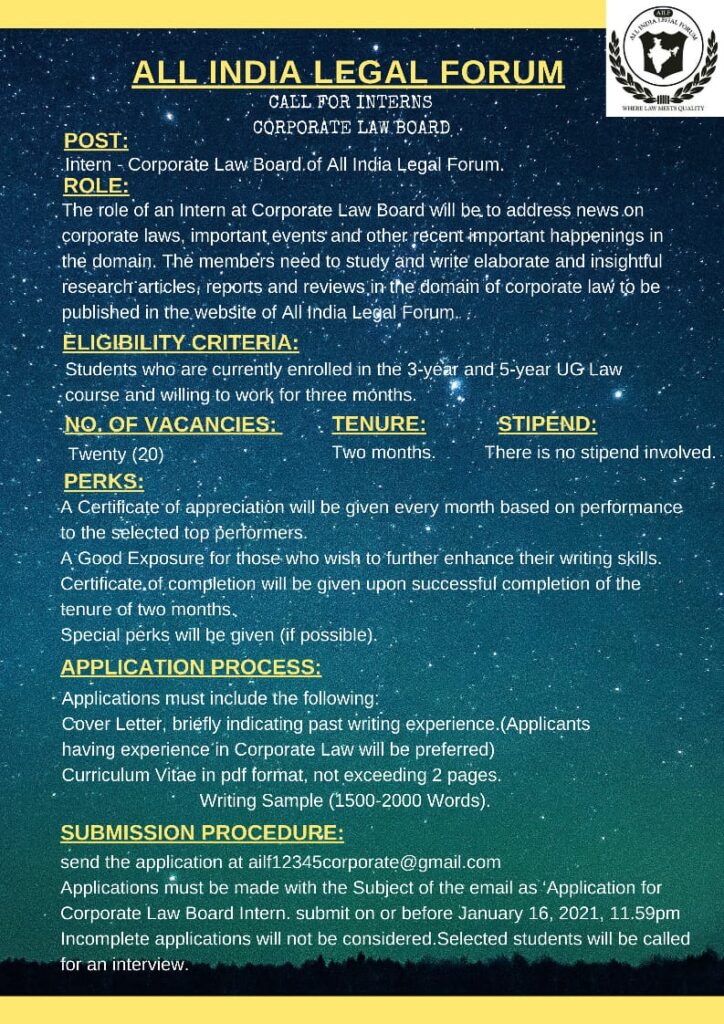
POST:
Intern – Corporate Law Board of All India Legal Forum.
ROLE:
You will be working under the Corporate Law Board of All India Legal Forum for the duration of your internship. The role of an Intern at Corporate Law Board will be to address news on corporate laws, important events and other recent important happenings in the domain. The members need to study and write elaborate and insightful research articles, reports and reviews in the domain of corporate law to be published in the website of All India Legal Forum.
ELIGIBILITY CRITERIA:
Students who are currently enrolled in the 3-year and 5-year UG Law course and willing to work for three months.
NO. OF VACANCIES:
Twenty (20)
TENURE:
Two months.
PERKS:
A Certificate of appreciation will be given every month based on performance to the selected top performers. A Good Exposure for those who wish to further enhance their writing skills. Certificate of completion will be given upon successful completion of the tenure of two months. Special perks will be given (if possible).
STIPEND:
There is no stipend involved.
APPLICATION PROCESS:
Applications must include the following: Cover Letter, briefly indicating past writing experience.(Applicants having experience in Corporate Law will be preferred)
Curriculum Vitae in pdf format, not exceeding 2 pages. Writing Sample (1500-2000 Words).
Applications must be made with the Subject of the email as ‘Application for Corporate Law Board Intern‘. The applications must be submitted on or before January 16, 2021, 11:59 pm. Please go through all the requirements carefully. Incomplete applications will not be considered. Selected students will be called for an interview.
In this article T.Preethi, student from government law college, Tirunelveli, writes about what the doctrine of estoppel is, its types and scope.
INTRODUCTION
Estoppels in the legal sense, is a principle that prevents someone from giving false evidence by holding then back from not making any contradictory statement in the court of law. This doctrine is basically to prevent the commission of fraud by one person against another person. A person will be held accountable for false representation made by him either by word or act under this doctrine. Section 115-117 of the Indian evidence act deals with this doctrine.
DEFINITION
Section 115 of the Indian evidence act interprets estoppels meaning as – when one person has by his declaration, act or omission, intentionally caused or permitted another person to believe a thing to be true and to act upon such belief, neither he nor his representative shall be allowed, in any suit on proceeding between himself and such person or his representative to deny the truth of that thing.
In simple terms, estoppel means that, a person can’t deny, declare, or contradict a statement as a false one that was previously made by him in the court. This particular doctrine is steep in matters of equity and good conscience. Equity won’t allow a person to contradict his own statement; rather it would “estop” him from denying his previous declaration, act or representation.
Estoppel is based on the legal maxim ‘allegans contraria non est audiendus”, which means, a person alleging contradictory facts should not be heard”. Under this doctrine, the fact presumed is taken to be true, but it is not against the entire world, just the particular party.
This is a complex legal notion, because it involves several essential elements to such as
A statement that is to be acted upon
Acting upon it, believing it to be true
Resulting detriment of the actor.
Estoppel is basically a rule of civil action and has very limited applicability in criminal matters.
Principle
Estoppel is based on the principle that some duty should exist. The section that when a person has by his
Declaration
Act or
Omission
Has intentionally caused or permitted another person
To believe the matter to be true and
To act upon such belief
Then, neither the person nor his representative will be allowed to deny the truth of that thing in any suit or proceeding between himself and such person or his representative.
To invoke this doctrine, certain conditions are to be satisfied. Those conditions are
The representation should be made by one person to another person
The representation should be made as to the facts and not laws
The representation should be made to an existing fact
The representation made should be in a way, Such that the other person believes it to be true.
The person to whom the representation was made, should experience a loss/ suffer a loss by the representation
Difference between Estoppel, Res Judicata and Waiver
Difference between estoppel and res judicata
Sl.no
estoppel
Res judicate
1.
This is a rule that prohibits one from contradicting to that which was earlier said by him in a court
This principle prohibits the other courts from deciding on the same matter that was already decided by a competent court
2.
This is based on the rule of equity which is natural law of the land
This has been recognized as a legal procedure by the law
3.
This looks into aspect such as equity, justice, and good conscience
This deals only with the public policy
4.
This arises out of the words, acts or conduct of a party
This arises out of the decision taken by the cases that had already been decided by a competent court.
5.
This has been incorporated from sections 115-117 of the Indian evidence act,1872
This principle has been incorporated under section 11 of the civil procedure code.
6.
Estoppel is implied through the actions or conduct of the parties
This is based on previous decisions given by a competent court; it is claimed by the parties.
Difference between Estoppel and Waiver
Sl.no
estoppel
Waiver
1.
This can’t be the cause of action although it can facilitate or aid the enforcing of a cause of action by preventing the defendant from not denying what was earlier said by him
This is contractual and it is an agreement to release somebody from an agreement by waving the previous set of policies or to assert a right. Waiver is a cause of action.
2.
The person injured will have prove the loss or harm occurred
There isn’t any requirement in waiver
3.
There isn’t any necessity for the party to know what the truth is or have the knowledge of the reality
The parties involved in a waiver must have knowledge about the real facts and they should know the truth
4.
There are situations where acquiescence would amount to estoppel
While in waiver , along with acquiescence, some act or conduct Is also necessary
5.
Doctrine of estoppels is used as a defence in the court of law and not as a cause of action
This can be used as a defence for claiming damages.
Kinds of Estoppel
There are different kinds of estoppel. They are
Estoppel by matter of record
Estoppel by deed; and
Estoppel in pais
Estoppel by Matter of Record
It is part of records of the court; it is narrative and the proof for the proceeding. Estoppel by records is a result of judgments by the competent court. This primarily is concerned with the effect of the judgments and their admissibility in evidence. It is the final decision and the parties, their representatives, executors, etc all are bound by that. This doctrine ‘estops’ the parties from raising another suit regarding the same matter of fact after the case has been closed.
There are certain situations where estoppel by records arise, such as
When the disputes on the facts have been decided by the tribunal and the same dispute arises again in matters that are subsequent to the first one, between the same parties.
When the issue resolved by the judiciary, comes into questioning in the subsequent proceeding between the same parties.
When an issue on the facts, is affecting the status of the person or thing, has been determined in a manner such that in the final decision it be included as a substantive part of the judgment in rem of the tribunal that has been authorized to decide the particular case. This must take place when the same issue comes directly to question in subsequent civil proceedings between any parties.
This judgment is of two types
Judgment in rem
Judgment in personam
Judgment in Rem
The decree delivered by a competent jurisdiction court, tells about the status of the person or thing, it is generally conclusive upon all persons.
Judgment in personam
This type of judgment is binding on the parties and their privies and determines the rights of the parties to a suit or the proceedings.
Estoppel by Deed
The parties here solemnly enter into an agreement deed as to certain facts; neither the party, nor his privies claiming through or under him are permitted to deny such fact. Application of this rule is subject to certain qualifications. They are
The rule applies only between parties and privies and only in action on the deed.
No estoppel arises upon recitals or descriptions which are either immaterial or not intended to bind
No estoppel arises where the deed is tainted by fraud or illegality.
A deed which can take effect by interest shall not be construed to take effect by estoppel.
Estoppel in Pais by Conduct
Estoppels in pais is “in the country or before the public”
Estoppel in pais arises from
Agreement or contract and
An act or conduct of misrepresentation which has made a change in the position in accordance with the intent of the party to whom the estoppel is alleged.
To apply these estoppels , a person must have by his word pr act should make the other person believe that it is a fact and make him act on that belief in a way he would not have done if he had known the facts.
Equitable Estoppel
If a person tries to take legal actions that would contradict with the statement, acts or claims that were previously given by him, this principle would restrict him from doing so. Thus, this principle would stop the plaintiff from bringing a suit against the defendant who acted according to the order of the plaintiff.
Proprietary Estoppel
This principle is brought in cases where land or property is involved. In order to claim right under this, the following things have to be proved.
The representation has to be made
The party should have believed it to be true and acted upon the same
The party should have suffered a loss as a result.
Promissory Estoppel
If the person/ party had made a promise or assurance by word or act, with the intention to affect the legal relationship between them. Once, the other party takes the words into consideration and acts on it, then the one who made the promise can’t revert the relationship as if no such promise or awareness had been made by him.
This doctrine evolved by equity in order to present injustice. This is premised on the conduct where a party makes representations to the other party, in order to make him act upon. The supreme court of India, held that in order to invoke this doctrine, a clear, sound, and positive foundation must be laid by the party in the petition itself.
Issue Estoppel
The effect of this doctrine in a criminal proceeding would come into picture only if the previous and subsequent proceedings were also criminal prosecution. This principle says that even if the court has made a decision the relitigation of the issue would be prohibited on a different course of action involving both the parties from the very first case.
Estoppel by Silence and Acquiescence
When a person owes to another person to speak or act, and he fails to perform and remain silent. Then such a silence would work as an estoppel against the former. But there is no need for speaking, no estoppel can arise. A man is bound to speak in certain circumstances, but if he fails to do so and remains silent, it will be decoded as if he has openly consented to what is said or done and has become a party involved in that.
If a person just stands by while his right is being infringed by another person, the rule of estoppel by acquiescence applies. Estoppel by acquiescence in these matters is applied under the following conditions.
The later must be mistaken as to his legal rights
The later must expend money or do some act on the faith of his mistaken belief
The former must known his own rights
The former must be aware of the other person’s mistaken belief.
The former must encourage the other in his expenditure of money or other act directly or by abstaining from asserting his legal rights.
Estoppel by Negligence
To claim estoppel on the ground of negligence, it must be proven that the party against whom then plea is raised, owed a duty to the party who raises the plea, or towards the general public of which he is one and that the negligence on which it is based should not be indirectly or remotely connected with the misleading effect assigned to it but must be proximate or real cause of that result i.e., the negligence which can sustain a pleas of estoppel must be in the transaction itself and it should be so connected with the result to which it led that it is impossible to treat the two separately.
Estoppel by Recital in Deed
The recital in deed or statement or instrument is conclusive in some cases. In all cases it is considered as evidence against the parties. It is deliberately made by the parties to go against other parties.
Estoppel by Election
When a person makes a choice out of the options given to him. His choice is finalized and can’t be altered or retracted. That is the other person can only enjoy his choice and can’t take the other option as a supplement material, when his choice fails. This is based on the rule of estoppel, that is one person cant appropriate and reprobate inheres in it. This doctrine is applicable to all kinds of proceedings including civil and criminal matters.
Estoppel by taking up a Particular Position
If a party takes a particular position before the court of law, then he/she can’t approbate, reprobate and resile from that position. This is based on the legal maxim “allegans contraria non est audiendus” that is, he shall not be heard to say things contrary to each other”
Estoppels by Attestation
The Privy Council said that, the attestation of a deed does not by itself stop the person who is attesting it from denying that he knew of its contents or that he consented to the transaction which it effects and that knowledge of the contents of a deed is not to be inferred from the mere fact of attestation.
Estoppels by Consent
Consent given in a court that a controversy is covered by a judgment which has no applicability whatsoever and pertains to a different field, cannot estop the party from raising the point that the same was erroneously cited. An estoppel by consent decree can arise only when the question raised in the subsequent suit was present to the minds of the parties and was actually dealt with by the consent decree. In order to affect estoppel it is also necessary that it should appear on record that the question had been put in issue.
Scope
In order to hold a case that comes under this section. The court must find.
That the party had believed a thing to be true
That, he acted in a particular manner, as a result of the belief
That the belief the person is acting upon was brought by some representation by another person, either by declaration, act or omission, which representation was made intentionally to produce such a result.
It isn’t necessary that the party claiming estoppels should have suffered any loss or detriment. The court held that “gradually the doctrine of promissory estoppel has developed to an extent that it is no longer necessary that the party seeking to enforce the principle must have suffered a detriment.
The Supreme Court has come up with certain requirements in terms of a large number of points.
To bring a case under the scope of estoppel,
There must be a representation by a person or his authorized agent to another in nay from- a declaration, act or omission
The representation must have been of the existence of a fact and not of promise de future or intention which might not be enforceable in contract;
The representation must have been meant to be relied on
There must have been belief on the part of the other party in its truth
There must have been action on the faith of that declaration, act or omission; that is to say, the declaration, act or omission must have actually caused another to act on faith of it, and to alter his former position to his prejudice or detriment
The misrepresentation or conduct or omission must have been the proximate cause of leading the other party to act to his prejudice;
The person claiming the benefit of an estoppel must show that he was not aware of the true state of things- if he was aware of the real state of affairs or had means of knowledge, there can be no estoppel;
Only the person to whom representation was made or for whom it was designed can avail himself of it. A person is entitled to plead estoppel in his own individual character and not as a representative of his assignee.
The law of estoppel doesn’t care about the movie or state of knowledge of the party upon whose representation the action took place. It cares about the position of the one who was induced to act upon a representation. The party can use an estoppel as a statement by which he was misled actually. The government is also not exempted from the equity arising out of the acts done by its citizens to their prejudice, relying on the representations as to its future conduct made by the government.
Public bodies are as much bound as private individuals in carrying out the representations of facts and promises made by them, relying on which the other people have altered their position to their prejudice. If a document is found to be void ab initio then, there would be no questions of estoppel.
The general idea about doctrine of estoppel so far is that it can be used as a defence and not a cause of action. But, the circumstances have changed it, now, under the impact of its application and extension to promissory estoppel; it can be brought as a cause of action also.
In RK Kawatra vs. DSIDC, AIR 1992 Del 28. The high court of Delhi observed that, the modern doctrine of promissory estoppel is of comparatively recent origin in the field of public law. The provisions regarding estoppel are a mere shadow of what the modern principles of promissory estoppel have come to be. The recent development in this area is that an independent action can be founded on a promissory estoppel and it is just a principle available only as a shield. It can also be used as a weapon of offence.
This article is written by Akhilandeswari Bonam, a student of Sri Padmavati Mahila Visvavidyalayam, Tirupati.
Case Number
Criminal Appeal Number 821 of 2000, Criminal Appeal No. 160 of 2001
Equivalent Citation
2001 3 SCC 673
Bench
R.P Sethi, B.N Agrawal, and Brother Thomas. J.
Decided on
2.3.2001
Relevant Act/ Section
Section 34,149,302 IPC
Brief Facts and Procedural History
Suresh (A-1) and Ramji (A-2) appealed under criminal number 2 of 1998 before the High Court against the judgment passed by the Sessions Judge Sri U.S Tripathi. Where they were convicted for a death sentence. In the other appeal, Pavitri Devi, wife of Suresh and the sister of Ramji appealed under Criminal number 18 of 1998 against the judgement passed by the sessions court. Where she was convicted for imprisonment with the aid of section 34 IPC. In this case, the victims Ramesh, his wife, and his children were murdered by the two accused Suresh (A-1) and Ramji (A-2) on 5.10.1996. The two accused severely injured the victims’ bodies in a very cruel manner and broke them into pieces. They harshly attacked the neck, spinal cord, and other parts with dangerous weapons, axes, and choppers. Jitendra PW-3, one of the Ramesh children, does not die that night. The reason for such an attack on Ramesh’s (deceased) family was a land issue between the accused Suresh (A-1) and the deceased Ramesh. With this issue, Suresh along with his wife Pavitri Devi and his brother-in-law Ramji planned to murder Ramesh’s whole family. Jitendra (PW-3) son of deceased Ramesh told before the court that while he was sleeping, he woke up with the sense of his father’s blood reaching his mouth. At that time Pavitri Devi(A-3) held his mother’s hair and pulled her up thereafter, she went outside and encouraged her husband to kill everyone. PW-1 Lalji and PW-2 Amarsingh who were neighbors of both accused and the deceased family gave evidence that when they reached the deceased house Pavitri Devi was standing before the house of the victim and the other two accused were busy with the cruelty acts inside the house. PW’s 1 and 2 did not support the incident which happened inside the house because they didn’t see such an incident. The trial judge acknowledged the evidence given by the witnesses and served the death penalty to Suresh and Ramji. Also convicted Pavitri Devi for imprisonment with the aid of section 34 IPC. Later, the Division Bench of the High Court considered the trial court’s decision. It acknowledged the evidence of PW-3 and it secured the evidence from the testimony of PWs 1 and 2.
The F.I.R shows that Pavitri Devi was standing on the road when the incident happened. She may have reached the place on hearing any sounds because her house is very close to the scene or she followed her husband and brother out of curiosity, because they were going with axes and choppers at that night time. It is not a necessary conclusion that she too would have accompanied the other accused.
Issues before the Court
1. Whether this case belongs to the category of the death penalty 2. Whether Pavitri Devi convicted with the aid of section 34 IPC 3. Whether the evidence of PW3 (Jitendra) can be accepted.
The evidence provided by PW-3 alleged that Pavitri Devi held his mother’s hair and pulled her cannot be accepted because no other witness is supporting this and also PW1 and PW2 have not supported the version of PW3. The conviction of Pavitri Devi under section 34 IPC was challenged before the Court. The learned counsel for the state contended that she was also present at the scene of occurrence and she has the common intention along with the two accused. If she does not have such a common intention, she may try to deter such murders because the two accused are her husband and brother. The ambiguous situation raised the meaning of section 34 IPC. The Court discussed and also referred to many previous cases to this. However, the prosecution had not succeeded in proving that A-3Pavitri Devi shared the common intention with the two accused. The Constitution Bench in Bachan Singh vs the State of Punjab restricted the death penalty to the rarest of the rare cases in which the lesser alternative is unquestionably foreclosed. Therefore, the court held that we cannot persuade ourselves to hold that this is not a rarest of the rare cases in which the lesser alternative is unquestionably foreclosed.
The Ratio of the Case
The trial court awarded the death sentence to the accused by considering the witnesses of PWs 1,2 and 3 and also convicted A3 Pavitri Devi with the aid of section 34 IPC. The Division Bench of the High Court accepted the evidence of child PW3 and secured the witness of PWs 1&2 and it did not quash the trial judge’s decision The High Court also contended that the death penalty shall be awarded to a rarest of the rare cases. The High Court concluded that a person shall not be convicted with the aid of section 34 IPC merely because of his presence at the scene of occurrence without doing any act or carrying a weapon. Reference cases:- • Aydroos vs. Emperor • Barendra Kumar Ghosh vs.King Emperor • Mahabub shah vs. Emperor • Pandurang vs. State of Hyderabad •State of U.P vs Iftikhar Khan, 1973 1 SCC 512.
The Decision of the Court
The High Court held that this case is not a rarest of the rare cases to grant death penalty and it justified that Pavitri Devi (A-3) did not share a common intention with the other two accused persons. By her mere presence near the scene of occurrence in the absence of other evidence, we cannot hold her guilty with the aid of section 34 IPC. The appeal of the state filed against Pavitri Devi has no merit and has thus rightly been dismissed by Brother Thomas, J. The Judges R.P Sethi and B.N Agrawal agreed with the Thomas, J judgement
This article is written by T.PREETHI, a student of government law college, Tirunelveli. In this article the student had discussed about whom an accomplice is, the evidence provided by an accomplice and its applicability in a trial.
INTRODUCTION
Accomplice is a person who knowingly, voluntarily and with a common interest unites with/gets along with the principal offender in committing a crime. He is some way or the other concerned or associated with the commission of crime. He/she is guilty of complicity in the crime charged, either by being present in that place and aiding or abetting it.
An accomplice may assist or encourage the principal offender to commit a crime. He/she may not be present in the place when the actual crime is committed. However, if a person is present in the place of crime without any criminal intent, then that person won’t be considered as an accomplice, no matter how reprehensible her/his inaction.
An accomplice is usually subjected to the same degree of punishment as the principle offender. In legal terms- an accomplice shall be a competent witness against an accused person; and a conviction Is not illegal merely because it proceeds upon the uncorroborated testimony of an accomplice.
The evidence by an accomplice might be lacking confirmation or evidence and seems to be untrustworthy because, he is also a silent part of the criminal act, yet it will be taken into consideration as they help to form the basis for a conviction under important circumstances, because it isn’t a easy job to convict the main accused without having enough resources. Though evidence of accomplice lack trustworthiness, it helps in detecting a crime, solving it. Therefore, it is treated as a beneficial and invaluable tool.
Accomplice
Who is an accomplice?
There isn’t any definition for the word “accomplice” under the evidence act, thus it is taken in an ordinary/ normal sense. In general terms he is a person concerned in the commission of a crime. Partner in a crime or associated with the criminal act with guilty intent.
A testimony of an accomplice is usually doubted for its trustworthiness and can’t be used against another accused. The reason why the testimony of an accomplice needs a proper confirmation is that
First of all, he might shift guilt from his side to other
Second of all, he is also a guilty person.
But under one circumstance it will be considered; that is if at all he turns into an approver, on his own will, he will be considered as a criminal who is providing evidence and supporting the prosecution with a promise of pardon and hope of getting his freedom. The approver’s testimony should pass the double test;
Firstly, It should be reliable
Secondly, It should be sufficiently corroborated
An accomplice can’t corroborate himself; contaminated evidence can’t lose its taint by repetition. He is a particeps criminis. However, in two circumstances a person will be held as an accomplice
A receiver who receives a stolen property- he will be treated as an accomplice of the thieves on a trial for theft.
The person who was an accomplice previously on trial are deemed to be an accomplice for committing the crime of the similar type or identical type. On another occasion be admissible to prove and intent of the accused in committing the offence changed.
Categories
A person will be considered as an accomplice when he participates in the same crime as that of the others. There are two major categories of modes of participation in crime.
The principals in the first degree or second degree, and
Accessories before the fact, or after the fact
Principles in the First and Second Degree
The person who actually commits the crime in the first place comes under the first degree and the person who assists the crime in any means comes under the second degree.
Accessory before the Fact
A person becomes accessory before the fact if he is involved in the preparation of the crime. That is if he motivates, encourages or counsels for the commission of the crime. Moreover to be an accomplice, he must participate in the same crime as that of the principal offender.
Accessory After the Fact
A person becomes an accessory after the fact when he extends a helping hand in comforting the accused person with the knowledge that he was accused or assists him in escaping from the punishment or escaping the arrest.
There are three conditions that are to be fulfilled in order to be an accessory after the fact.
The crime should have been completed;
The person who is helping the accused must have the knowledge that the person he is helping has been accused of committing a criminal act;
The actions of the person helping the accused should result in either escape of the accused or avoid the consequences of the principle crime.
Accomplice Witness
An accomplice will be considered as a witness as far as he Is not co-accused with the other under trial in the same case. An accomplice becomes a competent witness by accepting the pardon under section 306 CrPC and will be examined like any other witness on oath. Article 20(3) of the constitution of India, states that no accused shall be compelled to be a witness against himself. But an accomplice on his own and accepting the pardon will be a competent witness under the condition of true disclosure, in his own interest and isn’t compelled to give self-incriminating evidence. Therefore, a pardon accused need to fully disclose everything about the crime and if he fails to do so, he’ll be tried for the offence that he was originally charged for and his own statement may be used against him under section 308 of CrPC.
Competency of a Witness
Section 118 of the Indian evidence act says that any person is competent to be testified unless they are
Not able to understand the question put in front of them
To give answers to the questions owing to
Their age
Disease in mind or body
As well, under section 133 competency of an accomplice to be a witness is, he/she should be co-accused under trial in the same case.
Accomplice as Approver
An accomplice can be taken as an approver also. An approver is a person, who has been tendered pardon by the court on a primary condition that he’ll disclose the whole circumstances of the case. In Ravindra Singh vs. State of Haryana the court held that an approver gets his immunity so, he is entitled to prove his credibility in court. This is fulfilled by
Firstly, if the incident he relates involves him in the offence and appears intrinsically to be a natural and probable catalog of events that had taken place.
Secondly, the story that is given by the approver so far as the accused on trial is concerned should implicate him in such a way that it gives a conclusion of guilt beyond a reasonable doubt.
Accomplice in Sexual Crimes
The supreme court in Rameshwar kalian Singh vs. The state of Rajasthan, laid that, in case of rape, the prosecutrix can’t be treated as an accomplice as an accomplice. The court had insisted the need for corroboration of the evidence given by the prosecutrix as a matter of practice, but as a matter of fact, the evidence act does not say anything of this sort.
Need for Corroboration
Reading section 133 along with section 114 (b) gives a crystallized view about the issue involved with respect to the accomplice evidence. Therefore, even If a communication can be based on uncorroborated evidence of an accomplice, but as a rule of prudence, it is not safe to rely on evidence that lacks confirmation. So, judges and juris when dealing with such cases should be extremely cautious and should take extreme care while considering uncorroborated accomplice evidence.
Nature and Extent of Corroboration
The Supreme Court has laid down four principles with regard to nature and extent of corroboration. They are
That it is not necessary that there should be independent confirmation of every material circumstances in the sense that the independent evidence in the case, apart from the testimony of the complainant or the accomplice, should in itself be sufficient to sustain conviction; all theta is required is that there must be some additional evidence rendering it probable that the story of the accomplice is true and that it is reasonably safe to act upon it.
That independent evidence must not only make it safe to believe that the crime was committed, but must in some way reasonably connect or tend to connect the accused, with it by confirming in some material particular the testimony of the accomplice or complainant that the accused committed the crime.
That the corroboration must come from independent sources and thus ordinarily the testimony of one accomplice would not be sufficient to corroborate that of another.
That the corroboration need not be direct evidence that the accused committed the crime- it is sufficient if it is merely circumstantial evidence of his connection with the crime.
The courts while taking evidence provided by an accomplice must look up with great suspicion, because it could be decisive in securing conviction if it is found to be trustworthy.
Kolkata Metro Rail Recruitment(KMRC) invites application for Assistant Law Officer. Eligible/ Interested candidates are required to fill the form.
Last Date:
10 Jan, 2021
Vacancy:
01
Age Limit:
55+ year of age as on 1st November, 2020
Salary:
₹ 53,000-1, 07,900 + GP ₹ 5400/-
Qualifications:
Graduate (degree) /LLB
Group B professor who have experience of work in Indian Railways for 5+ years in matters including : dealing with claim and Arbitration cases.
Process of Selection:
Interview
How to Apply?
Applications included general data as candidate name, fathers name, DOB, address, email address, details of qualification, phone number, experience( which includes his/her areas of practicing) and in additional attested copies of documents given below with two copies of passport size photograph in favour in a sealed envelope titled : “Application for appointment to the post of Legal Coordinator on Deputation” should reach to the MD,KMRL, KMRCL Bhavan, HRBC Office Compound, Munshi Premchand Sarani, Kolkata.
Team LicitElite, focuses on providing assistance to Law students in self grooming while acquiring better knowledge, by generating an exclusive learning platform through activities like law classes, blog writing, competitions etc. It also aims to connect with legal experts to design better learning opportunities.
About Editor:
Dr Ashu Dhiman is a professor at Centre for Legal studies, Gitarattan international business school, Delhi. She is also the Editor in chief, LicitElite. She has edited many journals and annual magazines. Her areas of expertise are Family Law and Criminal Law
About the Book:
Crime is an unlawful act committed by a person against another person or society. Crime is considered as an act against the state. In today’s ever changing world we are evolving out of our historic laws which no longer serves our purpose, for ex – striking down adultery laws and homosexual laws. Further we need efficient laws to deal with rising problems such as of Rape, murder etc, as current laws are not deterrent to the commission of such crimes as we can observe from ever increasing cases of crime. These problems and issues are there for a long time and require special attention to deal with.
With the start of the New Era, we announce our call for chapters in order to create new opportunities for the authors in Criminal law to showcase their caliber in Legal research.
Theme:
Changing Dimensions of Criminal Law
Guidelines of Submission:
1. The authors should use the ILI (Indian Law Institute) format of Footnoting and Times New Roman Font 12 with bold headings and space lining 1.5.
2. Co-Authorship is allowed. However, there can be maximum two co-author in one research paper.
3. The work submitted shall be ORIGINAL and UNPUBLISHED
Perks:
Each Author with selected paper will be provided with a complimentary hard copy of the book (applicable on Indian Authors, Foreign Authors will get soft copy of the book) as well as an E-certificate and chapter published in ISBN book.
The body of the paper shall be:
Font: Times New Roman Font Size: 12 Line Spacing: 1.5
Citations Shall be: Font: Times New Roman Font Size: 10 Line Spacing: 1
Word Limit:
The word limit for research paper (inclusive of abstract) is between 3000 words (minimum) to 6000 words (maximum) This word limit is inclusive of footnotes.
Submission:
♣ All the manuscripts being contributed for the Edited book are to be sent at: licitelite@gmail.com
♣ The manuscript must be accompanied with an abstract of paper in not more than 300 words.
♣ The entries should reach the given email ID by 15th February 2021.
♣ Entry should be in either ‘.doc’ or ‘.docx’ format.
♣ The subject of the mail should be: “Submission for Edited Book by LicitElite”.
Publication Fees
There is a participation fee for Rs. 1000/- at par for all the contributors such as students, researchers, academicians, etc. and the participants are encouraged to participate. In case of Co- Author/s, each Co-Author/s is chargeable with Rs. 500/-. Payment for publication to be done after the acceptance of the submitted paper is communicated to the author.
• Indian Authors: Rs. 1000/-
• Foreign Authors: $15/-
• Indian Co-Authors: Rs. 500/-
• Foreign Co-Authors: $7/-
Publication:
The selected best quality papers will be sent for publication in ISBN numbered book.
The book will be published by Shree Ram Law House.
Candidate have to provide Legal assistant in the High Court Legal Service Committee at Patna High Court.
Stipend:
₹30, 000 per month.
Duration:
6 months.
Duration of job can be extendable on the basis of performance and can be over 2 years also.
Vacancies:
2
How to Apply:
Interested candidates are required to send their application form on the official mail I’d of Patna High Court Legal Service Committee i.e : phclsc@gmail.com
In a petition filed by an adult couple where one of has not attained majority for marriage. It has been submitted by them that their fundamental right of “protection of life and liberty” has been violated. Hence, its restoration has been invoked under article 226 of the Indian Constitution.
The petitioners submit that they have known each other for the last year and wish to marry each other with Petitioner no.1 not having attained the majority of marriageable age. But the parents of petitioner no. 2 are against this and have beaten her up several times, locked her up in her room, and have threatened her to get her killed. Further, several fights have been taken place between the families. After this, Petitioner no. 2 left her parents’ home and started living with Petitioner no.1 in a live-in relationship. This relationship not being acceptable to the parents, they have warned the Petitioners to bear harsh consequences.
The court in its observations held that both the Petitioners are adults and have the right to live their life on their terms and their parents can’t compel them to do it their way. Even if they have not attained the marriageable age still the fact that remains is that both of them are majors and can’t have their parents dictating their life for them. The court further went ahead and said that as per article 21 of the Indian Constitution, the right to life and liberty has been given to every individual and the choice of the partner for one is an important aspect of the right to life. For this case, the court relied on the case of Shafin Jahan vs. Asokan K.M., (2018) 16 SCC 368, where it was held by the Supreme Court that every person has his right to life and liberty and that also covers the right to choose a partner for oneself.
Society hence has no role to play in deciding the role of partners for people. Moreover, article 21 guarantees the right to life and liberty to everyone. It has been stated there that no one can be deprived of his right to life and liberty except for the procedure established by law. Only because one of the petitioners have not attained the age of majority to marry, they cannot be deprived to exercise their right to life.
Well you all know about what is this you have came across it several times a day, but here’s my duty to make you aware of what is True Caller:
True Caller is a Swedish Company.
Established in 2009, at Stockholm.
It is a platform for providing better communication.
About the Job Opportunity:
Truecaller is looking to hire for the job post of Legal Counsel for its Bangalore office.
As a Legal Counsel you will be handling Truecaller legal and compliance matters.You will report to the VP General Counsel based in Sweden and work in close collaboration with many people in different parts of the world.
Legal Team plays a key role in the continued success of Truecaller and operates across a wide range of legal disciplines as well as jurisdictions. We work very closely with management, product, business and engineering teams as well as other functional teams to support Truecaller’s continued growth, while at the same time ensuring compliance with legal requirements and internal controls.The existing team has three attorneys, two of whom are based in Bengaluru along with over 100 fun and ambitious colleagues.
Responsibility:
As legal assistant you have to deal with true caller legal matters of complaints.
Will have to report to a senior official: VP General Counsel.
Have to work with our Legal Team to provide legal assistance of draft and have to negotiate commercial contracts and partnerships in multiple markets.
Have to develop social contacts and to collaborate with stakeholders in Finance, Branding.
Have to Draft licensing agreements.
Have to create templates.
To mange any legal dispute arises.
Review of product functionality and design to ensure it aligns with legal requirements.
Qualification:
Law school degree from India with a minimum of four years relevant working experience as an in-house counsel and/or from reputable law firms
Strong knowledge and skills in commercial law with an emphasis on IT-related matters
Excellent negotiation and communication skills
Excellent organizational skills and time management
Strong skills in analyzing and interpreting advanced contractual relationships and monitoring the regulatory environment in which we operate
A strong sense of personal integrity and good personal judgment
Advantage:
Competitive salary.
Exposure of to grow your social circle by meeting of of new people’s during the job.
Learning environment ; In this not you only learn but also have the option to share your knowledge with wide variety of people’s .
Outdoor Activities as games.
Health insurances.
Working hours will be flexible, you don’t have to worry.