About the Organization

Treelife was founded with the sole purpose of empowering start-up businesses & helping entrepreneurs protect and monetize their ideas by providing customized legal, financial, and compliance advice at every stage of growth. Backed by a multidisciplinary team with a proven niche in the startup space, we are adept at swiftly identifying and delivering effective solutions for early-stage businesses. From company formation to fundraising transactions, co-founders’ agreement to founder disputes, and from investors coming on the capable to their exit, we provide bespoke solutions to complex financial, legal, and compliance problems.

Responsibilities

  • Conduct legal research and analysis on a variety of legal issues
  • Assist in the preparation and drafting of legal documents, such as contracts and briefs
  • Attend meetings with clients and take notes
  • Perform administrative tasks, such as filing and organizing documents
  • Assist in investment transactions for startups and investors in the ecosystem, from overseeing the drafting, and vetting to negotiating transaction documents
  • Assist in managing compliance & legal functions
  • Assist on a broad variety of matters from complex matters to routine standard matters: company law, data protection, commercial contracts, foreign investments, acquisitions & investment exits

Eligibility and Requirements

  • Currently enrolled in a law school.
  • The Intern should be available for a full-time (in-office) internship
  • Ability and willingness to work in a fast-paced environment
  • Solution-oriented
  • Excellent communication skills
  • Proficiency in using Microsoft Excel, Word, PowerPoint.
  • A highly motivated and organized Law Intern to join their legal team.
  • The Law Intern will work under the supervision of our experienced attorneys to provide legal support for our organization.

Internship Duration

The tenure for the internship is of 1 month(Assignment based)

Location

Delhi (CP)

Application Procedure

To apply, CLICK HERE

Disclaimer: All information posted by us on Lexpeeps is true to our knowledge. But still, it is suggested that you check and confirm things on your level.

For regular updates on more opportunities, we can catch up at-

WhatsApp Group:

https://chat.whatsapp.com/Iez749mZfpaGfG4x2J6sr9

Telegram:

https://t.me/lexpeeps

LinkedIn:

https://www.linkedin.com/company/lexpeeps-in-lexpeeps-pvt-ltd

About the Organization

Mimansa Law Offices came into existence in 2014 and has been flourishing ever since, owing to the loyalty of their clients and colleagues. The firm’s expertise lies in Commercial Disputes, Litigation, Commercial Negotiation, Due Diligence, Commercial Transactions, banking and debt recovery.

Location

Safdarjung Development Area, New Delhi

No. of Openings

1

PQE

2-3 years of experience in Delhi District Courts

Application Procedure

Interested Candidates can send their CVs, appearances of the past two years in Delhi District Courts, and a cover letter to gautam@mimansalaw.in.

Deadline

20.04.2023

Salary

As per Industry Standards

Contact details

+91-9899809187

Note: The Candidate should have experience handling bulk cheque bounce and civil recovery cases.

Disclaimer: All information posted by us on Lexpeeps is true to our knowledge. But still, it is suggested that you check and confirm things on your level.

For regular updates on more opportunities, we can catch up at-

WhatsApp Group:

https://chat.whatsapp.com/Iez749mZfpaGfG4x2J6sr9

Telegram:

https://t.me/lexpeeps

LinkedIn:

https://www.linkedin.com/company/lexpeeps-in-lexpeeps-pvt-ltd

-Report by Arunima Jain

The Mumbai High Court on Thursday upheld the Maharashtra Administrative Tribunal’s judgement that is related to the reinstatement and absorption in service of a wrongly terminated woman for the post of lecturer. The court has supported the judgement in the case of Sachin Dawale v. The State of Maharashtra while stating that ‘adherence to the rule of equality in public employment is a fundamental feature of our Constitution, and because the rule of law is at the heart of our Constitution, a Court would be barred from upholding a violation of Article 14 or ordering the disregard of the need to comply with the requirements of Article 14 read with Article 16 of the Constitution. Moreover, unless the appointment of a government servant is made in accordance with the relevant rules and following proper competition among qualified candidates, the appointee will not have any rights. It is not open to the court to prevent regular recruitment in the case of temporary employees whose period of employment has expired or ad hoc employees who, by definition, do not have any rights.’

FACTS

In the matter at hand, the State had imposed a ban on the recruitment of various departments in the educational sector. Upon upliftment of the ban, through a policy decision in July 2002, the respondent was instituted as a Lecturer on a contract basis for a period of two years or till

the availability of an MPSC-selected candidate, whichever was earlier. By subsequent government policies and resolutions after the completion of the two years of the contractual agreement, the respondent was reinstated as a Lecturer in a different university till October 2012. In lieu of an administrative ground against vacancy generated by contract lecturer transfer, the respondent’s employment was terminated in September 2012 before the end of her tenure. After the passing of the judgement in the case of Sachin Dawale v. The State of Maharashtra, the respondent filed an application challenging her termination before the Tribunal. The Tribunal directed reinstatement and absorption back into the service of the respondent as a Lecturer in the Government Polytechnic. The State Government has filed this case in order to challenge the Tribunal’s judgement and order.

CONTENTIONS

Petitioner

The petitioner’s learned counsel has submitted before the High Court that the Tribunal should not have entertained the original application owing to the fact that the respondent had accepted the termination of her services as a lecturer without a predicament, as and when it occurred. Moreover, the original application that challenged the termination was sought after 4 years of the respondent being relieved of her duties. The counsel for the respondent further stated that during the initial contract, it was made clear to the respondent that according to the law at the time, the contractual agreement existed till the specified date or till the availability of an MPSC-selected candidate. Since the termination was in lieu of the selection of an MPSC-selected candidate, the respondent was rightly relieved of her duties. Therefore, according to the petitioner’s counsel, the current contentions of the respondent are absurd and cannot be relied upon.

Respondent

Contrary to the petitioner’s counsel, the respondent’s learned counsel submits that all contractual lecturers instituted in service along with the respondent have been regularized in their jobs, with just the exception of the respondent. On top of that, the candidate employed in replacement of the respondent was not an MPSC-selected candidate, but a transferee to the Government Polytechnic. In addition, it is submitted that the job vacancy created through the transfer did not require the termination of the respondent’s post. As far as the limitation act condones the delay in filing the Original Application, the respondent’s counsel contends that the Court shall be awry in interfering with the interpretation of the Tribunal in the same regard.

JUDGEMENT

Upon giving due regard to the facts and law in the above-mentioned case, it is contended by the hon’ble court that this was a proper instance in which the Tribunal should have excused the delay in filing the application and the appellants should have been awarded relief in the same terms as the Full Bench of the Tribunal. As a result, the appeal is granted, the contested Tribunal judgement is reversed, the delay in filing the order is excused, and the application is granted. The Tribunal made no mistakes in overturning the order freeing the respondent from service or directing her regularisation.

Because of the unique facts and circumstances of the current case, the bench has also mentioned that it is inclined to maintain the Tribunal’s ruling directing the Respondent’s regularisation. As a result, no errors were detected in the Tribunal’s judgement and order. It was further directed to the petitioner to comply with the Tribunal’s instructions. The writ petition filed was thereby dismissed.

READ FULL JUDGEMENT: https://bit.ly/40T1C1H

-Report by Anurag Sinha

To review the environmental clearance given by the Ministry of Environment, Forest, and Climate Change (MoEF &CC) for the project by the Andaman and Nicobar Islands Integrated Development Corporation (the project) in Great Nicobar Islands, the Eastern Zone bench of the National Green Tribunal (NGT) has established a High-Powered Committee.

FACTS:

At the southernmost point of the Andaman and Nicobar Islands, a massive project will be carried out. An international airport, a terminal for trans shipping containers internationally, a township development, and a 450 MVA gas and solar-powered power plant are all included in the project, which spans an area of 16,610 hectares on the island. The NGT was hearing the appeal filed by the Conservation Action Trust and others against the Environment and Forest Clearances granted by the MoEF&CC for the project, including the clearance for the diversion of 130.75 sq. km of forest land under the Forest (Conservation) Act, 1980, on Great Nicobar Island.

APPELLANT’S CONTENTION:

The main contentions on behalf of the appellants are that the project will have an adverse impact on the rich biodiversity of the area and damage the habitats of the endangered species. The appellants emphasized that due to the existence of numerous coral colonies, the location of the port, which is a component of the project, is specifically forbidden in the CRZ-IA region. Additionally, the coast will erode as a result. While a thorough impact evaluation necessitates data collection for three seasons, this assessment only uses data from one season.

Additionally, the appellants argued that the Shompen tribes and Nicobari groups must be kept apart due to government policy, which has not been taken into account in this case. This element disregards the Andaman and Nicobar Islands (Protection of Aboriginal Tribes) Regulation of 1956 and the Forest Rights Act of 2006, respectively. Additionally, a recognized firm has not carried out the Environmental Impact Assessment (EIA). There are two national parks – Campbell Bay National Park (in the North) and Galathea National Park (in the South) which also will be adversely impacted, added the appellants.

RESPONDENT’S CONTENTIONS:

The project is important for Great Nicobar Island’s overall development as well as for defense, national security, and strategic reasons, according to responders MoEF&CC and the Project Proponent. With the completion of the project, India will have a stronger presence in Southeast Asia and the Andaman Sea. Additionally, a significant cargo transhipment terminal will be built, and a popular tourist destination will be established. The respondents claimed that the development of an international transhipment terminal offers significant prospects to further boost India’s commercial standing in the international arena.

JUDGEMENT:

After hearing arguments from both sides, the Tribunal determined there was no reason to interfere with the forest clearance, noting the necessity for both national security and economic development, neither of which could be proved to be unimportant. Regarding environmental clearance, the Tribunal asserted that the prescribed procedure had been followed, which included holding open forums, creating an environmental impact assessment (EIA), conducting an EAC assessment, preserving wildlife habitats, taking tribal welfare into account, and organizing necessary conservation measures. According to the MoEF&CC and the PP, all required steps will be implemented, eco-sensitive regions will not be covered, corals will be safeguarded, and the area proposed to be a part of the Port that is prohibited according to the CRZ notification will not be included. The Tribunal has directed that further work in pursuance of the impugned EC should not proceed, except for the work that may not be of an irreversible nature.

READ FULL JUDGEMENT: https://bit.ly/3ZPG3hr

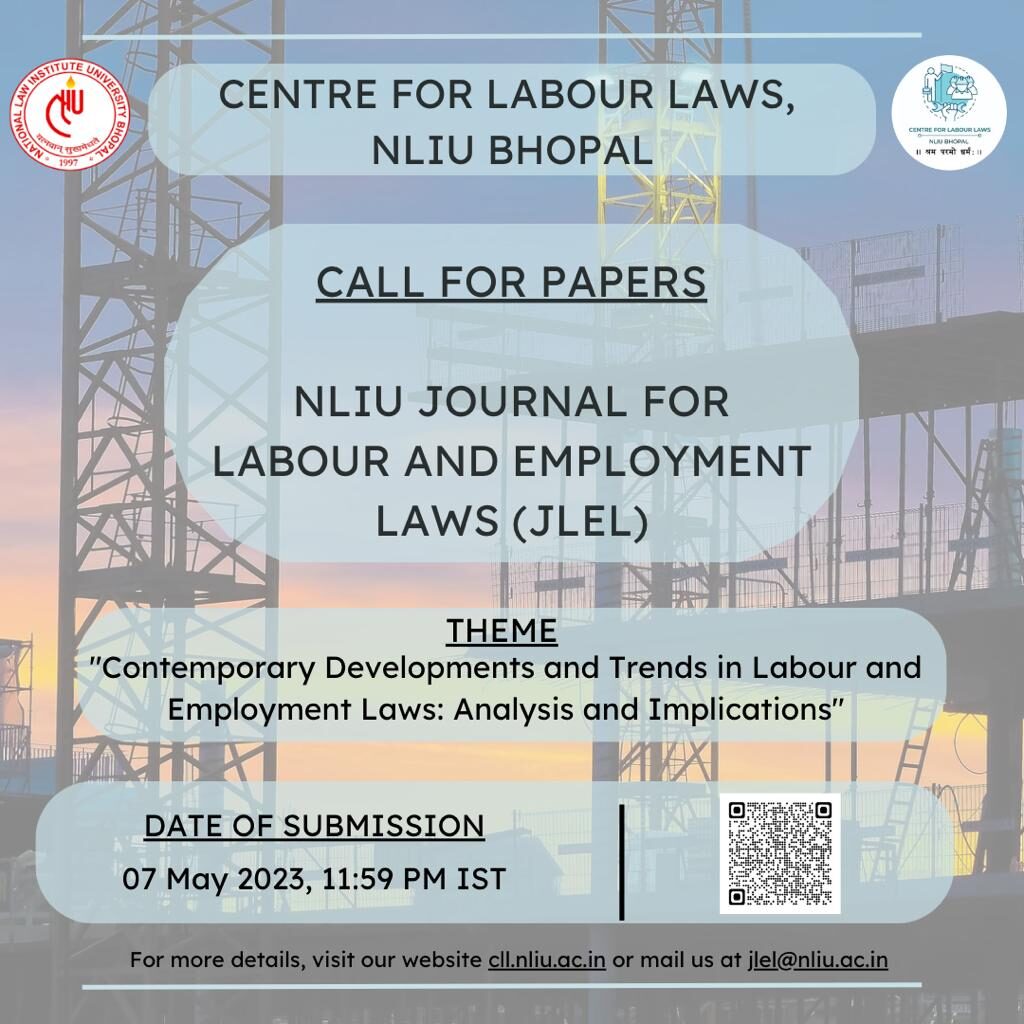
CLL is now accepting submissions for the third volume of the NLIU Journal for Labour and Employment Law (NLIU-JLEL).

About NLIU

National Law Institute University, Bhopal is one of the oldest and most reputed National Law Universities in India. NLIU has been at the forefront of imparting quality legal education and has produced an alumni base which spans the world, who have excelled not only in the traditional legal domain but also in public administration, academia, and policy-making. NLIU fosters and rewards a culture of academic rigour. The university promotes research in cutting-edge areas of law, regularly organising cross-disciplinary and industry-wide workshops, seminars, and training programs on subjects of contemporary relevance. The university is also the alma mater of many reputed journals which receive submissions from students, professionals, regulators, academicians et cetera all across the legal field, fomenting a culture of academic research and providing a platform for multi-directional conversation.

About CLL

The Centre for Labour Laws (CLL) at the National Law Institute University, Bhopal aims to generate scholarship and work as a think tank for the robustness and soundness of Employer-Employee Relations Management. To bring better analytical clarity at national, regional and global levels, the Centre seeks to engage public and private stakeholders for working together on the exchange of ideas, policy recommendations and allied regulatory issues. The Centre for Labour Laws (CLL) was established in 2019 but hit the shot amidst the most uncertain times mankind had ever seen i.e. Covid-19 pandemic, due to its initiative christened as Mazdoor Mitra, wherein the plight of migrant workers during the initial phase of lockdown was in a blatant misery. A bearer of light and empathy then, CLL is one of its kind and serves as an embodiment of labour rights for the brick-bearers of our nation- the Labourers. Over the short span of 2 years, CLL has taken various collective, collaborative and consistent initiatives to seek justice and spread general awareness, respect and empathy for the nation’s labour class.

Theme

The theme for the Volume III of the journal shall be “Contemporary Developments and Trends in Labour and Employment Laws: Analysis and Implications.” The Journal seeks to explore the latest developments and trends in labour and employment laws and to analyze their implications on society, economy, and governance.

Submissions

• Research Articles: 4,000 – 8,000 words
• Case Comments: 2,500 – 5,000 words
• Book Reviews: 1,500 – 3,000 words
• Legislative Comments: 2,000 – 4,000 words
• Short Articles or Notes: 2,000 – 4,000 words

Note: The journal permits up to two authors for co-authored submissions. However, for Case Comments, Book Reviews, and Legislative Comments, co-authorship is not permitted.

How to Submit

The submissions shall be made using the Google form link. The same can be accessed using the QR.

Last date for submission

7th May 2023, 11:59 PM IST.

Contact Details

Devansh Malhotra (Editor-in-chief) :+91 98724 50314 (WhatsApp only)
Udhav Mittal (Managerial Head): +91 81307 34392 (WhatsApp only)

Official Notification

Disclaimer: All information posted by us on Lexpeeps is true to our knowledge. But still, it is suggested that you check and confirm things on your level.

For regular updates on more opportunities, we can catch up at-

WhatsApp Group:

https://chat.whatsapp.com/Iez749mZfpaGfG4x2J6sr9

Telegram:

https://t.me/lexpeeps

LinkedIn:

https://www.linkedin.com/company/lexpeeps-in-lexpeeps-pvt-ltd

About the Firm

POSH at Work believes that sexual harassment at the workplace does not only cause mental and/or physical damage to the person harassed but also seriously curtails opportunities at work by creating a discriminatory work environment. They believe that to ensure equal participation and equal opportunity at work, it is extremely important to do away with discriminatory behaviour and re-instil the faith of employees/workers in the organization. They believe that this can be done only with effective and efficient compliance with the law against sexual harassment i.e. the Sexual Harassment of Women at Workplace (Prevention, Prohibition and Redressal) Act, 2013 and other related laws.

Responsibilities

  • Act as an External Member
  • Assist in handling inquiries and drafting reports
  • Assist in conducting training programs for different stakeholders
  • Conduct research, prepare opinions etc.
  • Any other work required as per the role

Experience

  • Preferably having knowledge of the POSH Law
  • Preferably 1-year experience as an in-house lawyer or at a law firm,
  • Preferably worked in the POSH space or women & child rights
  • Preferably having experience in drafting writs, reports, handling complaints of any kind

Educational qualifications

Bachelors’/Master’s degree (MBA) in Law (BA LLB, LLM )

Skills

  • Drafting skills (like research and drafting)
  • Looking for teamwork – interpersonal skills
  • Excellent verbal and written communication skills
  • Organizational and time management abilities
  • Critical thinking and decision making
  • Resourceful, proactive and solution-oriented
  • Comfortable in working against deadlines
  • Comfortable working from home and doing intra-city and inter-city travel

Remuneration

Remuneration will be decided depending on the value candidate brings, past records and industry practices

CLICK HERE TO APPLY

Disclaimer: All information posted by us on Lexpeeps is true to our knowledge. But still, it is suggested that you check and confirm things on your level.

For regular updates on more opportunities, we can catch up at-

WhatsApp Group:

https://chat.whatsapp.com/Iez749mZfpaGfG4x2J6sr9

Telegram:

https://t.me/lexpeeps

LinkedIn:

https://www.linkedin.com/company/lexpeeps-in-lexpeeps-pvt-ltd

Shriram General Insurance Company Limited is a Joint Venture between Shriram Capital Limited (Part of Shriram Group) and Sanlam Limited. The Company is looking for Senior Executive/Assistant Manager in their Legal Department.

Position Title

Senior Executive/Assistant Manager – Legal

Job Description

  1. Legal Officers monitor day to day working of MACT cases
  2. Coordinate with advocates and process the award in the system as per the company
  3. Must have knowledge of all basic laws including but not limited to Insurance Law, Criminal Law, Civil Law, and Public Interest Litigation (PIL)
  4. Should be able to advise and guide on all legal aspects relating to the business of the company

Skills Required

  1. The candidate must be a Law Graduate and on the roll.
  2. The candidate must have 1+ years in the relevant field.
  3. Proficient in English (both reading and writing).
  4. Good Communication & Presentation Skills
  5. Knowledge of Computers
  6. Analytical & Reasoning Skills

Salary

As per Industry Norms

Disclaimer: All information posted by us on Lexpeeps is true to our knowledge. But still, it is suggested that you check and confirm things on your level.

For regular updates on more opportunities, we can catch up at-

WhatsApp Group:

https://chat.whatsapp.com/Iez749mZfpaGfG4x2J6sr9

Telegram:

https://t.me/lexpeeps

LinkedIn:

https://www.linkedin.com/company/lexpeeps-in-lexpeeps-pvt-ltd

Introduction

The law of torts is a significant part of the Indian legal system, providing remedies to individuals who have suffered harm due to the wrongful acts of others. Over the years, the law of torts in India has witnessed significant growth and development, thanks to the active role played by the judiciary. The courts have interpreted and applied tort law principles in various cases, shaping and expanding the scope of the law. In this context, this discussion will examine the growth of the law of torts in India and the role of the judiciary in shaping it. We will also explore how the Indian courts have relied on the principles of tort law in other common law jurisdictions to fill gaps in the Indian law of torts.

Relevance

The law of torts in India has seen significant growth and development over the years, with the judiciary playing a crucial role in shaping and expanding the scope of the law. Tort law refers to civil wrongs or injuries that are committed by one party against another, resulting in harm or loss, and for which the aggrieved party can seek compensation.

The growth of the law of torts in India can be traced back to the colonial period when the British introduced the concept of negligence and other tortious liability concepts to the Indian legal system. Over time, Indian courts have expanded the scope of the law to include various types of torts, such as nuisance, defamation, and trespass.

One of the key factors that have contributed to the growth of the law of torts in India is the changing socio-economic and political landscape of the country. As India has developed into a more complex and diverse society, the legal system has had to adapt to meet the changing needs and demands of its citizens. The growth of tort law has been driven by a need to protect individual rights and interests, as well as to promote social justice and equity.

Another factor that has played a significant role in shaping the law of torts in India is the role of the judiciary. The Indian judiciary has been proactive in interpreting and expanding the scope of tort law, often relying on international legal principles and jurisprudence to guide its decisions. Through its judgments, the judiciary has not only clarified the legal principles and concepts of tort law but has also established new precedents that have had far-reaching implications for the development of the law.

One example of the judiciary’s role in shaping the law of torts in India is the landmark case of M.C. Mehta v. Union of India[1]. In this case, the Supreme Court of India recognized the concept of absolute liability, which holds industries strictly liable for any harm caused by their activities, regardless of whether they were negligent or not. This decision has had a significant impact on the development of environmental law in India, as it has provided a powerful tool for holding polluting industries accountable for their actions.

Another example of the judiciary’s role in shaping the law of torts in India is the recent case of Shayara Bano v. Union of India[2]. In this case, the Supreme Court of India declared the practice of triple talaq (instant divorce) among Muslims to be unconstitutional and violative of the fundamental rights of women. This decision has not only had a significant impact on the rights of Muslim women but has also expanded the scope of tort law to include violations of fundamental rights as a tortious acts.

In conclusion, the growth of the law of torts in India has been driven by a need to protect individual rights and interests, promote social justice and equity, and adapt to the changing needs and demands of society. The judiciary has played a critical role in shaping and expanding the scope of the law, through its proactive interpretation and application of legal principles and concepts. As India continues to evolve, it is likely that the law of torts will continue to grow and develop, driven by the changing needs and demands of its citizens and the role of the judiciary in shaping the law.

Criticism of Growth of Torts

The law of torts in India has seen significant growth and development over the years, and the judiciary has played a crucial role in shaping the law. Tort law is concerned with providing remedies for civil wrongs or injuries caused by one party to another. The development of the law of torts in India can be traced back to the colonial period when the British introduced the concept of tort law in India.

One of the significant contributions of the judiciary in shaping the law of torts in India has been the recognition and expansion of the scope of tort liability. In the landmark case of M.C. Mehta v. Union of India[3], the Supreme Court recognized the principle of absolute liability, which holds that any enterprise engaged in a hazardous or inherently dangerous activity must pay compensation to those who suffer harm from such activity, irrespective of whether or not the enterprise has been negligent. This decision expanded the scope of tort liability and ensured that victims of industrial accidents and environmental disasters received compensation for their losses. Another important contribution of the judiciary has been the recognition of new causes of action in tort law.

For instance, in the case of Vishakha v. State of Rajasthan[4], the Supreme Court recognized sexual harassment at the workplace as a violation of a woman’s fundamental rights and awarded compensation to the victim. Similarly, in the case of R.K. Anand v. Delhi High Court[5], the court recognized the tort of criminal contempt, which had not been previously recognized in India.

The judiciary has also played a crucial role in developing the principles of vicarious liability in India. Vicarious liability holds that an employer is liable for the torts committed by its employees in the course of their employment. The doctrine of vicarious liability has been expanded to cover not only traditional employer-employee relationships but also situations where a person has a sufficient degree of control over the activities of another person.

However, there are also some criticisms of the growth of the law of torts in India and the role of the judiciary in shaping the law. One of the main criticisms is that the development of tort law in India has been slow and inconsistent, and there is a lack of clarity on many tort law principles. For instance, there is no clear definition of what constitutes a tortious act, and the standards for determining negligence are not well-defined. This lack of clarity has led to uncertainty and confusion in the application of tort law in India.

Another criticism is that the judiciary’s role in shaping the law of torts has been too expansive, and this has led to judicial activism. Some argue that the courts have taken on a policymaking role in developing tort law, which should be left to the legislature. Judicial activism has also led to an increase in litigation and the clogging of the court’s dockets. In conclusion, while the growth of the law of torts in India and the judiciary’s role in shaping the law have been significant, there are also criticisms of the slow and inconsistent development of the law and the judiciary’s expansive role in policymaking. There is a need for greater clarity and coherence in tort law principles to ensure greater certainty and predictability in their application.

Conclusion

In conclusion, the law of torts has seen significant growth and development in India over the years. The judiciary has played a crucial role in shaping the law through its interpretations and rulings on various tort cases. The courts have often applied principles from other common law jurisdictions to fill gaps in the Indian law of torts. Additionally, the judiciary has expanded the scope of tort liability by recognizing new causes of action and extending the boundaries of existing torts. Overall, the growth of the law of torts in India and the role of the judiciary in shaping it have been instrumental in providing a remedy to individuals who have suffered harm due to the wrongful acts of others.


Endnotes:

  1. M.C.Mehta v. Union of India, 1987 SCR (1) 819; AIR 1987 965
  2. Shayara Bano v. Union of India, AIR 2017 9 SCC 1 (SC)
  3. Ibid 1
  4. Vishaka and Ors. v State of Rajasthan, AIR 1997 SC 3011
  5. R.K. Anand v. Registrar, Delhi High Court, 2009 8 SCC 106

This article is written by Aehra Tayyaba Hussain, a 1st-year B.A. LLB student at Symbiosis Law School Hyderabad. 

About the Job

The position will work closely with the Chief Legal Officer handling legal issues with regard to high stake transactions and contracts including fundraising exercises, mainly equity linked transactions. Primarily responsibility includes bidding, new business, equity-linked transactions (acquisitions, mergers, stake sale), transaction structuring and contract management. A close working relationship with the Airport Sector Legal Team will also be required for effective deliverables.

Job Title

AGM Legal

Roles and Responsibilities

  • Handling high-stake transactions in the airport sector including fundraising, due diligence, mergers, acquisitions, restructuring, divesture, stake sale etc. and drafting, negotiating and finalization of term sheets, agreements and contracts on this behalf.
  • Providing legal assistance to BD-related activities viz. new biddings (including RFPs, RFQs and Concession Agreements) for International/Domestic Airports.
  • Drafting, vetting, negotiating and finalizing contracts of various streams with regard to functions of the airport and its joint ventures for the development of existing/ new business.
  • Have a process/systems-oriented outlook with the ability to work under pressure and in a structured time frame.
  • Provide regular support for day to day requirements of the department

Educational Qualifications

LLB minimum. CS qualification is added advantage

Relevant Experience

10-12 Years minimum of experience in contracts and corporate & banking laws

Application Procedure

To apply, CLICK HERE

Disclaimer: All information posted by us on Lexpeeps is true to our knowledge. But still, it is suggested that you check and confirm things on your level.

For regular updates on more opportunities, we can catch up at-

WhatsApp Group:

https://chat.whatsapp.com/Iez749mZfpaGfG4x2J6sr9

Telegram:

https://t.me/lexpeeps

LinkedIn:

https://www.linkedin.com/company/lexpeeps-in-lexpeeps-pvt-ltd

About the Organization

JPMorgan Chase & Co. is a leading global financial services firm with assets of $2.6 trillion and operations worldwide. The firm is a leader in investment banking, financial services for consumers and small businesses, commercial banking, financial transaction processing, and asset management. A component of the Dow Jones Industrial Average, JPMorgan Chase & Co. serves millions of consumers in the United States and many of the world’s most prominent corporate, institutional and government clients under its J.P. Morgan and Chase brands.

Job Title

Associate Legal Counsel (Lending)

Role Description

  • JPMorgan’s EMEA seeks a lawyer based in Mumbai to support its Corporate & Investment Bank in the EMEA region. The lawyer will be an integral part of the EMEA Banking Legal team working closely with the regional lawyers based in London, and will support lending transactions and loan trading activity engaged in by several businesses across the Corporate & Investment Bank including the Global Corporate Bank, Syndicated and Leveraged Finance, Structured Lending, Credit Portfolio Group, Securitised Products Group, Secondary Loan Trading and Credit Trading.
  • Key functions will include assisting (in accordance with policies, procedures, regulatory requirements and based on internal guidance and standard operating procedures) in the documentation, negotiation and execution of lending and loan trading transactions, working on group projects and initiatives, and identifying and advising on related legal issues.
  • The lawyer will report to Carter Moore in London and to a local supervisor in Mumbai.
  • By joining the team, the successful candidate will have the opportunity to play a critical role in the success of several market leading businesses, where the role of the in-house lawyer is vital to the success of the business.
  • The Position involves frequent interaction with internal teams across the Corporate & Investment Bank including Sales, Credit Risk, Client Service, Business Management and Operations, as well as external Clients.

Roles & Responsibilities

  • Provides leadership and acts as the Team Lead for the EMEA Banking Legal Team in Mumbai.
  • Builds and manages key relationship stakeholders in the legal department as well as Sales, Credit Risk, Client Service, Business Management and Operations and external Clients in EMEA.

Candidate Qualifications And Skills

  • A qualified lawyer in India with 3 to 8 years of PQE (additional qualification England and Wales or other common law jurisdiction will be viewed favorably) and relevant experience gained at a leading domestic or international law firm and/or leading financial institution.
  • Has successful track record of coaching, mentoring team members and leadership skills including attracting, developing, and retaining talent.
  • Mature personality with skills and ability to work independently under pressure.
  • Strong drafting, negotiation and legal analytical skills with strong attention to detail.
  • Pragmatic with ability to strike appropriate balance between achieving the commercial goals of the business while protecting the interests of JPMorgan as a whole.
  • Ability to timely and appropriately identify risks and escalate issues to relevant stakeholders.
  • Confident and proactive with excellent communication skills.
  • Ability to work collaboratively and build close rapport with internal stakeholders across Sales, Product, Client Service, Operation, Risk and Compliance functions across jurisdictions.
  • Ability to adapt and apply legal skills in new contexts, to new businesses and subjects in which one may not have prior relevant experience, and willingness to develop and excel beyond his/ her comfort zone; and
  • Ability to manage competing priorities, project-manage and co-ordinate large projects, in a dynamic global environment.
  • Team player, confident and proactive with strong interpersonal skills,
  • Lawyer must be qualified and eligible to practice law in the jurisdiction in which the position is based.
  • The candidate must successfully complete a conflicts of interest clearance review prior to commencement of employment.

Application Procedure

To apply, CLICK HERE

Disclaimer: All information posted by us on Lexpeeps is true to our knowledge. But still, it is suggested that you check and confirm things on your level.

For regular updates on more opportunities, we can catch up at-

WhatsApp Group:

https://chat.whatsapp.com/Iez749mZfpaGfG4x2J6sr9

Telegram:

https://t.me/lexpeeps

LinkedIn:

https://www.linkedin.com/company/lexpeeps-in-lexpeeps-pvt-ltd