Maharshi University of Information Technology, NOIDA, U.P. and National Labour Law Association, New Delhi are organising the 3rd Maharishi Mahesh Yogi International Conference On Comparative Labour Laws in South-Asia: Labour and Management Perspective on 28th and 29th August 2023.

About the Conference

The year 2020 was a defining period for countries, particularly, in South Asia.  The COVID-19 pandemic caused not only a large number of deaths and displacements but also hastened the process towards digital-centred business models.  The rapid growth of the platform economy, MSMEs, and consumers’ preference for online shopping, etc. have created conditions that are entirely different from the conditions for which the prevailing labour laws were enacted. Additionally, the havoc caused by turbulence, both natural (such as flood and drought) and manmade (such as political, trade and religious) have collectively caused humanitarian crises.  These developments are having a detrimental effect on the workers, their employability, and their rights at work.  In this background, it is imperative for the national governments in the sub-region to understand the ongoing trends in the world of work, examine the working of the social dialogue institutions, and amend the existing labour/employment laws so that the same are in tune with the ongoing changes.

Themes of the Conference

  1. Social Security in South Asia
  2. Current Crisis in Labour Law
  3. Labour Law Reforms: Issues & Challenges
  4. Enforcement of Labour Rights
  5.  International Labour Standards in South Asia
  6. Employment of Women
  7. Job Security in South Asia
  8.  Collective Bargaining in South Asia
  9. Trade Unions in South Asia
  10. Minimum Standards of Employment in South Asia
  11.  Occupational Safety and Health in South Asia
  12. Legal Protection of unorganized workers
  13. Migrant Labour in South Asia
  14. Impact of COVID on Labour and Labour Law
  15. Resolution of Industrial Disputes
  16. Right to form Union and go on Strike
  17. Management of Contract Labor and Outsourcing
  18. Ease of doing business and Labour Law
  19. Sustainability and Labour Law
  20. Workers’ Participation in Management
  21. Corporate Social Responsibility and its utilization in social security fun for unorganized workers
  22. Labour Law Compliances for Start-ups
  23. Human Rights and Businesses
  24. Legal aspects drive Work-Life Balance of Employees
  25. Stakeholders legal protection during Bankruptcy and Insolvency
  26. IPR and Product & Process Layout
  27. Challenges and Opportunities of Involvement of AI in Business
  28. Management Aspects of Indian Ethos
  29. Legal Aspects of Managing the Tourism Industry
  30. Legal protections to Service Industry
  31. Any topic (Multi-disciplinary or inter-disciplinary) related to theme can also be accommodated

Conference Venue

Sector 110, Noida, PO- Maharishi Nagar, Distt. Gautam Budh Nagar, Uttar Pradesh 201304, India

Phone: +91 11 66763870
Website: https://muitnoida.edu.in/

Mode

Hybrid Mode

Guidelines for Conference Papers

The Authors should apply research skills and appropriate research methodology. The research paper should be thematic and desired to be linked to the sub-themes. The length of the abstract should not be more than 500 words. It must be typed in Times New Roman, Font Size 12 on A4 size paper, and margin on all sides with 1.5 line spacing using MS Word application. The Citation Pattern should be as per the Blue-book pattern or APA style.

Footnotes should follow the SILC standard of footnoting. Endnotes are not allowed. At the end of the paper, there should be a brief profile of the author with an E-mail ID, contact number, and address.

The plagiarism of research papers should be less than 20%. The plagiarism will be checked by Editorial Committee.

Registration Fees

For Offline Mode:

Academician/Advocate/Industry Expert:

  • Single Author: ₹ 1000 INR
  • With Co-Author: ₹1200 INR

Research Scholar/Student

  • Single Author: ₹ 700 INR
  • With Co-author: ₹ 1000/- INR

For Online Mode:

  • Single Author: ₹ 1200
  • Co-Author: ₹ 1400

Perks

  • Best Research Paper Award (Certificate + Memento)
  • A participation/ Presentation Certificate will be provided.
  • Selected papers will be published in UGC CARE JOURNAL/ ISBN/Maharishi Journal of Law and Society. (Publication charges for UGC/ISBN shall be borne by participants only.)

Accommodation

The accommodation can be provided to the Participants only on first-cum-first serve basis. The room will be on twin shared basis. The participant has to inform twenty days in advance and is required to pay the accommodation charges as per the university norms. Once registered for accommodation the refund cannot be claimed. No TA & DA shall be provided to the participants.

Send Your Paper to: mlsmuitconference@gmail.com

Upload your abstract and payment receipt: https://forms.gle/Kw3Ru4judSyWyirn8

UPI Link

Important Deadlines

  • Abstract submission- 30th July 2023
  • Registration – 30th July 2023
  • Full paper submission- 10th August 2023

If any query participant may contact mlsmuitconference@gmail.com

Disclaimer: All information posted by us on Lexpeeps is true to our knowledge. But still, it is suggested that you check and confirm things on your level.

EXPLORE MORE SUCH OPPORTUNITIES HERE!

For regular updates on more opportunities, we can catch up at-

WhatsApp Group:

https://chat.whatsapp.com/Iez749mZfpaGfG4x2J6sr9

Telegram:

https://t.me/lexpeeps

LinkedIn:

https://www.linkedin.com/company/lexpeeps-in-lexpeeps-pvt-ltd

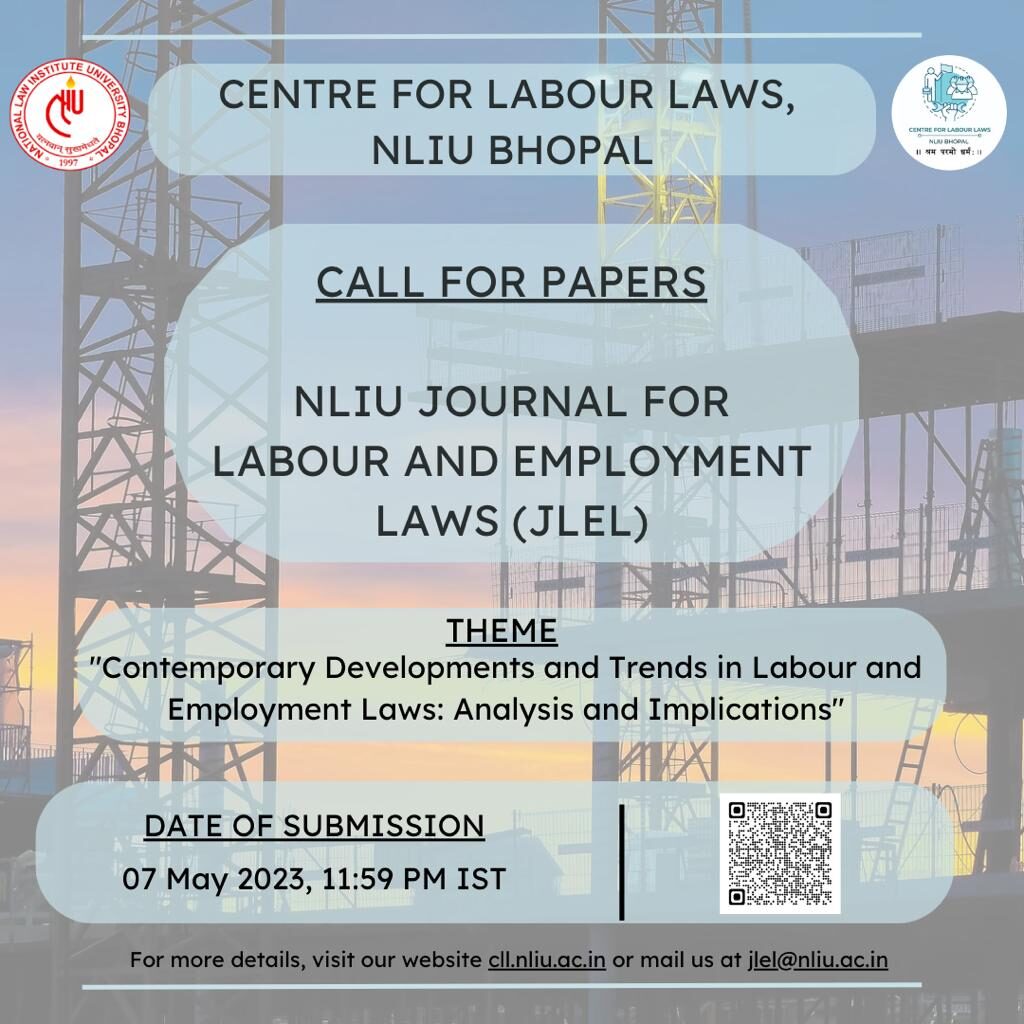
CLL is now accepting submissions for the third volume of the NLIU Journal for Labour and Employment Law (NLIU-JLEL).

About NLIU

National Law Institute University, Bhopal is one of the oldest and most reputed National Law Universities in India. NLIU has been at the forefront of imparting quality legal education and has produced an alumni base which spans the world, who have excelled not only in the traditional legal domain but also in public administration, academia, and policy-making. NLIU fosters and rewards a culture of academic rigour. The university promotes research in cutting-edge areas of law, regularly organising cross-disciplinary and industry-wide workshops, seminars, and training programs on subjects of contemporary relevance. The university is also the alma mater of many reputed journals which receive submissions from students, professionals, regulators, academicians et cetera all across the legal field, fomenting a culture of academic research and providing a platform for multi-directional conversation.

About CLL

The Centre for Labour Laws (CLL) at the National Law Institute University, Bhopal aims to generate scholarship and work as a think tank for the robustness and soundness of Employer-Employee Relations Management. To bring better analytical clarity at national, regional and global levels, the Centre seeks to engage public and private stakeholders for working together on the exchange of ideas, policy recommendations and allied regulatory issues. The Centre for Labour Laws (CLL) was established in 2019 but hit the shot amidst the most uncertain times mankind had ever seen i.e. Covid-19 pandemic, due to its initiative christened as Mazdoor Mitra, wherein the plight of migrant workers during the initial phase of lockdown was in a blatant misery. A bearer of light and empathy then, CLL is one of its kind and serves as an embodiment of labour rights for the brick-bearers of our nation- the Labourers. Over the short span of 2 years, CLL has taken various collective, collaborative and consistent initiatives to seek justice and spread general awareness, respect and empathy for the nation’s labour class.

Theme

The theme for the Volume III of the journal shall be “Contemporary Developments and Trends in Labour and Employment Laws: Analysis and Implications.” The Journal seeks to explore the latest developments and trends in labour and employment laws and to analyze their implications on society, economy, and governance.

Submissions

• Research Articles: 4,000 – 8,000 words
• Case Comments: 2,500 – 5,000 words
• Book Reviews: 1,500 – 3,000 words
• Legislative Comments: 2,000 – 4,000 words
• Short Articles or Notes: 2,000 – 4,000 words

Note: The journal permits up to two authors for co-authored submissions. However, for Case Comments, Book Reviews, and Legislative Comments, co-authorship is not permitted.

How to Submit

The submissions shall be made using the Google form link. The same can be accessed using the QR.

Last date for submission

7th May 2023, 11:59 PM IST.

Contact Details

Devansh Malhotra (Editor-in-chief) :+91 98724 50314 (WhatsApp only)
Udhav Mittal (Managerial Head): +91 81307 34392 (WhatsApp only)

Official Notification

Disclaimer: All information posted by us on Lexpeeps is true to our knowledge. But still, it is suggested that you check and confirm things on your level.

For regular updates on more opportunities, we can catch up at-

WhatsApp Group:

https://chat.whatsapp.com/Iez749mZfpaGfG4x2J6sr9

Telegram:

https://t.me/lexpeeps

LinkedIn:

https://www.linkedin.com/company/lexpeeps-in-lexpeeps-pvt-ltd

Background

For an empowered, affluent, and Aatmanirbhar India, workers must have more influence. Even after 73 years of independence, 90% of employees are still employed in the unorganized sector, where they are not eligible for all social security benefits. Over 50 crores of people are employed in both the formal and unorganized sectors combined. For the first time, a government is taking care of employees and their families in both the organized and unorganized sectors. India, a country where employment is not at will, has seen its fair share of job-related lawsuits, many of which involved allegations of unfair labour practices and wrongful termination. Although mainly restricted to the industrial sectors, labour unions have continued to be active throughout the nation. The new labour laws in India have not yet gone into force. 29 federal labour statutes are replaced by the four labour codes. Once put into effect, it will significantly alter our labour law system.

Defining Labour Laws in India

Labour law, often known as employment law, is the set of laws, administrative judgements, and precedents that address the legal rights and constraints of workers and their organizations. As a result, it mediates a number of relationship-related issues between trade unions, both employers and workers. In other words, labour law outlines the duties and responsibilities of employees, union members, and employers. In general, labour law addresses:

  • Industrial relations include union certification, labour-management interactions, collective bargaining, and unfair labour practices.
  • Occupational health and safety;
  • Employment requirements, such as severance compensation, minimum salary, layoff processes, general holidays, yearly leave, and working hours.

In the past, the Indian government at the federal and state levels strove to guarantee that employees had a high level of protection, but in reality, this has changed because of the structure of government and since labour is a topic on the concurrent list of the Indian Constitution. The Minimum Wages Act of 1948 mandates that businesses pay the government-set minimum wage and cap workweeks at 40 hours (9 hours a day including an hour of break). Since the reward for overtime is 100% of the overall salary, it is strongly discouraged. The Payment of Wages Act of 1936 requires that wages be paid promptly by bank transfer or postal service on the last working day of each month.

The Payment of Wages Act of 1936 requires that wages be paid promptly by bank transfer or postal service on the last working day of each month. Each employee is required to take 15 working days of fully paid vacation time each year, in addition to an extra 7 completely paid sick days, under the Factories Act of 1948 and the Shops and Establishments Act of 1960. Every company’s female employees are now entitled to 6 months of fully compensated maternity leave thanks to the Maternity Benefit (Amendment) Act of 2017. Additionally, it offers 6 weeks of paid time off in the event of a miscarriage or medical termination of pregnancy.

Workers can access the essential social security for retirement benefits, medical care, and unemployment benefits through the Employees’ Provident Fund Organization and the Employees’ State Insurance, all of which are controlled by statutes. Employees who qualify for Employees’ State Insurance coverage (those making less than Rs. 21000/month) are also eligible for 90 days of paid medical leave. It is always possible to include more rights in an employment contract than the bare minimum required by law. Four labour regulations were adopted by the Indian parliament in the 2019 and 2020 sessions. The Industrial Relations Code 2020, The Code on Social Security 2020, The Occupational Safety, Health and Working Conditions Code 2020, and The Code on Wages 2019 will combine 44 current labour laws.

History of Labour laws

The need for improved working conditions, the right to organize, and employer demands to limit employee rights in numerous groups and keep labour costs down led to the development of labour law. Therefore, the situation of labour legislation at any one moment is both a result of and an element of conflicts between various interests in society.

One of the earliest organizations to address labour concerns was the International Labour Organization (ILO). Following the signing of the Treaty of Versailles, which brought an end to World War I, the League of Nations formed the ILO as an agency. During and soon after the war, several countries focused on post-war rebuilding and the preservation of labour unions. Workers who wanted improved working conditions, as well as trade unions that objected by going on strike, were routinely and violently suppressed. Following the achievement of independence in 1947, a number of fundamental labour rights—including the ability to join and participate in unions, the idea of workplace equality, and the desire to establish a living wage and respectable working conditions—were incorporated into the Indian Constitution of 1950.

Constitutional Provisions under Labour laws

Articles 14–16, 19(1)(c), 23–24, 38, and 41–43A of the 1950 Indian Constitution specifically address labour rights. Everyone shall be treated equally under the law, according to article 14, and discrimination against citizens is prohibited under article 15. Article 16 also grants the right to “equality of opportunity” for employment or other state-related appointments. Everyone has the special right “to organize groups or unions,” according to Article 19(1)(c). Articles 23 and 24 forbid child labour under the age of 14 in factories, mines, or “any other dangerous occupation,” respectively. Article 23 also outlaws all forms of trafficking and forced labour. According to the Indian Constitution, labour is a concurrent topic, meaning that both the Union and the state governments have the authority to enact and enforce labour laws. The majority of significant pieces of legislation have been passed by the Parliament.

The following categories apply to the laws:

1) Central Government-enacted labour legislation, whose exclusive enforcement rests with the Central Government.

2) Central government-enacted labour rules that are upheld by both the federal and state governments.

3) State governments implement federal labour rules that the federal government enacts.

4) The different State Governments have passed and are enforcing labour regulations that are applicable to their respective States.

Indian Labour Policy

India’s labour strategy has evolved in response to the country’s unique circumstances in order to meet the demands of social justice and planned economic growth. Its dual goals are to preserve industrial peace and advance worker welfare.

Workplace reforms implemented since 2014

The use of IT-enabled systems for inspection has been made required for openness and accountability.

  • The maximum allowable gratuity has risen as of March 29, 2018, from Rs. 10 Lakhs to Rs. 20 Lakhs.
  • On 16.02.2017, the Payment of Wages Act became effective. Salary distribution to workers by check or giving it to their bank account for credit.
  • The 2017 Maternity Benefit Amendment Act went into effect on April 1, 2017, and raised the 12 to 26 weeks of paid maternity leave weeks.

The 4 Labour Codes of India

2019 Code of Wages

The Code on Wages aims to control salary and bonus payments in all work situations involving any type of manufacture, trade, or industry. It combines four pieces of legislation: the Equal Remuneration Act, the Payment of Bonus Act of 1965, the Minimum Wage Act, and the Payment of Wages Act.

The Code’s primary characteristics are:

  1. The State or Central Government may not revise the minimum wage more frequently than every five years.
  2. Any person who directly or indirectly employs one or more people at an institution is considered an employer for purposes of this term.
  3. The Payment of Salaries Act only applies to workers making less than Rs. 24,000 per month in wages. The Code on Wages has now eliminated this upper restriction. Therefore, regardless of monthly earnings, the Code should be applicable to all employees.
  4. In contrast to the many definitions provided in the Payment of Wages Act, 1936, the Minimum Wages Act, 1948 (Minimum Wages Act, 1948), and the Payment of Bonus Act, 1965, the Code offers a uniform definition of the term “Wages.”
  5. Employers are required to provide salaries equal to at least 50% of total compensation under the conditions outlined in the Code. Basic pay, dearness allowance, and retention allowance are included in the calculation of earnings; home rent allowance, conveyance, statutory bonus, overtime allowance, and commissions are not. Basic wage and dearness allowance must make up at least 50% of the cost to the company.
  6. Employers are not allowed to pay employees less than the minimum wage. The Central or State Governments, depending on the situation, are obligated to notify minimum salaries based on I the time or quantity produced, (ii) the employees’ skill, and (iii) the complexity of the task.
  7. According to the requirements of the Code, the Central and State Governments should establish Advisory Boards. Members of the Central Advisory Board must represent both businesses and employees, as well as five state government representatives and independents. The State Advisory Board must include an independent member as well as representatives from companies and employees.
  8. State Advisory Boards will be made up of independent individuals, employers, and workers. Additionally, women will make up one-third of the total members of the central and state boards. The Boards will provide guidance to the national governments on a variety of topics, such as setting minimum salaries and (ii) expanding possibilities for women in the workforce.

2020 Social Security Code

The Code on Social Security aims to update and codify the social security laws to cover all employees and workers, whether they are employed in the organized, unorganized, or any other sector.

Employees’ Compensation Act of 1923, Employees’ State Insurance Act of 1948, Employees’ Provident Funds and Miscellaneous Provisions Act of 1952, Employment Exchanges (Compulsory Notice of Vacancies) Act of 1959, Maternity Benefit Act of 1961, Payment of Gratuity Act of 1972, Cine Workers Welfare Fund Act of 1981, Building and Other Construction Workers Welfare Cess Act of 1996, and Unorganized Workers’ Social Security Act of 2008.

The Code’s primary characteristics are:

  1. Fixed-term employment, home-based workers, independent contractors, platform workers, and gig workers have all been defined.
  2. The term “employee” was added and is now used consistently across the whole Code.
  3. According to Section 3 of the Code, if an industry establishment is already registered under another Central labour regulation, registration is not required.
  4. The enforceability of social security organizations and their bylaws is provided in Section 4 of the Code. It is necessary for the administration of funds for various personnel.
  5. A fixed limitation period of 5 years will be established under Section 125 of the Code, including actions and enquiries to determine an employee’s financial obligations.
  6. Aggregators are described in the Code as a digital middleman or marketplace that connects a service’s user or buyer with its supplier or provider. The list of aggregators must pay between 1% and 2% of their yearly revenue to the social security fund, as stated in Schedule 7 of the Code.
  7. Employers are required to pay gratuities to fixed-term employees on a pro-rata basis. For working journalists, the gratuity term has been lowered from five years to three.

2020 Industrial Relation Code

The Code on Industrial Relations aims to make compliance easier to achieve and encourages convenience for customers and employees. The Industrial Disputes Act of 1947, the Industrial Employment (Standing Orders) Act of 1946, and the Trade Unions Act of 1926 are all included in this law.

The appropriate government may require the employer of an industrial business where 100 or more workers are engaged or have been employed on any day over the previous 12 months to form a works committee.

Industrial establishments with 20 or more employees must have a grievance redressal committee or committees to handle individual grievance problems.

Any trade union with seven or more members may register online or in another manner under the Code.

Every industrial enterprise where 300 or more employees are engaged or were employed on any day during the previous year is subject to the Standing Orders.

The Code’s primary characteristics are:

  1. Defines “employee” and “fixed-term employment” in the introduction.
  2. In the Code, the phrase “workmen” has been changed to “worker.”
  3. Today, more than 50% of employees define a “strike” as “mass casual leave” on any given day.
  4. Any grievance must now be filed with the grievance redressal committee in accordance with the Code, and an inquiry and its investigation must be finished within 90 days. The time frame begins on the day the employee was suspended.
  5. According to the Industrial Establishment Standing Order Act of 1946, standing orders were only applicable to workplaces with 100 or more employees. Standing order requirements have now been raised from 100 to 300 employees.
  6. In establishments with several trade unions, the Code has established a “single negotiating union.” According to Section 14 of the Code, this only negotiating union must have 51% or more workers as members. Terms with the employer may only be discussed by one negotiating union. In the absence of a qualifying exclusive bargaining union, a bargaining council made up of at least 20% of the workforce shall be established.
  7. After being laid off, people might find employment thanks to provisions in the Code. An initial fund made up of payments from the employer and the appropriate government must be established.
  8. The Central Government shall establish a national industrial tribunal and one or more industrial tribunals as the framework for resolving labour disputes.

Occupational Safety, Health, and Working Conditions Code of 2020

The Code on Occupational Safety, Health, and Working Conditions aim to control workplace health and safety conditions for employees in all mines and docks as well as companies with 10 or more employees.

It incorporates thirteen pieces of legislation, including the Factories Act of 1948, the Mines Act of 1952, the Dock Workers Act of 1986, the Contract Labor Act of 1970, the Inter-State Migrant Workers Act of 1979, the Plantations Labor Act of 1951, the Working Journalist and Other News Paper Employees (Conditions of Service and Miscellaneous Provision) Act of 1955, the Working Journalist (Fixation of Rates of Wages) Act of 1958, the Motor Transport Workers Act of 1961, The Sales Promotion Employees (Conditions of Service) Act, 1976 and The Beedi and Cigar Workers (Conditions of Employment) Act, 1966.

The Code’s primary characteristics are:

  1. For those working in transportation, media, and sales, specific clauses outline leave policies and working hours.
  2. Section 32 of the Code lays forth the rules for leave encashment at the moment of discharge/dismissal, death, or superannuation while employed. At the conclusion of the calendar year, provisions pertaining to leave encashment are available. Most importantly, the Code allows for leave carryover in the event that a worker does not use all of the leave that is granted to him in a given calendar year. However, the maximum number of days of unpaid leave that may be carried forward is 30, and any unpaid leave that has been denied can be carried forward indefinitely.
  3. All businesses are required to provide bathrooms, showers, and locker rooms for employees who identify as male, female, or transgender.
  4. There is now a clause that allows the employee to provide permission for the employer to work overtime. It will also be applicable to small businesses with up to 10 employees. The workers will also be paid twice as much for any overtime they put in.
  5. Employers are expected to arrange for the employee’s yearly health exams at their own expense.

Conclusion

The Minimum Wages Act of 1948 mandates that businesses pay the government-set minimum wage and cap workweeks at 40 hours (9 hours a day including an hour of break). Since the reward for overtime is 100% of the overall salary, it is strongly discouraged. Each employee is required to take 15 working days of fully paid vacation time each year, in addition to an extra 7 completely paid sick days. Every company’s female employees are now entitled to 6 months of fully compensated maternity leave. Four labour regulations were adopted by the Indian parliament in the 2019 and 2020 sessions.

The need for improved working conditions, the right to organize, and employer demands to limit employee rights led to the development of labour law. Following the achievement of independence in 1947, a number of fundamental labour rights were incorporated into the Indian Constitution. India’s labour strategy has evolved to meet the demands of social justice and planned economic growth. The use of IT-enabled systems for inspection has been made required for openness and accountability. The Code on Wages aims to control salary and bonus payments in all work situations involving any type of manufacture, trade, or industry.


References

  1. New Labour Code for India
  2. Minimum Wages Act, 1948
  3. The Payment of Wages Act, 1936
  4. The Factories Act, 1948)

This article is written by Puneet Kaur, a second-year student.

Introduction

Children are viewed as the personification of innocence in a human form. Children are the most pristine manifestations of humanity because they are unaffected by materialistic concerns. It is true that a nation’s fate can be effectively predicted by the state of its women and children. However, when kids are compelled to work and earn a living, their childhood purity, innocence, and morals are taken from them. India, home to the greatest youth population in the world, has one of the oldest and most significant issues with child labour. Despite the fact that the country’s politicians have passed numerous laws, child labour is still pervasive in many places, particularly in rural India.

Child labour is a widespread issue that is not specific to any one nation. The use of children in any type of manual labour is referred to as “child labour.” A “child” is defined as a person under the Child Labour (Prohibition and Regulation) Act, 1986 as someone who is under the age of 14. A child is compelled to labour and provide for his or her family at a young age when they should be expected to develop, enjoy childhood to the fullest, pursue education, and develop strong moral principles.

Article 23 of the Indian Constitution prohibits all forms of forced labour. Article 24 stipulates that no child under the age of 14 may be employed to conduct hazardous employment. Similarly, Article 39 specifies that “the health and vigour of workers, men and women, as well as children’s tender age, are not mistreated.” Similarly, the Child Labour Act (Prohibition and Regulation) 1986 forbids children under the age of 14 from working in hazardous industries or procedures. The Child Labour (Prohibition & Regulation) Amendment Act 2016 outlaws the employment of children under the age of 14 in all occupations and processes, as well as the employment of adolescents (14-18 years) in scheduled hazardous activities and processes.

Children’s participation in the informal economy and home-based jobs is increasing. Children work in agricultural, manual, domestic, and hazardous industries, such as matchbox, rag-picking, brick kilns, beedi-rolling, and so on. The most heinous kinds of child labour entail children being exploited, separated from their families, subjected to dangerous risks and illnesses, and often left to fend for themselves on the streets of major cities at a young age. Slavery, Child Trafficking, Debt Bondage, Serfdom, Forced Labour, and begar are the worst forms of child labour, according to the International Labour Organization.

Education is an essential component as well as one of the most significant tools of social advancement. A country’s growth might be praised or devalued based on its literacy rate. Civil upheaval and other social calamities lead to a shortage of knowledge. Child labour is one of the effects that bring our social behaviour about the country’s destiny into question. Every aspect of civilization, even this one, has been devastated by the worldwide pandemic. Working from home and taking online classes may appeal to a specific demographic. It has been a catastrophe for the remaining impoverished. The situation worsened for the children who had been exposed to the virus, and the struggle for the comfort of the fortunate intensified.

As a diverse country with different civilizations, India conforms to legal boundaries that are equally tolerant of other traditions. Education allows us to make distinctions between good and bad norms. Educational cultures should be regarded as the cornerstone of advancement among distinct civilizations. The research examines all of the various aspects of child labour, as well as the role of education in eradicating it. It is difficult to oppose social taboos without schooling a country’s people, but it is much more difficult to combat social taboos with educated individuals who are not socially conscious.

Importance of Education

Education is the component that contributes to human resource development, which includes a better and more sustainable natural upbringing for everybody. The major goal of the educational system is to give knowledge skills while also transmitting some key values. Economically, the final education package will differ between countries and cultures. In another dimension, it has been observed that the limited number of schools, their absence, the clash of school time and agricultural operations, the cost of schooling, and the limited nature of providing jobs opportunities to enter the labour market facilitate the route of children belonging to the state class. Children are eager to learn, but only with the proper authorization of their owners and parents.

They are particularly concerned about the cost of higher education and other expenses, therefore they want it to be free and close to their house. More than 86 million rural children in the age range of 5-14 years have not been enrolled in the school register, out of 140 million. In rural areas, approximately 62% of children do not attend primary school. Whereas Article 45 (Directive Principles of State Policy) specifies that “the state should attempt to offer” free and obligatory education for all children till the age of 14 years within a period of ten years from the start of this constitution.” However, compulsory schooling for children as an assimilation technique has been proved to be misleading. As a result, the phenomenon of child labour is the result of such apathy toward education. As a result of this disregard for education, the issue of child labour has emerged.

It not only helps children gain vital skills but also allows them to have a respectable life in the future. Education and training are essential drivers of social, economic, and democratic advancement. The elimination of all educational expenditures will result in the education of a huge portion of society. A strategy based on educating children and dragging them out of poverty will lessen the amount of child labour cases we now confront. No one has the ability to reject education as a fundamental right. It helps to change people’s perspectives on life and makes them better people.

Education is a lifelong endeavour. It commences when we are born and concludes when we die. It exists in all societies and takes numerous forms, ranging from the “school of hard knocks,” or learning via experience, to formal institutional learning—from post-industrial to non-industrial communities, rural to metropolitan settings, and young to elder learners. Education fosters critical thinking skills. This is crucial for teaching someone how to utilize intellectuals while making pronouncements and dealing with others. Education enables an individual to achieve basic employment qualifications and increases their chances of obtaining better jobs and a better way of life.

Child labour traps and encompasses them to a life with few prospects. As a result, it is critical to guarantee that every child is safeguarded and not exploited for cheap labour. Education has the potential to transform societies and the planet in general. Education is a strong instrument for making the world a better place to live. Education minimizes societal violence and crime. Teaching people to read has been found to reduce criminal behaviour. The Melissa Institute for Violence Prevention and Treatment, for example, is a non-profit organization that employs education to prevent violence and crime. Education fosters optimism for the future. One of the most profound consequences of education on society is the ability to give individuals hope that they may improve their situation in life.

Suggestions and Conclusion

A range of variables can contribute to poverty, child labour, and unemployment. For all we know, education is not only a solution, but also the most significant component of the formula, and without it, we cannot even contemplate the success sector. Instead, we should go forward and promote awareness about the value of education. Concerning our birthright to equality, it is only through education that we discover the worth of our own rights and have a better grasp of our duties and obligations. Millions of individuals who work as labourers or are compelled to work are unaware that they have the same rights as their employers.

There is simply one constitution that governs all of the country’s residents. No one is unusual in the perceptiveness of law. We can all agree that there are numerous ways to get information, but education provides us with greater power. And no nation can be as prosperous as one in which the majority of its population has access to self-development and self-awareness opportunities. We have not yet found a flawless means to permanently stop child labour since, despite having a remedy in our hands, it still remains. People do not recognize the link when the government implements legislation for the poor, and they do not trust that the government understands what they are going through and their hardships.

As a result, if the government enacts a regulation mandating parents to take their children to school or suffer fines, they will be obliged to comply. They feel they are ruled by a strong organization with conflicting interests, therefore they frequently lie about taking their children to school, often merely to escape a fine. We must promote mutual understanding between provider and receiver, with both sides working toward the same objective, as well as societal progress through education. Absolutely, education is the greatest way to deal with child labour. As an outcome, the government must teach children to evade child labour.

The government should propose measures to assist parents in seeing the benefits of education in their own unique ways. Parents must recognize that they are not required to educate their children, but must do it for their own benefit. Education helps generations grow, and while growth may not be as quick as we would want, it is a continuous and dependable process. A law is only beneficial if it is followed correctly. Rather than the way the government puts out all of the policies for citizens, we should improve the quality of execution. Following the passage of each law, the government should review its execution and implementation to determine how far it has proceeded.

References

  1. www.indiacelebrating.com
  2. www.ilo.org
  3. www.legalserviceindia.com
  4. “A Critical Analysis of Child Labour in India” <A Critical Analysis of Child Labour in India – Free Essay Example – Edubirdie>
  5. Child Labour laws in India < child labour: all you need to know in Indian context – iPleaders>

This article is written by Devishee Arora, a 4th year B.COM LLB (Hons.) student at Amity Law School, Noida.

INTRODUCTION

Whatever is given under power is a writ. Orders, warrants, headings, and so forth given under power are instances of writs. Any individual whose central freedoms are disregarded can move the High Court (under article 226 of the Indian constitution) or the Supreme Court (under article 32) and the court can give bearing or orders or writs. Accordingly, the ability to give writs is principally an arrangement made to make accessible the Right to Constitutional Remedies to each resident. Notwithstanding the abovementioned, the Constitution likewise accommodates the Parliament to give on the Supreme Court ability to give writs, for purposes other than those referenced previously. Additionally, High Courts in India are likewise engaged to give writs for the requirement of any of the freedoms presented by Part III and for some other reason.
In India, both the Supreme Court and the High Court have been engaged with Writ Jurisdiction. Further, Parliament by law can stretch out the ability to give writs to some other courts (counting neighborhood courts) for nearby constraints of the locale of such courts.

WRIT OF QUO WARRANTO

The word Quo-Warranto in a real sense signifies “by what warrants?” or “what is your power”.The Writ of Quo-warranto in the writ is given guiding subordinate specialists to show under the thing authority they are holding the workplace. If an individual has usurped a public office, the Court might guide him not to do any exercises in the workplace or may report the workplace to be empty. Consequently, High Court might give a writ of quo-warranto assuming an individual holds an office past his retirement age.
The Writ of Quo-Warranto can’t be given to an individual working in a private field. This writ is given to an individual in an office, the lawfulness of which is being addressed.

CONDITIONS FOR ISSUE OF THE WRIT OF QUO-WARRANTO

  1. The workplace should be public and it should be made by a sculpture or by the actual constitution.
  2. The workplace should be a considerable one and not only the capacity or work of a worker at the will and during the joy of another.
  3. There more likely than not be a negation of the constitution or a rule or legal instrument, in naming such individual to that office.

CASE LAWS FOR WRIT OF QUO WARRANTO

In the University of Mysore v. Govinda Rao, A.I.R. 1965 S.C. 491(1) case, the Court believed that the writ of quo warranto calls upon the holder of a public office to show to the court under the thing authority he is holding the workplace being referred to. On the off chance that he isn’t qualified for the workplace, the court might limit him from acting in the workplace and may likewise announce the workplace to be empty.

In Amarendra v. Nartendra, A.I.R. 1953 Cal.114. (2) case, the Court held that the writ lies in regard of a public office of a meaningful person and not a private office, for example, participation of a school overseeing panel.

In Mohambaram v. Jayavelu, A.I.R. 1970 Mad.63 (3); Durga Chand v. Organization, A.I.R 1971 Del.73. cases, the Court thought that an arrangement to the workplace of a public examiner can be subdued through quo warranto if in repudiation of significant legal guidelines as it is a considerable public office including obligations of public nature of essential interest to the public.

In K. Bheema Raju v. Govt, of A.P., A.I.R. 1981 (4) A.P. case, the Andhra Pradesh High Court suppressed the arrangement of an administration pleader as the technique endorsed in the significant standards, for this reason, had not been kept.

BUSINESS LAWS

Every one of the laws which relate to how what and why of how organizations are legitimately permitted to and expected to work are included by what is business law. Business law significance incorporates contract laws, assembling and deals laws, and recruiting practices and morals. In straightforward words, it alludes to and relates to the legitimate laws of business and trade in people in general just as the private area. It is otherwise called business law and corporate law, because of its tendency of directing these universes of business.

IMPORTANCE OF BUSINESS LAW

Business law is a significant part of law overall because, without the equivalent, the corporate area, producing area, and the retail area would be in oppression. The point of assembling business and law is to keep up with protected and utilitarian working spaces for all people associated with the business, regardless of whether they’re running it or working for individuals running it.

KINDS OF BUSINESS LAW

There are a few kinds of business laws that are perceived and pursued by nations all over the planet. A portion of these are:

  • Contract Law – An agreement is any record that makes a kind of legitimate commitment between the gatherings that sign it. Contracts allude to those worker contracts, the offer of products contracts, rental contracts, and so on
  • Employment Law – Employment law is the place where business and law should meet. These laws uphold the standards and guidelines that oversee representative boss connections. These cover when, how and for how much, and how long representatives should function.
  • Labour Law – Labour law likewise shows the suitable connection between worker and manager, and pay grades and such. Notwithstanding, an extra component to work laws is the relationship of the association with the business and representative.
  • Intellectual property Law – Intellectual property alludes to the immaterial results of the working of the human brain or mind, which are under the sole responsibility for a single substance, as an individual or organization. The approval of this possession is given by intellectual property law, which consolidates brand names, licenses, proprietary advantages, and copyrights.
  • Securities Law – Securities allude to resources like offers in the financial exchange and different wellsprings of capital development and gathering. Securities law precludes businesspersons from leading false exercises occurring in the protections market. This is the business law segment that punishes protections extortion, for example, insider exchanging. It is, accordingly, additionally called Capital Markets Law.
  • Tax Law – As far as business law, tax assessment alludes to charges charged upon organizations in the business area. It is the commitment of all organizations (aside from a couple of expense excluded humble organizations) to pay their duties on schedule, inability to finish which will be an infringement of corporate duty laws.

BUSINESS LAWS IN INDIA

In the Indian setting, there are a few business law areas vital to the country’s business area. A portion of these are:

Indian Contract Act of 1872 –
The Indian Contract Act administers the working of agreement laws in our country. A portion of its necessities for contract laws are:

  • Complete acceptance of the contract by both parties.
  • Lawful consideration from both parties.
  • Competent to contract:
  • Neither party should be a minor.
  • No party should be of unwell mind.
  • Free consent: neither party should have been pressurized into signing.
  • Agency: when one party engrosses another party to perform in place of it.
  • Final enforcement of contracts

Sales of Goods Act 1930 –
The exchange of responsibility for substantial, enduring ware between a purchaser and a dealer for a concluded measure of cash warrants an offer of products contract, whose particulars are described by the Sale of Goods Act 1930.

Indian Partnership Act 1932 –
An association in business alludes to when at least two business elements meet up to make another endeavor together. The speculation and benefits are parted equally between the elaborate gatherings. The Indian Partnership Act gives the laws under which associations in India can work.

Limited Liability Partnership Act 2008 –
This Act is separated from the IAP of 1932. A Limited Liability Partnership is a different legitimate element, which proceeds with its business with no guarantees, regardless of whether an organization breaks down, just experiencing the responsibility as referenced in the agreement.

Companies Act 2013 –
This is a definitive business law, which administers and gives the principles relating to every part of creation just as the disintegration of organizations set up in India.

This article is written by Sara Agrawal student at Sinhgad Law College, Pune.