
About the Organizers

DME is a prestigious ‘A’ grade academic institution affiliated with Guru Gobind Singh Indraprastha University (GGSIPU) in New Delhi. DME offers legal, management, and journalism programs, with the law courses being recognized by the Bar Council of India. The Bachelor of Business Administration (BBA) curriculum at DME Management School is a three-year (6-semester) intense programme. It’s a highly qualified program that goes further than textbook learning. The objective of this course is to improve managing abilities. DME offers a variety of options for learners to study more about real-world business scenarios. They host professional seminars on management subjects delivered by well-known industry figures. The programme allows students to gain inter-disciplinary understanding of all functional areas as well as a real working experience for a smooth transition into management.

About the Conference

In the Metaverse, FinTech is a multifaceted domain of technical connections that maps the technical face of the economic world. FinTech is transforming the landscape of business and commerce in the international market in the fields of investments and transactions due to its quick developments and expansion. The rising online world and role of tech has piqued the attention of FinTech companies in delivering financial services in a society that has altered dramatically. With the maturation of FinTech enterprises in Virtual world, additional prospects for diversified income sources and thus development are opening up. The DME Management School is organizing a conference from 11th – 12th November 2022 which attempts to provide a full understanding of the use of financial technologies in metaverse management and thus provide a forum for businesses, universities, and researchers to discuss this rapidly rising field. To help with this, financial analysts, presidents/CEOs, industry experts, and professors have been encouraged to contribute their knowledge while building the route ahead.

Privileges for Attending the GSMC 2022

  • The GSMC 2022 theme is focused on the most recent trend, that is dramatically reshaping the global economies.
  • GSMC 2022 provides contributors with good publication chances in addition to worldwide visibility. The chosen and discussed research papers/extended abstracts will be featured in Scopus Indexed/UGC CARE certified journals as well as a book.
  • Participants can offer their multiple viewpoints during GSMC 2022. Get chance to connect with International Experts from all around the globe.
  • Academics and industry professionals from all around the world to share their various views and suggestions.

Who can Attend?

Academics, students, and corporates interested in learning more about the significance of FinTech in the Metaverse in many managerial levels.

The Conference can also help researchers and doctoral/post-doctoral students seeking professional expertise and assistance on the topic.

Theme of the Conference

FinTech in Metaverse: Challenges, Opportunities and Future Trends

Call for Papers

Scholars, professionals, academicians, and students are encouraged to contribute

  • research articles or
  • extended abstracts on the topic

Following peer assessment, shortlisted extended abstracts and research papers will be accepted for publishing in books and Scopus/UGC journals, accordingly. In the approaching Conference Brochure, the titles of the Scopus and UGC journals will be revealed.

Process for Review

  • The publication will go through a rigorous double-blind peer review procedure.
  • Turnitin will be used to check for plagiarism. The maximum percentage allowed is 15%.
  • The author(s) should ensure that the research article or extended abstract they present is authentic and has not been published or is under evaluation for publication somewhere.
  • The submission of an Author Declaration is required. (Attached below)

Opportunity for Publication

The following publications are available to authors:

  • Scopus/UCG CARE Indexed Journal
  • Publication in an ISSN-recognized journal
  • Publication in a book with an ISBN number

Following a review, the papers will be published in the above-mentioned journals, as per journal policy. The names of the journals will be announced as soon as possible.

Guidelines for Authors

Manuscript Title: The headline should be precise and comprehensive, and it should include details about the paper’s substance.

Author(s):For each author, include their full name and association with the organisation. Research Paper Abstract: The abstract should provide brief info about the manuscript’s contents, methodology, results, and conclusions. There should be no more than 200 words.

Extended Abstract: The extended abstract will cover the entire substance of the manuscript, as well as the methodology used, the outcomes, and the conclusions. A minimum of 1000 words is required.

Keywords: Include up to 5-6 words that describe the article to the readers.

Referencing:APA (7th Edition)

Word limit: 4000–6000 words (depending on the journal for which the abstract is accepted).

File Format: MS Word.

Conference Track: The author must specify the conference track where the article will be submitted.

Important Dates

Last Date for Submission of Abstracts ……………………………………….……..15/07/2022

Last Date for Submission of Full Paper………………………..……………………15/08/2022

Intimation of Acceptance/Modifications Suggestions after Review …………..……05/09/2022

Dates of the Conference ………………………………………………..11/11/2022-12/11/2022

How to Register

It is required to complete out the registration form below in order to participate or submit a paper: – https://forms.gle/sLxWWH4N6pwfaPUW8

Note:- For undergraduate and post graduate students only, according to the journal’s policy, there will be an additional publishing charge, which will be communicated subsequently.

Registration Fees

To be paid after filling the form.

Fee payable through IMPS/NEFT

Name: Delhi Metropolitan Education

Bank: HDFC Bank Ltd

Account No: 50100187447560

IFSC Code: HDFC0001592

Branch: Sector 18, Noida

Students* (Attendees/Participants) ………………………………………………………Rs.200

Academicians (Faculty/Research Scholars) …………………………………………..…Rs.500

Corporate Professionals……………………………………………………….….………Rs.800

Brochure and Declaration Form

Contact Details

In case of any discrepancy or queries raised, write to Conference@dme.ac.in or contact:-

Conference Convenor: – Dr. Shuchi Goel- 8527916057, 9773567129

Disclaimer: All information posted by us on LexPeeps is true to our knowledge. But still, it is suggested that you check and confirm things on your level.
For regular updates, we can catchup at-

WhatsApp Group:

https://chat.whatsapp.com/GRdQLsHRwmB7QVRmS3WK

Telegram:

https://t.me/lexpeeps

LinkedIn:

https://www.linkedin.com/company/lexpeeps-in-lexpeeps-pvt-ltd
About Lexpeeps Pvt. Ltd.

Lexpeeps Pvt. ltd. is an organization that works to assist and help law schools in organizing and managing their events. We’re seeking to provide young and dynamic law students with a platform to experience the legal world in their academic capacities. We organize different events where budding lawyers can experience the legal world. With a self-directed educational strategy and the guidance of industry experts, Lexpeeps provide you with the recent happening in the legal world in the form of news, opportunities, where you can find what suits you the best, and articles to explore your interests, and many more. Lexpeeps also provide help in placements for Law students and guide them on their path to success.

Keeping practical exposure for the law students in mind:

Lexpeeps provides you with internships, where the legal experts and budding lawyers come in touch with each other and grow by associating with the company.

“Lexpeeps Pvt. Ltd. thrives on commitment and creativity”.

About Scholarship Test

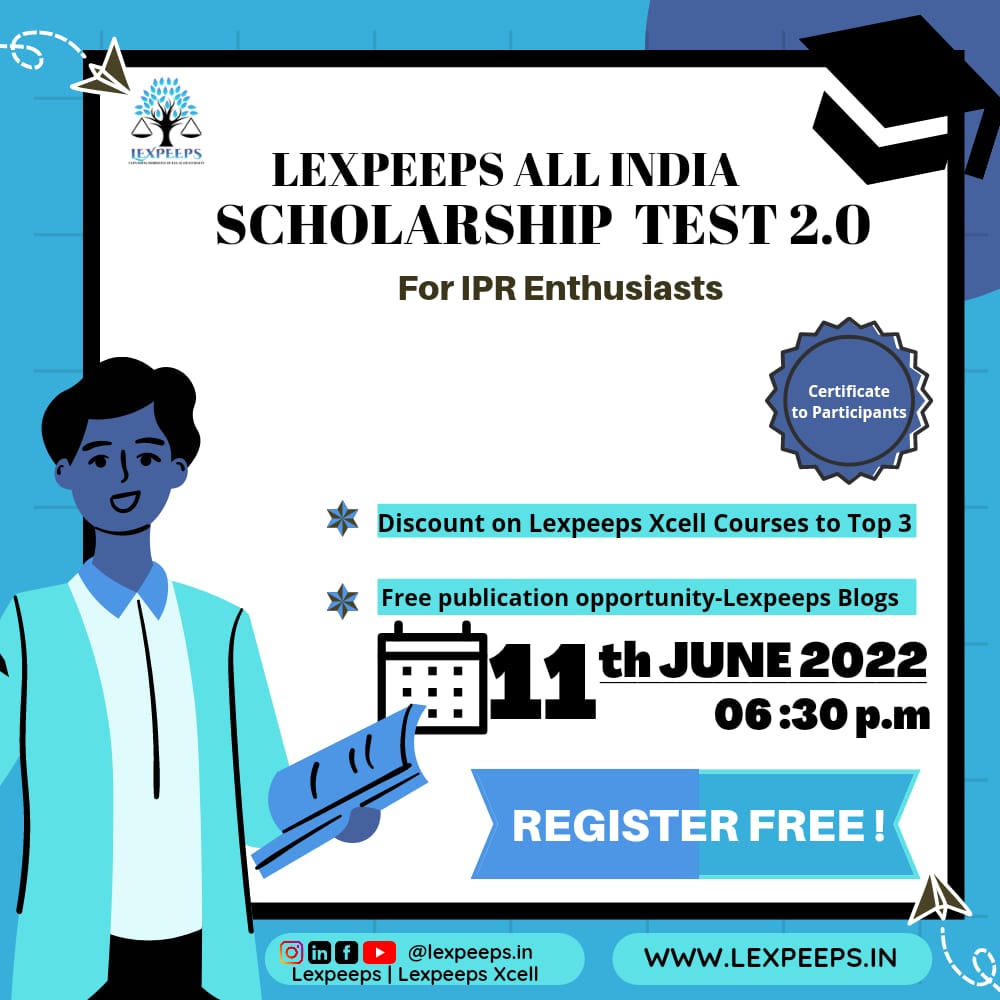
Lexpeeps Pvt Ltd. is organizing the All India scholarship test for all the IPR Enthusiasts with the aim to provide a platform where they can test their knowledge about Intellectual Property Rights and quizzing instincts to the test.

Eligibility

The Competition is open to all students of law.

Perks

  • Free Publication opportunity in blogs section on Lexpeeps Official website for Top 3.
  • Top 3 participants will be receiving a 50% discount on Lexpeeps Xcell Courses.
  • Certificate of participation will be provided to all the participants.

Mode of Examination

Online

Rules & Regulations

  • Quiz shall take place online.
  • The participant can give this exam from their home or hostel or any other place with the use of a laptop or Mobile Phone.
  • The quiz shall be conducted on Google Forms.
  • The quiz will comprise 30 MCQs to be attempted in 15 minutes and in one go.
  • Every question will carry equal marks & there will be no negative marking.
  • The quiz is open to all.
  • Participation as a team is not allowed.
  • Any technical issue faced by any participant shall entirely be at his responsibility and organizers owe no liability/responsibility towards the same.
  • Participants shall ensure decent internet connectivity and are advised to be online at least 10 minutes before the quiz begins.
  • All certificates shall be in digital form and will be sent on the e-mail id provided in the google form.
  • The decision of the Organizers shall be final and binding in relation to any matter connected with the competition.

Important Dates

  • Last Date for Registration: June 10, 2022 till 12 PM
  • Date of Competition: June 11, 2022 at 06:30 PM.
  • Declaration of Result: Will be announced later.

Contact Information

For queries or clarifications, please feel free to write to us at xcell@lexpeeps.in.

Click here for Registration

For regular updates, we can catchup at-

WhatsApp Group:

https://chat.whatsapp.com/GRdQLsHRwmB7QVRmS3WK

Telegram:

https://t.me/lexpeeps

LinkedIn:

https://www.linkedin.com/company/lexpeeps-in-lexpeeps-pvt-ltd

About the Office

The Office advises the State Government regarding all its legal affairs and defends legislation and public policy before the Supreme Court of India, the High Court of Karnataka, and various other Tribunals and judicial fora.

Job Description

The selected Law Clerk-cum-Research Assistant will get a unique opportunity to work at the Office of the Advocate General on a wide variety of cases, with a particular focus on research for matters impacting public policy. They will be
mentored by senior litigators and experienced lawyering from a public institutional perspective.

They will directly assist the Learned Advocate General/Addl. Advocates Generals/State Public Prosecutors/Government Advocates/High Court Government Pleaders or Public Prosecutors, as required. The role will also include regular interactions with government officials and other public servants.

Number of Vacancies

5 Law Clerk-cum-Research Assistants

Duration

1 year with effect from the date of joining

Location

Advocate General’s Office, High Court of Karnataka Building, Bengaluru, Karnataka, India (physical presence required).

Eligibility

• Students must have graduated/be due to graduate from Law Universities/Colleges recognized by the Bar Council of India.
• 0-2 years of experience.
• Demonstrable interest in litigation and public policy.
• A strong academic record from a leading educational institution.
• Well-developed research, drafting, and writing skills.

Salary

The Honorarium payable shall be a sum of Rs. 25,000/- per month.

Application process

  1. Send an email with the subject as “Application for Law Clerk-cum-Research Assistant” to: agkar.careers@gmail.com.
  2. This email should include the following:
    • A cover letter of not more than 500 words describing your interest in this position
    • A resume
    • A recent sample of academic writing of not more than 2000 words.
    • Consolidated transcript (if not available, please include the transcripts of all semesters till date)
    • Provisional/Final Degree, if available (a copy of which will need to be submitted prior to joining, if not presently available)
  3. Shortlisted candidates will be contacted for a virtual interview.

Note: Any false/incomplete information provided by an applicant will lead to immediate rejection from the recruitment process and/or termination of employment.

Application deadline

June 10, 2022 (Wednesday) 11:59 PM IST.

Disclaimer: All information posted by us on Lexpeeps is true to our knowledge. But still, it is suggested that you check and confirm things on your level.

For regular updates, we can catchup at-

WhatsApp Group:

https://chat.whatsapp.com/GRdQLsHRwmB7QVRmS3WK

Telegram:

https://t.me/lexpeeps

LinkedIn:

https://www.linkedin.com/company/lexpeeps-in-lexpeeps-pvt-ltd

About All India Legal Forum

All India legal Forum is a platform to provide a valuable contemporary assessment of issues and developments in the legal field and also put forward quality legal content for the masses. The initiative aims to generate diverse social, political, legal, and constitutional discourse on law-related topics for the ever-growing legal fraternity. The platform distinguishes itself by promoting quality legal education and aims to tackle basic problems which a legal researcher faces in day-to-day life from basic research to drafting. With the assistance and guidance of an exemplary Honorary and Advisory Board consisting of eminent jurists of the Supreme Court and professors from various National Law Universities and other prominent Law Schools, the All India legal Forum poses a paramount source of an educational forum for the ever-developing legal fraternity. 

Themes or Topics

The Editorial Board welcomes blogs that address contemporary issues in any field of law. It will be appreciated if submissions are with respect to editorial commentary and candid views. We prefer posts that include critical analysis or explore particular themes of wider resonance.

Submission Guidelines

For Submission Guidelines, visit us at: https://allindialegalforum.com/submission-guidelines/.

Entry Fee

No entry fee will be charged. One person can submit as many articles as one wishes and as frequently as one wishes to.

Important Dates and Deadlines

All India Legal Forum is currently accepting submissions on a rolling basis.

Submission Procedure

Submissions should be mailed to ailf12345submission@gmail.com in MS Word .doc format, with the subject of the mail as “Submission of Blog”.

Perks and Awards

An e-certificate of publication would be awarded to all those authors whose articles are selected for publication. A certificate of appreciation will be given to authors who have a minimum of 3 entries published on the website of the All India Legal Forum. The top 3 reads for the month will get a shout-out on all our social media handles along with a certificate of appreciation.

Contact Details

Disclaimer: All information posted by us on Lexpeeps is true to our knowledge. But still, it is suggested that you check and confirm things on your level.

WhatsApp Group:

https://chat.whatsapp.com/GRdQLsHRwmB7QVRmS3WK

Telegram:

https://t.me/lexpeeps

LinkedIn:

https://www.linkedin.com/company/lexpeeps-in-lexpeeps-pvt-ltd

About the Opportunity

The team is expanding and looking for an associate preferably having 2-3 years of post-qualification experience in the field of litigation. Freshers with a good academic record and extensive litigation internship experience may also apply.

Practice in the areas

Commercial, Arbitration, Insolvency, and Trial Litigation across various Courts and Tribunals.

Last date to Apply

25th May 2022.

Office Address

C-11, LGF, Panchsheel Enclave, New Delhi- 110 017

Application Procedure

Email Resume along with Cover Letter at recruitment.pkaoffice@gmail.com.

Disclaimer: All information posted by us on Lexpeeps is true to our knowledge. But still, it is suggested that you check and confirm things on your level.

WhatsApp Group:

https://chat.whatsapp.com/GRdQLsHRwmB7QVRmS3WK

Telegram:

https://t.me/lexpeeps

LinkedIn:

https://www.linkedin.com/company/lexpeeps-in-lexpeeps-pvt-ltd

About The Organizer

Delhi School of Professional Studies & Research (DSPSR) affiliated with Guru Gobind Singh Indraprastha University under the aegis of Divine Group has been set up by the Society for Human Transformation & Research (SHTR) which is a registered body under Societies Registration Act XXI of 1860 of the Government of India. The society has been promoted by luminaries from the field of academics having national and international recognition. It came into existence in 1999, the year its affiliating University, Guru Gobind Singh Indraprastha University (GGSIPU) came into existence. The Institution has been rated in ‘A’ category by NAAC, the Academic Audit of the University, Joint Assessment Committee (JAC) of the University & Directorate of Higher Education (DHE), Government of NCT of Delhi.

As a part of its endeavor to promote excellence in higher education in Management and Commerce in the society, DSPSR has been organizing, each year since its inception in 1999, an International Seminar/ Conference in India and abroad on a topical theme wherein a good number of academicians, researchers, practicing managers from around the globe have been participating over the two-days spread, punctuated by inaugural and valedictory.

About Pre-Seminar Workshop by ELSEVIER on the theme, “How to find quality content using Science direct”

Date: June 03, 2022

Time: 11:00 a.m. – 12 noon

Kindly note that the Seminar would be held in the HYBRID EVENT.

For online registration please visit: https://bit.ly/XXIV-AIS-2022

Key Dates

Online Registration: May 23, 2022

Submission of Full Papers along with Abstracts: May 23, 2022

Communication of Full Paper Acceptance: May 25, 2022

The registration fee is to be paid before May 30, 2022

More details about the seminar are available on the website: www.internationalseminar.org

Disclaimer: All information posted by us on LexPeeps is true to our knowledge. But still, it is suggested that you check and confirm things on your level.

WhatsApp Group:

https://chat.whatsapp.com/GRdQLsHRwmB7QVRmS3WK

Telegram:

https://t.me/lexpeeps

LinkedIn:

https://www.linkedin.com/company/lexpeeps-in-lexpeeps-pvt-ltd

KCC Institute of Legal and Higher Education, Greater Noida is organizing a National Conference on “SOCIAL IMPACT OF DIGITIZATION (NCSID-2022)” on 24th June 2022. KCC Institute of Legal and Higher Education imparts comprehensive education to the students matching the global standards, foster a socially responsible culture in the students, and is globally recognized and accepted as an institution delivering world-class education.

Important Information

28th May 2022: Abstract Submission

5th June 2022: Full Paper Submission

10th June 2022: Last date of registration

24th June 2022: Date of Conference

IMPORTANT LINKS

Register at: https://forms.gle/y98ztTEZfVo7Noyy5

Send Research Paper to: conferences@kccilhe.edu.in

For More information contact: Dr. Deepti Sharma- 9873721167

Visit them at: http://www.kccilhe.edu.in

Disclaimer: All information posted by us on LexPeeps is true to our knowledge. But still, it is suggested that you check and confirm things on your level.

WhatsApp Group:

https://chat.whatsapp.com/GRdQLsHRwmB7QVRmS3WK

Telegram:

https://t.me/lexpeeps

LinkedIn:

https://www.linkedin.com/company/lexpeeps-in-lexpeeps-pvt-ltd

About DSLSA

DSLSA or the Delhi State Legal Services Authority provides free and competent legal aid and services by advising on legal aspects and assigning lawyers to certain categories. It also runs helpline services to give quick and easy access to legal advice and services.

The DSLSA is also engaged in conducting Legal Service Clinics, Lok Adalats, Special Lok Adalats and Permanent Lok Adalats, Legal awareness Programmes for general masses, Pre-Institution Mediation in Commercial Matters, as well as Granting compensation to the victims under the Delhi Victims Compensation Scheme 2018.

About the DSLSA Summer Internship

Delhi State Legal Services Authority invites online applications for the Summer Internship Programme 2022 for law students of Law Universities/Colleges of India.

Number of Seats

150

Eligibility

3rd and 4th Year Law students (in case of 5-year LLB) AND 1st and 2nd-year law students (in case of 3-year LLB)

Duration of the Summer Internship

The internship period will be of 21 days.

Skills Required

  • Efficiency in written communication
  • Legal writing skills
  • Basic legal knowledge

Suggested field areas for visit during the Internship period

  • Delhi High Court
  • Department of Family Welfare, GNCTD of Delhi
  • Motor Accident Claim Tribunal
  • Special Courts exercising jurisdiction over cases of Section 138 N.L Act
  • Observation Homes for juveniles.
  • Mental Health Institutions (IHBAS).
  • Delhi Commission for Women
  • Legal Services Clinics.
  • Meditation Centres
  • Family courts
  • Labour Courts & Tribunals
  • Juvenile Justice Boards
  • Children Homes & Child Welfare Committees
  • Civil & Criminal District Courts
  • Lok Adalats
  • Jails
  • Special Juvenile Police Unit, Delhi Police
  • Police Stations/ Forensic Science Laboratory
  • National Commission for Protection of Child Rights/ Delhi Commission for Protection of Child Rights
  • National Commission for Women/ Delhi Commission for women
  • National Human Rights Commission
  • National Consumer Disputes Redressal Commission/ State Consumer Disputes Redressal Commission
  • Old Age Homes
  • Society for Promotion of Youth & Masses (SPYM)
  • Door to Door Campaign

How to Apply?

Students can apply online from May 1 to May 15, 2022, through the online application link (The link shall be updated in this post on the date announced).

Furnishing of recommendation letter on the proforma prescribed by DSLSA duly signed by Dean/Principal/Faculty is mandatory.

Application Deadline

May 15, 2022

Link for more details

https://drive.google.com/file/d/1uUMsipXsm1dOHkTej3WZFw8tUeoN_Tlt/view

Click here to apply for the DSLSA Summer Internship.

Disclaimer: All information posted by us on LexPeeps is true to our knowledge. But still, it is suggested that you check and confirm things on your level.

WhatsApp Group:

https://chat.whatsapp.com/GRdQLsHRwmB7QVRmS3WK

Telegram:

https://t.me/lexpeeps

LinkedIn:

https://www.linkedin.com/company/lexpeeps-in-lexpeeps-pvt-ltd

ABOUT NLUJAA

The National Law University and Judicial Academy, Assam (NLUJAA) has been established by the Government of Assam by way of enactment of the National Law School and Judicial Academy, Assam Act, 2009 (Assam Act No. XXV of 2009). The word ‘School’ was replaced by the word ‘University’ by amending the National Law School and Judicial Academy, Assam (Amendment) Act, 2011. The Chief Justice of Gauhati High Court Hon’ble Mr. Justice Sudhanshu Dhulia is the Chancellor of the University.

THE MOOT COURT COMMITTEE

The Moot Court Committee of the institute is shouldered with the responsibility of moulding the abilities of the students and boosting their knowledge in the legal spectrum. The committee actively takes part in organizing various such competitions with great zeal in order to provide the students with a platform to hone their skills, such as communication, drafting, researching, and the like which are essentials for any aspiring candidate choosing to move forward in the field of law. The committee is looking forward to creating a thrilling and educated professional environment to provide the students with the required exposure to have hands-on experience in understanding and legally approaching the issues arising in modern-day society.

ABOUT THE COMPETITION

Vox Anatolis National Moot Court Competition (“The Voice of the East”) is one of the flagship moot court competitions organized by the National Law University and Judicial Academy, Assam. The proposition for the competition revolves around the theme concerning the Northeastern region of the country based on the issues and the questions of law related to the region which has helped the moot carve out a niche and hence, this moot court competition provides a great opportunity to the students to research on such legal issues and provides a meaningful platform to present such legal nuances. In its previous editions, Vox Anatolis has delved into the contentious issues relating to the region such as the Citizenship Amendment Act and the National Register of Citizens.

This year we are collaborating with the Assam State Biodiversity Board, in lieu of their attempts to spread awareness about Access and Benefit Sharing (ABS) Regulations 2014 and Fair and Equitable Benefit Sharing. This year’s moot proposition also revolves around the nuances of the ABS Regulations, 2014, and Fair and Equitable Benefit Sharing.

The moot problem for this edition has been drafted by Irfan Hasieb, Advocate, Delhi High Court.

IMPORTANT TAKEAWAYS

  • Last date of registration for the competition is – 10th May 2022 (11:59 PM IST) (any changes in the same will be duly communicated).
  • Last date for memorial submission is –  25th May 2022 (11:59 PM IST).

MODE OF COMPETITION

  • The Competition shall be conducted in OFFLINE MODE.

OFFICIAL INVITATION, RULEBOOK AND MOOT PROPOSITION

REGISTRATION PROCESS

  • A maximum of 25 teams will be allowed to participate in the competition. Slots for participating in the competition will be filled on a basis of ‘First Come, First Serve Only’.

PAYMENT DETAILS

The registration fee must be paid to the following account with the account details:

Name of the Beneficiary: National Law University and Judicial Academy Assam, Grants In Aid
Bank Name: State Bank of India
Branch Name: ICD Amingaon Branch, Hajo Road, Guwahati-781031
Account No: 32432292915
IFSC Code: SBIN 000 9201

PROVISIONAL REGISTRATION

Provisional registration, in case the team composition has not been determined, may be done by sending an email confirming participation.

Kindly direct all correspondence related to the competition to  voxanatolis@nluassam.ac.in .

PRIZES AND AWARDS

The rewards for the participants stand as follows-

  • The team with the highest cumulative score in the Final Round will be declared as the “Winning Team” and shall be awarded the “Winners” Trophy.
  • The team with the second-highest score will be declared the “Runners-up Team” and shall be awarded the “Runners-Ups” Trophy.
  • The speaker with the highest individual oral round score in the Preliminary Round will be declared the “Best Speaker” and shall be awarded the “Best Speaker” Trophy.
  • The researcher with the highest researcher test score will be declared the “Best Researcher” and shall be awarded the “Best Researcher” Trophy.
  • The team with the highest marks obtained on their written submissions will be declared as the “Best Memorial” and shall be awarded the “Best Memorial” Trophy.
  • All participants will be given Participation Certificates and all the winners of awards will get Merit Certificates.

CONTACT DETAILS

For any query, you may, kindly send your mail correspondence to voxanatolis@nluassam.ac.in  or contact us at the below-mentioned numbers –

Ankur Madhia (Faculty Coordinator)- 9355633557
Neil M. Goswami (Convener)- +918876568897
Aviral Vats – +91 8178157688
Vitthal Dixit- +919450989790
Devanshi Srivastava- +918953922746
Akansha Sharma- +919678766040

Disclaimer: All information posted by us on LexPeeps is true to our knowledge. But still, it is suggested that you check and confirm things on your level.

WhatsApp Group:

https://chat.whatsapp.com/GRdQLsHRwmB7QVRmS3WK

Telegram:

https://t.me/lexpeeps

LinkedIn:

https://www.linkedin.com/company/lexpeeps-in-lexpeeps-pvt-ltd

Case Number

Transfer Case (civil) 92-95 of 2002

Equivalent Citation

2004 (2) Mh.L.J. 1090

Bench

  • Chief Justice Vishweshwar Nath Khare
  • Justice Brijesh Kumar
  • Justice Arun Kumar

Decided On

April 8, 2004

Relevant Act/Section

  • Securitization and Reconstruction of Financial Assets and Enforcement of Security Interest (SARFAESI) Act, 2002
  • Essential Services (Maintenance) Ordinance Repeal Act, 2001
  • Transfer of Property Act, 1882

Brief Facts & Procedural History

Here, the constitutionality of SARFAESI was challenged, particularly Sections 13, 15, 17, and 34, on the grounds that they are arbitrary and unjustified.

The Industrial Development Bank of India (for short, ‘the IDBI’) issued a notice to Mardia Chemicals Ltd. on July 24, 2002, under Section 13 of the then-current Ordinance, requiring it to pay the amount of arrears indicated in the notice within 60 days, failing which the IDBI, as a secured creditor, would be entitled to enforce the security interest without the intervention of a court or Tribunal, using all or any of the measures contained in sub-section (4) of S The petitioner was also prohibited from selling, leasing, or otherwise transferring any of the secured assets.

Other financial institutions and banks issued similar notices to other parties who filed petitions in various High Courts under the terms of Section 13 of the Ordinance/Act. This was united with a number of other writ petitions filed in several High Courts contesting the constitutionality of the Securitization and Reconstruction of Financial Assets and Enforcement of Security Interest Act of 2002.

The petitioners argued that the Recovery of Debts Due to Banks and Financial Institutions Act 1993 was sufficient to address the difficulty created by NPAs and that the current statute was unnecessary. It is debatable whether the Court should delve into the necessity of a statute while considering its constitutional legitimacy. “The Parliament and Legislatures composed as they are of the Representatives of the people are supposed to be cognizant of the requirements of the people and what is good or harmful for them,” the Supreme Court has previously decided.
The Court is unable to sit in judgment of their wisdom… A law passed by Parliament or a state legislature can be overturned for two reasons:

  1. inadequacy of legislative authority
  2. infringement of any constitutional rights1

In BALCO Employees Union v Union of India2, the Supreme Court has ruled that the right place for discussing policy issues is the legislature, not the courts.

In light of the Court’s previous pronouncements, it is evident that the question to be answered is whether the legislation is constitutional. Any discussion of whether a statute is required, particularly in light of another Act whose scope is not in question in this case, was superfluous. As a result, the Court declined to hear the case.

Many petitioners argued that the existing rights of private parties under a contract cannot be interfered with, particularly by putting one party in a more advantageous position than the other. In the present case, for example, in a matter of private contract between the borrower and the financing bank or institution, the borrowers’ rights have been curtailed and enforcement of secured assets has been provided without the intervention of the court, denying them the remedy available under the law by approaching the civil court.

The Appellants are vague on where they find the legal validity of their claim. The Honourable Supreme Court has pointed out that, unlike the US Constitution, there is no bar to prospective contract invalidation in India, and hence such a statute is completely constitutional.3

Indeed, the 44th amendment removed the right to property as a basic right from the Constitution, leaving it only as a constitutional right. Indeed, even while the right existed in part III, the courts ruled that absolute contract freedom, as defined by the idea of leissez faire, was no longer valid.4

The Appellants have also been unable to locate the rights under Art 19(1)(g) and Art 298. The Supreme Court has ruled that these articles are subject to reasonable constraints and that what is acceptable is to be interpreted in the public interest, regardless of how onerous the restrictions are on the individual’s interests.5

In light of these precedents, it’s difficult to identify where the appellants’ reasoning originates. The respondents’ counsels, on the other hand, have not taken a position on the Constitution’s freedom of contract or right to trade, but have pointed out that a similar argument has been raised in a different context, namely statutes providing relief to agricultural borrowers, and has been repeatedly rejected.

It has been contended that certain facts must be determined before the power u/s.13 can be used, such as whether the person to whom notice is given is liable to pay, the magnitude of the liability, and so on. Furthermore, issues such as the law of limitation and bar under consortium agreements, set-off/counterclaim claims, creditors defaults as bailees or failure to disburse credit on time, the changeability of penal interest or compound interest, non-appropriation of funds already paid, and so on and so forth must be resolved.

So, using case law that will be covered in the main project, it was claimed that a lis exists in such a case and that the ability to resolve a lis is a judicial or quasi-judicial power, not solely an administrative function. As a result, a suitable forum must be established to resolve all such disagreements at an early stage.6

The statutory provision becomes arbitrary, procedurally, and substantively unfair if such a forum is not established. This is a false argument based on facts. S.13 does not preclude the use of any judicial venue; it just states that a judicial remedy can be sought only after the secured creditor has used his powers under s.13 (4). This is entirely correct. Many legislations provide for the use of a forum after the aggrieved party has exhausted self-help options.

It was also pointed out that the provisions of s.13 generate some practical challenges that could lead to serious legal errors. Section 2(f) of the Act, for example, specifies that the meaning of the term “borrower” includes the guarantor. A guarantor is relieved of his commitment under Section 135 of the Contract Act in certain circumstances. Now, if a discharged guarantee receives a notification under Section 13(2) of the Act, he cannot approach the Court to show and establish that he is a discharged guarantor because Section 34 prohibits him from filing an action in the Civil Court. As a result, notice under Section 13(2) is unfavourable.7

These concerns have been addressed by Section 35 of the Securitization Act, which states that the Act’s provisions have precedence over all other laws. Finally, it was pointed out that under s.13 read with s.34, the borrower has no right to go to court before the lender employs the rights granted under s.13 (4), exposing him to arbitrary and potentially fraudulent lending practises. It was argued in defence of this section that because the asset cannot be sold for 60 days under Section 9 of the Rules, the borrower has the option of approaching the Tribunal within that time frame. The Court accepted the plaintiffs’ argument in part and added two riders to s.13. To begin with, it was held that the lender had an obligation to reveal the reasons for not accepting the objections or points expressed in response to the notice issued to them before taking action under Section 13 (4). Second, the Court made a comparison to an English mortgage, pointing out that enforcement proceedings under an English mortgage can be contested on the basis of fraud. This section is also subject to such provisions.8

Another point that the Court has overlooked is that a statute must be read in context and in pari materia as a standard rule of legislative construction. The present Act’s s.13 is pari materia with the State Financial Corporation Act of 1951’s s.29. Art 300A, 21, and 14 have all been challenged on the basis of this section’s constitutional vires, specifically that it provides no right of appeal. Though the matter was never heard by the Supreme Court, it was considered by a number of High Courts. The courts have consistently ruled that the Act itself reveals a clear aim and objective and that the power granted under s.29 is intended to carry out that policy, namely, the prompt collection of dues.9

Issues before the Court

  • Is it possible to challenge the statute on the grounds that it was unnecessary to create it given the circumstances, especially when another statute was already in effect?
  • Whether the terms or existing rights under a contract entered into by two private persons could be altered by provisions of law conferring one-sided powers in favour of one of the contracting parties?
  • Whether or not Section 13 of the Act is unconstitutional?
  • Whether the requirement that 75% of the amount owing to be paid before filing an appeal with the DRT is onerous and thus Section 17 of the Act unconstitutional?

Decision of the Court

In this case, the Supreme Court held that:

a) The Parliament’s superiority in deciding the need for legislation was emphasised.
b) The connection between the RDB Act and SARFAESI was rejected since the latter deals with the highly particular issue of nonperforming assets (NPAs) (among other differences such as the latter dealing only with secured creditors).
c) As a result, it is up to Parliament to decide whether or not legislation is required.
d) Section 13 was found to be constitutionally legitimate by the Court.
e) The secured creditor is only exercising his entitlement because the default that led to the sec 13 measure might be considered a “second default”—NPA + 60 days extra time to repay following notice.
f) Prior to the 2016 Amendment, Section 13 acknowledged the Right of Redemption in a sense. Rule 8 and 9 of the SI Rules stated that the bank must serve a notice confirming the sale of secured property and that the borrower may pay off the obligation and reclaim possession at any point prior to the actual sale
g) While the Supreme Court confirmed the constitutionality of the section, it pushed hard for borrowers to have the right to representation.
h) The Supreme Court determined Section 17(2) to be arbitrary, and ordered that the heading be altered from “appeal” to “application.”

Impact of the Judgement

  1. Section 13 now states that the bank must evaluate all of a borrower’s representations and respond within seven days (which was later changed to 15 days).
  2. Within section 17, the word “appeal” was replaced by “application,” despite the fact that the marginal header remained the same (wow). In 2016, the appeal was superseded by an application in the marginal heading.
  3. DRTs now have jurisdiction over the rights of tenants in a security property. In such instances, the property is given to the person who files the application (if he meets the requirements).
  4. Section 18 was also considerably amended. When filing an appeal with the DRAT, you must deposit 50% of the total cost, which can be lowered to 25%. DRT was likewise granted a similar waiver right under Section 17.

Citations:

  1. State of Andhra Pradesh v McDowell, AIR 1996 SC 1627
  2. AIR 2002 SC 350
  3. Raghubir Dayal v Union of India, AIR 1962 SC 263
  4. YA Marmade v Authority under Minimum Wages Act, (1972) 2 SCC 108
  5. Krishan Kakkanth v Government of Kerala, (1997) 9 SCC 495
  6. Kihoto Hollohan v. Zachillhu & Ors1992 Suppl. (2) SCC p. 651 and Associated Cement Companies Ltd v. P.N. Sharma (1965(2) SCR p. 366 at pages 386-87).
  7. Mafatlal Industries Ltd. and Ors. v. Union of India and Ors., 1997(5) SCC
  8. Adams v. Scott, (1859) 7 WR (Eng.) 213 (Z49)
  9. K Surendranathan v Kerala Financial Corporation AIR 1988 Ker 330

This case analysis is done by Arryan Mohanty, a 2nd Year Student student of Symbiosis Law School.