Applications are invited in the Proforma given in the Annexure, from the officers working under the Central Government through proper channels for filling up one post of Registrar in the Appellate Tribunal under Smugglers and Foreign Exchange Manipulators (Forfeiture of Property) Act, 1976, New Delhi on deputation basis.
with five years’ service in posts on the scale of 2 8000-275-13500 (pre-revised) or equivalent in the parent cadre or Department; or
with eight years of regular service in posts on the scale of & 6500-200-10500 (pre-revised or equivalent in the parent cadre or Department; and
Possessing experience in administration, establishment and accounts matters and preferably a degree in Law from a recognized University or equivalent.
Tenure
Period of deputation including period of deputation in another ex-cadre post held immediately preceding this appointment in the same or some other Organization/Department of the Central Government shall ordinarily not exceed three years.
Application Process
Applications in the prescribed Proforma, along with up-to-date attested copies of ACR/APAR dossiers for the last five years, cadre clearance, vigilance clearance, integrity certificate and major/minor penalty statement for the past 10 years may be forwarded to the Under Secretary (Ad.IC), Ministry of Finance, Department of Revenue, Room No. 51-II, North Block, New Delhi-110001 within 60 days from the date of publication of the advertisement in the Employment News.
Disclaimer: All information posted by us on Lexpeeps is true to our knowledge. But still, it is suggested that you check and confirm things on your level.
JAIN & PARTNERS is an IPR & Corporate law consultancy firm. It provides services to domestic companies, start-ups and individuals for their overseas investment and also to foreign companies and individuals for their investment in India in all respects that includes Corporate Law, Intellectual Property Law, Foreign Exchange Management Law, Import Export Law and Taxation Law etc.
Jain & Partners, is looking for an Assessment intern for the IPR Team on an immediate basis.
Area of Law
Intellectual Property Rights with a prime focus on TRADEMARK LAW.
Eligibility
Only Final year students/ Law Graduates with prior experience in the field of intellectual property and;
Freshers with 0-6 months of experience in Intellectual Property can also apply.
Disclaimer: All information posted by us on Lexpeeps is true to our knowledge. But still, it is suggested that you check and confirm things on your level.
JPMorgan Chase & Co., one of the oldest financial institutions, offers innovative financial solutions to millions of consumers, small businesses and many of the world’s most prominent corporate, institutional and government clients under the J.P. Morgan and Chase brands. Their history spans over 200 years and today they are a leader in investment banking, consumer and small business banking, commercial banking, financial transaction processing and asset management.
Job Title
Corporate Legal Assistant Vice President – Senior Counsel
About Opportunity
The Corporate Legal Assistant Vice President – Senior Counsel will be part of the Legal Support Team that provides legal services to various Practice Groups within the Corporate Legal department. The successful candidate may be responsible for the delivery of one or more functions with a focus on specific Practice Groups or regions in Corporate Legal.
Responsibilities
They are currently hiring an experienced transactional lawyer to support the Corporate Legal Practice Group with corporate and transactional-related matters.
Drafting, reviewing and negotiating a variety of agreements (e.g., non-disclosure agreements, grant agreements, share purchase agreements, warrant agreements).
Assist attorneys with advising on corporate governance-related issues.
Assist with due diligence review and deal closing deliverables, as needed.
Assist with drafting various other corporate law transactional documents.
Conduct legal research and analyze laws, regulations and developments and communicate to senior leaders.
Actively provide subsidiary management advice with legal entity integration matters as a result of mergers or acquisitions.
Engage in other special projects, as needed.
Qualifications
Law Degree from a premier law school and membership in the jurisdictional organization. Attorney candidates must be in compliance with all relevant licensing requirements including the requirements of the jurisdiction where the role will be located prior to commencement of employment.
5-8 years of corporate governance, or corporate law experience in a major law firm and/or financial institution.
Excellent English language skills, both spoken and in writing – are required.
Excellent organizational skills – required.
Self-starter and proactive – required.
Working knowledge of legal search engines, including Westlaw/Lexis Nexis – is preferable.
All candidates for roles in the Legal Department must successfully complete a conflict of interest clearance review prior to commencement of employment.
Disclaimer: All information posted by us on Lexpeeps is true to our knowledge. But still, it is suggested that you check and confirm things on your level.
Justice Sanjiv Khanna enrolled as an Advocate with the Bar Council of Delhi in 1983. He began his practice in the District Courts at Tis Hazari in Delhi and soon shifted his practice to Delhi High Court.
His area of practice was wide and varied from writ petitions in public law matters, direct tax appeals, income tax prosecutions, arbitration cases, commercial suits, and environmental and pollution laws matters, besides medical negligence cases before consumer forums and company law cases before the Company Law Board.
About Opportunity
The chamber of Hon’ble Mr Justice Sanjiv Khanna, Judge, Supreme Court of India, is accepting applications for internship on a rolling basis for September and October 2023.
Available Internship Slots
1st September 2023 to 30th September 2023
1st October 2023 to 31st October 2023
If you wish to apply for more than one slot, please fill out separate applications for each slot.
Since the office receives a large number of applications for each slot, it would not be possible to intimate each applicant of the status of their application. If you do not hear from the office 4 weeks prior to the start of the desired internship slot, please consider your application as not accepted.
Shortlisted candidates will be contacted telephonically/via email 4-6 weeks before the start of the desired internship slot.
Eligibility
Law students in their 4th or 5th year of the 5-year B.A./B.B.A. LL.B. course (or equivalent), or
Law students in their 2nd or 3rd year of the 3-year LL.B. course.
NOTE: The internship is open only to law students in their 3 or 5-year law course. Those who have completed their law degrees are not eligible to apply.
Disclaimer: All information posted by us on Lexpeeps is true to our knowledge. But still, it is suggested that you check and confirm things on your level.
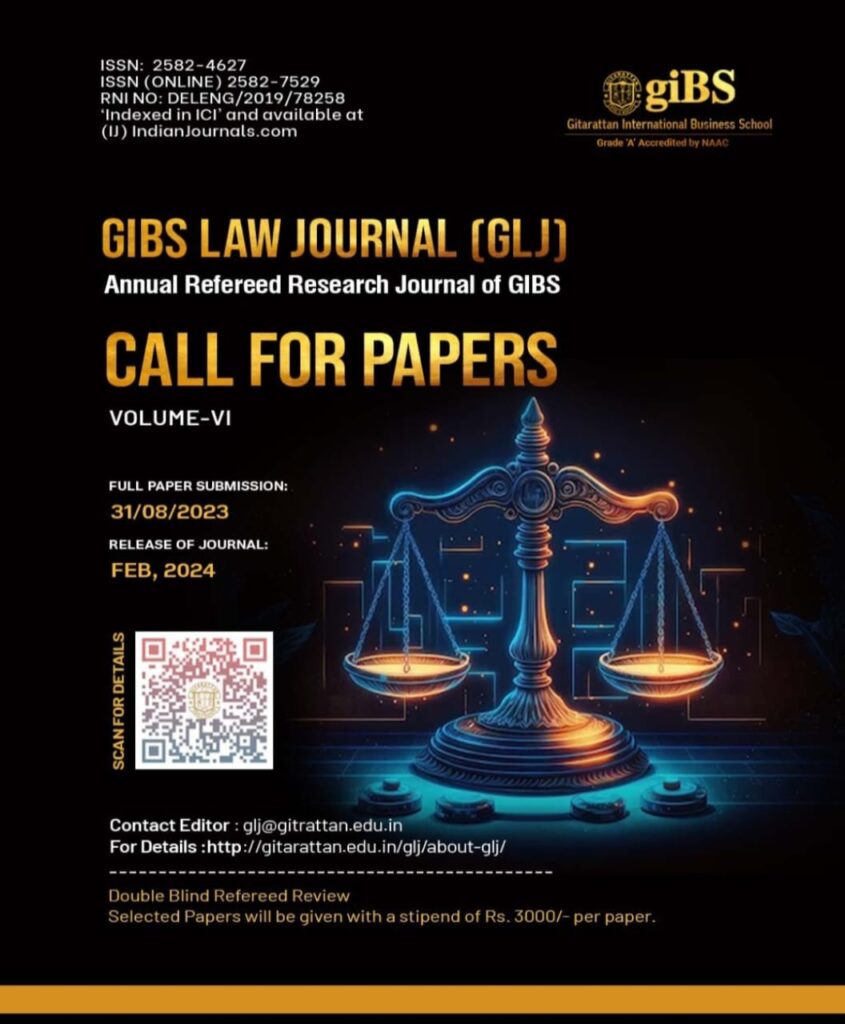
Gitarattan International Business School (giBS) was established in the year 2004. giBS is affiliated to Guru Gobind Singh Indraprastha University, Delhi and is approved by All India Council for Technical Education (AICTE), Ministry of HRD, and Government of India The institute is accredited as ‘A’ grade by NAAC and assessed as Category ‘A+’ by Joint Assessment Committee of Government of Delhi and Guru Gobind Singh Indraprastha University.
About Journal
The Institute publishes the prestigious Gitarattan International Business School Law Journal (GLJ) every year with a focus on research papers on Law, Social Science and other relevant topic. The institute has announced the 6th issue of our GIBS Law Journal (GLJ). The Journal gives a platform to intellectuals to share their knowledge and expertise with society at large.
(GLJ) invite academicians and professionals to contribute research papers, case comments, articles and book reviews for itsforthcoming issue.
General Guidelines
Selection shall be done on the basis of a Blind Refereed Review. The decision of the Editorial Advisory Board and the Institute shall be final and binding.
The contribution must be original, neither published nor under consideration for publication anywhere else.
The cover page is to contain the title of the paper, author’s name, designation, official address, contact phone, and email address. In case of multiple authors, the cover page should indicate the author to whom correspondence should be addressed.
An abstract of not more than 200-250 words along with five keywords, in alphabetical order, is to be attached.
The main text is not to contain the author(s) name or affiliation.
The author(s) are to submit a duly filled copyright form/claim of originality in a prescribed format.
After publication, the author(s) will receive one copy of the journal.
Formatting Guidelines
The length of a full paper should be 3000- 5000 words (15-20 pages). The author(s) are to submit one hard copy of the manuscript on an A4 sheet along with one soft copy in MS Word. The soft copy of the contribution is to be sent by email attachment to glj@gitarattan.edu.in.
Use British spellings throughout: ‘programme’ not ‘program’, ‘organisation’ not ‘organization’, ‘behaviour’ not ‘behaviour’.
References are to be given separately at the end of the manuscript and the entries should be arranged alphabetically. The word ‘References’ should appear as a heading.
For citation and references, the Indian Law Institute, (ILI) Rule of footnoting should be followed. The author may freely access the website of the Indian Law Institute http://www.ili.ac.in/footnoting12.pdf for footnoting.
Footnote on the first page is to bear Designation, Institution, email address; Font size: 8; Running.
Sub-part, if any, are to be serially numbered in lowercase English alphabets as (a), (b), (c), (d) and unbold. Any further sub-parts are to be serially numbered in small Roman numerals (i), (ii), (iii), (iv) and un-bold.
Margin on all four sides is to be 1 inch.
Important Dates
Last date for submission of full paper along with abstract
31/08/2023
Review of papers by experts
30/09/2023
Revised Paper Submission
30/10/2023
Final Review & notification for selection of paper
30/11/2023
Next Issue Release
28/02/2024
Contact Information
The manuscript and all other editorial correspondence should be sent to:
The Editor, GIBS Law Journal (GLJ), Gitarattan International Business School PSP 2 A & 2 B Complex – II, Madhuban Chowk, Rohini, Delhi – 110 085 Phone: 011- 27555607 / 08 glj@gitarattan.edu.in
Disclaimer: All information posted by us on Lexpeeps is true to our knowledge. But still, it is suggested that you check and confirm things on your level.
Dr. Ram Manohar Lohiya National Law University (RMLNLU) is a public law school and a National Law University located in Lucknow, Uttar Pradesh, India. It was established as Dr. Ram Manohar Lohiya National Law Institute in 2005, and since then, has been providing undergraduate and post-graduate legal education. It ranks 15th among India’s law institutes in the 2021 edition of the National Institutional Ranking Framework report by the Ministry of Education (India) (erstwhile MHRD). The University is fully funded by the Government of Uttar Pradesh.
About the Journal
RMLNLU Law Review (‘Journal’) is an annual peer-reviewed journal published by the Journal Committee of Dr. Ram Manohar Lohiya National Law University, Lucknow which seeks to provide numerous insights and views into contemporary legal issues and encourages conversations about the same. The RMLNLU Law Review runs parallel to the RMLNLU Law Journal on CMET (Communications, Media, Entertainment, and Technology).
After having celebrated thirteen years of immense success and acclaim as a reputed Journal, we are pleased to announce the call for papers for Volume XIV of the RMLNLU Law Review. The Editorial Board of the Law Review works in close collaboration with an Advisory Board to select articles for publication. The expertise and experience of the diversely composed Advisory Board, which has representation in the form of professors, advocates and legal professionals, is to provide a holistic review of each article and uphold the standard of the articles that finally get accepted for publication; with there being a great emphasis on quality research, the relevance of topic and novel contributions in the scrutiny phase of review.
Call for Papers
The Journal accepts submissions from law students and professionals all over the country and abroad, under the following categories:
Articles: 5000-7000 words
Essays: 4000-5000 words
Case notes/comments: 2000-3000 words
Book Reviews: 2000-3000 words
Review Process
There shall be a rigorous review process comprising 3 stages. Members of the Advisory Board will be closely involved in the review process.
This would ensure a greater standard of review and identification of quality academic writing.
The authors shall be intimated about the status of their manuscript at every stage.
Submission Guidelines
Content:
Font – Times New Roman
Font size – 12 pts.
Line spacing – 1.5
Margin – 1” from all sides
Alignment: Justified
Footnotes:
Font – Times New Roman
Font size – 10 pts
Line Spacing – 1.0
All the sources in the footnotes must be properly cited strictly in accordance with the latest OSCOLA (4th edition) format. No endnotes or speaking footnotes (descriptive footnotes) are allowed.
General Submission Guidelines
The submissions may be on any contemporary legal issue. The authors are expected to adhere to the prescribed word limit (excluding footnotes and abstract), as indicated above.
Each of these entries shall be required to conform to the set of guidelines that follow.
An abstract of about 250-300 words and 5 keywords should be mandatorily included in the same Word document as a part of the submission.
The title should be Bold, Underlined, in Capitals, Size 16, and Centre Aligned.
Headings should be Bold, in Capitals, Size 14, and left-aligned.
The contents should in no way, directly or indirectly, indicate or reference the identity of the author(s).
Co-Authorship to a maximum of two members is allowed. However, co-authorship is not allowed in “book reviews” and “case-notes/comments”.
Please note that all submissions must adhere to a strict plagiarism limit of 33%, as any papers exceeding this threshold will be automatically rejected.
How to Submit?
The submissions may be emailed at lawreview.rmlnlu[at]gmail.com in Microsoft Word (.doc or .docx) format.
The name of the attached submission in the email, i.e., the name of the document must be the name(s) of the author(s). Please note that only one submission per author or a team of co-authors is permissible. In case of more than one submission, only the one received first would be considered for review.
The subject title for the mail must be ‘Article/Essay/Case Comment/Book Review for Volume XIV’.
Submission Deadline
06 September 2023
General Instructions
The submission must exhibit originality in thought, critical evaluation, and careful interpretations. Submission of a paper shall be taken to imply that it is an unpublished work and is not being considered for publication elsewhere.
The author(s) must include the cover letter in the body of the mail, which must contain all the relevant biographical details (Name of the author(s), their degrees, Designation, Name of College/University/Institution, Postal Address, Phone Number and Email ID). A separate attachment for a cover letter shall not be entertained.
Editors’ decision shall be final and binding. They reserve the sole rights to the publication of the selected articles in addition to; inter alia, any edits/amends/reproduction. The contributions presented to and accepted for publication and the copyrights therein shall be the intellectual property of the Journal Committee, RMLNLU.
Contact Information
e-Mail ID: lawreview.rmlnlu[at]gmail.com
Maitrey Chaudhary: 7458877788
Aarushi Jain: 9315633972
Priyanshi Bhageria: 8852012939
Disclaimer: All information posted by us on Lexpeeps is true to our knowledge. But still, it is suggested that you check and confirm things on your level.
HIGH COURT OF DELHI invites online applications from eligible candidates for filling up 16 vacancies (15 existing & 01 anticipated) by way of direct recruitment in Delhi Higher Judicial Service by holding the Delhi Higher Judicial Service Examination.
Stages
Delhi Higher Judicial Service Examination will be held in three successive stages:-
Delhi Higher Judicial Service Preliminary Examination (Objective type with 25% negative marking) for selection of candidates for the Mains Examination (Written); and
Delhi Higher Judicial Service Mains Examination (Written) for selection of candidates for calling for Viva-Voce.
Viva-Voce.
Eligibility
The qualifications for direct recruits shall be as follows:-
must be a citizen of India.
must have been continuously practising as an Advocate for not less than seven years as of the last date of receipt of applications, i.e., 29.07.2023.
must have attained the age of 35 years and have not attained the age of 45 years on the 1st day of January of the year in which the applications for appointment are invited, i.e., on 01.01.2023.
Important Dates
Date and Time of commencement for creation of New Log In and filling Online Application Form
14th July 2023
Last Date and Time for filling Online Application Form and/or making payment through Debit Card/Credit Card/Internet Banking/UPI
29th July 2023
Delhi Higher Judicial Service Preliminary Examination
20th August 2023 (11 AM to 1 PM)
Fees
General Category – Rs.2000/-
Scheduled Caste / Scheduled Tribe / Person with Disabilities (identified disabilities) – Rs.500/-
The candidates should pay through Debit Card//Credit Card/Internet Banking/UPI.
Application Process
The candidates shall submit their applications online only in the prescribed format through the official website of the High Court of Delhi i.e. www.delhihighcourt.nic.in.
The candidates can take a printout of the application form and keep it for future reference. They should not send the printout of the online application form to the High Court of Delhi.
Disclaimer: All information posted by us on Lexpeeps is true to our knowledge. But still, it is suggested that you check and confirm things on your level.
The Office is headed by Mr.C.Arulvadivel @ Sekar, Senior Advocate, Hon’ble High Court of Madras, The Senior Counsel is also the Special Public Prosecutor for Customs and The Narcotics Control Bureau. The Associates is the counsel for the NHAI, The Tamil University, Thanjavur and Gandhigram University.
C.Arulvadivel Associates is looking for a Junior Associate to join the office in Madurai, Tamil Nadu and is accepting applications for the same.
Location
The office is located in K.K. Nagar, Madurai, Tamil Nade
Job Summary
Their Office is seeking a Highly motivated Junior associate with minimum 2 years of experience in representing the High Court or Supreme Court.
Key Responsibilities
Managing a Caseload of Clients
Drafting
Representing before the High Court
Contribute to the Growth
Support of the Firm.
Qualification
LL.B. or LL.M. in any reputed College.
Got Enrolled in the Bar Council of India.
Minimum of 2 Years of experience in Practice in the High Court.
Exceptional Skill in Communication (Both English and Tamil), drafting and research.
Application Process
Send your CV through Email: arulvadivelassociates@gmail.com
Disclaimer: All information posted by us on Lexpeeps is true to our knowledge. But still, it is suggested that you check and confirm things on your level.
Even after 75 years of Independence India is struggling or lacking to resolve the expanding problem of corruption in the nation. Corruption is the practice that is prevailing in the roots of the nation to get work done through backdoors or an illegal or illicit way and at the same time it is acting as a backfire step in the evolution or growth of the nation. The practice of corruption is seen as a hindrance and as a major barrier to success for developing countries like India. As India is a country with a vast and growing population is a tough and challenging problem to regulate or control the activity which is against the law. India is not only the country facing the problem of corruption every growing or evolving nation in the present world faces complications regarding corruption practices prevailing in the nation. This problem was significantly neglected or ignored by the government at the starting point as they felt that these practices will not affect the nation in a threatening way but after reviewing and scrutinizing the corruption practices the government felt there should be policies, acts, regulations structured or designed in such a way so that it can curb the problem of corruption. So the government decided to frame or structure policies, acts, statutes, and norms that can considerably regulate this growing constraint.
UNDERSTANDING THE CONCEPT OF CORRUPTION
“Corruption” is described as “the unlawful use of governmental authority for private gain.” This abuse of power weakens a democracy by undermining trust between two or more parties. Additionally, corruption may exacerbate poverty and inequality while impeding a country’s ability to prosper economically. Understanding how corruption operates is crucial to exposing it and holding the dishonest accountable for establishing a corrupt system. The growth of the nation is badly impacted by its aftermath and acts as a hindrance toward the systematic and continuous progress of the nation.
HISTORY OF CORRUPTION IN INDIA
We are natives of Gandhi’s country, for whom the essential tenets of life were honesty and nonviolence. I will use the 2000-year-old Vedic proverb “Satyam vadhadharmam charah” as an example. The motto of our country is Satyameva Jayate. Therefore, we all support honesty and truth, at least on a lip service level. Our government thinks that telling the truth will win, and all of our major faiths support this idea. However, India is one of the most corrupt nations in the world.
The actual degree of corruption in India is unknown. However, everyone is aware of how ubiquitous it is and how it is steadily eroding the nation’s foundation. There is little question that the future of democracy is in jeopardy if corruption, bribery, and nepotism are not stopped as soon as possible. The parallel is distressing to those of us who are aware of the high moral standards that prevailed before and shortly after India became an independent nation. We seek in vain the integrity, effectiveness, quality, and commitment to duty that once distinguished government. One starts to doubt whether we are the same people that rode to independence with the motto “truth and sacrifice.” A nation or society can improve its ability to reduce corruption to manageable levels by taking a comprehensive strategy and including all of the key players in the anti-corruption reform process. However, none of this can be dealt with without wise and tenacious political leadership. without substantial levels of public backing and knowledge, as well as without a driven and competent corporate sector. In many nations, creating a thriving wicked society that is willing and able to play a significant role in influencing its surroundings is the most challenging aspect of the equation.
REASONS FOR RISING CORRUPTION IN INDIA
The corruption practices have been happening due to various reasons in the system of the nation. Therefore, mentioning and discussing a few of them will surely highlight the main reasons for corruption.
Low Pay Scale of Government Employees- At present in India, there is a sterling increase in the demand for government jobs due to the security of jobs its offers and other benefits it gives to its employees. Due to the huge population and growing population, there is expanding demand for government jobs as everyone cannot secure his place in the private sector. A person who tirelessly prepares for getting a government job in India and if he is selected, he does not see any financial gain or activity of efforts which he has undergone while preparing for his exam. He, therefore, chooses an unethical way to gain more money in less period.
Lack of Accountability- A government employee is not responsible for reporting his duty or activity or any of the work carried out by him on a specific day. Therefore, he thinks that he is free to act in his way and not to abide by ethics or behaviour. It was after the passing of some acts legislations and statutes that brought the illegal practice of corruption under the surveillance of the government.
Lack of Stick and Fast Punishments- One of the most crucial features of the government job is that there is a lack of punishment which a government employee can get if he is involved in corruption. If he is involved in corruption investigation proceedings are undertaken against him which do not render any result and the employee is transferred from one place to another or merely there is suspended for a particular period.
Greed and the Need of becoming rich overnight- One of the main reasons for growing corruption is the mindset of the people working in the government sector. The need and desire to become rich and successful is also a motivating factor in involving such type of heinous activity.
Tolerance of corruption by the people- In the present world where everyone is busy carrying out his day-to-day activity in the best and most effective way no one wants that his time is wasted on any futile activity which does not render any financial gain. Therefore, when they visit any government office, they try to adopt corrupt practices to get their job done easily.
EFFECTS OR CONSEQUENCES OF CORRUPTION
Lack of quality of services- The quality of services drastically decreases if one is involved in corrupt practices as he does not put any effort from his side in rendering services and gives services in the easiest way possible which in turn decreases the quality of services that needs to be maintained by the government.
Lack of proper justice- If corruption is taking place in any judicial department or any department which is authorized to provide give basic services to common people then it will affect a large portion of the society.
Low rate of economic growth- The involvement of any government employee will surely affect the growth rate of the nation as it will put a halt to the flow of currency in the economy. There is a hoarding of money in the form of cash, assets, and in the form of stocks which directly plays a role of hindrance in the growth of economy of the nation.
Low Foreign Direct Investment- If corruption exists in the government sector foreign investor will hesitate to invest in the nation as they know that their funds or capital will not be utilized in the best and most effective manner.
STEPS TAKEN BY THE GOVERNMENT TO CURB THE PRACTICES
To codify all existing laws, eliminate corruption in government institutions, and prosecute and discipline public servants who commit corrupt activities, the Prevention of Corruption Act, 1988 (POCA)1, was developed. It is a potent weapon against this evil. The success of the anti-corruption campaign depends on how well this legislation works. This Act gives the Central Government the power to appoint judges to look into and try instances involving offenses that are punished under the Act, as well as situations where an attempt or conspiracy to commit an offense is made.
EVOLUTION OF THE ACT
The Indian Penal Code of 18602 first addressed cases of bribery and corruption involving public employees in the Indian Justice System. However, it became clear throughout the 1945s that the legislation in place at the time was inadequate to address the circumstances, and it was considered that special rules about bribery and corruption were to be established. As a result, the Prevention of Corruption Act, of 19473, was impressively enacted. The Anti-Corruption Laws (Amendment) Act of 19644 and the Criminal Law Amendment Act of 19525, both of which were based on the Santhanam Committee’s recommendations, respectively, altered the 1947 Act twice.
As a result, the 1988 Prevention of Corruption Act, which became effective on September 9, 1988, was based on the 1947 Act. To make the whole resolution more feasible and eradicate corruption in Indian government offices and public sector organizations, it was intended to enhance the standards and widen the inclusion of anti-corruption laws. The Prevention of Corruption Act’s goal is to eradicate corruption throughout Indian government agencies and the public sector.
The extent of corruption in government organizations must be understood, but it’s also critical to prosecute and discipline public employees who take part in corrupt activities. The Act also takes into account individuals who helped the offenders commit the bribery or corruption offense.
AMENDMENTS IN ACT FOR BETTER WORKING
Some of the amendments were done in the year 2013 and 2018 which was related to bribery and the period given to Special Judges (Section 4)6 for investigating the case.
2013’s Amendments
Bribery was declared a criminal offense. A person who was forced to bribe will not be prosecuted under the Prevention of Corruption Act if they disclose the incident to law authorities within seven days.
The modified criminal misbehaviour law addressed two different sorts of offenses. Illegal enrichment, which is defined as accumulating money that is out of proportion to one’s sources of income, and fraudulent property misappropriation are the offenses.
The modifications were made with the pertinent government authority’s prior consent to undertake any inquiry into any offenses allegedly committed in public instances. However, if the criminal has already been detained for accepting bribes, then this authorization is not required.
If a special judge is handling the case, the PCA trial limit was set at two years. Only four years should be allowed for the trial’s overall duration.
2018’s Amendments
Bribery is a particular and explicit offense.
Anyone who accepts bribes faces a fine and a jail sentence of three to seven years.
Bribe-givers may additionally face a fine and a sentence of up to 7 years in jail.
In the case that the incident is reported to law enforcement within 7 days, the 2018 amendment adds a provision to safeguard persons who have been coerced to pay a bribe.
It redefines criminal behaviour to just include property theft and having an excessive amount of assets.
By requiring that investigative agencies like the Central Bureau of Investigation obtain prior clearance from a competent authority before starting an inquiry into them, it proposes a “shield” to protect government employees, including those who have retired, from punishment.
However, it specifies that such authorizations are not required in situations when a person is immediately detained on suspicion of taking or attempting to accept an unfair benefit for himself or another person.
The concept of “undue advantage” must be proven in every case of corruption involving a public employee.
Within two years, the trial in instances involving the payment of bribes and corruption must be concluded. Furthermore, the trial cannot be longer than four years, even with justifiable delays.
It includes the potential for business organizations that provide bribes to face sanctions or legal action. However, they don’t apply to nonprofit organizations.
It outlines the authority and processes for seizing and forfeiting the property of a public official suspected of corruption.
PENALTY AFTER 2018 AMENDMENT
The penalty for an infraction committed by a public employee has been increased under Sections 77, 128, and 149 of the Amendment Act from a minimum penalty of 6 months to a minimum punishment of 3 years and from a maximum punishment of 5 years to 7 years, with or without fine. In situations of abetment, sentences also go longer.
When a crime is committed repeatedly, the penalty is increased from a minimum of 2 years to 5 years and a maximum of 7 years to 10 years in jail.
Corruption by Public Servant: The Prevention of Corruption Act of 2018’s10, Section 13 made reference to the misappropriation of assets and unfair justifications for doing so. It offered the justification for making a criminal misconduct accusation against the public employee.
Sanctions for Prosecution: According to the 2018 Prevention of Corruption Act11, any prosecution of public employees must get the approval of the relevant government. Section 17A of the Amendment Act12 expands the protection to include inquiries or investigations made before prosecution. Therefore, neither a police officer nor a former one may open an investigation into a public employee.
CONCLUSION
One thing is abundantly clear from the above analysis: Corruption threatens not only the national or global economy but also the entire human race. Thousands of people and families in India are living in extreme poverty and are unable to access even the most basic necessities for survival. As a result, they are forced to bear the harsh consequences of corruption when they are unable to provide the required standard of service.
Endnotes:
Prevention of Corruption Act, 1988 (Act No 49 of 1988)
Indian Penal Code, 1860 (Act No 45 of 1860)
Prevention of Corruption Act (Act No 2 0f 1947)
Anti-Corruption Laws (Amendment) Act of 1964
Criminal Law Amendment Act of 1952
Section 4 of the Prevention of Corruption Act 1988
Section 7 of the Prevention of Corruption Act 1988
Section 12 of the Prevention of Corruption Act 1988
Section 14 of the Prevention of Corruption Act 1988
Prevention of Corruption Act, 2018 (Act No 16 of 2018)
Prevention of Corruption Act, 2018 (Act No 16 of 2018)
Section 17A of the Prevention of Corruption Act 2018
This article is authored by Animesh Nagvanshi, a student at ICFAI University, Dehradun.
ICFAI University Tripura was established in 2004 by an Act of the State Legislature (Tripura Act 8 of 2004). ICFAI University Tripura is popularly known as IU Tripura. ICFAI University Tripura is accredited with ‘B+’ Grade by the National Assessment and Accreditation Council (NAAC), recognised by the University Grant Commission (UGC) and approved by the Bar Council of India (BCI). The mission of IU Tripura is to promote world-class education to the students. ICFAI University Tripura offers courses at UG, PG, integrated, diploma, postgraduate diploma, M.Phil and Ph.D level. ICFAI University Tripura has national and international collaborations with other universities and institutions such as IIT Bombay, Daffodil International University, Bangladesh and many more.
ICFAI University, Tripura is inviting applications for the position of Professor, Associate Professor or Assistant Professor for various departments including law. Those various departments include:
Law
Education
Special Education (ID/MR)
English
Psychology
Clinical Psychology
Sociology
Soft Skills
French
Management
Commerce
Statistics
Paramedical Sciences
Computer Science & Engineering
Administrative Position
Student Placement
Qualifications and Experience
Educational Qualification and Experience for Various Positions, as per UGC norms.
In addition, teaching/research/industry experience as applicable for different positions, the applicant should have an excellent academic record throughout.
The candidate should be computer savvy with excellent communication and interpersonal skills.
Remuneration
As per university norms, however, salary is not a constraint for deserving candidates.
Disclaimer: All information posted by us on Lexpeeps is true to our knowledge. But still, it is suggested that you check and confirm things on your level.