Indian Review of Advanced Legal Research

The Indian Review of Advanced Legal Research (IRALR) is aimed to act as a platform for promoting high-quality legal research and writing on a variety of legal issues among the budding legal minds of India. 

Submission Guidelines

  1. IRALR invites blog submissions on a rolling basis from law professionals, academicians, research scholars and students of law on any topic related to law and policy.
  2. Submissions which are contemporary in nature are generally accepted.
  3. IRALR Blog only accepts original and previously unpublished articles.
  4. IRALR generally accepts blogs in the range of 1000-1500 words. However, this range is merely recommendatory in nature and the Editorial Board may accept submissions which do not fall within the said word limit at their own discretion.
  5. The authors are expected to use only hyperlinks in their submissions to cite the relevant sources. In case, a source cannot be hyperlinked, the authors are expected to provide endnotes and follow any uniform citation method.
  6. The authors are expected to ensure that the text of the submission is in Times New Roman and the size of font is 12 with line spacing of 1.5. In case, endnotes are present in the submission, the same shall be in Times New Roman, font size 10 and line spacing of 1.0. Use of footnotes is not permissible.
  7. The submission has to be mailed at blog@iralr.in .The submission must be made in a word file only (.doc or .docx format). The authors should not disclose their identity to ensure an anonymous review. The authors are expected to include their short-bio in the submission mail itself. 
  8. The Editorial Board of IRALR Blog reserves the rights to accept and reject the submissions at any stage of review. The Editorial Board will take around 10 days to complete the review process from the date of receipt of the article. The Editorial Board shall try its best to provide a personalised review to all the authors for their submissions, in case of rejection.

Copyright Policy

IRALR is not responsible for any copyright infringement which may arise with respect to the blog article. If the article submitted for publication infringes the copyright of any third person, then IRALR shall not be responsible for the same and all the liabilities arising therein shall be solely of the author. Blogs once selected for publication shall become a property of IRALR and all the copyrights of the same shall vest solely with IRALR.

For more information visit here https://www.iralr.in/submission-guidelines

ABOUT SAMVIDHI

SamVidhi is a socio-legal venture with an aim to develop insights, committed to propagating and promoting discourse in the socio-legal field.

ABOUT THE BLOG

The blog aims to encourage & provide a platform to all those who wish to hone their research skills and provide their diverse insights on the cotemporary social, legal, environmental, political, economic and international developments.

This platform has been crafted to disseminate quality and in-depth analysis and opinions pertaining to interdisciplinary issues in the form of blogs.

THEME

The article may not strictly be a legal analysis of any contemporary development but it must highlight the socio-legal, societal or environmental impacts arising therefrom. Authors are encouraged to discuss any socio-legal issues/events which need to be brought in the public debate. However, such articles must show their relevance in the present time or in the future.

 SUBMISSION GUIDELINES

We invite and acknowledge submissions from the students, academics, professionals and practitioners alike. 

  1. The article should be an original work of the author and should neither be published nor be under consideration for publication anywhere else.
  1. The word limit for the article is 1500-2000 words, inclusive of end notes.
  2. Co-authorship is permitted up to a maximum of two authors.
  3. The Body and Endnotes of the article must have –

Font style: Times New Roman

Font Size: 12

Line Spacing: 1.5

Alignment: Justified

5.All the references should ideally be hyperlinked within the text itself. Those sources which cannot be hyperlinked should be duly mentioned in the Endnotes following a uniform style of citations.

6.Any kind of plagiarism will lead to disqualification of the manuscript.

7.The articles must be submitted in .doc or .docx format.

8.The submissions have to be made by email to submission.samvidhi@gmail.com.

9.The body of the email shall specify the name(s) of the author(s), theme/title of the article, institutional affiliation, e-mail address and contact number.

10.Authors may send a brief bio to be included in the post in a separate document, if they may desire.

11.In case of disputes, the decision of the Editorial Board shall be final.

Further, it must be noted that-

  • No publication fee of any sort shall be charged from the contributors at any stage.
  • Authors are requested to send an electronic version of their manuscripts .doc or .docx format to submission.samvidhi@gmail.com with the subject as “Submission for the SamVidhi Blog”.
  • The articles shall be reviewed by professionals from respective field.

DEADLINE

The submissions will be on a rolling basis.

CONTACT DETAILS

In the case of any query, contact us at samvidhiforum@gmail.com or 9631222159.

Website- http://www.samvidhi.org/

IP EXPO 2020/21

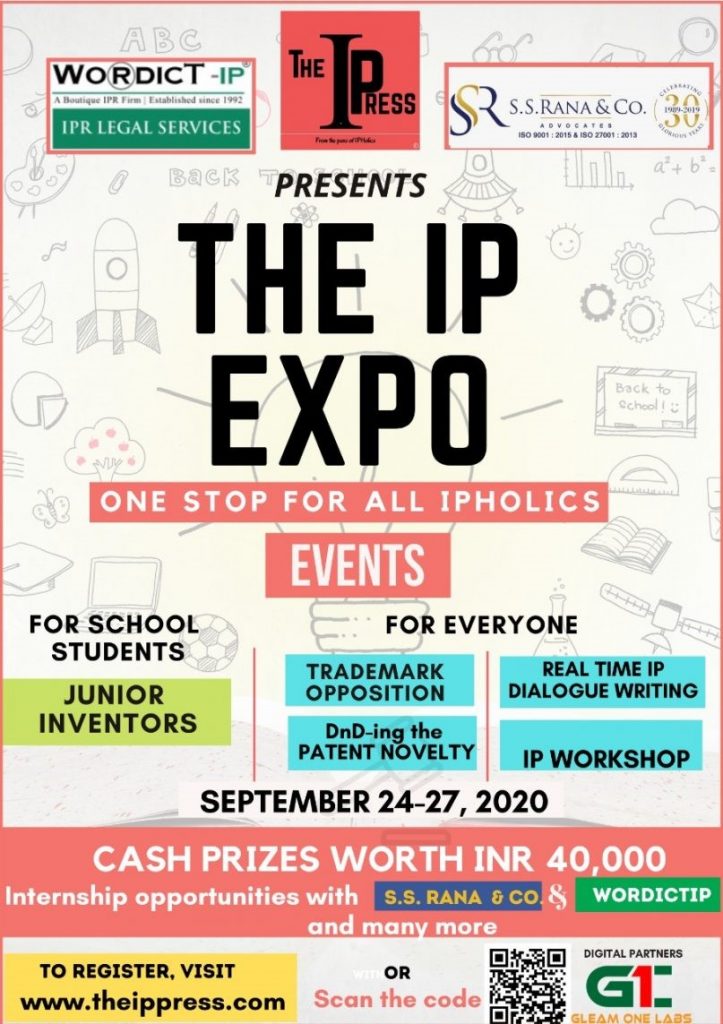
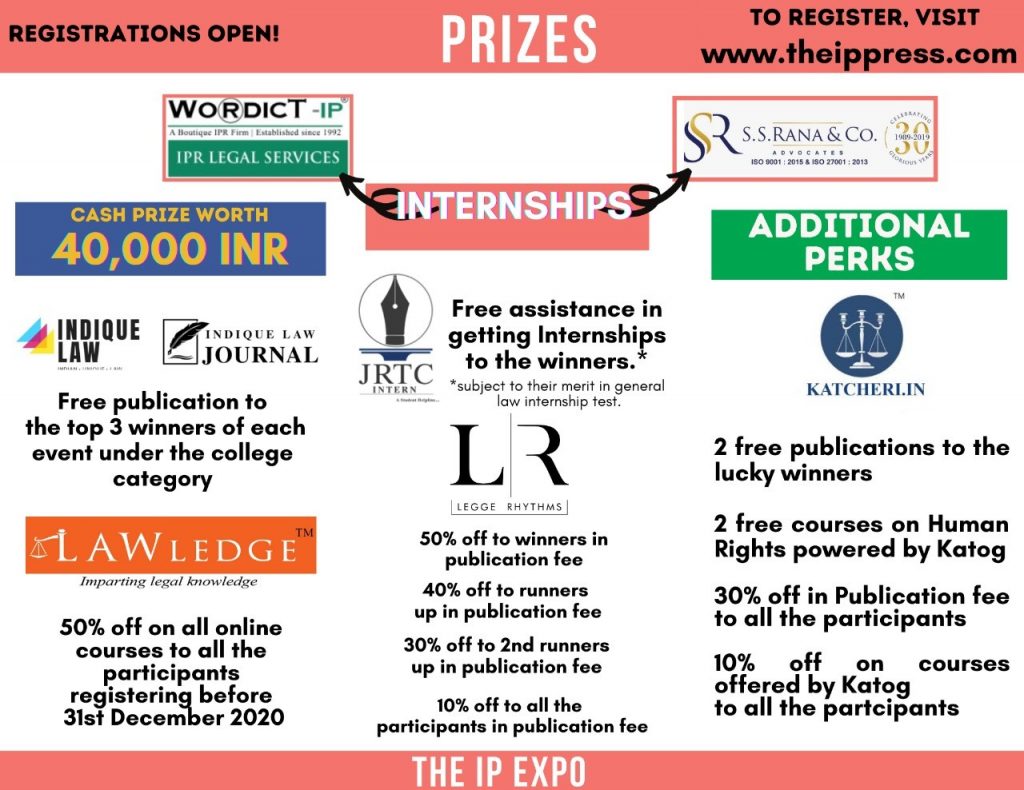
We, the IP Press along with the title, event, supporting, knowledge, digital and media partners, are delighted to bring the IP Expo 2020-21 (ONLINE EVENTS) for all the school and college students having an interest in science, intellectual property, creativity and innovation.

The last date for registration is September 15, 2020.

We are looking forward to seeing you at the IP Expo 2020/21 on September 24 to 27, 2020. Upon registration, further details about each event will be shared with the participants via email. Wish you all good luck.

Should you have any queries or questions, please write to us on theippress@gmail.com

Centre for Civil Society (CCS)

Centre for Civil Society (CCS) has been ranked amongst the top 60 think tanks in the world (and amongst the top 3 from India) by the University of Pennsylvania’s highly acclaimed annual Think Tanks and Civil Societies Program (TTCSP) report, for the past 5 years.

About the Program

  • Have you ever wondered what makes a policy work?
  • Have you thought about the reason for India still being poor?
  • Have you ever questioned what the role of the government should be?
  • Explore these questions at ipolicy for young leaders- a 2-day certificate course in Public Policy organised by India’s leading thinktank Centre for Civil Society in four cities – Delhi, Mumbai, Hyderabad, and Bangalore.
  • ĂŹpolicy is an introductory course in Public Policy. The course involves a variety of interactive learning methods including dynamic games, talks, dialogues, and documentaries, designed to provide participants with opportunities to explore and share ideas about policy-based solutions to social problems from a liberal perspective.
  • Only 30 best applications would be selected for the course! Applications are open for all college students and young professionals.

Goals of ĂŹpolicy:

  • To create a fun, open, and respectful environment where everyone is encouraged to think critically about social, economic, and political issues.
  • To evoke in participants a passionate inquiry into their own values and role in creating a good society.
  • To equip participants with fundamental concepts of political economy and sound public policy to enable them to understand the root cause of current challenges and effectively advocate for policy solutions through their current work and future professions.
  • To plug participants into a global network of opportunities to propel their intellectual growth, make personal connections and access resources to help them advance their vision of a free society.
  • We have conducted this same program across premier institutions in India like ISB Hyderabad, FMS Delhi, NLS Bangalore, IIM Kozhikode, IIT Delhi, IIT Madras, IIT Bombay, Delhi School of Economics and many more.

Eligibility

Who Can Apply? College students, young professionals, development leaders under the age of 30

Fee Details: Rs. 2,000/-

(Includes course material and lunch on both days)

For more details click here https://ccs.in/ipolicy-programs

National Law University, Delhi

The National Law University, Delhi, in collaboration with INSOL India, supported by the Insolvency and Bankruptcy Board of India (IBBI) and UNCITRAL Regional Centre for Asia and the Pacific, has initiated a unique moot competition on Insolvency and Bankruptcy.

Insolvency and Bankruptcy Code, 2016 (IBC)

The Insolvency and Bankruptcy Code, 2016 (IBC) came into effect on 01st December 2016.  It is one of the most critical components of the financial architecture of the country involving a wide range of stakeholders. It is essential that the students of law, commerce and management understand the nuances of this specialised subject through both education and training in this field. This will enable them to choose a career out of many streams of profession this branch of commercial law offers and prepare them for industry engagement. In light of the same, the inaugural edition of the competition was held during 11th-12th November 2017 at the National Law University, Delhi, India.

About the Competition

The fourth edition of the competition will be held on 10-12 December 2020. The theme is ‘Corporate Insolvency Resolution, including issues on Individual Guarantors and Cross-Border Insolvency’. The format of the competition is based on the process envisaged under the IBC.

Representation will be through a team of not more than four (4) and no less than two (2) students. All participants must be full-time candidates presently enrolled in an undergraduate degree programme in law or postgraduate/undergraduate degree management programme at the respective universities.

Registration may be done by sending an email along with the Registration form to insolvency@nludelhi.ac.in and copy to contact@insolindia.com with the subject “Registration for Insolvency and Bankruptcy Moot 2020”. Any registration received after 30.09.2020 will not be considered. For further queries kindly send an email to insolvency@nludelhi.ac.in.

Registration form can be accessed from here. You can also follow our Facebook page here for further details.

We cordially invite you to participate in the fourth edition of Insolvency and Bankruptcy Moot Competition.

For any further queries please contact us at insolvency@nludelhi.ac.in

Faculty Coordinator:

Dr. Risham Garg

Assistant Professor of Law & Director,

Centre for Transnational Commercial Law (CTCL)

National Law University, Delhi

Sector 14 Dwarka, New Delhi- 110078. INDIA

Email: ctcl@nludelhi.ac.in

INTRODUCTION

The Delhi High Court on Thursday questioned Arnab Goswami, the Editor-in-Chief of Republic TV for running a parallel investigation and trial in the Congress leader Shashi Tharoor’s wife Sunanada Pushkar’s death case and directed him to be bound by his undertaking on showing restraint and bringing down the rhetoric.

Appellant’s Contentions

A plea was moved by Shashi Tharoor seeking interim injuction against Arnab Goswami, restraining him from reporting or broadcasting any news or any show related to the death of Mrs. Sunanda Pushkar till the case is pending and also to restrain him from defaming the plaintiff in any manner.

Senior Advocate Kapil Sibal, appearing for Shashi Tharoor argued that despite the charge sheet being filed in the Sunanda Pushkar case, where no case of murder is made out, Arnab Goswami claims in his shows that he has no doubts that Sunanda Pushkar was murdered. He even pointed out that Goswami has continued to broadcast defamatory content against Tharoor and even claimed that he doesn’t trust the investigation being conducted by the Delhi Police, even though the Court’s last order of 1st December, 2017 directed to restraint and refrain from conducting a media trial.

Mr. Kapil Sibal stated,

“Can a man be abused like this in a public debate? How can he (Goswami) say that a murder was committed, when the charge sheet say otherwise? This can’t continue like this till this court hears the matter”.

Key Highlights

  • Pushkar was found dead in a suite of a five-star hotel in South Delhi on the night of January 17, 2014.
  • The Delhi Police filed a Charge sheet in the trial court which took cognizance of it and Tharoor was summoned under Section 306( Abetment to suicide) and Section 498 A (cruelty to married woman) of IPC in the light of the investigation done by the agency.

Defendant’s Contentions

Ms. Malvika Trivedi, Goswami’s counsel, took the stand by saying that they have credible evidence from an AIIMS doctor that points towards Pushkar’s death.

Court’s Decision

The Single Bench consisting Justice Mukta Gupta, putting aside the defendant’s stand stated,

“When a case under abetment to suicide is made out in the charge-sheet, why are you still saying that murder has been committed? Were you there at the spot, are you an eye-witness? You must understand and respect the sanctity of criminal investigation and the various contours of it. Just because there’s a bite mark, it doesn’t amount to murder. Do you even know what constituted a murder? You need first to understand what murder is before claiming that a murder took place.”

The court further observed that when a chargesheet has been filed by an agency authorized to conduct investigation and a competent court, while taking cognizance of the same, has pima facie concluded that the case involves abetment to suicide and not murder, the statements made by the defendant insinuating murder being committed by Tharoor violates the directions of the court’s previous order.

The court even remarked by stating’

“People must take a course in criminal trial and then get into journalism“.

Therefore, the court directed Arnab Goswami to comply with the court’s previous order and exercise restraint till the next date of hearing or else consequences will follow.

-Report by Abhilasha Kumari

READ THE FULL NEWS HERE…

About the Organisers

Students for Liberty (SFL) is an International libertarian non-profit organisation whose mission is to “educate, develop, and empower the next generation leaders of liberty.” Formed in 2008, SFL has since grown into a full organisation with various programs and a network of affiliated student groups in North America, Europe, Latin America, Africa, South Asia and the Asia-Pacific. Students for Liberty is the world’s largest law and academically market-oriented movement of students who have been deliberating and focusing on essential policy issues that our societies face.

About the Session

The SASFL’s Speaker Session on ‘Consumers, Corruption and Economic Development’ is organised on Sep 17, 2020, from 7:38:30 PM to 7 PM IST via Zoom.

Speaker

Dr. Krisztina Pusok, Director of Policy and Research at the American Consumer Institute- Center for Citizen Research

How to Register?

Interested applicants can register for the session through https://forms.gle/tVs4WhwPmhAQvLn46
Registration is free and compulsory.
Registration Deadline
September 16, 2020

Contact
Ritik Kumar: rikumar[at]studentsforliberty.org (+918136841952)

NLSIR

NLSIR is the flagship law journal of the National Law School of India University, Bangalore. In its 33rd year now, the NLSIR is a bi-annual, student-edited, peer-reviewed law journal, which holds the distinction of being the first Indian student-run law journal to be cited by the Supreme Court of India, in its decision in Action Committee, Unaided Private Schools v. Director of Education. Notably, we have also been cited recently in the Supreme Court’s landmark judgment, Justice K.S. Puttaswamy v. Union of India(2019) 1 SCC 1 which established the Fundamental Right to Privacy in India. NLSIR has also been recently cited in Justice R. S. Bachawat’s Law of Arbitration and Conciliation, a leading treatise on arbitration law in India.

To further our aim to encourage legal writing, provide inclusive legal scholarship, and contribute to issues at the forefront of contemporary legal discourse, the Board of Editors is inviting submissions for its forthcoming Volume 33, Issue 1.

Submission Guidelines

  1. All contributions submitted to the NLSIR should be original, and should not have any plagiarized content.
  1. By submitting contributions to NLSIR, the author(s) confirms that the manuscript is not being simultaneously considered for publication elsewhere (online or print).
  2. Pieces with relevance to India or Indian law are particularly welcome. This, however, is not a prerequisite.
  3. Submissions are accepted for the following categories:
  4. Long Articles: Between 5,000 and 10,000 words. Papers in this category are expected to engage with the theme and literature comprehensively, and offer an innovative reassessment of the current understanding of that theme. It is advisable, though not necessary, to choose a theme that is of contemporary importance. Purely theoretical pieces are also welcome.
  5. Essays: Between 3,000 and 5,000 words. Essays are more concise in scope. These papers usually deal with a very specific issue and argue that the issue must be conceptualized differently. They are expected to make an easily identifiable and concrete argument.
  6. Case Notes and Legislative Comments: Between 1,500 and 2,500 words. Case Notes are expected to analyse any contemporary judicial pronouncement, or a new piece of legislation, whether in India or elsewhere. The Note must identify and examine the line of cases in which the decision in question came about, and comment on implications for the evolution of that branch of law. In case of Legislative Comment, the Note must analyse the objective of the legislation, and the expected legal impact.
  7. Book Reviews: Between 2,000 to 3,000 words.
  8. The journal is flexible regarding the word count depending on the quality of the submission. All word limits are exclusive of footnotes.

Formatting Guidelines 

  • The body of the manuscript should be in Times New Roman, font size 12 with 1.5 line spacing. The footnotes should be in Times New Roman, font size 10 with single line spacing.
  • The manuscript should contain only footnotes (and not endnotes) as a method of citation. Citations must conform to OSCOLA (Oxford University Standard for the Citation of Legal Authorities) (4th) style of citation.
  • Authors are required to adhere to the NLSIR Style Guide which can be found here.

Submission Procedure

Submissions may be emailed to mail.nlsir@gmail.com under the subject “33(1) NLSIR – Submission”. All submissions must contain the following:

  1. The manuscript in a .doc or .docx format. The manuscript should not contain the name of the author, their institutional affiliations, or any other identification markers. The title of the manuscript should indicate the sub-theme that the author(s) have chosen.
  1. A separate cover letter in a .doc or .docx format, containing the Name of the author, Professional Information, Title of the manuscript, and Contact information.
  2. An abstract of not more than 150 words.

General Information

The deadline for submissions is October 30th, 11.59 PM.

  1. Co-authoring of papers among individuals of the same or different institutions is permissible, for a maximum of three authors.
  1. Upon submission, every manuscript will undergo two internal reviews by the Board of Editors. If approved in both the rounds, it is subject to a double-blind peer review process.
  2. We hope to update authors on the submission within 4 weeks of their submission.

CONTACT

For more information, please visit www.nlsir.com. For queries, write to us at mail.nlsir@gmail.com.

The RGNUL Student Research Review (RSRR) Journal is a bi-annual, student run, blind peer reviewed, flagship journal based at Rajiv Gandhi National University of Law, Punjab. It has been founded with the objective of facilitating arguments in black and white. Legal Research skills form the core of the learning process in any dimension of law.

About Saikrishna and Associates Advocates 

Saikrishna and Associates Advocates is a Tier-1 full-service firm and its expertise extends across wide practice areas and issues related to clients from diverse sectors. The firm has been recognized in the Legal 500 Asia Pacific and the Asia Pacific Chambers and Partners in 2018. An academically and research driven firm, the Firm’s consumer law practice has also gained prominence through the years. The Firm has represented thousands of clients in hundreds of consumer complaints, making it a leading law Firm for consumers across India.

The Editorial Board in collaboration with Saikrishna and Associates Advocates invites submissions from academicians, practitioners, legal luminaries and students on the theme â€œProtecting Consumers in the 21st Century: Broadening the Outlook.” 

Background

The dawn of the 21st century has witnessed drastic changes in the market dynamics, the modus operandi of businesses and the technological landscape. With the advent of the Consumer Protection Act, 2019  new concepts to protect the consumers have been introduced, namely criminal liability, product liability, liability for misleading/ false advertisements, amongst many. However, despite the recent turn of legislative measures, the implementation and realisation of the objectives of CPA, 2019 is yet to be tested. A comprehensive legislation entailing a strong consumer protection framework and an efficient consumer disputes redressal mechanism has always been a challenge for India.

Thus, in light of the changing market dynamics and evolving consumer protection laws, RSRR seeks to delve into this theme, to review the legal and policy framework in today’s consumer centric economy.

We welcome submissions from legal practitioners, academicians, students and members of the legal fraternity.

For more details, kindly refer to the ‘Call for Papers’ PDF attached, herein.

Sub themes

RSRR invites submissions on the following sub-themes:

  1. Liability under Consumer Protection: A Boon or a Bane?
  1. Criminal Liability: A Step Backwards?
  2. Critical Analysis of the Product Liability Framework
  3. Imputability of liability in the age of Robots and AI
  4. Protecting a Digital Consumer
  5. The Impact of AI on Consumerism
  6. Privacy of an Online Consumer
  7. Unsolicited Commercial Communications
  8. Changing Ambits of Consumer Grievance Redressal Mechanism: A Cross Jurisdictional Analysis
  9. Mediation as a Fresh Resolution Mechanism
  10. The Arbitrability of Consumer Disputes
  11. Expanding the Jurisdiction of Consumer Disputes
  12. Online Dispute Resolution: A Viable Remedy?
  13. Consumer Law in a Global Village
  14. Need for Uniform and Standard Principles of International Consumerism
  15. Jurisdictional and Enforcement Issues vis-a-vis Cross-Border Trade
  16. Comparative Consumer Law: Analyzing International Best Practices
  17. Revamping the definition of ‘Service’
  18. Educational Institutions: Serving Students?
  19. Accountability for ‘Free’ Healthcare Services?
  20. Content Moderation on Social Media Platforms: A Consumer Issue?
  21. Applicability of Sovereign Immunity for Government Services
  22. Aggregators and Gig Economy: Are gig workers consumers?
  23. Issues Around Consumer Consent
  24. Consenting to Unfair Contractual Terms
  25. Impact of Big Data Analytics on Consumer Rights
  26. Consent in Internet of Things and Consumer Law
  27. Consumer Protection in the Financial Sector
  28. Regulating Fin-Tech and E-payment Portals
  29. Deficiency of Service by Banks- An Expansive Interpretation
  30. Insurance Regulation for the Benefit of the Consumer
  31. Insolvency and Bankruptcy Issues vis-Ă -vis Consumer Laws
  32. Consumer as a Creditor to the Corporate Debtor
  33. Concurrent Reliefs for a Consumer
  34. Individual Bankruptcy: A Consumer Protection Measure or a Market Abuse Measure?
  35. Evolving Anti-Competitive Practices and Consumer Protection: Are the existing legislations adequate?
  36. Consumer Protection and Environmental Sustainability: Creating a Balance
  37. IPR Regulation for Consumer Benefit
  38. Regulation of Advertising and Marketing Laws: Influencing Consumers’ Behavior
  39. Liability of Advertising Agencies and Influencers
  40. E-Commerce Portals: Targeting Online Consumers
  41. Regulation of Telemarketing and Robocalls
  42. Deceiving Vulnerable Consumers: Advertising and Trademarks

Note: The submissions are, however, not restricted to the aforementioned sub themes, provided they fall within the ambit of the main theme.

Submission Categories

The RSRR invites papers under the following categories: –

  • Articles (5,000 to 10,000 words)
  • Short Notes (3,500 to 5,000 words)
  • Case Comments (2,500 to 4,500 words)
  • Normative Law Articles (3,000 to 5,000 words)

Instructions for Authors

  1. All submissions must be in Garamond, font size 12, spacing 1.5.
  1. All footnotes shall be in Garamond 10, single-spaced and should conform to the Standard Indian Legal Citation (SILC).
  2. Margins: Left 1 Inch and Right 1 Inch, Top 1 Inch and Bottom 1 Inch (A4).
  3. The word limit is exclusive of all the footnotes.
  4. Co-authorship is allowed up to 2 authors.
  5. All entries should be submitted in .doc/ .docx format only.
  6. The author(s) bear sole responsibility for the accuracy of facts, opinions or views stated in the submitted paper. In case of any plagiarism found in the contents of submitted paper, the Manuscript shall be subject to rejection.

Abstract Submission

All submissions must be accompanied with an abstract of subject to a maximum of 250 words. Abstract shall also be accompanied by at least 3 keywords in the paper, up to a maximum of 7 keywords.

Submission Procedure

The abstracts and the papers must be mailed at submissionsrslr@rgnul.ac.in, with the subject “Submission for Volume 7, Issue 1 – Type of Submission (Article/ Short Note/ Case Comment/ Normative Law Articles)”.

The submissions of abstracts and papers should accompany a cover letter specifying author’s name, designation, institute, contact number and email for future reference in the mail body itself.

Deadline

The last date for submissions of abstracts is 15th October, 2020 by 11:59 P.M. (Indian Standard Time).

Deadline for final paper submission is 15th November, 2020 by 11:59 P.M. (Indian Standard Time).

Contact

For any further queries, contact the Editorial Board at submissionsrslr@rgnul.ac.in

Furthermore, the following people can be contacted:

Senior Editors 

Stuti Srivastava (98738-81807)

Aditya Vyas (94148-78054)

Sehaj Singh Cheema (87250-82864)

Child Rights and You (CRY)

Recognized as India’s most trusted NGO, Child Rights and You (CRY) works tirelessly to ensure happier and healthier childhoods for India’s underprivileged children.  CRY addresses children’s critical needs by working with parents, teachers, Anganwadi workers, communities, district and state level governments as well as the children themselves. Over the last 41 years, CRY has impacted the lives of over 3 million children.

Details about the opportunity

8 weeks long non intensive online volunteering programme from the comfort of your home/ desk whereby you learn- reflect and contribute to the cause of child rights, honing your perspectives and skills on the way!

Why someone should apply

We’re ALL inherently kind and compassionate beings – qualities we’ve exhibited in so many big and small ways right from the time that we were children. If you look back, we’re sure you’ll remember so many such instances of your own!

But you’ll also agree that sometimes, as we grow older, we may not do it as consciously anymore. Volunteering for a good cause is such a great way to reconnect with the truest part of ourselves!

And if you’d like to volunteer with CRY, we have an incredible online volunteering program that you should totally sign up for this programme.

For details watch this youtube video to know more about CRY.

Duration and expectations from volunteers

8 week long, starting October 1. Typically a three hour commitment per week. Volunteers will be expected to follow the handbook as will be provided before the tenure begins and undertake the weekly activities and do the submissions.

Eligibility criteria

Anyone above the age of 14 years and willing to experience volunteering or making satisfying use of time for a social good.

Application and selection procedure

Anyone interested can sign up using this application link by September 30.

The programme starts in the first week of October 2020. Every valid application will stand a chance to be a volunteer. There will not be any screening done.

Deadline

Application deadline: September 30.

The recruitments are on through the entire month of September. All applicants will hear from CRY between Oct 1-3 regarding the tenure, after they have filled and submitted the form.

The programme will run through the months of October and November. The final submission should not be beyond December first week.

Contact

You will get a detailed mail with guidelines on 1st October. All specific clarity that you seek will be addressed at that stage. If you have any other queries, send an email to volunteering.cry@gmail.com.

To know more, visit the official website of CRY.