This case analysis is made by Bhavna Arul, a fourth-year law student from Symbiosis Law School.

Case Number

Criminal Appeal No. 78 of 1954

Bench

Bhagwati, Jagannadhadas, V Ayyar, JJ) 

Decided on

15/9/1954

Citations

AIR 1956 SC 654 / 1956 CriLJ 1265

Facts

The father of the accused and the father of victim had gotten into a fight. This fight led to the father of the accused getting severely injured to the extent of having his leg amputated. The accused, Kapur Sigh, was hence enraged by the amputation of his father’s leg and wanted to take revenge. After planning for a long time, Kapur Singh took the help of his friend Chand Singh to plan his revenge on the victim. 

On 30th September 1952 Kapur Singh with the help of Chand Singh forcefully held the victim inflicted injuries upon him with a gandasa. The victim was hit over 18 times on his hands and legs. These wounds inflicted led to the death of the victim. The accused, Kapur Singh absconded after the incident.

Procedural History

Kapur Singh had initially absconded. Meanwhile, Chand Singh was charged for murder under Section 302, IPC and was given a sentence of transportation of life.  

Kapur Singh was later arrested and tried. The sessions court held him liable under Section 302, IPC and he was given the death sentence. The death sentence was confirmed by the Punjab High Court. The current judgement analyzed was passed by the Hon’ble Supreme Court which taken on appeal.

Issue

Whether the appellant had the intention to kill as per Section 300 (intention to murder) or not?

Rule

Section 32, IPC- Common Intention

Section 299, IPC- Definition Clause- Culpable Homicide

Section 300, IPC- Definition Clause- Murder

Section 302, IPC- Punishment Clause- Murder

Section 304, IPC- Punishment Clause- Culpable Homicide

Ratio Decidendi

The Supreme Court based its decision on the distinction of the meanings of Culpable Homicide and Murder.

When we look at the definition sections of murder and culpable homicide, it reads as follows-

Section 299. Culpable homicide. —Whoever causes death by doing an act with the intention of causing death, or with the intention of causing such bodily injury as is likely to cause death, or with the knowledge that he is likely by such act to cause death, commits the offence of culpable homicide.

Section 300. Murder. —Except in the cases hereinafter excepted, culpable homicide is murder, if the act by which the death is caused is done with the intention of causing death, or—

—If it is done with the intention of causing such bodily injury as the offender knows to be likely to cause the death of the person to whom the harm is caused, or—

—If it is done with the intention of causing bodily injury to any person and the bodily injury intended to be in­flicted is sufficient in the ordinary course of nature to cause death, or—

—If the person committing the act knows that it is so imminently dangerous that it must, in all probability, cause death or such bodily injury as is likely to cause death, and commits such act without any excuse for incurring the risk of causing death or such injury as aforesaid.

The definitions of both may sound the same as both of the definitions talk about 2 key ingredients- the intention to cause death and an act that has caused death. However, culpable homicide is considered less severe than murder as the gravity of intention to cause death in culpable homicide is lower than the intention to cause death in murder. 

The judgement of the Supreme Court was reasoned on the following factors-

  1. The injuries inflicted on the victim were only on his arms and legs. 
  2. There was no injury recorded on any vital organ.
  3. The intention was only to cause grievous hurt on arms and legs of the victim.
  4. However, any reasonable person will know that gruesomely hitting someone 18 times will result in death of the person.
  5. There was no clear intention to kill the victim.  

Judgment

The Hon’ble Supreme Court overruled the judgement of the Session’s Court. It held the accused liable of Culpable Homicide under Section 304(1), IPC and set aside the sentence of the Session’s Court and changed it from death penalty to life imprisonment. 

Latest Posts


Archives

This article is written by Tulip Das, currently pursuing BBA L.L.B(H) from Amity University Kolkata.

Case Number

Criminal Appeal No. 522 of 1910 and 

Criminal Appeal No. 32 of 1912

Judges

Benson, J. Sundara Aiyar, J. and Rahim, J.

Decided On

02/01/1912

Citation

1912, 22 MLJR 333 (Mad)

Relevant Act

Section 26, 39, 299, 300, 301, 302, 303, 321, 323 and 324 of the Indian Penal Code, 1860.

Section 429 of the Criminal Procedure Code, 1973.

Facts

The accused, Mushnooru Suryanarayana Murthy, called Appala Narasimhulu to his brother-in-law`s house and with an intention to kill him, gave him some sweetmeat (halva) which contained arsenic and mercury poison in soluble form.

Appala Narasimhulu ate a portion of the sweetmeat and threw away the rest.

Rajalakshmi, the 8 or 9-year-old daughter of the accused`s brother-in-law, unknowingly ate some sweetmeat and also gave some to another little child to eat. However, this happened without the knowledge of the accused.

The two children who had eaten the poisoned sweetmeat, died from the effects of it, but Appala Narasimhulu, though the poison severely affected him, eventually recovered.

The accused has been sentenced to transpiration for life for having attempted to murder Appala Narasimhulu.

Procedural History

The accused, Mushnooru Suryanarayana Murthy had made large amounts of insurance on the life of Appala Narasimhulu without the knowledge of the latter. In order to obtain the sums for which he was insured, he wanted to murder Appala Narasimhulu. With an intention to do so, Mushnooru invited Narasimhulu to his brother-in-law`s house and offered the latter poisoned sweetmeat (halva) to eat. Narasimhulu ate a portion and then threw it. Later, Rajalakshmi, the 8 or 9-year-old daughter of Mushnooru Suryanarayana Murthy`s brother-in-law, unknowingly ate the same sweetmeat and also gave a portion of it to another child. This happened without the knowledge of the accused. Unfortunately, the two children died after eating the sweetmeat but Narasimhulu eventually recovered in spite of being affected by the poison. Therefore, the accused, Mushnooru Suryanarayana Murthy was acquitted and sentenced with an attempted to murder of Appala Narasimhulu.

Issues Raised

Whether the accused is guilty of the murder of Rajalakshmi and the other child?

Whether the accused is guilty under Section 302 of IPC?

Whether the accused was so indirectly or remotely connected to the death that he cannot be said to have caused it?

Whether the death of Rajalakshmi was caused by the accused`s act within the meaning of Section 299? 

Ratio Decedendi

The accused was convicted under various sections of the Indian Penal Code, 1860 and the Criminal Procedure Code, 1973. The case has in itself, a number of sections mentioned. When we look into the definitions of the section, it reads as follows: –

The Indian Penal Code, 1860

Section 26. Reason to believe – A person is said to have “reason to believe” a thing, if he has sufficient cause to believe that thing but not otherwise.

Section 39. Voluntarily – A person is said to cause an effect “voluntarily” when he causes it by means whereby he intended to cause it, or by means which, at the time of employing those means, he knew or had reason to believe to be likely to cause it.

Section 299. Culpable homicide – Whoever causes death by doing an act with the intention of causing death, or with the intention of causing such bodily injury as is likely to cause death, or with the knowledge that he is likely by such act to cause death, commits the offence of culpable homicide.

Section 300. Murder – Except in the cases hereinafter excepted, culpable homicide is murder—

  1. If the act by which the death is caused is done with the intention of causing death, or
  2. If it is done with the intention of causing such bodily injury as the offender knows to be likely to cause the death of the person to whom the harm is caused, or
  3. If it is done with the intention of causing bodily injury to any person and the bodily injury intended to be inflicted is sufficient in the ordinary course of nature to cause death, or
  4. If the person committing the act knows that it is so imminently dangerous that it must, in all probability, cause death, or such bodily injury as is likely to cause death, and commits such act without any excuse for incurring the risk of causing death or such injury as aforesaid.

Section 301. Culpable homicide by causing death of person other than person whose death was intended – If a person, by doing anything which he intends or knows to be likely to cause death, commits culpable homicide by causing the death of any person, whose death he neither intends nor knows himself to be likely to cause, the culpable homicide committed by the offender is of the description of which it would have been if he had caused the death of the person whose death he intended or knew himself to he likely to cause.

Section 302. Punishment for Murder – Whoever commits murder shall be punished with death, or imprisonment for life, and shall also be liable to fine.

Section 303. Punishment for murder by life-convict – Whoever, being under sentence of imprisonment for life, commits murder, shall be punished with death.

Section 321. Voluntarily causing hurt – Whoever does any act with the intention of thereby causing hurt to any person, or with the knowledge that he is likely thereby to cause hurt to any person, and does thereby cause hurt to any person, is said “voluntarily to cause hurt”.

Section 323. Punishment for voluntarily causing hurt – Whoever, except in the case provided for by section 334, voluntarily causes hurt, shall be punished with imprisonment of either description for a term which may extend to one year, or with fine which may extend to one thousand rupees, or with both.

Section 324. Voluntarily causing hurt by dangerous weapons or means – Whoever, except in the case provided for by section 334, voluntarily causes hurt by means of any instrument for shooting, stabbing or cutting, or any instrument which, used as a weapon of offence, is likely to cause death, or by means of fire or any heated substance, or by means of any poison or any corrosive substance, or by means of any explosive substance or by means of any substance which it is deleterious to the human body to inhale, to swallow, or to receive into the blood, or by means of any animal, shall be punished with imprisonment of either description for a term which may extend to three years, or with fine, or with both.

Criminal Procedure Code, 1973.

Section 429. Absence of complainant – When the proceedings have been instituted upon complaint, and on any day fixed for the hearing of the case, the complainant is absent, and the offence may be lawfully compounded or is not a cognizable offence, the Magistrate may, in his discretion, notwithstanding anything hereinbefore contained, at any time before the charge has been framed, discharge the accused. 

Judgment of the Court

Benson, J.

Justice Benson is of the opinion that the accused did cause the death of Rajalakshmi and is guilty of her murder. Although the accused did not intend to cause the death of Rajalakshmi, and he did not know that his act was even likely to cause her death, but it is clear that he did intend to cause the death of Appala Narasimhulu. Therefore, he poisoned the sweetmeat for him. It was this act of the accused which caused the death of the girl, though no doubt her own action, in ignorantly picking up and eating the poison, contributed to bring about the result, backed by Section 299 of the Indian Penal Code, 1860. It is to be observed that the section does not require that the offender should intend to kill any particular person. It is enough if he “causes the death” of any one by doing an act with the intention of “causing death” to any one, whether the person intended to be killed or anyone else. So it is neither Appala Narasimhulu`s act of throwing away the poisoned sweetmeat nor Rajalakshmi`s act of picking up and eating the poisoned sweetmeat caused the death of the latter. It was the act of poisoning the sweetmeat by the accused that caused the death of Rajalakshmi. So, it is clear that he is definitely guilty of the murder caused and this is also properly backed by Section 301 of the Indian Penal Code. 

The accused was originally sentenced to seven years’ rigorous imprisonment for having attempted to murder Appala Narasimhulu. This sentence was enhanced to one of transportation for life by this court acting as a court of revision in December, 1910, when this appeal was not before them. Looking to these facts Justice Benson impose a sentence of death, though it would have been appropriate if the accused had been convicted of murder at the original trial.

Sundara Aiyar, J. 

In this case the accused Suryanarayana Murthi was charged by the Sessions Court of Ganjam with the murder of a young girl named Rajalakshmi and with attempt to murder one Appala Narasimhulu by administering poison to each of them on the 9th February 1910. He was convicted by the Sessions Court on the latter count but was acquitted on the former count and was sentenced to seven years’ rigorous imprisonment. He appealed against the conviction and sentence in Criminal Appeal No. 522 of 1910, and this court confirmed the conviction and enhanced the sentence to transportation for life. The present appeal is by the Government against his acquittal on the charge of murdering Rajalakshmi. 

After statement of several witnesses, the conclusion drawn was that Suryanarayana Murthi had no intention to murder Rajalakshmi. This is because he had no reasons to believe that the poisoned halva will be thrown away by Narasimhulu and will be picked up and eaten by Rajalakshmi which will lead to her death. This statement is rightly backed Section 26 of the IPC. According to this, he had no sufficient cause to believe that poisoning the halva for Narasimhulu would cause the death of Rajalakshmi. The girl`s death could not have been caused but for the intervention of the prosecution’s 1st witness, i.e., Narasimhulu. The case, in his opinion, is not one covered by Section 301 of the Indian Penal Code. The conclusion, therefore, appears to follow that the accused is not guilty of culpable homicide by doing an act which caused the death of the girl. It is not contended that there was a legal duty on the part of the accused to prevent the girl from eating the halva and that he is therefore not guilty of murder by an illegal omission. 

 He upheld the finding of acquittal of the lower court and dismissed the appeal.

Benson J. would find the accused guilty of the murder of Rajalakshmi, while Sundara Aiyar J., agreeing with the Sessions Judge, holds a contrary view.

As both the lawyers differ in their opinion, the case was led before another judge with their agreed opinion under Section 429 of the Criminal Procedure Code, 1973.

Rahim, J.

After a deeper investigation into the case and proper justifications of actions and the applied laws, Justice Rahim, therefore, agreeing with Benson J., set aside the order of the Sessions Judge acquitting the accused of the charge of murder and convict him of an offence under Section 302, Indian Penal Code. He also agreed with him that, in the circumstances of the case, it is not necessary to impose upon the accused the extreme penalty of the law, and he sentenced the accused under Section 303, Indian Penal Code, to transportation for life. 

Latest Posts


Archives

This article has been written by Niti Shah who is studying  BLS/LLB at Pravin Gandhi College of Law

Case Number

184

Citation

AIR 2004 SC 184

Bench

R.C. Lahoti, Ashok Bhanu

Decided on

29 August 2003

Relevant Act/Section

Section 23 of the Consumer Protection Act, 1986

Petitioner

CCI Chambers CO-OP. HSG. SOCIETY LTD.

Respondent

Development Credit Bank LTD.

Facts of the Case

In this case, the rights of a consumer have been liberated. According to the facts of the case, the appellant had a savings bank account with the respondent bank. The bank, in this case, is the development credit bank  Ltd. Days passed, After which the appellant found out a few problems in his account. Any issue which a consumer comes across is considered to be grave and based on this problem a complaint was filled to the National Redressal Forum alleging deficiency of the services provided by the bank and also submitted that the bank had mistakenly debited an amount of RS. 75,70,352 in the account of the appellant by honouring certain cheques as forged cheques i.e. fully fake and not appropriate and in some of the cheques that were submitted, the amount was wrongly tampered by someone. The photocopies of the fake cheques were submitted along with the complaint made. It was noticed that around 72 cheques were issued on the same date when one of the persons who made the tampering at the cheque was found dead. The other one denied the signatures given and all such signatures did not even tally the standard signatures of the complainant. the entire suspect went towards one of the employees of the bank who was suspected to be the person due to which the whole issue was created. A complaint was filed in the police against that employee immediately. the case went to the Supreme Court of India at that instant. The court took help from the National Forum to have a detailed analysis of the case and therefore come into a conclusion to get the entire facts and to check whether the Respondents were guilty in this case or not. The court had given a detailed and equitable justice for the parties after looking into several other cases.

Issues

  • Whether the crime was committed by the respondents by tampering the cheques?
  • Whether it was a case under section 23 of the Consumer Protection Act, 1986?
  • Whether it was the case of NCDRC?

Judgment

The Judgment of the Court was delivered by R.C. Lahoti, J.

The Judges of the particular case made a detailed judgment by analyzing the matter properly with every issue being studied deeply. The complaint was filed under section 23 of the Consumer Protection Act. The main issue which arose over here was about determining the commission. The court had held that it cannot be denied that the National Level, the State level, and at the District level have been constituted under the Act with the only object of providing a speedy remedy in conformity with the principles of natural justice, taking care of such grievances as are amenable to the jurisdiction of the forum established under the Act. Having heard the learned counsel for the parties we think that the appeal deserves to be allowed and the matter sent back to the NCDRC for hearing and decision afresh. Shri Harish N. Salve, the learned senior counsel for the appellant has submitted, placing reliance one three-Judge Bench decision of this Court Dr. J.J Merchant & Ors. v. Shrinath Chaturvedi, [2002] 6 SCC 635, Indian Medical Association v. V.P. Shantha and Ors., [1995] 6 SCC 651 and Amar Jwala Paper Mills (India) and Am. v. State Bank of India, [1998] 8 SCC 387 that the approach adopted by NCDRC does not deserve to be countenanced. Shri P. Chidambaram, the learned senior counsel for the respondent-Bank has supported the impugned order placing reliance on Synco Industries v. State Bank of Bikaner & Jaipur and Ors. These forums have been established and conferred with jurisdiction in addition to the conventional courts. The principal object sought to be achieved by establishing such forums is to relieve the conventional courts of their burden which is increasing day by day and where the disposal is delayed because of the complicated and detailed procedure which at times is accompanied by technicalities. After looking into the arguments advanced, issues raised, and also a detailed study of the entire case, the court had held that the decision that was given by the NCDRC(National consumer dispute Redressal commission) was a premature opinion. The entire commission issued a particular notice to the respondent and which was taken as pleadings. Only when pleadings for both of the parties were available, the commission at that instant should have formed an opinion based on nature and also the scope of the inquiry which means whether all the questions that arose in the light of the proceedings of both the parties were detailed and even a complicated nature of the investigation was made into the facts which were not at all capable of being taken speedily. The commission then could have formed justifiably an opinion that could have been proved a lot useful for removing the complaint to the civil court. It was just a complicated nature of the entire facts and also the law for the decision which could not be decisive at all. The appeal was allowed and the decision of the National Commission was set aside. The case was again sent back to the commission for a fresh hearing and fresh study of nature and then making a final decision.  There was no order made concerning the costs of the case. Thus, the court made an equitable decision which was quite relevant too because the commission did not perform their job nicely. They should have studied the entire case deeply and then they should have decided whether this case had a proper judgment or not. conventional courts. The principal object sought to be achieved by establishing such a forum is to relieve the conventional courts of their burden which is ever-increasing with the mounting arrears and whereat the disposal is delayed because of the complicated and detailed procedure which at times is accompanied by technicalities. 

Latest Posts


Archives

This case analysis is written by Shambhavi Shree, a student of KIIT School of Law, Bhubaneswar (4th year).

Case analysis

AIR 1943 Mad 571 

Case Number 

Case number 152, R.T.No. 41 of 1st February 1943

Equivalent Citation

(1943) 2 MLJ 13

Bench

Honorable Mr. Justice King and the Honorable Mr. Justice Byers.

Decided on

29th March 1943

Relevant Act/Section

Section 302 of the Indian Penal Code, 1860 says that whoever commits murder shall be punished with death or imprisonment for life and shall also be liable to fine.

Brief Facts and Procedural History

On the evening of 26th September, a woman named Meenakshi Achi was murdered in her flower garden situated a distance away from her village. She was found dead into the well of the same flower garden on 27th September. Two persons have suspected in which one was the gardener and the other one was an associate of the lady who was in the current need of money. The body recovered had three punctured wounds upon the head. Police recovered a chain from the possession of the associate person which the deceased was wearing at the time of her death. It was contended that the portion of the chain was divided equally between the two accused. Further, the associate confessed before Taluk Magistrate of Tirupattur that he was persuaded by the gardener to assist him while killing the lady. The associate as assisted by the gardener did not allow the deceased to leave the garden by seizing her legs and holding her tightly. Now after the death of the deceased both the accused persons threw her body into the well. 

Issues before the Court

  1. Whether the death caused by the accused was intentional?
  2. What was the cause of action?
  3. Whether at the time when the woman was thrown into the well was she alive?
  4. What were the evidence from the post mortem report and the testimony of the doctor?
  5. Whether the accused was guilty under Section 302 of the Indian Penal Code, 1860?

The Decision of the Court

In the medical report, the doctor stated that the body had innumerable external injuries. The external injuries recovered from the body were insufficient to cause death. And it was comprehended that the accused persons considering her to be dead threw her body into the well. It was held that the intention of the associate of the lady was not to kill her. And therefore he is not liable under Section 302 of the Indian Penal Code, 1860. The court referred Palani Goundan V. Emperor (1919) 37 M.L.J. 17: 42 Mad. 547 (F.B.). and stated that in this case the deceased was thrown upon the railway line with the intent to cause injury while in the present case body was thrown after the death of the lady. But the Learned Sessions Judge stated that the accused will be liable even if the body was disposed of after or before the death of the deceased. Therefore it was concluded that they will be sentenced to death.

Reference

  • https://indiankanoon.org/search/?formInput=ratio+of+the+case+In+re+Thavanani+V.+Unknown%2C+AIR+1943+Mad+571+
  • https://www.indialegallive.com/constitutional-law-news/supreme-court-news/conviction-section-302-modified-section-3041-absence-intention-cause-murder-supreme-court#:~:text=Supreme%20Court%20on%20Thursday%20converted,of%20intention%20to%20cause%20murder.
  • https://www.latestlaws.com/bare-acts/central-acts-rules/ipc-section-302-punishment-for-murder/
  • https://www.lawyerservices.in/Thavamani-In-re-1943-03-29
  • https://www.casemine.com/search/in/in%20re%20thavamani

Latest Posts


Archives

This case analysis is made by Bhavna Arul, a fourth-year law student from Symbiosis Law School.

Criminal Appeal No. 33 of 1919 and Referred Trial No. 2 of 1919

(Before- J Wallis, S Aiyar, C Trotter)

Decided on

7/4/1919

Citation

1919 ILR 547 (Mad)

Facts

The accused had an argument with his wife. Enraged during the argument, the accused had hit his wife on the head with a ploughshare. This resulted in the wife falling down unconscious. The mother of the accused who was outside came into check what happened after the shouting the argument had suddenly stopped. When she came in, she saw her son with the ploughshare and the motionless body of the wife lying in the corner of the room. The accused had assumed that he had killed his wife. In the fear of being charged for murder the mother of the accused and accused together tried tampering with the evidence and the crime scene. He hung the body of his wife to make it look like a suicide. Later when the post mortem was conducted on the body of the wife, it showed the wife had survived the blow of the ploughshare and was only unconscious then and she had died due to being hung by the neck.

Procedural History

The case was initially tried in the Coimbatore Sessions court where the accused was held liable for murder. The case was further taken on appeal to the Madras High Court where the current judgement was passed.

Issue

Can the accused be held liable for Murder or is this a case of Culpable Homicide?

Rule

Section 32, IPC- Common Intention

Section 204, IPC- Definition Clause- Tampering of Evidence 

Section 299, IPC- Definition Clause- Culpable Homicide

Section 300, IPC- Definition Clause- Murder

Section 302, IPC- Punishment Clause- Murder

Section 304, IPC- Punishment Clause- Culpable Homicide

Section 322 IPC- Definition Clause- Grievous Hurt

Ratio Decidendi

Section 299. Culpable homicide. —Whoever causes death by doing an act with the intention of causing death, or with the intention of causing such bodily injury as is likely to cause death, or with the knowledge that he is likely by such act to cause death, commits the offence of culpable homicide.

Section 300. Murder. —Except in the cases hereinafter excepted, culpable homicide is murder, if the act by which the death is caused is done with the intention of causing death, or—

—If it is done with the intention of causing such bodily injury as the offender knows to be likely to cause the death of the person to whom the harm is caused, or—

—If it is done with the intention of causing bodily injury to any person and the bodily injury intended to be in­flicted is sufficient in the ordinary course of nature to cause death, or—

—If the person committing the act knows that it is so imminently dangerous that it must, in all probability, cause death or such bodily injury as is likely to cause death, and commits such act without any excuse for incurring the risk of causing death or such injury as aforesaid.

The definitions of both talk about 2 key ingredients- the intention to cause death- mens rea and an act that has caused death- actus reus. The court in this judgement keenly analyzes these two ingredients in its judgement. 

The judgement was based on the following points-

  1. When looking at the definitions of culpable homicide and murder, a key element in both definitions is intention to cause death of person. 
  2. Here Court observed from the facts that the accused did not have the intention of causing death of his wife when he hit her with the ploughshare.
  3. The reason for the death of victim was due to being hung by the neck. The victim had no intention of causing her death when he hung her as he had presumed she was dead and one cannot kill a dead person once again.
  4. The court hence held this was not a case of murder or culpable homicide as the key element- intention to cause death, was absent in both scenarios, when the accused hit the wife with a ploughshare and when he hung her body.

Judgment

The Hon’ble High Court overruled the judgement of the sessions court and held that the accused will not be held liable for murder or culpable homicide. He will instead be held liable only for the grievous hurt caused when using the ploughshare to hit the victim and for tampering with evidence.

Latest Posts


Archives

ABOUT US:

Lexpeeps is totally dedicated to the legal fraternity law professionals get an opportunity to flourish their career in a better way. Lexpeeps organises various events like debates, seminars of its own and also organises the major law school activities on tie-ups with leading law school. Lexpeeps is not only limited to managing the legal events but it also provides internships to law students where the law professionals come in touch with each other and grow by associating with the company.
Lexpeeps is also focusing on several social works like providing information and free legal aid to the poorer section of society.

TOPIC OF THE EVENT:

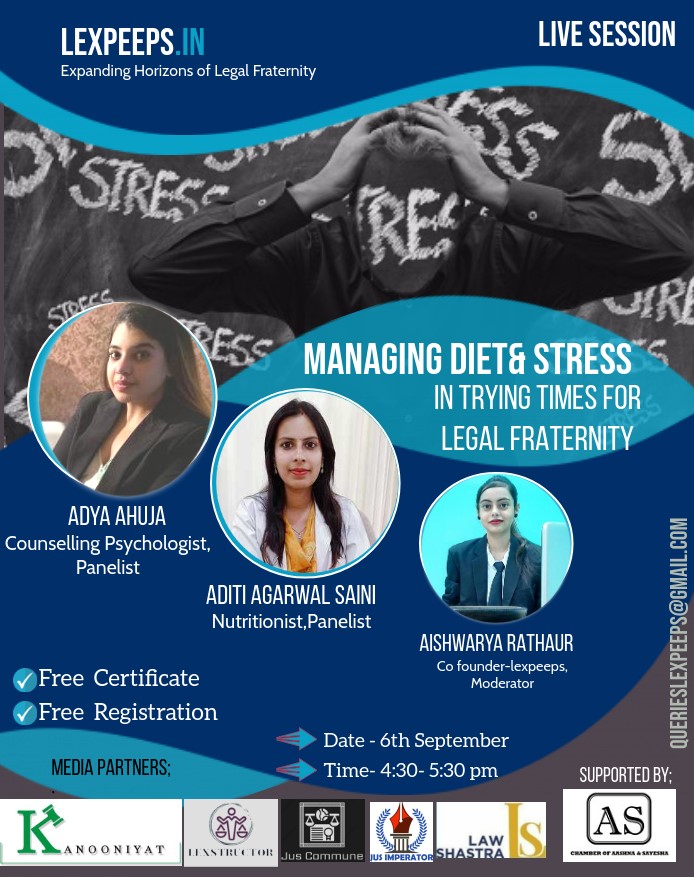
Lexpeeps.in is organising a Live Session on “Managing Diet & Stress in Trying Times for Legal Fraternity”. 

WHY THIS EVENT:

In the time of stress, the best thing we can do for each other is to listen with our ears and our hearts and to be assured that our questions are just as important as our answers. Lexpeeps cares for the health of everyone belonging to legal fraternity.

EXPERT GUEST:

MS ADYA AHUJA (Counselling Psychologist)

MS ADITI AGARWAL SAINI (Nutritionist)

Moderator:

AISHWARYA RATHAUR

Co-Founder, Operational Head, Lexpeeps

Date and Time:

SEPTEMBER 06 ,2020 4:30-5:30 P.M.

Registration Procedure:

Registration Fee: Totally Free

Registration Link:

https://docs.google.com/forms/d/e/1FAIpQLSesOBHEs3jwdWQFGE1a6QDi2cyB0xlS1TUzkz8fQn-Fnm4_-w/viewform

Link to join the webinar will be sent through mail after successful registration.

Perks: Free E Certificate

Limited Seats Hurry UP (First Come First Serve Basis)

For Queries Contact Us:

Email: lexpeeps.in@gmail.com

This Article is Written by Manav Sony from Amity University, Kolkata. The Article talks about the principle of Right to Privacy in our country with a reference to the latest Puttaswamy Judgement which came up in the year 2015.

INTRODUCTION

“Man’s house is his castle.” This short phrase depicts a lot about Right to Privacy in a Human Being. Every human being desire to have some things confidential in their life which they do not want to share with anyone else. The Right to Privacy has earned a lot of momentum and prosperity throughout the world and it has been recognised as a fundamental right. The enormous deliberation on the right to privacy had actually commenced after a debate of “Warren and Brandeis” and this particular debate was elucidated nicely in the research paper. Many countries like UK, USA, India etc. have given a lot of recognition to the right of privacy. This particular right is recognised at the books of our constitution under Article 21 which reads as follows:

21. Protection of life and personal liberty No person shall be deprived of his life or personal liberty except according to procedure established by law”

Our Constitution has not actually guaranteed the right as an explicit right to the entire citizens, but nonetheless, the Supreme Court of India had construed this right as a part of a person’s life and also personal liberty as per Article 21 as mentioned earlier and this right had been unravelled by the Indian Government in the recent case of Justice KS Puttuswamy v. Union of India where this right has been recognised as one of the most important rights in the field of judiciary and also the well being of the citizens at large. Regarding Article 21, Justice Khanna had clearly stated a point that human existence is not like mere animal existence. Each and every person deserves to have dignity and privacy is the most important fact with regards to the utmost enjoyment in someone’s life at a glance. Right to Privacy has actually travelled a widespread journey so as to attain a status of fundamental right in the books of the Indian Constitution. There are a large variety of cases which deals with the acceptance and denial of the particular right with respect to all the mentioned points which will be further elaborated so as to have a technological understanding with regards to its evolution within the Indian region and also it was the contribution of the laws of the United States of America since our Judiciary fully relied upon the laws which were formulated by the US Government in order to have unequivocal adjudication of the matters which concerns about the privacy of a particular person. Privacy is something which is really very needed during this time. There have been a lot of cases that happened under this context which has portrayed various dimension on the basis of this right. In the next subtopic, we are going to discuss the landmark judgement which was given by none other than Justice KS Puttuswamy which totally changed the concept of this right under the Indian Judiciary. This case also gives setback information as to how this right to privacy actually came into existence and what judgement was actually made. 

Justice KS Puttaswamy Judgement

Right to Privacy one of the most eminent and alarming aspects came into a steeper force when the nine-judge bench of the Supreme Court of India had delivered its judgement in the case of Justice K.S. Puttaswamy (Retd.) v. Union of India. This particular case had held that the right to privacy is a constitutionally protected right that not only emerges from the guarantee of life and even personal liberty as per Article 21 of the Constitution of India. It also mentioned a fact that it arises into various other contexts too from the other parts of freedom and also dignity which is guaranteed by the fundamental rights that are included in Part III of the Indian Constitution. The nine-judge bench had made a landmark judgement in which they had stated that privacy included at its main head the preservation of the personal atrocities, the sanctioned family life, marriage, procreation, home and also sexual orientations. Privacy also included a right to be left fully alone. Privacy actually safeguards the autonomy of a person and it also recognizes the ability of a particular person so as to control certain important aspects of his or her life. Some personal choices govern a way of a normal life which are intrinsic to the right of privacy. Privacy also helps in protecting heterogeneity and also gives recognition to the plurality and also diversification of the culture. When the entire legitimate expectations were made and it varied from the intimate to the private zone and also from private to public areas. It is really very important to note that privacy is not lost or surrendered under any instant because of the fact that the individual lies in a public place. Privacy attaches to the person from the fact of the dignity of that particular person. 

Conclusion

The inference can be drawn from the above-mentioned discussion that India relied upon the USA constitution for the interpretation of the right to privacy within Indian sphere, therefore, it can be said that American constitution has played a pivotal and significant role in moulding the right to privacy inaccurate shape. It was always observed that right to privacy is derived from the right to life and personal liberty and the recent judicial precedent about recognition of the fundamental status of the right to privacy has provided constitutional protection to private and confidential information and violation of said right will result in stringent legal action against the infringer. The purpose behind establishment of the right to privacy is with respect to the protection of personal information shared on digital platforms and since India doesn’t have privacy law as such, the fundamental status of privacy will protect this right from being contravened by others. Right to privacy which was pronounced as “right to be let alone” by Justice Subba Rao while dissenting the majority judgement in the case of Kharak Singh v. State of U.P., has finally obtained the correct place in the Indian constitution after various discussions and deliberations took place in numerous cases which dealt with various aspect of the right to privacy in Indian constitution. Therefore the effort of apex court should be commended because providing the fundamental status was a daunting task and despite plenty of protest and problems, the supreme court succeeded in giving the right space to the right to privacy and now a confidential and covert information of private individuals will be under the protection and unauthorized intrusion in private matters will result in rigid punishment.

Latest Posts


Archives

This article is written by Tulip Das, currently pursuing BBA L.L.B(H) from Amity University Kolkata. This case analysis is about C.C.I. Chamber/s Co-op. Housing Society Ltd. v. Development Credit Bank Ltd, (AIR 2004 SC 184).

Case Number

Civil Appeal No. 7228 of 2001

Judges

R.C. Lahoti and Ashok Bhan, JJ

Decided on

29/08/2003

Citation

AIR 2004 SC 184, 2003 Supp (3) SCR 139, CTJ 849

Relevant Act

Section 32 of the Consumer Protection Act, 1986.

Facts

The appellant, C.C.I. Chamber/s Co-op. Housing Society Ltd., had a Savings Bank Account with the respondent, Development Credit Bank Ltd.

The appellant filed a complaint claiming insufficiency in service by the respondent, proposing that the Bank had wrongly debited an amount of Rs. 75,70,352 in the account of the complainant by honouring such cheques that bore forged signatures of the complainant and in some of the cheques, the figures had been altered. 

Around 72 cheques were issued on such dates when one of the two persons while drawing the cheques found that they were already dead.

One of them denied his signatures and such disputed signatures did not at all tally with the standard specimen signatures.

Suspicion was raised against an official of the respondent Bank.

The complaint was thus filed after serving notice on the respondent Bank.

Procedural History

In 2001, the residents of C.C.I Chambers Co-operation Housing Society Ltd., an upmarket housing society in South Mumbai, filed a complaint with the National Consumer Disputes Redressal Commission, New Delhi (NCDRC) stating that in their bank account in the Development Credit Bank Ltd, Rs. 75,70,352 have been wrongfully debited. They filed a complained under Section 32 of the Consumer Protection Act, 1986, that such a big amount has been debited by the bank to their account through cheques that contained forged signatures and some cheques with figures altered. However, not being satisfied with the decisions of the National Commission, the appeal was made to the Supreme Court by the residents. The appeal was allowed. The impugned decision of the National Commission is set aside. The case is sent back to the Commission for a fresh hearing.

Issue Raised

  1. Whether the crime was committed by the respondents by tampering the cheques?
  2. Whether it was a case under section 23 of the Consumer Protection Act, 1986?
  3. Whether it was the case of the NCDRC?

Ratio Decedendi

The appellate argued that the bank has acted in an inappropriate manner by debiting such a huge amount into their account and then lodged a complaint to the NCDRC under Section 23 of the Consumer Protection Act, 1986.

When we look into the definitions of the section, it reads as follows: –

Section 23. Appeal – Any person, aggrieved by an order made by the National Commission in exercise of its powers conferred by sub-clause (i) of clause (a) of section 21, may prefer an appeal against such order to the Supreme Court within a period of thirty days from the date of the order: Provided that the Supreme Court may entertain an appeal after the expiry of the said period of thirty days if it is satisfied that there was sufficient cause for not filing it within that period:

Judgment of the Court

The decision arrived at by the NCDRC was premature. The Court said that when the pleadings of both the parties were available, the Commission should have formed an opinion of the nature and scope of the enquiry. If the Commission had acted in a matured manner, then the question whether decision in the light of the pleadings of the parties required a detailed and complicated investigation into the facts which was incapable of being undertaken in a summary and speedy manner would not have aroused. The decision in the light of the pleadings of the parties required a detailed and complicated investigation into the facts which was incapable of being undertaken in a summary and speedy manner. 

Therefore, the appeal was allowed and the impugned decision of the National Commission has been set aside. The case is sent back to the Commission for hearing afresh consistently with the observations made hereinabove. There was no order as to the costs.

Latest Posts


Archives

This article is written by Shambhavi Shree, a student of KIIT School of Law, Bhubaneswar (4th year).

Nozick’s Theory of Justice

Robert Nozick an American political philosopher was born in Brooklyn, New York in 1938. He died of stomach cancer in the year 2002. He introduced in his first book Anarchy, State, and Utopia (1974) “the entitlement theory of justice” and stated that every human being shall possess what they are entitled to. Nozick said that every human being is born with a fundamental individual right. No one should seize the right of entitlement from the other by wrongful act or misconduct. Some people gain benefits illegally by stealing, seizing, forgery, subterfuge, abuse, defraud, etc. As Nozick rightly pointed out the concept of just distribution through legitimate means. The most important demand for the rule of law is that those who work the hardest have more rather than equal distribution. Entitlement theory lays down three principles:

  1. Justice in acquisition: A person who acquires a holding justly is entitled to that holding. 
  2. Justice in transfer: If someone transfers you something then you can possess but such transfer must be legally valid.
  3. Principle of rectification of injustice: If someone’s right is infringed through coercion, fraud, robbery, looting, mugging, enslavement, theft, etc then they can file a claim against the beneficiaries.

Rawls’s Theory of Justice

Jhon Rawls an American political philosopher was born in Baltimore, Maryland in the year 1921 and died in 2002. He wrote his book Political Liberalism (1993), The Law of Peoples (1999), and Justice ad Fairness (2001). Although the concept has been already discussed by other philosophers the original book of Justice as Fairness was reissued in 2005. He introduced various principles and stated that the people must decide the principle of justice from behind a “veil of ignorance”. Veil of ignorance is a method of determining the morality of issues in which the decision-makers are completely clueless and they decide the law with a new conception. Rawls suggested the literal interpretation of a veil of ignorance should not be considered. The purpose of this theory was to promote fairness, equality, justice, morality, a good conscience, and social status. Rawls two principle of justice includes:

  1. The principle of greatest equal liberty.
  2. Principle of justice.

People living in society frame the laws and the individuals are instructed to follow the same this concept is also known as the social contract theory. Law framed by one single authority can exercise his/her position of power among a large number of people that’s why it is necessary to split the authority rather than vesting the power to one single individual. Earlier the power was given to men to take decisions and they were not aware of the problems faced by the woman resulted in biased judgment which leads to coercion, threat, deception, fraud, etc. Decision-makers do not give decisions based on gender bias, rich or poor, wealth, skin color, caste, class, race, creed, or religion. He further stated that to resolve the property-related disputes a judiciary is necessary and police force or military is responsible for protecting the rights of individuals. According to Jhon Rawls, all people in a fair society must possess:

  • Right to freedom. 
  • Self-respect.
  • Powers and opportunities. 
  • Every individual must have sufficient money to fulfill their needs and demands.

Fuller’s Theory of Justice

Lon Luvois Fuller was a most popular American legal philosopher born on June 15, 1902, and died on April 8, 1978. He published his book named Morality of Law, 1964. Natural law is the law that transformed old law into a cosmopolitan system. Fuller stated that there is no connection between law and morality. He debated with prominent British legal philosopher H.L.A. Hart that there is not a complete separation but a close connection between morality and law. He further argued that there are two kinds of morality:

  1. External morality of law
  2. Internal morality of law

         i) To put law or degree into action.

        ii) Retroactive legislation.

        iii) Be general.

        iv) Unclear legislation.

        v) Not be inconsistent.

        vi) Not require the impossible.

       vii) Be congruent or consistent with official action.

       viii) Be reasonably stable.

These laws incorporate moral standards of fairness, respect, and predictability that together constitute the rule of law. To have an adequate legal system one must keep in mind these principles in a system of governance otherwise the system will lack behind.

Case

Ram Lakhan V. State on 5th December 2006 137(2007) DLT 173

In this case, a beggar was found begging and he was arrested in a Certified Institution for 1 year (later reduced to 6 months) under Section 5(5) of Bombay Prevention of Begging Act, 1957. Hon’ble High Court looked after various circumstances:

  1. A person begs when he is unemployed.
  2. He may be an alcoholic or drug addict.
  3. He might be involved in some sort of gang or something.
  4. He may be helpless, starving, poor, or in desperate need of food.

It was concluded that a person found begging need not and ought not to be detained in a Certified Institution because his act of solicitation was not voluntary but under duress. The beggars beg to survive and the authority must look that nobody should beg.

Conclusion

Nozick was not in favor of Rawls’s theory and stated that his theory resulted in inequality in human development. Rawls’s theory focused on interference with individual liberties against laws promoting public order and safety. Nozick principles focused on basic fundamental rights of an individual (right to freedom, right to equality, right to speech, right to property, right to constitutional remedies, right against exploitation, right to freedom of religion, culture, and educational rights, etc). But he falsely pointed out the concept of dealing with the freedom of one single individual rather than all the individuals living in the society or the community at large. Rawl looked into the welfare of the community without discriminating against any individual.

Reference

  • https://www.omicsonline.org/open-access/robert-nozick8217s-entitlement-theory-of-justice-libertarian-rights-and-the-minimal-state-a-critical-evaluation-2169-0170-1000234-97787.html
  • https://www.britannica.com/biography/Robert-Nozick/The-entitlement-theory-of-justice
  • https://www.researchgate.net/publication/337402791_Lon_Fuller’s_Rule_of_Law
  • https://heinonline.org/HOL/LandingPage?handle=hein.journals/otago4&div=9&id=&page=
  • https://www.jstor.org/stable/27652636?seq=1

Latest Posts


Archives

This Article is Written by Manav Sony from Amity University, Kolkata. The article throws light on defamation and electronic defamation which is taking place these days in various social media sites.

INTRODUCTION

A man’s Reputation is considered as the most valuable thing and everyone has the right to protect his/her reputation. Reputation is the only thing which matters the most in this world these days. Even when you apply for a job, the boss first checks your reputation and also your background and then only you are considered for it. The right to protect reputation is an inherent personal right which is also known as jus in rem i.e. a right good against all the other persons in this entire world. Talking about defamation, it means any sort of oral or written statement which is made by a person which results in damaging the reputation of some other person. According to Black’s Law Dictionary, defamation is any sort of offence that injures the character of a person and also fame, reputation by giving false and malicious statements. If the statement is written, it is known as “libel” and if the statement is spoken, it is known as “slander”. In order to prove any statement defamatory in nature, there are certain essential elements which have to be considered. They are enumerated as follows:

  • A statement should be made either spoken or through any expressions, signs etc.
  • The statement should refer to the plaintiff
  • The Statement must be Defamatory in nature
  • There must be an intention of the wrongdoer
  • The statement should be false
  • The statement should not at all be privileged
  • The statement must be published somewhere
  • The third-party must believe that the defamatory matter is to be true
  • The statement must cause injury to the plaintiff

When one person or group of persons try to agree in order to write or utter some defamatory words of another and one of the persons writes or utters the words when the others are present who all had agreed earlier, would be sued under the charges of joint tortfeasor provided in the defamatory matter to the persons rather than those who were acting all together or the plaintiff. Usually, the person who makes a defamatory statement first is not all liable if that particular statement is republished by another person although he expressly stated that he was reproducing what he heard from some other source. But no person has the right to repeat any sort of slanderous statements against anyone without any proper justification of the statement. If any person is aware of the fact that a statement is defamatory in nature and still repeats to spread it or communicates further, then he can be held liable for defamation at that instant. There may be publication by omission. If in any case the failure by a defendant was authorised and was also able to remove any sort of defamatory matter which is the work of some other person is the publication made by him. For suppose, if anybody tries to put up any sort of a defamatory letter on the notice board of an office or club and the person who is the in-charge has not removed the letter from the board within a reasonable time then that person also would be liable for defamation. 

Defences Available Against Defamation

Talking about the defences that are available against defamation, there are certain points which are enumerated as follows: –

  1. Justification by truth
  2. Fair and Bona fide Comment
  3. Fair Comment and Justification distinguished
  4. Absolute Privilege or absolute statement
  5. Parliamentary Privilege as per Indian Constitution
  6. Qualified Privilege or a legal statement
  7. Opinion Statement
  8. Consent
  9. Censure passed by a person in good faith having lawful authority
  10. The accusation made to the person in good faith

Defamation in the Digital World

Our world has actually progressed a lot. From having pagers to having keypad mobile phones to having touch screen phones, the technology has earned a lot of progress during these recent times. The progress in digitalisation has also led to rise in various sort of crimes. One such crime is known as Cyber Defamation. This particular theory means publishing of any false statement by a person against any other person in cyberspace i.e. social media sites that can actually harm the reputation of that particular person and also cause injury too. In our country, defamation is treated as a civil and criminal offence. Cyber Defamation is entirely a new type of concept. The defamatory statements must refer to the plaintiff and the intention must be to lower the reputation against the others which is done through by using modern technological devices like computers or the internet. If any person publishes any sort of defamatory statements on a website or sends any E-Mails which contains defamatory materials to that particular person to whom the statement has been made would lead to cyber defamation.  

Referring to the Liabilities of our country, there are certain sections which come under this particular heading. They are as follows:

  • Section 499 of The Indian Penal Code which gives the definition of defamation
  • Section 500 of IPC that gives the punishment which is two years of imprisonment or fine or both
  • Section 469 of IPC which deals with forgery
  • Section 503 of IPC which deals with criminal intimidation through electronic methods

Apart from all these, there was a section which was section 66A of the Information Technology Act, 2000. That particular section has been struck down by the Supreme Court in the year 2015. It talked about offences made through electronic means. 

Cases

1. Kalandi Charan Lenka v. State of Odisha:

In this particular case, the petitioner was being stalked continuously by someone and also a fake account of hers was prepared by the culprit in which some obscene messages and pictures were sent to the friends. Also, a morphed naked picture of the plaintiff was posted on the walls of the hostel where the plaintiff used to stay. After a clear- cut search operation by the police, they had arrested the culprit and presented before the court of law. The court held the culprit liable for committing such a big offence. 

2. Rajiv Dinesh Gadkari v. Smt, Nilangi Rajiv Gadkari:

In this particular case, when the defendant got the divorce letter from her husband, she filed a suit against him for harassing her by uploading morphed photographs and defamed her. The particular offence was registered in the court of law and in the end the wife claimed compensation of Rs. 75,000. 

Conclusion

The intense volume of information and an easy way of transferring it on the Internet makes it a critical source of defamation. After researching on the aforesaid topic, it can be said that the present scenario of India regarding laws do not have an adequate approach towards cases of cyber defamation. Also, defamation laws should be sufficiently flexible to be applied to all media. As the defamation laws in the era of the Internet, it becomes practically impossible to apply the principle of 18th and 19th-century cases to the issue arising on the Internet in the 21st century. Cyber Defamation in Corporate world can have far-reaching effects on the organizations in some cases. However, there are laws in place to deal with cyber defamation and with the admissibility of electronic records as evidence things have been eased. If the plaintiff is able to prove that defamation has occurred then the onus lies on the defendant to prove that he was innocent. Further, there is also Cyber Crime Investigation Cells to deal with Cyber Crimes in India.

Latest Posts


Archives