About DSNLU

Damodaram Sanjivayya National Law University is a National Law University located at Sabbavaram, Visakhapatnam, Andhra Pradesh, India constituted by the DSNLU Act, 2008.


About Legal Incubation Centre (DSLIC)

DSLIC is the Legal Incubation Centre inaugurated by DSNLU in 2018 with the aim of developing entrepreneurship and advocacy skills among young lawyers and students.


About the Workshop

DSLIC is conducting a One-Day Online Workshop on Law of Evidence, October 10, 2020.

Topic

Law of Evidence: Challenges in Practice and Procedure


Platform CISCO Webex


Speakers

Hon’ble Mr Justice N. Kumar (Retd.) High Court of Karnataka
Hon’ble Mr Shri Avadhanam Hari Haranadha Sarma Principal District Judge Vishakhapatnam, A.P
Shri K. Srinivasa Reddy State Public Prosecutor
High of A.P
Shri Anup Koushik Karavadi Advocate, Karavadi Associates
A.P and Telangana


Important Dates and Time

Event Date: October 10, 2020
Time of the Event: 10 AM – 5 PM
Last Date for Registration: October 8, 2020
Contact Persons
 Rohan Gupta: 07013842602
 B. Rachna Gupta: 07981101373

ABOUT LAWSCHOLE

Lawschole is an e-learning platform which offers online self-paced Certificate Courses for law students and professionals! Our Courses are designed in a way that will not only help students learn law but will also help them acquire practical legal skills. Our students include UG/PG law
students, lawyers and advocates!


ABOUT THE CERTIFICATE COURSE ON OFFENCES AGAINST HUMAN BODY UNDER IPC


The Certificate course on Offences against Human Body consists of three (3) Modules, which shall be made accessible to the enrolled students from the “My Courses” section from October 11 to November 10. The students must submit the “Assignment” be eligible for the issuance of the
Certificate.

COURSE STRUCTURE: WEEK 1 MODULE-I: Offences against the Human Body (PART I)
a. Culpable Homicide and Murder
b. Rash and Negligent Act
c. Dowry Death
d. Attempt to Murder
e. Attempt and Abetment to Suicide

WEEK 2 MODULE-II: Offences against Human Body (PART II)
a. Hurt and Grievous Hurt
b. Criminal Force and Assault
c. Wrongful Restraint and Wrongful Confinement
d. Kidnapping and Abductions

WEEK 3 MODULE-III: Offences against Women

a. Outraging the Modesty of Women, Voyeurism, Stalking, Acid Attack
b. Rape and Unnatural Offences
c. Cruelty and Offences relating to Marriage

WEEK 4
Submit your Assignment- CERTIFICATE WILL ONLY BE ISSUED ONCE YOU SUBMIT THE ASSIGNMENT

REGISTRATION FEES-COURSE FEE- RS. 799/-

You can submit the Registration fee via PayTm UPI Money Transfer, Bhim UPI, or Gpay by using the following

UPI ID OR SCANNING THE QR CODE GIVEN ON OUR WEBSITE

https://www.lawschole.com/offences-against-human-body-under-i(PLEASE NOTE: We DO NOT accept payments in Paytm Wallet. Make sure the transfer is a UPI MONEYTRANSFER.)

UPI ID- aprajitabhardwaj18@okicici
or,
PAYTM UPI ID- 7461015926@paytm

ENROLL HERE- FROM OUR WEBSITE- www.lawschole.com

OR, FROM THE GOOGLE FORM-

https://forms.gle/TfRrsRKUT4yRx4Ku5

IMPORTANT DATES:

LAST DATE OF REGISTRATION– OCTOBER 10, 2020
BATCH STARTS– OCTOBER 11, 2020
MODULES ACCESSIBLE FROM– OCTOBER 11, 2020
ASSIGNMENT DUE DATE- NOVEMBER 10, 2020
ISSUANCE OF CERTIFICATE– NOVEMBER 15, 2020

VISIT OUR WEBSITE

https://www.lawschole.com/

CONTACT US

Contact us at lawschole@gmail.com

About Path Lexis


Path Lexis is a Youth Organization Specializing in Organizing Moot Courts, Debates, Seminars and Other Legal Competitions for a much better learning experience than What is Offered to The Law Students. Driven by a sense of Excellence and Talent in the young minds, a Variety of mediums are provided to help Students Achieve perfectionism in every
the domain of the Legal Field. The Vision at Path Lexis is based around equality of opportunity in the field of Law. By creating a Community of Law Students, all Students are delivered an equal shot at growing
and learning. Every person is a manifestation of their past experiences, upbringing and the socioeconomic backgrounds and Path Lexis transcends such barriers.


About Legal Fumes

Legal Fumes is a team of budding Lawyers that created this platform to gather legal luminaries all around the country under one roof to discuss and analyse the happenings of the world. Through this platform, we strive to provide information to all in the simplest form of language. Legal Fumes is focused on bringing upon the opportunities close to students and the legal academicians. Legal Fumes is one such platform which saw huge growth in a short span of time and is inclined towards the benefits of the students and the legal Academicians.

About Virtual Workshop

This virtual workshop is organized to facilitate the students of legal education across the nation to develop their skill. In the modern era, most of the law graduates are moving towards the corporate field and vacillate to enter the legal clan due to the absence of advocacy skill. we planned to conduct a two-day virtual workshop on the art of advocacy.
This virtual workshop will provide the basic structure of advocacy, presentation, communication, personality development and drafting skills.
The eminent speakers of the virtual workshop include Advocates of Supreme Court of India and High Court of Rajasthan who will impart their valuable knowledge on the theme of the workshop.
The main objective of this virtual workshop is to inculcate to the law students about the various tinge of advocacy.


Details of the Programme
Topic Name: Art of Advocacy- Changing Dimensions in the Contemporary Era

Topic Cover 
TrialAdvocacy
AppellateAdvocacy
professional ethics
Cross-Examination and Examination In Chief
The Art of Defending, Convincing 
Negotiation Skills and much more.


About Speaker

Mr Mudit Singhvi (Rajasthan High Court, Jaipur):- Trial and
Appellate Advocacy  on 10 October 2020 ( 4 PM  – 6 PM) 

Mr Aditya Singh (AOR Supreme Court of India):-  Cross
Examination and Examination in Chief On 11 October 2020 ( 11 AM – 1 PM)

Mr Vikas Kabra (Rajasthan High Court, Jaipur) :-  Art of
Defending, Convincing and Negotiation Skills  on 11 October 2020 ( 4 PM – 6 PM) 


Payment Details and Registration Fee:-
Registration Fee:- 150/-
9078473139 (Paytm, Google pay, Phone Pay)
For NEFT/RTGS Drop a WhatsApp Message at 9078473139

Registration Link :-

https://docs.google.com/forms/d/e/1FAIpQLSeiT1zoysnbFMeEhOfJR79pm6_tcFOhVUJa88ozmp4QRMcQcQ/viewform

Contact :– 7688879430, 9078473139

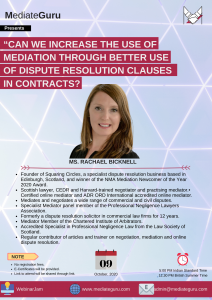
About MediateGuru

MediateGuru is a social initiative led by members across the globe. The aim of the organization is to bridge the gap between the general public and litigation. Here our organisation comes into the picture. We are creating a social awareness campaign for showcasing mediation as a future of alternative dispute resolution to provide ease to the judiciary as well as to the pockets of general litigants.

About event

This presentation will look at different types of dispute resolution clauses, why they are important to increase the use of mediation in some jurisdictions and some recent case law on the enforceability of mediation clauses

About the Speaker


Ms. Rachael Bicknell
• Scottish lawyer, CEDR and Harvard-trained negotiator and practising mediator.

• Certified online mediator and ADR ORD International accredited online mediator. 
• Mediates and negotiates a wide range of commercial and civil disputes. 
• Founder of Squaring Circles, a specialist dispute resolution business based in Edinburgh, Scotland, and winner of the NMA Mediation Newcomer of the Year 2020 Award.

• Specialist Mediator panel member of the Professional Negligence Lawyers Association.

• Formerly a dispute resolution solicitor in commercial law firms for 12 years.

• Mediator Member of the Chartered Institute of Arbitrators.

• Accredited Specialist in Professional Negligence Law from the Law Society of Scotland.

• Regular contributor of articles and trainer on negotiation, mediation and online dispute resolution.

Registration Link

https://bit.ly/3idyk6O

Note: E-Certificate will be provided to participants who will fill the attendance form at the end of the session. 

 Date and Timings 

The Webinar will be conducted on 9th October, 2020.

05:00 PM Indian Standard Time

12.30 PM British Summer Time

Registration Fees: 

Kindly note there is no registration fee for the webinar.

Contact info:

For any query mail :

admin@mediateguru.com

Event Coordinator:

Ms. Garima Rana

+91 8800 474 226

About the Organisation

ONGC Petro additions Limited (OPaL), a private joint venture company was incorporated in year 2006, by Oil and Natural Gas Corporation (ONGC) and Gujarat State Petroleum Corporation (GSPC), with 26 percent and 5 percent stakes respectively.

Job Description

ONGC Petro additions Limited is opening job posts of Manager [Legal].

Broad Job Profile: Incumbent shall be responsible for dealing legal issues relating to Petrochemical Industry viz. drafting and vetting of EPC contracts, Service contracts, handling arbitration proceedings & other connected litigations, tendering process and shall assist in complying statutory regulations of SEZ Act, Labour Laws, Factories Act, Companies Act, etc.

Eligibility

Graduate with a Degree in Law OR 5 years integrated degree in Law from reputed university duly recognized by Bar Council of India with practical experience in dealing legal issues relating to EPC contracts, handling arbitration & other connected litigations, Labour Laws, tendering process, etc. preferably in large size manufacturing operations in Petrochemicals/Hydrocarbon sectors.

Candidate with First class degree in the mentioned qualification and experience in the above relevant area wll be given preference.

Years of Experience: Minimum 12 years.

Location

Vadodara, Gujarat, India.

Salary

Rs. 16.00– 21.00 Lacs

How to Apply?

Deadline: 10th October 2020.

CLICK HERE TO APPLY.

CLICK HERE FOR THE WEBSITE.

Maharaja Agrasen 1st National Moot Court Competition, 2020

About the Institution

Maharaja Agrasen Institute of Management Studies was established in 2003 by Maharaja Agrasen Technical Education Society.

About the Competition

Maharaja Agrasen 1st National Moot Court Competition, 2020 seeks to provide a platform to the students across the nation to showcase their advocacy and research skills by competing in a professional and competitive environment.

Date & Venue

The Maharaja Agrasen 1st National Moot Court Competition, 2020 will be held from 26th November 2020 to 28th November 2020 virtually over Google Meet.

Team Eligibility

  • The competition is open for students who are pursuing LLB three year/five-year course during the current academic year.
  • Only one team is permitted to participate in each participating institution.
  • Each team shall consist of a minimum of two and a maximum of three members. This number cannot be modified under any circumstances.
  • In a team consisting of three members, two members shall be designated as ‘Speakers’ and the third member shall be designated as ‘Researcher’.
  • If a team consists of two members, then such a team shall designate both the members as speakers and no member in the team shall be allowed to be represented as a researcher.

Registration

All the participating institutions have to confirm participation by sending a duly filled Registration Form by email to mootcourtsociety@maims.ac.in on or before 20th October 2020.

Provided that if a team is unable to get the Signature of Head of the Institution and Seal of the Institution on the registration form, in such a case an approval letter from the Institution containing names of all the participants shall be attached to the registration form.

Upon successful registration, the teams will receive notification from the Moot court society via email to acknowledge their registration along with the fee payment details latest on or before 22nd October 2020.

Payment Details

  • The participating teams are required to pay INR 1,500/- as registration fees. The link for online payment will be emailed to the Registered Teams.
  • Non-payment of Registration Fees shall result in the cancellation of Registration of the Participating Team.

A soft copy of the Receipt of the Online Payment shall be sent via email to  mootcourtsociety@maims.ac.in with the subject line ‘Maharaja Agrasen’ 1st National Moot Court Registration’ latest by 27th October 2020.

Prizes

  • Best Team: Rs. 20,000/-
  • Runners Up: Rs. 15,000/-
  • Best Speaker: Rs. 5,000/-
  • Best Researcher: Rs. 5,000/-

Contact Information

  • Abhishek Vats: +91-9718089761
  • Aniket Vashisth: +91-9810243599
  • Arushi Goyal: +91-9990107831
  • Kritika Khanna: +91-9899490838

About the Journal

Christ University Law Journal (CULJ), ISSN 2278-4322 is a biannual peer-reviewed journal.

Call for Paper

Theme: Labour Law Reforms in India and its Implications

It is estimated that our country has more than 44 central legislations under four heads (yet to be enforced) viz.,- Code on Wages, Code on Social Security and  Occupational Safety, Code on Industrial Relations, and code on Health and Working Conditions, for regulating and protecting labour and we also have laws for ensuring the health, safety and better working conditions of workers. However, Indian labour laws are often characterized as “inflexible.” Investors claim that a majority of the firms hesitate from hiring new workers because of the stringent permission provisions existing in the present legal system, thus hindering the growth of Indian companies.

Though the amalgamation of labour legislations can be considered as a major step towards reform, another concern will be regarding the dilution of the socialistic oriented labour perspective, which existed in the Indian industrialjurisprudence. Liberalized policies will create more contractual freedom but reduce the availability of a healthy environment for workers, specifically in terms of their rights. The daunting challenge before governments will be to balance the market, labour, and the employer.

Themes

  • Labour Reforms in India: Issues & Challenges
  • Economic Perspective on Labour Reforms in India
  • The Code on Wages, 2019: A Critical Analysis
  • The Occupational Safety, Health and Working Conditions Code – Issues and concerns
  • The Code on Social Security and informal sector in India
  • Industrial Relations: Challenges
  • Collective bargaining and the role of trade unions at the outset of labour reforms in India
  • The Code on Social Security: Issues & Challenges

How to Submit?

  • Please send your articles (5000-6000) words following the guidelines mentioned in our website at the latest by 30 June 2021.
  • Kindly include the abstract of the article in 150-200 words, 5 Keywords and a summary of the CV of the author in 100-150 words.
  • The citation format to be used is The Bluebook: A Uniform System of Citation, Harvard Law Review (20th ed.).
  • Deadline: 30th December.

CLICK HERE TO SUBMIT.

CLICK HERE FOR THE WEBSITE.

About NITI Aayog

The National Institution for Transforming India, also called NITI Aayog, was formed via a resolution of the Union Cabinet on January 1, 2015.

NITI Aayog is the premier policy ‘Think Tank’ of the Government of India, providing both directional and policy inputs. While designing strategic and long term policies and programmes for the Government of India, NITI Aayog also provides relevant technical advice to the Centre and States.

Job Description

NITI Aayog is opening job posts of Young Professionals.

The engagement would be purely on contractual basis for a period of 2 years (extendable by another year based on satisfactory performance) from the data the candidate joins the assignment. However, being a contractual arrangement, the engagement could be terminated at any time by the competent authority without assigning any reasons.

Number of Vacancies

5 (five)

Salary

Rs. 60,000 (Consolidated inclusive of all)

Eligibility

Essential: Master’s Degree or BE/B.Tech or 2 years PG Diploma in Management or MBBS or LLB or CA or ICWA or possessing any Professional Degree earned after a study of 4 years or more acquired after 10+2.

Desirable: Masters in Economics/Statistics/other Social Sciences/Public Policy/Administration/Management Sciences.

Essential: Minimum of one year experience relevant to the job description. The broad work experience will be based on the functional areas assigned to NITI Aayog. Preference will be given to persons with work experience in the Public Policy domain supported by published work/policy papers/appraisal/monitoring of projects & schemes etc.

The experience of internship/training will not be considered.

How to Apply?

Deadline: 10th October 2020.

CLICK HERE TO APPLY.

CLICK HERE FOR THE OFFICIAL WEBSITE

Amid all the chaos happening inside the country due to the ongoing pandemic situation, the Common Law Admission Test – CLAT-UG 2020 examination was successfully conducted on 28th October. CLAT 2020 was conducted via online mode this year. Students willing to get admitted to various NLUs wrote the examination.

The Question paper was based on the new pattern which carried 150 Questions only. (Previously 200 Questions):

The CLAT 2020 examination could be considered as “Moderate yet Lengthy “, as most of the question were based on passages.

CLAT-Peeps is an initiative by Lexpeeps. CLAT-Peeps presents you a brief section-wise Paper Analysis. Keep reading in order to see the detailed analysis.

First Impression – Paper was lengthy(Even Questions and Options were lengthy)

Difficulty -Moderate (Overall)

Total No. of Questions -150

Time Allotted -120 minutes (No section wise time-limit observed)

Section Wise Break Down of Questions:

Current Affairs – Moderate to Difficult

  • The questions were analytical rather than just factual. Excerpts from various newspapers were seen.

Key Areas-

  • COVID- 19
  • Atma Nirbhar Bharat Scheme
  • National Education Policy
  • Peace Deal between UAE & Israel
  • RAFALE
  • Indo-Pak SAARC Virtual meet held on September 24.
  • Inaguration of Road to Kailash Mansarovar.

Legal Reasoning – Moderate to Easy

Key Areas-

  • Force Majeure
  • COVID -19
  • Obscenity
  • Excerpts based on landmark cases
  • Principal Of Natural Justice
  • Mob Lynching
  • Defamation
  • Common Intention
  • Article 20 (1)

Logical Reasoning– Moderate to Easy

Reasoning was mainly focused on logical deductions.

Key Areas-

  • Premise Arguments
  • Statement-Arguments
  • Statement-Assumptions
  • Statement -Course of Action
  • Statement Conclusions
  • Deriving Conclusions from passages
  • Theme detections
  • Cause and Effect Reasoning
  • One Question from Analogy
  • One from PuzzleTest (Classification type Question)

English Language -Moderate

A set of passages were given, The questions were set to test the students’ ability to understand the content of the passage and to infer information and meaning from it.

Key Areas-

  • No Grammar questions were seen.
  • The comprehensive part was lengthy.
  • Boys Locker Incidence, Climate Change, etc (current issues based).

Quantitative Techniques -Moderate to Difficult

Key Areas

  • Five Questions from Tabulation
  • Five Questions from bar diagram
  • One Question from Geometry based on Area

Want to READ more related to CLAT, Law Entrances

CLICK HERE

CLAT-Peeps Expected Cutoff- 93+

Feeling Unwell or Stressed : Write us back -lexpeeps.in@gmail.com 🙂


Join Our WhatsApp Group

Feminism as a concept emerged in the society in the late 1960’ and early 1970s. Before this, the notion of equal rights for all was missing the sphere. The prevalent norm was and is still continuing is the dominance of men is out society. Domination by men is deep-rooted and well established in the world. Feminism still needs to firmly hold the ground.

There are different schools of feminism in the world. Radical feminism is one where a violent means is used to put forward oneself. Liberal feminism is demanding the abolition of public and private dichotomy. Marxist or socialist feminism wants the class struggle between men and women to come to an end. Then there is Criminology feminism which projects the issues affecting women in regard to crime in the public domain.

The late 1960 to mid-1970 saw the development of feminist criminology. The rise of feminist criminology can be ascribed to the second wave of women’s liberation development that assisted with anticipating issues influencing ladies concerning crimes in the public area. The issue of women and crime was basically examined and seen from the male viewpoint. Feminist viewpoints in criminology have had an extraordinary effect on the overall comprehension of ladies as two parts (a) culprits and (b) survivors of wrongdoing. The connection between feminism and criminology is inserted with the rich investigation of strategies, order, epistemology, and strategy. Researchers in the field of criminology have throughout years put to scrutinize a portion of the gender- blind supposition in criminology all together make space for the voices and encounters of ladies. There are different contentions put across by ladies in the field of criminology that offer a comprehensive perspective concerning ladies as casualties or culprits of the crime.

Throughout the years, feminist points of view in criminology have tested the current speculations, ideas, presumptions and techniques. For example, Carol Smart 1976, a critique of British criminology saw that ladies represent an exceptionally little level of offenders and subsequently center has been given around the issue of ladies and crime. Also, the issue of ladies and crime had been seen regarding the generalizations related to their mental and biological nature. Smart contends that ladies are oppressed on the grounds of sex; in this manner, there are sexism impacts that decide condemning, detainment of ladies and discipline. She accuses the adjudicators, police and faculty in the criminal equity frameworks for the generalization accept that a woman could be frantic on the off chance that they conflict with their biological nature of latency or consistence and perpetuate certain crimes (Pickering and Alder 2000).

Concerning the sentiments of Spelman (1988), feminist hypotheses on crime have ignored the issue of distinction. She contends that feminists have focused on the figure of a special lady consequently the cliché attitude toward female guilty parties. Then again, Freda Adler (1975) partners the 1970 second flood of women’s liberation to the sensational upsurge of ladies in crimes. Adler contends that while ladies battled for the equivalent open door as their male partners, the decided ladies constrained their way into the scene significant crimes, for example, burglary, murder, and middle-class violations. Adler further builds up that as ladies are ascending the collaborate business stepping stool this changing nature summons their wide association in crimes (Alder 1995).

In 1979 Cerkovich and Giordano led examines that included ladies between 17 to 29 years. The discoveries of these examinations built up that the more freed the member’s reaction to questions the less deficient they were. For example, they found that the ladies who react that lady ought to be associated with the work power rather than stay at home doing homegrown tasks were the least reprobate. An examination of ladies’ detainees further uncovered that an enormous level of these ladies originated from uninformed and devastated foundations. When requested the intentions behind their culpable these ladies didn’t have all the earmarks of being freed. Accordingly in spite of Adler’s hypothesis on liberation similarity likewise represents a chance to annoy.

Farrington (1983) found that ladies were exposed to less serious disciplines when contrasted with their male partners. It was likewise found that ladies will in general perpetrate less genuine violations utilizing less brutality. Besides, feminists in the field of criminology use protections, for example, postnatal depression as an explanation for their culpable. Biological reasons have been referred too much of the time of female guiltiness thus, the general public has disregarded the conservative and social purposes for female culpable (Gelsthorpe and Morris 1990).

Then again, ladies have been regular casualties of crimes. Feminist authors in the field of criminology have rushed to bring up that due to their weak mental and biological nature of ladies are bound to be survivors of crime when contrasted with their male partners. Ladies are bound to capitulate to violations, for example, attacks and abusive behavior at home among numerous different crimes. Women’s activists in the field of criminology contend that criminal equity frameworks have dismissed the exploitation of ladies. They rush to bring up that three out of four ladies will be casualties of crime during their lives. Feminists further contend that these figures have been overlooked in this way respecting female misuse. Past ages of ladies endured peacefully be that as it may after some time ladies have picked up force and therefore wrongdoings against ladies are progressively been accounted for (Alder 1995).

Until the second half of the 20th century, most criminological findings focused on male offenders and the criminal justice system responses to male crime. The inefficient attention to female offending stemmed from the fact that most crimes was committed by males. However, by the previous two decades of the 20th century, female imprisonment rates were skyrocketing, leading to a surge in research on girls, women, crime, and the criminal justice system. Many researchers point to the “war on drugs” and the federal sentencing reforms of the 1980s as the primary explanations of the huge increase in female prisoners as well as of the emergence of feminist criminological scholarship. They are instead found in second-wave feminism as well as in the radical criminology of the 1960s and the 1970s.

Feminist criminological thought gained eminence during the highly political era of the 1960s and 1970s. At first, the field focused on the absent information on girls and women in criminological scholarship. As the field grew, the center shifted to include violence against women as well as the development of feminist criminological theories and feminist ways of approaching existing theories. A broad base of scholarship has been amassed from the women’s liberation movement, critical theories, and radical feminism.

Latest Posts


Archives