ABOUT THE ORGANIZERS:

Legalify India is founded in July 2020. It is an organization that has been started with its cardinal motive to help Law students and the public ranging from diverse backgrounds to enhance their legal knowledge and help them to know their rights and duties so that they can make a decisive viewpoint towards society and the governing law. We will be dealing with legal news, updates, and comprehensive information which will flawlessly help you to keep your legal knowledge up to date.

Our main focus would be towards providing an ambient and distinctive content to our readers over a wide spectrum of legal issues and laws like cyber law, media and entertainment law, environment law, ADR, and many additional fields. While designing this organization we kept every aspect in our mind, be it an article, blog or any news updates our utmost motive is to make this a one-stop destination for everyone who visits us.

JLSR JOURNAL

Journal for Law Students and Researchers (JLSR), envisions to empower the individuals of tomorrow to advance and learn from the theoretical and practical aspects of the contemporary law today. Law as a field, is a predominantly present in the lives of people in society, and as such its discourse and dissemination are requisite in a proper forum today.

Journal for Law Students and Researchers (JSLR), therefore, acts as a platform for the researchers and students, along with academicians to publish their research on contemporary issues of the law, so as to enable the growth and understanding of the aspects of the law to the interested individuals in society.

WORKSHOP DETAILS

Speaker: Adv. Ayushi Richa Mishra, Lawyer & TM-Attorney. 

Ayushi is a Lawyer Cyber-security enthusiasts, exploring Cyber Law since 2015 and till today. She is a speaker and a researcher practicing in the field of IPR, IT. She is keynote speaker to National Insurance Academy, Pune rural police in electronic evidence and cyber laws and crime, she is also a visiting faculty in Pune.

Day1

Fighting the fear online threat’s Atmosphere.

  •   How to protect yourself from cyber-crimes technically.
  •  Study on different cases related online money laundering, frauds and other crimes.
  •  Legal procedures for protecting from Cyber-crime and what punishment can be given for crime.

Day2

  • E-filing and practical knowledge on cyber-crime.
  • Procedure for e- filing a cyber-crime and detailed knowledge on how to file a complaint.
  • What are the evidences are to be asked from victim for filing a complaint.

Do Register and Participate in this Workshop.

Date: 31st October, 2020 & 1st November, 2020

Fee: 100/-

PAYMENT DETAILS: 

Google pay/ Paytm on 9140252620

Link to the Registration Page: CLICK HERE TO REGISTER

HIGHLIGHT OF THE WORKSHOP:

  • E-Certificate of participation shall be given to all the attendees. 
  • Notes and Power Point Presentation of the session will be provided.
  • Interactive, practical session.
  • Recording of the session will be provided.
  • Questions and answers round.

CONTACT INFO

Mobile: +91 9352603383

For more details Visit:

www.legalifyindia.com

www.jlsrjournal.in

About Jurisperitus

Jurisperitus: The Law Journal (ISSN 2581-6349) (Indexed) is a non-annual peer-reviewed journal initiated with an aim to provide a platform to the masses of our country and re-iterate the importance and multi-disciplinary approach of law.

This journal is an initiative by Legal Education and Awareness Foundation, a registered Non-Governmental Organization, which aims at providing legal education and awareness to all parts of the country beyond any social and economic barriers.

Jurisperitus is indexed with Scientific Indexing Service, Scientific Journal Impact Fact, IJIFactor, RsearchBib and International Institute of Organized Research. It has A++ Impact Factor Rating.

About the Event

Jurisperitus is calling for unique and unpublished research papers, Short Notes, Book Reviews & Case Comments for its Volume 3, Issue 1.

How to Submit?

To submit, click here or email your manuscript at editor@jurisperitus.co.in.

  1. The manuscript should be in MS Word format.
  2. The title of the manuscript should be appropriate.
  3. The manuscript shall be original and unpublished.
  4. The submission should not be plagiarized, and free from grammatical, spelling and other errors.
  5. Full names of all the author(s) must be given.
  6. Any uniform method for citation may be followed.
  7. The body of the manuscript shall be in Times New Roman, font size 12, 1.5 line spacing. Footnotes should be in Times New Roman, size 10 single line spacing.
  8. Normal/Default Margins shall be used.
  9. New Roman, size 10 single line spacing
  10. Page borders shall not be used.

Last Date of Submission of Full Manuscript: 5th November 2020

Perks

Selected papers will be provided with the following:

  • Soft copy of their certificate of publication within a week of acceptance of their paper and completing all the formalities
  • Soft copy of the journal available on the website, here.
  • One best paper selected will be awarded a cash prize of Rs. 10,000/-
  • The publication will be released on 15th November 2020 and authors will be able to download it from the website.

Word Limit

  1. Articles: 3000-5000 words including footnotes
  2. Short Notes: 2000-3000 words including footnotes
  3. Book Reviews: 1000-2000 words including footnotes
  4. Case Commentaries: 1000-3000 words including footnotes

Fee Details

The fee is to be paid after acceptance of Manuscript.

  • Rs. 600/- for Single Authored manuscript
  • Rs. 900/- for Co-authored manuscript
  • Rs. 1200/- for Triple Authored manuscript

Mode of Payment

Paytm: 9013078358

UPI (Bhim/Tez/Phonepe): 9013078358@upi

Account Details

  • Account Holder’s Name: MR SIDDHARTH DHAWAN
  • Account Number: 104210100028711
  • IFSC Code: ANDB0001042
  • Bank & Branch: Andhra Bank, Rajadani Enclave Branch

Contact Details

Mr. Siddharth Dhawan

Phone/WhatsApp: 9013078358

Email ID: editor [at] jurisperitus.co.in

                    The website link of Jurisperitus: The Law Journal is here.

About KATOG-CAP

KATOG [A unit of KATOG EDU LLP] have launched – Campus Ambassador Program to widen their reach to colleges, universities and students through Campus Ambassadors.

As their Campus Ambassador, you will get an opportunity to work with a leading start-up, learn new skills, be innovative and get rewarded for it as well.

Tasks for our CAs

Major tasks of our ambassadors will entail the following:

  1. Meet weekly targets allocated to you by your mentor.
  2. Digital Marketing: Circulate our ads, posters and videos through email, WhatsApp, Instagram, Facebook, and Twitter.
  3. Daily reporting of work progress to the assigned Mentor.

Location

Work from home

Duration of Work

4 weeks [Oct 12th- Nov 12th]

Eligibility

  • Students pursuing their graduation degree in Law.
  • Active on social media.

Perks for our Campus Ambassadors

  1. Certificate of Appreciation: CA will receive a Certificate from us which will strengthen their CVs.
  2. Performance-based Incentives and Rewards.

Application Procedure

Interested students can mail their CVs at katog.courses@gmail.com

Contact

Mail Id : katog.courses@gmail.com

For More : www.katogcourses.com

About the Organization

MNF Law Firm is a dream project of three young and enthusiastic Law Graduates. Our primary objective is to provide legal assistance to the people from the grassroots level, our platform also promotes research, writing on various topics like legal, social, political etc.

        We will also focus on providing various opportunities to the student’s fraternity by conducting various competitions like Quiz, Article writing and offering Internship to the students. We have our Honorary Board consists of Reputed Advocates of Supreme Court of India, Partners from Indian Top Law Firms. Also, a sound Advisory Board consists of  Experienced Member from 

Duties and Responsibilities of Research Board

  1. Doing Research on Current Issues National and International aspects and Report Submission.
  2. Making Current affairs.
  3. Making Reports on Recent  Judgment of Supreme Court of India and Various High Courts of States.
  4. Doing Research on Important Judgment.
  5.  Doing Research on Important legal topics.

ELIGIBILITY

      Law Student

DURATION

  Duration of membership will be 2 month may extend based on interest of the Stakeholder.

PERKS

  1. Certificate of Excellence will be provided to Top- 5 Members based on their works
  2. Certificate of Appreciation for Top- 15 Member.
  3. Letter of Recommendation will be issued to few members based on their exemplary work.
  4. All the Members will get a Certificate of Completion after Completion of term

Apply here – https://docs.google.com/forms/d/e/1FAIpQLScf7zPdYqCajLAjWbwKzBQPJzwCgJ7G4DJ4FN5XXAT8BQes7Q/viewform

Terms and Condition will be issued by the Firm later.

ABOUT 

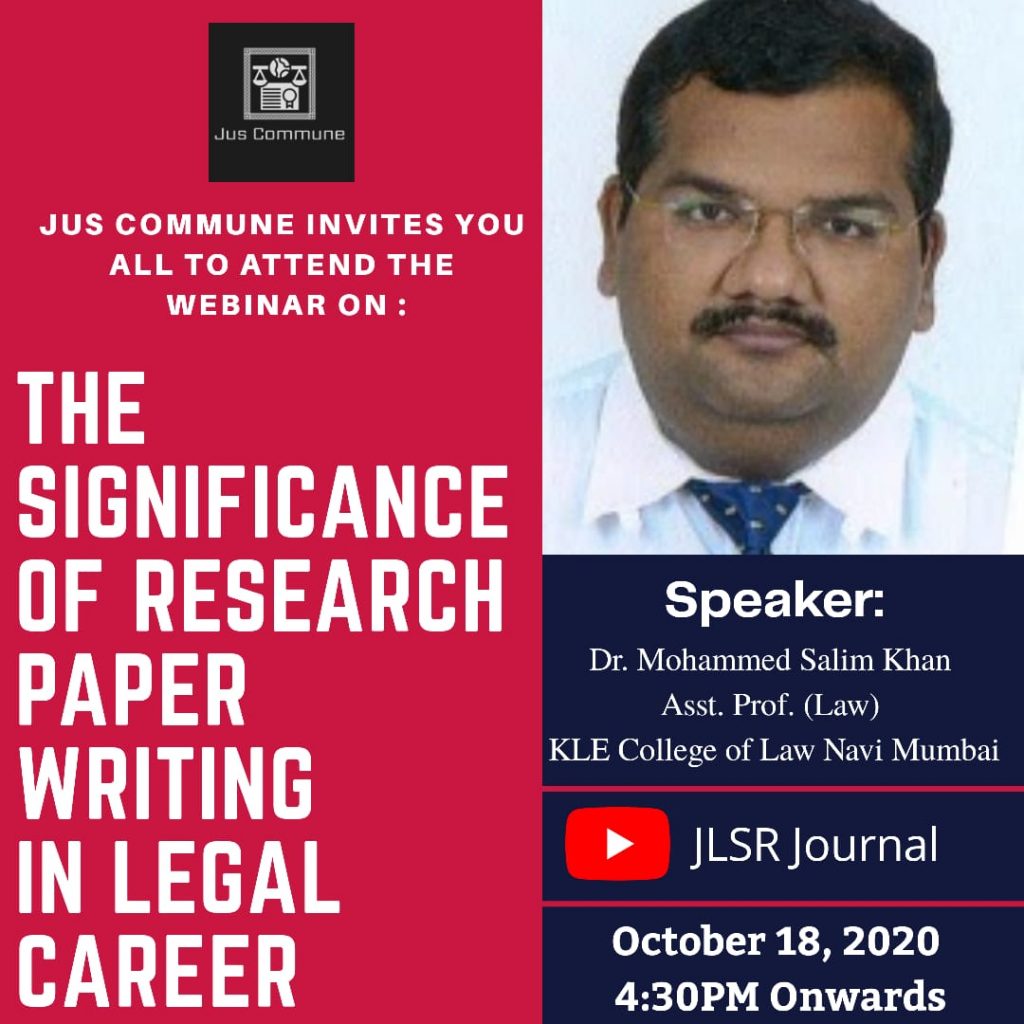
WEBIMPACT is an initiative by JLSR, JUS COMMUNE AND LAW COLUMN. It was started to educate law students through webinars.

WEBINAR DETAILS :

TOPIC: The Significance of Research Paper Writing in Legal Career
SPEAKER: Dr Mohammed Salim Khan, Assistant Professor – Law, KLE College of Law
DATE: 18th October 2020

TIMINGS: 4:30 PM

REGISTRATION LINK :

https://docs.google.com/forms/d/e/1FAIpQLSfFXzm8wu-iFyVwt05epiLU7jGnuUoonjiGoMSxOto-UT6syw/viewform?vc=0&c=0&w=1&flr=0 

NOTE: No Participation Certificate will be provided but the knowledge you will receive would be immense 

FOR ANY QUERY

Write to us at- communejus@gmail.com 

jflsrjournal@gmail.com

site.lawportal@gmail.com

WEBSITES :

 www.jlsrjournal.in

https://lawcolumn.in

This article is written by Mahenoor Khan, a student of Rizvi Law College

Background

Before getting into details of what lifting of the corporate veil is we shall know what is the company, For a better understanding of application doctrine in the corporate world, 

Thus, The word ‘Company’ is derived from the Latin word ‘Com’ meaning “with or together” and ‘Pains’ meaning “bread, however  Under Companies Act, 1956, a company is a corporation registered under the Act  Thus, a company comes into existence only by registration under the Company Law Act or under the company law in India.  It can be concluded that a company is an organization of persons who have come together or who have provided money for some common individuals and who have incorporated themselves into a different legal entity in the form of a company for that purpose.

History

The Doctrine of the lifting of the corporate veil was first propounded in the year 1897 within the distinguished English case of Salomon v A Salomon & Co Ltd. [1] 

This case firmly ascertained that upon incorporation, a new and separate artificial entity appears and according to law, a corporation is a distinct person with its personality separate from and autonomous of the individuals who established it, who invest money in it, and who direct and manage its operation independent of the corporate existence of a registered company, The case, however, is the recognition that a company is a separate legal entity in its own right is the organization of modern corporate law and gave basis to the doctrine ” lifting of the corporate veil” which means that whenever any wrong is committed by the corporation its members cannot be held liable for those wrongs, it further helps to determine when the shareholders of the company are liable for the obligations of the companies.

What is Lifting of Corporate Veil?

The doctrine of “Lifting of Corporate veil ” is the most essential Principle of Company Law which establishes a company as an entity that is completely distinct from its shareholders, advocates, managers and directors: Thus, when a company is incorporated, a legal entity gets created, which is separate from its members, employees, shareholders, directors, and promoters etc.

In simple terms, it divides the personality of a corporation from the personalities of its shareholders and other individuals and protects them from being personally liable for the company’s debts and other obligations and is the mythical boundary that separates the company from those that organize it and from those that acquire it.

The objective of establishing this Doctrine was to provide business potency and convenience hence, the main goal behind the formation of a  company is the limited liability which is offered to its shareholders and because of this limited liability, the liability of each shareholder is restricted to only what he or she has provided as shares to the corporation, however, this protection is not invulnerable or sealed, Where a court determines that a company’s business was not conducted by the provisions of corporate legislation.

Frequently, it is seen that shareholders of the company commit frauds and unlawful acts which leads to removal of the corporation in most cases Thus, the doctrine of the lifting of corporate veil is used, when a shareholder is held responsible for its company’s debts despite the rule of limited liability( The liability of the members of the company is limited to contribution to the assets of the company up to the face value of shares held by him) and separate personality. (The significance of associating a legal personality to a company is that it is a distinct entity from its members)

In the Doctrine of ‘Lifting the Corporate Veil’, the law goes behind the veil of incorporation to determine the group of people behind the company who defrauded and cheated. It is thus used as a means to stop fraud, improper conduct or where the protection of public interest is of important concern, it is to be noted that the corporation is regarded as an organization of persons rather than a legal entity when the very exact legal entity is used to defeat public convenience and justify wrong or to defend crime. 

The Concept of “Lifting of Veil in India”

The Doctrine of Lifting the Corporate Veil is not cited expressly in any of the  Indian Company Law, but it could be interpreted from various provisions moreover, The doctrine has now become of precedential value after being mentioned in many cases.

The Companies Act, 2013 provides for the subsequent provisions facilitating courts to lift the company veil Frequently the courts lift the corporate veil to repair liability and punish the members of the administrators of the company. 

Section 7(7) of the Act empowers one such provision. Whither the incorporation of a corporation is effectuated the way of furnishing false information, the court may fix liability and for this purpose, the veil could also be lifted.

Section 251(1) may be a corrective provision. The Act asks for the submission of a petition for the removal of the term corporate from the clerk of the businesses. Anyone who creates a deceitful application is overhauled with liability, Moreover

Section 34 and 35 of the act also enable the judiciaries to lift the veil of incorporation to repair liability. When a report comprises misrepresentation, the court may impose a compensatory penalty upon the one who has misrepresented.

Under Statutory provisions

  1. Reduction of membership (section 45)
  2. Misrepresentation in the prospectus (Section 62)
  3.  Holding Subsidiary companies (Section 212)
  4.  For enabling the task of an inspector to examine the affairs of the company (Section 239)
  5.   Improper use of Name (Section 147(4)]
  6. Fraudulent conduct (Section 542)
  7. Failure to refund application money (Section 69(5))
  8.  Liability for ultra vires acts

Under Judicial Interpretations

  1.  Protection of revenue.
  2. Prevention of fraud or improper conduct 
  3. Determination of the enemy character of a company
  4.  Where a company acts as a deputy for its shareholders
  5.  In case of economic offences
  6.  Where Company is a sham or cloak

CONCLUSION

The concept of the corporate veil contemplates a corporation as a separate legal entity from its founders and shareholders and courts can employ the action of “lifting the corporate veil to ensure that corporations are not used to injure civil rights, the corporate law and its responsibilities to creditors.

Latest Posts


Archives

This article is written by Aanchal Rawat, a second-year student of R N Patel Ipcowala School of Law and Justice pursuing B.Com-LL.B. (Hon.). This article talks about vicarious liability, civil law, criminal law.

INTRODUCTION

When a person does a wrongful act then he is liable for that act and not any other person.

However, in certain cases, a person may be held liable for the actions of others. In such cases, the law imposes vicarious liability on one person for the acts of others.

A can be liable for the act done by B, if there is a certain kind of relationship between A and B, and the wrongful act done is somehow connected with that relationship.

Vicarious liability is a form of a liability that arises under the common law doctrine of agency, respondeat superior, and the responsibility of the superior for the acts of their subordinates.

Principles of Vicarious liability

Vicarious liability is based on two principles. Following are those principles:

  • Qui facit per alium facit per se: One who makes the other do the act does it himself.
  • Respondeat Superior:  The superior/principal will be liable / responsible for the work done by his subordinate, agent, etc. If it is done in the course of the business.

Example: If an employee of a company commits fraud then the company will be liable for it.

If an employee cheats the client of the company then the company will be liable.

Civil law

In civil law to constitute vicarious liability two conditions must be satisfied. Following are the two conditions:

  • Relation
  • Ratification

Relation

There should be a relation between the wrongdoer and the other party, such as Principle and Agent, Master and Servant, Employer and Employee, etc.

Ratification

 A person is also liable for the wrongful act or omission of some other party in the following ways-

  • If the person abets the other person to any wrongful act then he is also liable.
  • If the former ratifies or authorizes the act of the other knowing that the act committed or omission done was wrong.
  • As standing towards the party who committed a wrong in such a relation that it entails responsibility for the acts or omission done by the other person.

Reasons for Holding the Master Vicariously Liable

  • Respondeat Superior

This maxim is used to hold Master vicariously liable which means “Let the superior/principal be liable/responsible”.

  • Avoiding Exploitation of the Servant

Many times a servant does the dirty work of its Master in his course of employment and to avoid the responsibility the Master then fires the servant. So, to stop the exploitation of the servant’s a Master is made liable for the wrongful act done by the servant if the act is done during the course of his employment.

  • Qui facet alium facet per se

This maxim is also used to hold the Master liable.  It means “One who makes others do an act; it will be seen as if he has done it himself”. 

  • Damages

A Master is considered as an insurance that the aggrieved will be will able to get compensation/damages.

Examples of Vicarious liability

  1. Principal and Agent
  2. Partners
  3. Master and Servant

Principal and Agen

When an agent does any wrongful act which the principal has ratified him to do then both the principal and agent are liable for it. Their liability is joint and several. The principal can authorize the agent to the wrongful act either by expressing it or by implying it.

It is not necessary the principal will be liable for only the wrongful act he had authorized an agent to do. The Principal will also be held liable if an agent does a wrongful act in the ordinary course of the performance of his duties as an agent.

Example:

Shasha had Villa on her name which she wanted to sell; she approached Rera Estate Agency for that. There a manager named Manglesh made Shasha sign a document which she believed were the sale deed which, in reality, the manager Manglesh had made her sign the gift deed in his name. After getting the Villa he sold it and then misappropriated the money received from selling it.

Here, Manglesh had acted solely for his benefit and without the knowledge of his principal (Rera Estate Agency). Manglesh being an agent and acting in the course of his apparent or ostensible authority, due to which the principal will also be liable for the fraud.

Partners

If a partner commits any wrong in the course of business of the partnership firm then other partners are also liable for the same.

The partners are liable jointly and severally.

Example

If one partner commits fraud then other partners of the firm are also liable for the fraud.

Master and Servant

If a servant does a wrongful act in the course of his employment, the master and servant both are liable for it.

The act of the servant is considered the act of the master as well. This is based on the doctrine of liability of the master for the act of his servant which is based on the maxim respondeat superior, which means ‘let the principal/superior be liable/responsible’ and this puts the master in the same position as the servant as if he had done the act himself. 

This liability also derives its validity from the maxim qui facit per alium facit per se, which means “he who does an act through another is deemed in law to do it himself”. As both master and servant are liable, the plaintiff has a choice to bring an action against either or both of them. Their liability is joint and several. They are joint tortfeasors. Here the maxim respondeat superior (let the principal be liable) is used so that the clam can be met because of the master’s large pocket and also to pass on the burden of liability through insurance. The liability arises even though the servant acted against the express instructions, and for no benefit of his master.

For making the Master liable following two conditions must be satisfied:

(1) The wrong was committed by the ‘servant’. 

(2) The servant committed the wrongful act in the ‘course of his employment’.

Who is a master? 

 Master is that person who employs another person subject to certain terms and conditions to work under his orders and supervision.

Who is a servant?

 A servant is a person who is employed to do work under the directions and control of his employer/Master.

Example:

  • A son is not the servant of his father.

An employer is not liable for any wrongful act done by servant, if he does it after the duration of his employment.

Example:

  • Danish’s servant Golu commits theft at Danish’s neighbour’s home at 3 am at night. The work time for Golu was 10 am to 5 pm. In this case Danish will not be liable as Golu has committed theft at 3 am which is outside his work time.

An employer is not liable for any wrongful act done by an independent contractor.

Example:

  • Mahesh hired a taxi to reach the Railway station. The taxi driver negligently hits Mangla; here Mahesh will not be liable towards Mangla because the driver is not his servant but only an independent contractor. The taxi driver will only be liable for that.

Criminal Law

A person can be liable for the act done by the other person if he is also a party to the offence.  Example: 

  • Two persons go to rob a bank, one of them stayed outside the bank and the other went into bank to rob it. The person who stayed outside the bank will also be liable along with the person who went inside the bank for robbing the bank.

 The principle which is followed the is that a person may be held liable as the principal offender, even if the actus Reus was committed by some other person. The person who commits the act on the instruction of the other will also be held liable. He will not be considered innocent. 

Example:

  • Mayank a contract killer was assigned to kill Kalpa by Pratmesh. Mayank killed Kalpa. Here Mayank had done the act as per the instructions of Pratmesh. Though Pratmesh has not killed Kalpa he had instructed someone else to do it. The law will also held Pratmesh liable along with Mayank. Pratmesh will not be considered innocent.

Latest Posts


Archives

Spotify users can enjoy singing on karaoke, that too, online. Yes, you are right, through a patent granted by the United States it is more like an online karaoke feature got permission to make singing more easily and fun to all the music lovers. 

If we look at a typical karaoke system it consists of many weird and hard to carry things such as a microphone that is physically connected into a device that only plays content that is stored in it. If looking at a bigger picture there is no harm in saying that there was a need for an online karaoke feature to introduce as an alternative that can make singing on karaoke easier and reliable. 

The patent also explains how an online karaoke will work. The patent explains that by using a user’s device the microphone can capture a vocal which may be transmitted to a media presentation system. Also from a client’s device, a remote server distinct will transmit the corresponding media content such as a music track, to the media presentation. Whereas the client device is a mobile phone and the media presentation system could be any external speaker. The part that interests everyone the most is its reference to “auto-tuning the vocals”.

One question that concerns everyone who is reading this is why getting the patent is so important for Spotify that to get it Spotify waited for almost 5 years. 

The app-based karaoke system is largely popular in China and companies like Tencent Music Entertainments (TMC) app WeSing has a huge market in China where it generates 10 million recordings per day. According to the senior executive of TMC the company is in no hurry to expand its online karaoke app to a more international market, this is indeed the most solid reason for Spotify to enter into the online karaoke app market to make a huge profit. A great chance for Spotify to make a huge customer base. 

Report by Vanshika Sharma

After the Hatharas case came into light, the Judiciary of India and the Government of India flooded by the people demanding stringent justice for the sexual offense victims, the protection of women, and most significantly the role of police officials into it. In the light of increasing concern about such incidence where the role of police officers becomes very crucial. The Women Safety Division of the Ministry of Home Affairs (MHA) has governed all the States and Union Territories via writing a letter to register FIR and conduct time-bound investigations if the information is received is about the sexual offense against women. If any action by the officials seems unreasonable the state shall take strict action against the official, says MHA. 

In the case of cognizable offenses, the FIR shall register under Section 154, subsection (1), of the Codes of Criminal Procedure, 1973. 

“The Government of India has also issued various advisories to the States/Union Territories from time-to-time emphasizing the strict actions to be taken by the police in cases of crime against women, including in cases of sexual assault which includes registration of FIR, collection of evidence for forensic examination and use of Sexual Assault Evidence Collection (SAEC) Kit, completion of investigation in sexual assault cases in two months, use of National Database on Sexual Offenders for identifying and tracking repeat sexual offenders, etc.,” the MHA said in its letter.

Sexual assault on the women is a cognizable offense and police shall without any delay file FIR on getting informed about the crime. MHA authorized the police officials to register ‘Zero Hour’ FIR in case the crime is committed outside the jurisdiction of their particular police station. 

The MHA also describes sections that give power to the government to take action against any police officers in case of omission of their duty. Section 166 A(c) of the Indian Penal Code 1860 (IPC) talks about the punishment to a public servant for failure to record FIR in relation to cognizable offences punishable under sections 326A, 326B, 354, 354B, 370, 370A, 376, 376A, 376AB, 376B, 376C, 376D, 376DA, 376DB, 376E or 509 in IPC. 

If a person who is dead in written or in verbal form states the reason or a cause behind his death or ground that resulted in his death shall be treated as a relevant fact in the investigation. 

Report by -Vanshika Sharma

About Us

Team Attorneylex is a newly developed organisation that is devoted to the law students of the country. Our primary purpose is to guide the law students in their legal research, content writing, analyse the case, read or understand the courts’ judgments, etc. because we believe that these things are an essential part of the legal profession.

About the National Online Quiz Competition

Team Attorneylex is organising its 3rd Online National Quiz Competition on IPC, CPC & CrPC scheduled to be held on 25, 26 & 27  October 2020.

Eligibility

Team Attorneylex looks forward to participation from law aspirants, students pursuing 5-year law and 3-years law, and LLM courses. Professionals from the legal fraternity are also invited to participate in the Quiz.

Important Dates & Timing

  • Last date for registration: 23th October 2020, 11:59 PM
  • Competition Dates: 
    • IPC: 25th October 2020, 06:00 PM
    • CPC: 26th October 2020, 06:00 PM
    • Crpc: 27th October 2020, 06:00 PM
  • Declaration of Results: 29th October 

Venue – Online (Google forms)

Details:

  1. IPC Quiz Details( 25th October 2020, 06:00 PM)
  • The quiz competition is not a team-based competition, and thus, each student shall participate individually.
  • The Quiz will consist of IPC  questions, including significant/landmark judgments.
  • It will consist of 30 MCQs.
  • The total time limit for the Quiz is 10 minutes.
  • Every question carries one mark, and there will be no negative marking.
  1. CPC Quiz Details( 26th October 2020, 06:00 PM )
  • The quiz competition is not a team-based competition, and thus, each student shall participate individually.
  • The Quiz will consist of CPC questions, including significant/landmark judgments.
  • It will consist of 30 MCQs.
  • The total time limit for the Quiz is 10 minutes.
  • Every question carries one mark, and there will be no negative marking.
  1. CrPC Quiz Details( 27th October 2020, 06:00 PM )
  • The quiz competition is not a team-based competition, and thus, each student shall participate individually.
  • The Quiz will consist of Crpc questions, including significant/landmark judgments.
  • It will consist of 30 MCQs.
  • The total time limit for the Quiz is 10 minutes.
  • Every question carries one mark, and there will be no negative marking.

Registration Fees

  • IPC Quiz Fee: Rs. 50 (Early bird offer: Rs. 30, till 12th October)
  • CPC Quiz Fee: Rs. 50 (Early bird offer: Rs. 30, till 12th October)
  • CrPC Quiz Fee: Rs. 50 (Early bird offer: Rs. 30, till 12th October)

Register for any two @ Rs. 85 (Early bird offer: Rs. 60, till 12th October)

Register for all three @ Rs. 110(Early bird offer: Rs. 90, till 12th October)

NOTE: On successful registration, an acknowledgement mail will be sent to you within 48 hours of the registration.

Payments details:

Paytm/ G-pay/Phonepe- 9616696008 (Gaurav yadav)

Bhim UPI- 9616696008@upi

Registration Process:

  • Make the payment and take ScreenShot
  • Registration link:
  • Interested candidates can fill the registration form – Click here

or, https://forms.gle/ijziThN27odcbQiM7

Note: Please prefer mentioning your Whatsapp number as all important updates will be shared on Whatsapp.

General Rules

  1. The registered candidates should join our WhatsApp group for updates.
  2. Link of the quiz will be shared in our Whatsapp groups.
  3. The Quiz results will be declared on the social media platforms and the Website of the Team Attorneylex.
  4. In the case of a tie, Time will be considered (Person who submits early will be given preference).
  5. Team Attorneylex will not be responsible for any technical error, any connectivity/device failure during the Quiz.
  6. The results declared would be final and the authority vests with Team Attorneylex to change or modify the same.

Perks

  1. Winner: Cash prize Rs. 2000/- + Certificate of Excellence + Article publication on the website + Online Internship opportunity with the Team Attorneylex.
  2. Runner Up: Cash prize Rs. 1000/- + Certificate of Excellence + Article publication on the website + Online Internship Opportunity with Team Attorneylex.
  3. 2nd Runner Up: Cash prize Rs. 500/- + Certificate of Excellence + Article publication on the website + Online Internship Opportunity with Team Attorneylex.
  4. Certificate of Merit to Top 10 performs.
  5. E – participation Certificate will be provided to all the participants.

If you have any queries feel free to contact

Vanshika – 07055460463

Gaurav -09616696008

Email– contact@teamattorneylex.in 

Website: teamattorneylex.in

Post link: