About the Organization

Legal Armor is a multi-dimensional legal website. They primarily work in Drafting Legal Contracts and Publishing. They tend to live by our name and provide a protective shield to the Legal Community by providing quality writing for both Students and Professionals.

About the Blog

The blog is our key aspect at the moment, currently, it has posts from a number of industry professionals, which revolve around the Legality of a case, the Current Legal Scenario, and Rights. The plan is to provide quality blogs for both Students and Professionals and be the link during the transition phase.

Themes:

All topics amidst the ambit of Legal Education and Profession are welcome.

Word Limit

  • Minimum: 600
  • Maximum: 800

How to Submit?

You may go to and fill the Google form to submit the blogs.

Important Dates

26th October 2020

Perks

Legal Armor will add a separate video, for each selected blog with the blog contents.

Submission Guidelines

  • Only Single Author is permitted to submit.
  • The work should not be plagiarized more than 10%, excessive plagiarism may lead to rejection.
  • All entries should be submitted in .doc or .docx format.
  • The write-up (in the same document) should be accompanied with the Author’s Name, designation/institute, E-mail Id and LinkedIn ID.
  • All references to other texts must be hyperlinked in the write-up itself, no other modes of Citation are allowed.
  • Copyright of all blog posts shall remain with Legal Armor; however, the moral Rights shall vest with the Author.
  • The language has to be politically neutral and not conflicting with the general guidelines.
  • The language should be civil and neutral and should not defame another person.
  • The Final discretion will be of Legal Armor.

Note 1: Publications shall be made within 30 days of acceptance of the write-up. The review committee may take between to 48-56 hours to accept or reject the write-up.

Note 2: Only on Selection and Posting of a minimum of 10 Blogs, the author shall be eligible for Certificate of Contribution.

Who shall apply?

  • Law students exploring their interests and trying to give an edge to their writing skills. Want to excel in their interpersonal skills like writing, communication. 
  • 1st and 2nd-year law shall apply as these are the opportunities that give them exposure. 
  • All the law students trying to bring laurels to them. 
  • Knowing and not knowing about the topic doesn’t matter if you are willing to work hard and research a lot about your topic. 

Note: This is just a suggestion from Lexpeeps side to everyone reading as Lexpeeps not only talks but works. Creativity, Innovation, Enthusiasm, Connections, or whatever the work requires we use each and every tool to bring out the best, Visit us: http://lexpeeps.in/. It has been seen that in this hard time, students are panicking and doing everything and anything just to add on to their CV/Resume, even the things that are not going to add so much value to their CV’s.  

Blogs published by Lexpeeps: For understanding purpose:

http://lexpeeps.in/category/our-blog/

For queries, you may click here.

Legal Armor’s website link is here.

About the Organization

Lovely Professional University is a private university situated in Phagwara, Punjab, India. The university was established in 2005 by Lovely International Trust, under The Lovely Professional University Act, 2005 and started operation in 2006.

About the Event

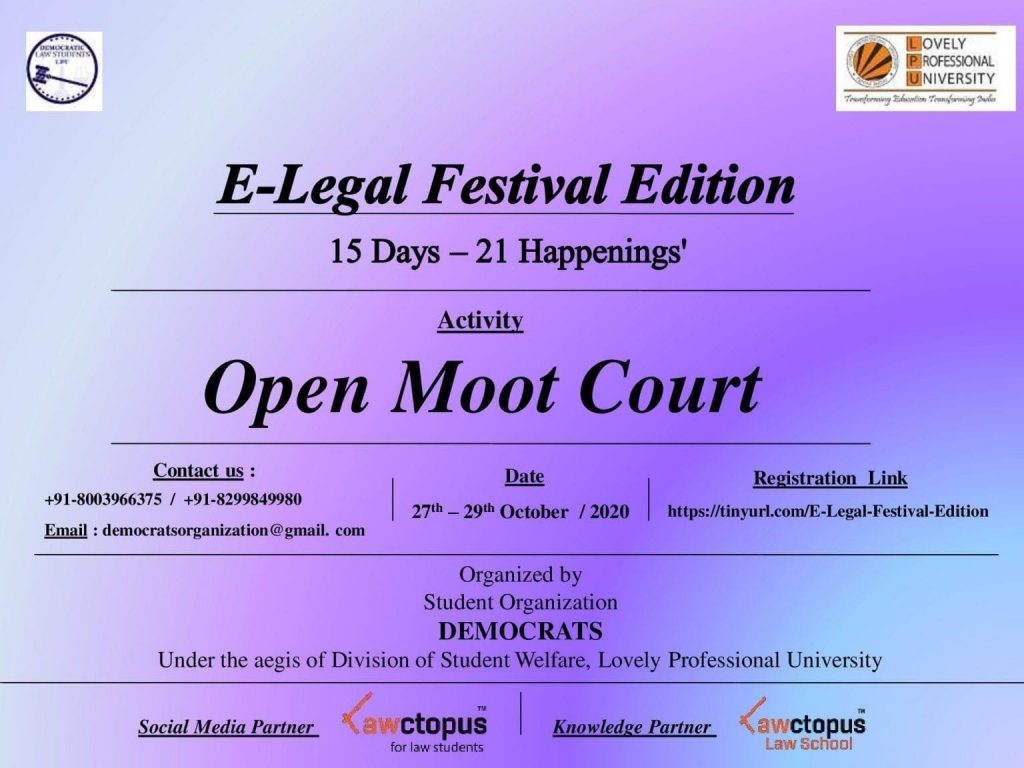
Student Organization “Democrats” under the aegis of Division of Students Welfare, Lovely Professional University is organizing E-Legal Festival Edition.

Activity: Open Moot Court

Event Details: Open Moot Court is aimed on testing Argumentation Skills on an open given theme of Gender Laws in India.

Date of Event: 27th October 2020 to 29th October 2020

Register here: https://docs.google.com/forms/d/e/1FAIpQLSeie4Ru3y-Ca 78mVhPjMvq5kLnjUMbN5WJg_aDo2bnhdWSwA/viewform 

Registration Fee: Rs. 100/- Individual & Rs. 150/- Team (2 members)

Note: Registration is Open for Limited slots, First Come Basis.

Who shall apply?

  • Students willing to start their mooting, beginners want to get some experience. 
  • All the law students trying to bring laurels to them. 
  • Knowing and not knowing about the topic doesn’t matter if you are willing to work hard and research a lot about your topic. 

Note: This is just a suggestion from Lexpeeps side to everyone reading as Lexpeeps not only talks but works. Creativity, Innovation, Enthusiasm, Connections, or whatever the work requires we use each and every tool to bring out the best, Visit us: http://lexpeeps.in/. It has been seen that in this hard time, students are panicking and doing everything and anything just to add on to their CV/Resume, even the things that are not going to add so much value to their CV’s.  

Prizes

  • Amazing Goodies for Winners
  • E-Participation Certificates to all the Participants.

Contact Information

Sanjay Bafna: +91-8003966375

Ujjwal Mishra: +91-8299849980

For the E-Legal Festival Edition Activity Brochure, click here.

This article is written by Aanchal Rawat, a Second Year student of R N Patel Ipcowala School of Law and Justice.

INTRODUCTION

Directive principles are those principles which the state takes into consideration while making laws.

In India, these principles are mentioned in the Indian Constitution under Part -4 from article 36 to article 51.these principles are borrowed from the Irish Constitution. There are 15 principles.

History of Directive Principles

In 1945, the Sapru Committee suggested that there should be two types of individual’s rights.

  1. Justiciable Rights
  2. Non-Justiciable Rights

Justiciable rights are those rights which are legally enforceable by a court and Non-Justiciable Rights are those rights which are non – enforceable by a court.

Fundamental rights are justiciable rights and Directive principles are non-Justiciable rights.

Directive Principles are taken into consideration by the state when it formulates policies or enacting laws.

Definition

In Government of India Act, 1935, the Directive principles are defined as,

“Instrument of Instructions”.

Classification of Directive Principles

The directive principles can be classified into 3 groups:

  1. Social and Economic Charter
  2. Social Security Charter
  3. Community Welfare Charter

Social and Economic Charter

Article 38:

The welfare of the people should be promoted by the State which is to be done by maintaining Social order through justice.

The justice should be social, economic and political.

The state should try to minimise inequalities in income, status, facilities and opportunities.

Article 39:

The State shall direct its policy towards the following:

  1. Sufficient means of livelihood for all its citizens.
  2. Material resources should be distributed in such a way among the community that it is for common good.
  3. Equal pay for equal work for everyone
  4. Due to economic necessity, no one should do the work unsuited to them
  5. Opportunities and facilities should be given to children so that they can live a healthy life and also can live with dignity.

Social Security Charter

Article 41:

The state shall make sure that that the people are given employment, education, and public assistance if they are unemployed, are old or are sick and disable.

Article 42:

Just and Humane conditions should be made for workers and maternity relief should be provided to pregnant females.

Article 43:

All the workers irrespective of their working sector should be able to have a living wage. So that they can have a decent standard of living and can enjoy social and cultural opportunities.

Article 43-A:

The workers should participate in the management of the industry irrespective of the nature of the industry.

Article 45:

Compulsory education should be provided to children until the age of 14 years.

Article 46:

Promotion of education and economic interests among weaker sections. Protection of weaker sections from social injustice and exploitation.

Article 47:

Prohibition on the consumption of drinks which are injurious to health.

Community Welfare Charter

Article 40:

 Organising village panchayats and endowing them powers so that they can function as units of self-government.

Article 44:

Uniform civil code for citizens throughout the nation.

Article 48:

Organising agriculture and animal husbandry with the help of modern and scientific lines. Prohibition on the slaughter of cows, calves and other milch cattle. Improvement of animal breeds.

Article 48-A:

Protecting and improving the environment and safeguarding forests and wildlife.

Article 49:

Protection of monuments, places and objects of the artistic and historic event which are declared is of national importance.

Article 50:

Judiciary should be separate from the executive.

Article 51:

The State shall make sure to achieve the following things:

  1. International peace and security 
  2. Just and Honorable relations are maintained.
  3. Settlement of international disputes by arbitration.

To achieve these things the state should promote and encourage them.

The Relation between Directive Principles and Fundamental Rights

Fundamental rights and Directive principles are mentioned in Part 3 and Part 4 of the Indian constitution respectively. Both of them are important for the governance of the nation. They both set out state duty and action. 

While fundamental rights tell not to interfere with an individual’s rights and liberty arbitrarily, Directive principles tell how the state should take positive action.

Both of them talks about welfare. While Fundamental rights talk about an individual’s welfare, Directive principles talk about the welfare of people as a whole.

Fundamental rights are enforceable in court but Directive principles are not enforceable. But both of them are important for establishing an egalitarian state.

Difference between Directive Principles and Fundamental Rights

  1. Fundamental rights are those basic rights which an individual needs to live while Directive principles are those principles which the state takes into consideration while framing laws.
  2. Political democracy is established with the help of Fundamental Rights and Social and Economic democracy is established with the help of Directive principles.
  3. Violation of fundamental rights is punishable but the violation of directive principles is not punishable.
  4. Fundamental rights are suspended during an emergency but directive principles cannot be suspended during any circumstances.
  5. Fundamental rights are negative rights and directive principles are positive rights.

Amendments in Directive principles

For amending Directive principles, Constitutional amendment should be made. It should be approved by the special majority in both the houses of parliament.

It has been amended many times. In 1976, Directive principles were amended for the first time. It is known as the 42nd Constitutional amendment, 1976. There were 4 changes in it.

  1. Article 39 was amended.
  2. Article 39 –A was added.
  3. Parliament came up with the Legal Services Authorities Act, 1987 
  4. Article 48-A was added.

In 1978, Article 38 clause (2) was added (44th Constitutional Amendment, 1978).

In 1992, Panchayats were brought in Part IX of Indian constitution had its origin from Article 40 of the Constitution (Constitutional Amendment, 1992).

In 2002, Article 21-A was added in the Indian Constitution. The origin of this amendment came from Article 41(86th Constitutional Amendment, 2002).

In 2011, Article 43-B was added in Indian Constitution (97th Constitutional Amendment, 2011).

Conclusion

Directive principles are an important part of the Indian Constitution. Though they are not enforceable and are non-Justiciable the State still considers them while making laws. Because these principles help in the governance of the State. Some of the origins of the fundamental rights are from Directive principles such as article 21-A : Free and compulsory education whose origin can be seen in Article 41which talks about the right to work, education and public assistance in certain cases.

Latest Posts


Archives

About the Magazine

The Student Research Development Council [SRDC] ADR Magazine is a quarterly publication which invites submissions from experts, working professionals, academics and students in the field of Alternate Dispute Resolution.

The ADR Student Research Group launched its first edition of the ADR Magazine in May, 2020. This flagship publication of the ADR SRG witnessed several articles pertaining to the recent developments, judicial decisions and practices of ADR in Indian and several foreign jurisdictions.

The second issue of the Magazine witnessed articles written by leading practitioners well versed in the field of ADR. An additional highlight of the issue is the interview given by Mr. Sitesh Mukherjee, a former Dispute Resolution head and Partner at Trilegal, who recently began his independent practice.

The SRG collaborated with several experts and practitioners in the field of ADR who supervised the process of the publication, thereby adding to the scholastic appeal of the Magazine.

Topics

Authors may make submissions on topics pertaining to any one of the following:

  • Domestic Arbitration
  • International Commercial Arbitration
  • Investment Arbitration
  • Negotiation
  • Mediation
  • Conciliation

Please note that the above list is not exhaustive and authors are free to write on issues falling broadly within the field of Alternative Dispute Resolution.

The magazine permits Articles, Case Comments, Legislative Comments and Book Reviews falling within the scope of Alternative Dispute Resolution.

Submission & Formatting Guidelines

  • Co-Authorship: Co-authorship is permissible only up to a maximum of two authors.
  • Word Limit: 2000-2500 words (exclusive of citations).
  • Body: The body of the manuscript should be in Garamond, Font Size 12 and line spacing 1.5.
  • Footnotes: The footnotes should be in Garamond, Font Size 10 and line spacing 1.
  • The citations must conform to the OSCOLA style of citations, 4th edition.
  • No hyperlinks are allowed.
  • The piece should not contain any reference to the author, including their names and institutional affiliations.
  • Any failure to adhere to submission guidelines may result in rejection of the submission. 

Cover Letter

The submission should be accompanied by a Cover Letter, within the manuscript attached and must contain the following details:

  • Name of the Author(s)
  • Contact Details: Address and Mobile Number
  • Name and Address of the Institution of the Author(s)
  • Academic Qualifications (year of studying)/Affiliations of the Author(s)
  • Title of the Manuscript

Mode of Submission

  • The Magazine accepts submissions on a rolling basis. Should the submission be made after the editorial process of an issue, the articles shall be considered for subsequent issues.
  • The submissions can be made via email to the SRDC ADR editorial team on the following email ID: srdcadr[at]gnlu.ac.in
  • The email should contain the manuscript in .doc or .docx format accompanied by the cover letter as per the aforementioned specification.
  • Authors are requested to submit their manuscripts before 11:59 PM on 10th November 2020. The submissions can be made via email to the SRDC ADR editorial team on the following email ID: srdcadr[at]gnlu.ac.in.

Copyright and Editorial Policy

  • Submissions made to the SRDC are on an exclusive basis.
  • The submissions must not have been previously published or submitted for publication elsewhere. The contribution presented to and accepted for publication along with the copyrights therein shall be the intellectual property of the SRDC and vests with it.
  • SRDC strives to promote originality and commits itself to strict requirements of integrity. Plagiarized works shall be ineligible for publication.
  • The author(s) are to cite their sources and acknowledge the sources for the content which is not original. SRDC ADR editorial team reserves its right to reject and/or discontinue further collaboration on non-fulfilment of the academic integrity criterion.

Contact Details

E-mail ID: srdc[at]gnlu.ac.in

Rahul Kanoujia: Editor-in-Chief: +918451084791

Raghav Bhargava, Senior Editor: +919838164641

Important Links

The link for the first and second issues are here and here, respectively.

An articles related to the topic published by lexpeeps: For understanding purpose.

Parvaaz parindey, an attempt to take a leap into the sky of the unspoken. We are here to shed some light on the things that might be unsettling, but are of great essence to each one of us. There are so many things we are oblivious to, some unconsciously and some on purpose because they make us uncomfortable. But it is important that we join hands and raise our voice together, that we educate ourselves and others and become better members of the society. Parvaaz Parindey is an initiative of Asha Akanksha Foundation to put such issues, that have been ignored for centuries in a spotlight. We hope that through this initiative we can educate people and make them aware about the problems that no one is questioning!

  Topic Guidelines

The topics must be related to the current affairs of national or international importance. The writers are advised to check the website before choosing their topic to avoid repetition as far as possible.

https://parvaaz-parindey.aafngo.org/

Eligibility

The following persons are eligible:

  • Undergraduate and postgraduate students.
  • Students pursuing PhD programme.
  • Advocates and other professionals.
  • Professors and Assistant/Associate Professors.

Submission Guidelines

  • Submissions must be original and free from any plagiarism. Any plagiarism shall not be allowed in any circumstances.
  • Submissions can be made in the form of articles, opinion, case comments on the aforementioned laws.
  • The title of any submission must be attractive and should not be more than 10 words.
  • The articles must be within the word limits of 700- 1500 words. The authors must keep their articles precise and concise to ensure reader friendliness. Authors are advised to make a compact summary in the initial paragraph.
  • Only Single Author is permitted to submit.  
  • Should the article use any material as a reference, an appropriate link should be provided therefore in the main text itself. 
  • The editorial team reserves the right to conduct a strict editorial review of submissions received and holds absolute discretion in determining whether to accept a submission or not. We will send an email receipt upon acceptance as soon as possible.
  • The language has to be politically neutral and not conflicting with the general guidelines.The language should be civil and neutral and should not defame another person.
  • Only on Selection and Posting Blogs, the author shall be eligible for Certificate of Contribution. 
  •  inviting blog posts from students, professionals and fellow citizens which will be published free of cost.  Perks
    • Due credit for articles.
    • E-certificate of appreciation for writers
    • Opportunity to spread legal awareness.
    • Networking opportunities.
  • Submission ProcedureAll submissions are accepted on a rolling basis. The authors should email the MS Word file to  aaf.parvaazparindey@gmail.com.  Name, designation or institute, and contact number of the author(s) should be mentioned in the body of the email. Also, plagiarism report for the submission made should be attached in the mail. The subject of the email should be “Blog Post Submission”.They will respond regarding the selection of submitted content within 20 working days. If there is no response within that time, it means that the content could not be selected, and the authors are free to use it for any other purposes. 
  • All correspondence and queries may be addressed to aaf.parvaazparindey@gmail.com

This article has been written by Nikhat Chaudhary pursuing Law from Rizvi Law Colle

Rules and Format

The debates start with the candidates standing behind their podiums, with the moderator on the other side. According to the format, either the moderator or a member of the audience can be the one to ask questions. Generally, opening statements are made, and a ritual of closing statements has been prolonged. A coin toss determines who gets to answer the first question and who will make their closing remarks first. Each candidate will get alternate turns. 2 minutes are assigned to the candidates to answer the questions. And 1 minute is assigned to the opposing counsel to rebut the argument. 30 seconds per candidate may be extended depending on the moderate’s discretion. 

A flag or a buzzer is used when the times are up. In recent times traffic lights as in red yellow and green, have been installed to aid the candidate as to the time left with green indicating 30 seconds, yellow indicating 15 seconds, and red indicating only 5 seconds are left. 

Recent Presidential Debate  

With the elections in the corner for The United States, a 4 debate setup has been formulated by the Commission of Presidential Debate.

The first took place on the 29th of September 2020  at 9:00 pm EDT.

US President Donald Trump and Joe Biden from Republic and Democratic Parties respectively participated in their first 2020 presidential campaign debate held on the campus of the Cleveland Clinic at Case Western Reserve University in Cleveland, Ohio, US, September 29, 2020. The turbulent 90-minute event has been trumpeted as the “Worst presidential debates” in history by netizens, politicians, and political commentators alike. The event was punctuated by continual interruptions, squabbles between the two candidates, and hopeless pleas from Fox News anchor Chris Wallace, the debate’s moderator, to maintain decorum. Phrases like “will you shut up man?” have been used by a visibly disgruntled Joe Biden due to constant respites by President Donald Trump.

Candidates View on Pandemic

Questions were raised by Democratic nominee Joe Biden on the smartness to tackle the situation of the President. “A lot of people died and a lot more are going to die unless he gets a lot smarter, a lot quicker,” said Biden.

Questions were further raised by Trump as to how Biden is incapable of attracting larger crowds and how the rallies that Trump held outside were much greater and larger in numbers because that’s how experts do it and that’s what experts do emphasize on the word “expert”.

The fundamental disparity between the two candidates came out as a bloke when on one occasion trump said  “People want their places open,” and Biden countered “People want to be safe,”.

Race with Supremacist and the Suburbs

When the subject of race issues appeared within the debate format belligerent exchanges were made that made it extremely clear Biden was easier talking about the previous while Trump wanted to debate the matter.

Biden accused the president of fomenting racist divisions, while Trump swiped at Biden’s support for a 1993 anti-crime bill that led to higher incarceration rates for blacks.

“This isn’t 1950, of these dog-whistles and racism don’t work anymore,” Biden said. “The suburbs are by and largely integrated.”

He added that the important threat to the suburbs was Covid-19 and global climate change.

Trump Touts His Records of Getting Things Done

A clear message was put forth through the campaign by President Donald Trump and was also tweeted from the President’s official account on Twitter was that Joe Boden has been in the business for almost half a century i.e 47 years to solve the problems that the country is facing and the problem still exists.

Trump’s exact words in the campaign were “In 47 months, I’ve done more than you’ve done in 47 years,” 

Later Biden replied to this and said “Under this president, we’ve become weaker, sicker, poorer, more divided and more violent,” 

The message was very clear from the republican party as to how The President has got things done, unlike the Vice President who holds the public office for years now.

“THIS WILL NOT END WELL”

The closing segment of the debate was on election security and concerns – presented by both the left and the right – that the election will not be free and fair.

The major part of the debate revolved around Trump’s misleading anecdotes that demonstrate mail-in voting which a lot of Americans will resort to die to the ongoing Pandemic. A clear allegation was put forth on it being corrupt and incompetent and would be manhandled.

Trump at one point said “THIS WOULD NOT END WELL” – which is a sentiment to the whole of America of course the reasons vary.

Amidst all this Boden still decided to take the High ground and called for all the ballots and votes to be counted suitably and that he would respect the results once the winner is declared. Just when he was adding something else to this, Trumps interrupted him again just like he did throughout, and then Wallace announced the debate was over.

It was a sudden end to a chaotic evening that can hardly be called a debate in any traditional sense of the word. While the debates are held to change minds or to give a clear idea of thoughts of the elected ones, the muddled mess of debate comes off unlikely on the fact minds were changed.

This is probably bad news for Trump, given the fact that how he has gone through in his 5 years of the ruling has turned off a lot of people especially the suburban woman.

The Winner of the Debate and Conclusion

In a debate that was the political equivalent of the Show Game of Thrones, the winner was the man who fought the battle in consonance with the rules and still put forth a tough fight.

On Tuesday night, based on instant polls and betting markets, that man was Joe Biden – As it was quite visible in the debate that his main goal was to prove to the Americans that Age is just a number and he is still sheer driven to catch the arrow and throw it in the opposite direction. He almost met the standards of the debate and was at least in part as President Donald Trump by his constant respites and interludes barely, gave the Former Vice President a chance to enunciate damaging to his rationale.

THE NEXT EDITION OF THE DEBATE WAS TO BE HELD ON 15 OCTOBER 2020 WHICH STOOD CANCELED AFTER DONALD TRUMP DENIED DO A VIRTUAL DEBATE DESPITE HIM BEING DIAGNOSED WITH CO-VID 19.

Latest Posts


Archives

This article is written by Gaurav Purohit from Amity University Rajasthan Currently Pursuing BBA LLB.

Definition of Tort

The word Tor has been derived from the Latin word “tortum” which means curved or crooked. Definition as given by the jurist Salmond, Tort is a civil wrong for which the remedy is the action for unliquidated damages (damages which are not fixed) in common law, and it is not considered exclusively as a breach of contract or breach of trust or and other equitable remedies.

It is unique in relation to breach of agreement or contract and trust. A tort is when the act of one party causes harm to another party which is due to negligence or carelessness on part of another party. The person who files the suit is known as the Plaintiff and the person against whom the suit has been filed is known as the defendant.

The individual who causes such damage will be made subject to pay compensation to the injured party (offended party), this compensation can include cash. This money which has been received as compensation is called Damages. So as to claim damages, there must be some breach of obligation towards the plaintiff which resulted in injury. Regardless of whether the damage which is caused was not intentional but rather because of carelessness or negligence, then the other party can be sued. Tort permits individuals to consider the other individual responsible for the wounds which are suffered by them.

According to  P.H. Winfield– Tortious Liability arises from the Breach of Duty which is primarily fixed by Law. The duty is towards persons generally and the breach of duty is repressible by an  Action for Unliquidated damages ( The damages which are not fixed )

The Limitation Act 1963 defines Tort as a Civil Wrong which is different from the Breach of Contract or Breach of Trust

Essential Elements of Law of Tort

  1. Act or Omission: To establish a tort there must be an act, which can either be negative or positive. There must be some breach of the obligation to comprise such a wrongful act or omission. It implies there was an obligation to do or not to do a specific activity, or to carry on in a specific way in which a sensible man is relied upon to act under certain conditions.

For example, if someone fails to help a starving man then he should not be held liable because he was not having any legal obligation to help that starving man and it was just a moral wrong.

  • Legal Damage: In order to establish tort, breach of lawful obligation must be present. The lawful right vested with the party who files the suit should have been breached i.e certain act or omission brought about the breach of legal obligation. The action can be established if there is a breach of a legal right. The injury sustained by the plaintiff then the damages could be claimed by the plaintiff.

Injuria Sine Damnum

Injuria sine damnum: Injuria means the violation of the legal right of an individual and Damnum means loss or damage suffered by the plaintiff as in terms of cash, health. When there is an infringement of a legal right with no damage caused to the plaintiff then its actionable in the Court of Law and plaintiff can approach the court.

In Ashby v. White[1], the injured party was confined by the respondent, a returning officer. The injured party was a qualified voter according to the law at the parliamentary election yet because of confinement, his democratic right to vote was violated. The injured party sued the defendant for infringement of his legal right. Where there is a right there is a remedy available for it.

In Bhim Singh v. State of J&K[2], the injured party was an MLA of J&K who was wrongfully detained by the police officers while he planned to go to the Assembly meeting. The Fundamental Right of individual liberty was disregarded and additionally, he was not produced before the magistrate inside the requisite period of time. Here the malicious and wrongful act of the respondent was actionable in the court of law and the court awarded exemplary damages of Rs 50000 to the Plaintiff Bhim Singh.

Damnum Sine Injuria

Damnum sine injuria: According to this maxim there should be some injury caused to the injured party without any unauthorized interference with the legal right of Plaintiff. An individual can’t claim damages even if the injury was caused due to the intentional act of the defendant until such a party exercises his legal right. For example, the defendant set up a school precisely in front of the school of the plaintiff. The plaintiff suffered loss because of this act committed by the Defendant as he himself has to lower down the fees due to this competition between him and the defendant school. It was held that that was no remedy available to the plaintiff for the loss incurred by him as the defendant was just exercising his legal right.

In the Gloucester Grammar School Case[3], the defendant was a teacher in the plaintiff’s school., the respondent left the plaintiffs school and discovered an opponent school next thereto of the plaintiff. Since the respondent was well known among students for his skills of teaching, many students left the plaintiffs school and joined the school of the defendant. The party sued the respondent for the financial loss caused to him by the defendant school

 It was held that no suit could lie against the respondent as the respondent was not liable. Compensation isn’t any ground of activity but the money-related loss is caused however in the event that no right was violated. The respondent had legitimately established his school and didn’t violate any rights of the plaintiff in doing as such the students prior who were studying in the appealing party’s school loved the skills of the teaching of the defendant, subsequently, it had been their choice to choose the institution to review in. The appealing party couldn’t stop the defendant to maintain the business as a Competition at his school.

Development of Law of Torts in India

To deal with the malicious conduct of the individual’s tort existed in Hindu and Muslim law yet it tends to be said that tort was officially presented by the Crown in India. It is completely based on equity justice and good conscience. The law of Torts is also based on the principles of Common Law which is mainly the English law of Tort. The utilization of the law of tort is applied specifically in Indian courts while keeping in mind  whether it suits the conditions of Indian culture and society

Justice Bhagwati in M.C Mehta v. Union of India that:

We need to advance new standards and set down new norms that will sufficiently manage new issues that emerge in a highly industrialized economy. We can’t permit our judicial thinking to be built by reference to the law as it prevails in England or for the matter of that in any foreign nation. We are absolutely set up to get light from whatever source it comes yet we need to construct our own Jurisprudence.

Difference between Tort and Crime

TORTCRIME
Proceedings take place in Civil Court.Proceedings take place in Criminal Court
Violation of Private RightsViolation of Public Rights and duties can affect the whole community.
Not Codified and Judge Made LawsCodified and all punishments are defined
The remedy is Unliquidated DamagesThe remedy is Punishment to the Offender
  

Difference Between Tort and Breach of Contract

TORTBREACH OF CONTRACT
Uncodified Law Codified Law
Duty is Fixed by Law Duty is Fixed by Parties
Right in RemRight in Personam
Duty towards Persons GenerallyDuty Towards Specific Person

CONCLUSION

The tort is a Civil Wrong but every Civil Wrong should not be Considered as a Tort and it is redressable by an action for unliquidated damages and which is different from breach of contract or breach of trust. In a suit for damages in tort, the court generally awards pecuniary compensation to the plaintiff for the damage or injury caused to the party against whom tort is committed by the Wrongful Act of Defendant.


[1] Ashby v. White 1703) 92 ER 126.

[2] Bhim Singh v. State of J&K AIR 1986 SC 494.

[3] Gloucester Grammar School Case ((1411), Y. B. 11 Hen. 4, f. 47, pi. 19)

Latest Posts


Archives

About ProMooters

ProMooters is a website created by a group of avid-mooters, who conduct mini-moots every month. It is a monthly moot, each moot dealing with one specific area of law. 

Upcoming ProMoot

Insolvency & Bankruptcy Code on November 14-15, 2020

Who can participate

  • Law Students
  • Individual participation. No cap on entries from any college/university.

Points to be noted:

ProMoot follows a single participant format that balances key aspects of research and advocacy skills.

ProMoot adopts the traditional mooting format of memorial submissions and oral rounds. 

All ProMoots are conducted virtually using video call technology.

How to Register:

  • A one-time registration on the website is required to access all moots conducted throughout the year. 
  • To register, go to the website https://promooters.com/  and click on “Sign Up”.
  • Attach a photograph of your college ID card to validate your registration.
  • The Moot Problem and the Memorial are available on the website.

Registration Fee:

There is no fee payable for registration for students.

Deadline:

October 31, 2020

Location:

Virtual

Platform:

The platform will be declared post-registration.

Perks:

  • Cash prizes up to Rs. 15,000/-, internships and more.
  • Feedback and 1-1 interactions with judges and fellow participants.

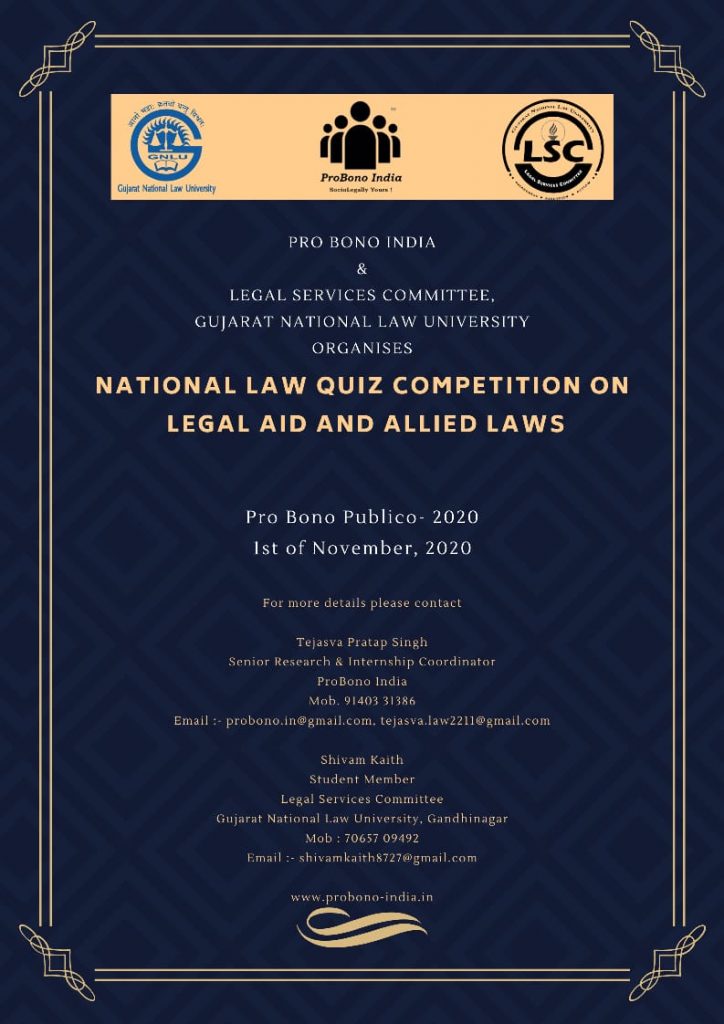
Details of the Competition

1) Competition is open for law students studying in 3-year law/5 year
law, from recognised law colleges in India.
2) There will be two rounds in the competition, Preliminary and Final
Round.
3) Preliminary Round will be done through Google Form and Final
Round will be done through Cisco Webx/Zoom/Google Meet having
different rounds as mentioned below.
4) In the final round there will be rounds on
a) Current Affairs in Legal Aid and Awareness
b) Audio-Visual Round
c) Rapid Fire Round
d) Legal Startups working in the field of Legal Aid and Awareness
e) Make a Questions Round
5) Questions will be asked from the area of Legal Services Authorities
Act, 1987, Public Interest Litigation, Right to Information Act, Human
Rights, Consumer Protection Act, Rights of the Victim, Alternative
Dispute Resolution.
6) Only 100 teams will be allowed to participate in the Preliminary
Round on the first come first serve basis. Registration of the Team
having 2 members in each team will be done through Google Form.
7) There is no registration fee for participation. Please register by
Tuesday, October 20, 2020, 4 pm here

https://docs.google.com/forms/d/e/1FAIpQLSc8jtngMPn5UZ-tFnRbxUqss1PDhBhgAp1CxeVR1eta9iaiqw/viewform

8) Preliminary Round will be held on Sunday, October 25, 2020 at 7-
00 pm. Total 50 MCQs will be asked in the duration of 30 minutes.

9) Top 10 teams will proceed to the Final Round. Selection of the team
will be decided on the basis of total marks scored and the time clocked
in the preliminary round. Final Round will be held on Sunday,
November 1, 2020, at 11 am onwards.
10) All the participants will get the certificate of participation and top
three teams will get the Certificate of Merit in addition to participation
certificate.
11) In the case of any dispute, the decision of the organiser will be final and
binding.


For more details please contact

Tejasva Pratap Singh
Senior Research & Internship Coordinator
ProBono India
Mob. 91403 31386
Email :- probono.in@gmail.com, tejasva.law2211@gmail.com
www.probono-india.in


Shivam Kaith
Student Member
Legal Services Committee
Gujarat National Law University, Gandhinagar
Mob: 70657 09492
Email:- shivamkaith8727@gmail.com

This article has been written by Yash Mittal, pursuing LLB-1 year from Mewar Law institute. 

Court – Madhya Pradesh High Court

Case title – Gyarsibai W/O Jagannath vs The State 

Decided on – 23 October 1952

Equivalent citations – 1953 CriLJ 588

Bench: Dixit, Chaturvedi

Facts of the case

The appellant (Gyarsibai), her husband, her children, and her sister-in-law Kaiserbai lived together in the same house. Kaiserbai and Gyarsibai were not on good terms, they were in constant quarrels and often had verbal arguments between them. 

Her husband Jagannath used to beat her and use violence against her. One such argument happened on 14/9/1951 in the morning when her husband Jagannath was not present at home. Gyarsibai left the house along with her three children aged 7 years, 5 years, and 1.5 years when Kaiser bai asked the appellant to move out of the house. After that, she jumped into a well along with her three children. After some time people around the village found Gyarsibai and her three children. Gyarsibai survived but her children died.

Issues before the court

Whether the appellant is guilty of the offense of murder of the three children and attempted the offense of Suicide. 

Background

The following case is discussed under section 300(4). Section 300 of the IPC defines murder and states Except in the cases hereinafter excepted, culpable homicide is murder, if the act by which the death is caused is done with the intention of causing death.

And Section 300(4) states that- If the person committing the act knows that it is so imminently dangerous that it must, in all probability, cause death or such bodily injury as is likely to cause death, and commits such act without any excuse for incurring the risk of causing death or such injury as aforesaid. 

Related case

In Emperor VS Dhirjia, a village woman was ill-treated by her husband, so she left the house with her six months old baby. When her husband woke up he found that his wife and baby were missing. He went out in search of them. But, when she heard of him coming after her she became worried and jumped into a well with the baby in her arms. 

The little child died while the woman was eventually rescued and had little or no injury. 

Dhirjia was charged with the murder of her baby and with an attempt to commit suicide, by the session judges.

Judgment

The act of the appellant falls under section 300(4), Indian penal code defines murder. 

The question, therefore, when the appellant jumped into the well together with her three children, she knew that her act was so imminently dangerous, as to cause in all probability the death of her children and further  if she had such knowledge; her act of jumping into a well with her children was “without any excuse for incurring the risk of causing death or such bodily injury as it is mentioned in clause 4 of Section 300, Penal Code. 

She left the house on the day of the occurrence saying that she would jump into well with her children, it cannot be said that she was in such an abnormal state of mind that could not have any knowledge of the nature of her act. The court observed that,  there was no material, whatsoever, to conclude that the appellant could not have escaped the harassment at the hands of her sister-in-law except by jumping herself into a well with her three children. 

The appellant was  sentenced to transportation for life under Section 302, Penal Code.

The Hon’ble SC concluded that the appellant was rightly prosecuted under section 300(4), as she was not a person of unsound mind, she could think and also know the outcomes of her actions. Jumping into a well was not the only option left with her. So there was no justification for her actions, so, it is appropriate to prosecute her under section 300(4).

Latest Posts


Archives