This article is written by Aanchal Rawat, a 2nd year student of R N Patel Ipcowala School of Law and Justice.

INTRODUCTION

“Only 5.78 Crore individual taxpayers filed income tax return for the financial year 2018-19 till Feb 2020 and even in that only 1.46 Crore, individual taxpayers filed returns declaring income above ₹5, 00,000.”

This was said by Anurag Singh Thakur, MoS, and Ministry of Finance in a reply to a question asked in Lok Sabha.

Tax Evasion

Tax Evasion is the illegal non-payment of tax or underpayment of tax.

The taxation system in India

Art. 256 of Indian Constitution,

                       “No tax can be imposed unless it is passed as a law.”

The Tax structure of India consists of 3 parts:

1. Central Government

2. State Governments

3. Local Municipal bodies

 Taxes are imposed and determined by the Central Government and State Government along with local authorities like municipal corporations.

 Salient Features of Tax System of India                      

  1. Role of  Central and State Government

The entire system is demarcated with specific roles for the central and state government.

 The Central Government of India takes following taxes: customs duty, income tax service tax, and central excise duty.

The state governments take the following taxes: income tax on agricultural income, professional tax, value-added tax (VAT), state excise duty, land revenue and stamp duty.

The local bodies take the following taxes: octroi, property tax, and other taxes on various services like drainage and water supply.

  1. Types of taxes

Taxes are of two types: 

  • Direct tax  
  • Indirect tax.
  • Direct Tax
  • Direct Tax is directly paid by the taxpayer to the government.
  • Examples: Income Tax and Wealth Tax.
  • Indirect Tax
  • Indirect taxes are consumption-based taxes which are applied on goods or services when they are bought and sold. 
  • The government receives indirect tax from the seller of the good/service and the seller receives it from the buyer of that good/service.  
  • Examples: sales tax, Goods and Services Tax (GST), Value Added Tax (VAT), etc.
  1. Revenue Authorities
  • Central Board of Direct Taxes
  • Central Board of Excise and Customs
  • Central Board of Indirect Taxes & Customs

Impact of Tax evasion on Indian Economy

Tax evasion has many negative effects on the entire economic system of India. Some of the important impacts are:

  • Less Tax for the Government

 Due to tax evasion, the Indian Government fails to collect the estimated amount of tax from the people. As a result, credit has to go to the black money-driven underground economy showing the impact of illicit wealth on GDP.

  • Creation/Growth of Mass Poverty

The misdistribution of wealth and income in India has seriously affected the growth of the underground economy. If all black money can be recovered in the tax havens the amount which will be recovered will be approximately by which the Indian Government can pay off all the outstanding liabilities of the it and even then there will still be money left for spending.

  • Uncontrollable Inflation

Due to tax evasion there is loss of revenue because of which the prices of commodities increases beyond normal level. And people who have money offer more money on specific items. 

  • Investment on Gold, Stones and Jewellers

People convert black money into white money to evade tax by largely investing in precious metals like gold and other jewellers. Gold can be bought and converted back to money any time with least efforts. Thus, the flow of underground money has caused the Indian economy to stall on its growth. Estimation says that if all the money in the underground economy could be diverted to our main economy, the Indian economy would grow more.

  • Transfer of Black Money from India to Abroad

Black money generated in India is kept in foreign tax havens through secret channels with the help of two important methods, 

  1. under-invoicing of exports 
  2. Over-invoicing of imports.
  • Corruption 

Corruption creates tax evasion and it creates black money in the economy. Black money holders then bribe different people to reach their desired goals and can get what they want.

  • Effect on GDP of the country

As income is not shown properly, tax collection decreases and thus the GDP cannot be calculated properly. The GDP is underestimated. 

  • The higher tax rate on existing taxpayers

The Government is forced to enhance the tax rates every assessment year for increasing its revenue resulting in the high tax burden of those paying taxes promptly.

Consequences

Tax evasion is a criminal offence.

Chapter ⅩⅫ of Income Tax Act, 1961 deals with the punishment for evading tax.

 In following scenario punishment is given:

  • On not filing income tax returns

If income tax return is not submitted as per s.139 (1) of Income Tax then assessing officer can penalise penalty of ₹500

  • Providing Wrong PAN or Not Providing PAN

If PAN is not provided to the employer at the time of employment then instead of 10% TDS (regular) 20% TDS will be deducted.

If PAN number is wrong then penalty of ₹10,000 may be penalised.

  • Not checking form 26AS before filing income tax return

The details of Form 26AS should be checked multiple times as if any mismatch is found in details it could lead to severe punishment.

  • Non payment of Tax as per Self Assessment

The taxpayer will be treated as defaulter if he fails to pay either wholly or partly self assessment tax or interest.

Being a defaulter he may be penalized by the assessing officer if justified reasons are not provided for the delay of payment.

  • Concealing Income to evade Tax

If correct income details are not provided or concealed then the taxpayer will be penalized 100 % to 300% of the tax evaded.

Section 271AAB penalises penalty for the following scenario:

  • Tax payer admits the undisclosed income

Penalty: 10% of the previous year’s undisclosed amount along with interest.

  • Taxpayer does not disclose the undisclosed income but does so in return of income furnished in previous year

Penalty: 20% of the undisclosed amount along with interest.

  • Amount undisclosed for the previous year

Penalty: Minimum 30% and Maximum of 90% penalty can be levied.

Ways to tackle tax evasion

  1. Reduction in taxes
  2. Simplifying the law and tax system.
  3. Designing well organised administrative structure for taxation.
  4. Strengthening Anti-corrupt policies.
  5. To increase awareness among the taxpayers with the use of different mediums like conducting seminars, conferences, etc.
  6. Relief provisions for huge tax payers.
  7. Strengthening laws related to it and making sure it is being implemented.
  8. A permanent tax structure for once and all.

Latest Posts


Archives

This article is written by Khan Mahenoor Barsati, a student of Rizvi Law College.

Equivalent Citation

AIR 1974 SC 244, 1974 CriLJ 324, (1974) 3 SCC 623

Bench

S Dwivedi, Y Chandrachud

Decided on

19 November 1973

Relevant Act and Section

Section 304

Section 302

Brief Facts and Procedural History

On May 4, 1968, Damrulal Went to the cottage of deceased Bucha where he at that point of time was overseeing foundation-digging near his cabin. However, earlier a person whose name was Damrulal instructed the deceased to avoid utilizing bricks relating to him to which Bucha replied that he was using his bricks. 

It led to an argument of heated phrases between them both. Thereafter Damrulal left the area angrily after bestowing a threat to Bucha that he would shortly settle the matter, The chore came to an edge at approximately around 9 a.m and the labourers working there evacuated the spot. 

While the deceased was grabbing his feast in the verandah of his home, Damrulal, Ganesh and the appellant along with their brother Har Charan entered at his residence and in a moment Ganesh prompted his brother Har Charan to grab hold of Bucha and kill him who was dragged out of his dwelling up to an immediate neem tree where he was badly beaten by fists and exhilaration and all three brothers Bucha managed to disentangle himself from their grip and pick up a Khutai lying close, He gave three blows on the head of Har Charan with the Khutai. Har Charan fell on the ground and became unconscious. Thereafter the appellant and his remaining two brothers, Ganesh and Damrulal, snagged hold of Bucha. The appellant grabbed the Khutai from the needle of Bucha and bestowed two or three blows on his head. Bucha fell on the ground and became lifeless. The appellant, Ganesh and Damrulal carried away Har Charan in a carriage and lodged a report with the police. Kanhaiyalal P.W. 6. lodged the F.I.R. about the incident in the Police Station Prithvipur and Bucha died soon afterwards.

Later on, the prosecution assessed four eyewitnesses of the incident I.e Kanhaiyalal (P.W. 6), Mst. Khumania(P.W.1), MstTujia(P.W.2), and Bhagola, (P.W.3 ) Kanhaiyalal dwelled declared contentious by the prosecution. 

The Additional Sessions Judge depended on the evidence of Khumania, Tujia and Bhagola to the importance that the appellant Ganesh and Damrulal along with the deceased Har Charan had gone to the home of Bucha and whacked him by fists and kicks. He also said that Bucha disengaged himself from their grip and picked up a khutai. 

He gave three hits on the head of Har Charan and became unconscious. The appellant wrestled with Bucha and grabbed the khutai from his hand. He then gave two or three blows on the head of Bucha and became unconscious.

 The Sessions Judge formulated that Ganesh and Damrulal did not participate in beating Bucha after Har Charan had fallen on the ground. Accordingly, he held that only the appellant was responsible for causing injuries to Bucha. 

He was of the impression that after Bucha had the khutai there was an adequate apprehension of grievous injury in the mind of the appellant. So when the appellant snatched the khutai from his hand and struck blows on his head, he was behaving in the activity of the right of self-defence and hence, he had no intention to cause terrible hurt to Bucha or to seize his vitality. 

It was also found that Bucha was the aggressor thus, The Sessions Judge contemplated that the appellant could be held guilty under Section 304 Part II I.P.C., but as he protects in the exercise of the right of self-defence, he was not guilty of that offence. The Sessions Judge, therefore, vindicated the appellant as well as his co-accused and three persons lived strived for the murder of one Bucha by the Additional Sessions Judge, Tikamgarh.

Furthermore, the State petitioned against the judgment of the Sessions Judge to the High Court on the ground convicting the appellant under Section 302 I.P.C. and sentencing him to imprisonment for life and convicted Ganesh and Damrulal under Section 323 I.P.C and assessed a sentence of Rs. 50/- each which they have not contested.

Issue Before the Court

Whether the Conviction of Ganesh and Damrulal is lawful?

Judgment of the Case

The high court held that appeal is accordingly dismissed by Turning to the second argument that the appellant and his co-accused had gone to the house of Bucha intending to cause physical harm to him and hence, They went unarmed to Ms house So they did not then have any intention to kill him. 

On the other hand Bucha picked up the khutai and inflicted deadly blows on the head of Har Charan, brother of the appellant Har Charan fell and became unconscious. (He died soon thereafter).

At that moment the appellant hurled the khutai on the head of Bucha. The blow was so serious that there was profuse bleeding inside the brain. 

One of the skull fractures broadened from the right temporal region to the left temporal region and proceeded internally to the basis of the skull. Dr. S. N. Banerji, who did the autopsy on the dead body of Bucha has deposed:

With these injuries death was inevitable.” This medical opinion clearly brings the case of the appellant within the purview of Section 300, third clause. So the High Court is right in convicting him under Section 302 I.P.C. 

Latest Posts


Archives

This article is written by Aanchal Rawat, a 2nd-year student of R.N. Patel Ipcowala School of Law and Justice. This article talks about what is tort, essential elements of the tort, history of tort and development of tort.

Suppose you went to vote but you were not allowed to vote by the officer assigned to make sure election is done properly. You were not allowed to vote without any reason even when you were a qualified voter. What will you do? Will you leave this matter and do nothing or will you do something? You should know right to vote is your right. You can go to court to ask for compensation for violation of right. When there is right then there is a remedy available for it. There has been no specific law which punishes for this offence. But as there is a legal injury there is a remedy available for it.

Tort

“Tort” is derived from the Latin word “Tortum” which means to twist or wrong. This term tort originated from the common law of England which means wrong.

Salmond has defined tort as follows:

“A tort is a civil wrong for which the remedy is an action for liquidated damages and which is not exclusively the breach of a contract, or the breach of a trust, or the breach of other merely equitable obligation.”

Winfield has defined tort as,

“Tortious Liability arises from the breach of a duty primarily fixed by law; this duty is towards persons generally and its breach is redressable by an action for unliquidated damages.”

Ratanlal and Dhirajlal has defined tort as,

“Tort is a civil wrong, independent of contract, for which appropriate remedy available damages.”

Essentials of Law of torts

1. Wrongful Act or Omission

Duty to do but not done is an omission.

An act which one is not supposed to do but he does is a wrongful act.

The wrongful act must be wrongful in the eyes of law. A moral wrongful act is not punishable.

2. Legal Damage

The damage should be such that the legal right of a person is violated. If there is no violation of right then there is no legal damage.

3. Legal remedy

      The remedy for such acts should be in form of unliquidated damages.

History of Law of Tort

The first time tort was used as a legal term was in the 1580s before it different words were used to define the same concept.[1]

1st case in which the term tort was used for the first time is Boulton v. Hardy. [1597, Cro.Eliz.547]

The law of torts originated from the common law of England. It has been developed as a branch of law in many commonwealth countries.

Till Mid-19th Century law of tort was not developed very much we can say it was underdeveloped.

In the 1860s the first American Treatise on tort was published. However, the subject of tort became particularly established in the 1880s when Oliver Wendell Holmes Jr. wrote about it.

Development of Law of Tort

After Norman’s conquest of England, the legal system becomes disorganized so judgements were carried out on a case by case basis more or less. After 1066, to understand the laws of the village which have developed over two centuries, judges wee delegated a region to travel there and understand their law. At that time the judges which were delegated this work noted and implemented those laws which they thought were most fair-minded and used them in their court findings. These court findings are known called as legal precedents. These precedents were meant to apply equally to the people of society whether it was a lord or a serf.

Due to Norman’s Conquest in England French became the spoken language in England’s Judiciary and thus many technical terms are originated from French language and tort is one of them. The term tort was based on the idea that everyone has certain rights in society. The purpose of tort was to enforce those rights and duties in society.

As precedent was meant to apply equally to everyone in society it was termed as common law.

The law of Torts came to India from England.

Important Case Laws which Developed Tort law in India

M.C Mehta v. Union of India

 In this case, the court applied the concept of Absolute liability and held the accused responsible. The principle of absolute liability was taken from the English case Rylands v. Fletcher in that the court held that when a person who for his own purpose brings anything in his land or collects or keeps which is dangerous and if it escapes then the person who brought it will be prima facie liable for the damages which are the natural consequences for its escape.

Similarly, in M.C. Mehta v. Union of India, Shree Ram Fertilizers were held responsible for the damage which happened due to the leak of oleum gas to society.

Jai Laxmi Salt Works Ltd. v. the State of Gujarat

In this case, the court talked about the duty of care and the causation of tort. In the case, the Government of Gujarat had constructed a bundh on the land which involved the risk of change in the course of water. Due to a change in the flow of water nearby properties would be flooded and damaged. So, the Owner of Laxmi Salt Works wrote to Government a letter explaining this matter and asked for a change of location but the Government rejected his request. And afterwards due to heavy rainfall, the claimant’s factory was destroyed. He asked for compensation from the Government. However, the Government refused to pay compensation. Then the Claimant went to court for compensation. The trial court dismissed the case based on Act of God. The High Court held that since the suit was time-barred the respondents will not be liable. However, when the case went in Supreme Court the court held that the damage done to claimant’s factory was not Act of God and the State must care towards the citizens. The court held the State guilty for breaching its public duty and the claimant was awarded compensation.

[1] Bruce R. O’Brien, “Anglo-Saxon Law”, in The Oxford International Encyclopaedia of Legal History, vol. 1 (Oxford: Oxford UP, 2009), 179.

Latest Posts


Archives

This article is written by Madhur Samriti Sharma, a student of ICFAI Law School, Hyderabad

INTRODUCTION

We are living in the 21st century where there is the growth of youth, talents, technology, science, education, society, mind-set and various other zones where a human being actively participate, either on his own choice or moral pressure. But let’s not talk about any kind of pressure on people right now. Although moral pressure does play a role in the topic we are going to discuss further in detail.

DENOTATION AND CONCEPT

Marriage is an institution or a legal system in which two partners come together and unite with each other. In this system, not only the two partners but also their family members create a social, economic and legal bond with each other. As I pointed earlier about the growth and development in the societies, there are various types of marriages, literally;

  1. Child Marriages: -Marrying before the legal age, i.e. the age of 18 years and 21 years for girls and boys respectively.
  2. Marriages between two partners of the same sex: – Gay and Lesbian marriages
  3. Group marriages: – Individuals marry in groups with a lot of wives and husbands. All wives and husbands are common. Children are also the children of the entire group as a whole.
  4. Monogamy: – Where one man marries one woman.
    1. Straight Monogamy: – Remarriage is allowed after the death or divorce of one partner.
    2. Serial Monogamy: – Remarriage is not allowed.
  5. Polygyny: – A male marrying more than one female at the same time.
  6. Sororal Polygyny: – A man marrying more than one woman at the same time where all the women are sisters.
    1. Non- Sororal Polygyny: Where the wives aren’t related as sisters.
  7. Polyandry: – A woman marrying several men.
    1. Fraternal Polyandry: – Where many brothers share the same wife.
    2. Non-Fraternal Polyandry: – In this type, there is no necessity of any relation between the husbands. The wife spends time with each husband and when she spends, no other husband can claim any right over her at that time.
  8. Devitalized Marriage: – Where divorced couples stay together. One individual is married and divorced from someone and another individual is married and divorced from someone else. Both partners get divorced from their respective partners and stay together after some time.
  9. Financial Marriage: – Where the marriage is only stable on financial terms.
  10. Conflicted Marriage: – Where the spouses are not happy at all in their union and seek pleasure outside of their marriage like religious activities, children etc.
  11. Traditional Marriage: – Where the partners are moderately satisfied with marriage and life. Although the main source of stress for them is their sexual relationship and communication with each other. In some tribes, in these type of marriages, the groom brings everything which has been mentioned on the bride’s lists to legitimize the relation with the lady. He then comes with family, friends to complete the rites and rituals of the marriage and both seek the blessings of the elders.
  12.  Balanced Marriage: – Partners are moderately satisfied with everything in their marriage and life. Although the main source of stress for them is finance.
  13.  Harmonious Marriage: – Partners are satisfied with each other but they are self- centred, viewing children as a burden and parenting as a source of distress.
  14.  Vitalized Marriage: – Partners are highly satisfied with almost every area and zone of their marriage and life.
  15.  Customary Marriage: – This type of marriages are common in various tribes where the father of the bride is given gifts, money, agricultural produce etc. by the family of the groom.
  16.  Religious Marriage: – These marriages can either be a Muslim Marriage or a Christian Marriage or any other religious one. These marriages are backed by the couple’s religious beliefs.
  17.  Civil Marriage: – These marriages are performed in Court, i.e. these marriages are known as Court Marriages.

Likewise, there are still some more types, which are defined under specific religious norms and traditions, which varies from individual to individual. Now if we talk about live-in relationship and how is it related to marriage and how it is impacting on marriages, the answer would be straight yet difficult for most of the people to understand. We are in the 21st century, where adopting westernization is equally important to move ahead in life. In lieu of having a broad mind-set on various other areas which are equally important, today’s youth is more focused on broadening their mind-sets on such ideologies which are not accepted in some societies or religion still. Being a broad-minded person does not mean to go against your parents, teachers, elders or even the society if you are actually wrong!

The trend of live-in relationship starts with the young adults or even teens, where partners live together to know each other, to spend time together and then be able to decide further for the future. Living together also includes living independently with your partner, without depending on parents or others, taking responsibilities, engaged in a sexual relationship and presenting themselves as the unmarried couples.

When I say, that, this idea belongs to western countries, it is because their society is different from the other societies of the world. Children, there, are habitual of such situations where they need to be responsible and live separately from their parents. But in other societies, like India, children are closely attached to their parents and are not raised like that. Parents, here, always take care of their children even if they are 40 years old! Now when I mentioned the types of marriages above, the only motive of mine was to explain the different cultures and traditions all around the world has when it comes to marriage. Let’s talk about India’s perspective. In India, especially, marriage is considered to be a highly sacred union of partners and families all together. In ancient times, getting a divorce after marriage, or even getting remarried after divorce or the death of the male spouse, especially, for women, was considered to be a sin. Now, if we look around in today’s times, of course, there are many laws and even women are strong enough to handle themselves, but not every woman still!

The concept of live-in became so popular among young adults or even adults that the law has made few amendments. Earlier, the child born out of live-in was considered as illegitimate as the child born was not from legal marriage. There were also rights which were only given to the legally wedded wife and husband. But now, there are many cases where the couples in a live-in relationship have been given certain rights for the protection under the law. Women and children have been given:

  1. Protection against Exploitation.
  2. Section 125 of the Criminal Procedure Code has been provided to give a legal right of maintenance to lady partners in or out of the marriage.
  3. Section 16 of the Hindu Marriage Act, provides the legal status of legitimacy even to the illegitimate child.
  4. Children born out of wedlock or in a live-in relationship would also be the part of the inheritance.
  5. Section 2(f) of the Protection of Women against Domestic Violence Act, 2005.

The only guidelines by the Central Adoption Resource Authority are that the partners in a live-in relationship would not be allowed to adopt any child. But apart from this, there are many landmark judgements given by the Supreme Court in recent years;

  1. Badri Prasad v. Dy. Director of Consolidation, 1978– In this case, the couple was living together without getting married for 50 years. So, the court held that couples cohabiting and living together in a live-in relationship for long period would be assumed as married in the eyes of law. The court and the law favoured the legitimacy and frown upon bastardy.
  2. Indra Sarma vV.K.V. Sarma, 2013– The SC has illustrated four categories where the concept of live-in relationships can be considered and proved in the court of law;
  3. Domestic relationship between one adult male and one adult female, both unmarried. It is the most uncomplicated sort of relationship.
  4. Domestic relationship between a married man and an unmarried woman entered knowingly.
  5. Domestic relationship between an unmarried man and a married woman.
  6. Domestic relationship between same-sex partners.
  7. Tulsa and Ors. v. Durghatiya & Ors, 2008– The Supreme Court provided legal status to the child born from live-in. The court also mentioned that the relationship of parents must be long term and should not be a walk in and walk out the relationship as per their wishes. The court also granted Right to Property to a child born out of a live-in relationship.

CONCLUSION

Although, people are way too broad-minded and forward now still marriage remains a sacred union since ancient times and it also gains legal status automatically. After all this live-in relationship system, the purity and bond of marriage still remain pure between partners and family as the relationship is also supported by families in hard times. If a couple can live for 20-30 years together, without getting married and also with children, then I think marrying each other will not affect anything in their lives. Couples would get more secured and happy.

Latest Posts


Archives

This article is written by Gaurav Purohit of Amity University Rajasthan Currently Pursuing BBA LLB.

INTRODUCTION

The Muslim Law of Inheritance was understood on the Foundations of Pre Islamic Customary Law of Succession. There is no understanding of Joint Family Property in Muslim Law. The teachings of Mitakshara School of Hindu Son’s Birthright and survivorship was additionally not perceived in the Muslim Law.  All properties devolve by Succession under Muslim Law and the privilege of the heir apparent doesn’t come into existence till the death of the Ancestor. The Right of Succession opens just on the death of the Deceased. Whenever a Female acquires property then she takes her share absolutely and with no limitations. Prophet Mohammed expressed about the Succession under Muslim law: One ought to become familiar with the laws of Inheritance and instruct them to individuals for they are one portion of useful knowledge. The Succession under Muslim Law is a Unique Aspect. It is the standard law that holds succession to the property of an enunch and not Muslim Law.

The Muslim law of Inheritance gets its standards from four major sources of Islamic law which are: the blessed Koran, the Sunna for example the act of the Prophet, the Ijma example the consensus of the educated men of a community on a specific purpose of law and the Qiya, for example, the analogical derivations of what holds just and right and following the principles of God.

The Muslim Personal Law (Shariat) Application Act, 1937 is appropriate to non-testamentary succession, for example, succession without a will.  In the case of Testamentary succession,  when the deceased has made a will,  the Muslim Shariat Law is applied to succession, as exercised by the Sunni and Shia Muslims.

Under Muslim law, there is no severe contrast between immovable or movable property and incorporeal or corporeal properties. Because of the absence of a property differentiation between properties, when a death occludes, under the Muslim law, all property owned by the deceased is dependent upon inheritance. Yet, although all the properties owned and possessed by the death are subject to be inherited, the part of property inheritable is resolved after appropriations like obligations and debts, will, expenses paid in the pace of a burial service are resolved and paid off. When these appropriations are made, the rest of the property would now be able to be disposed of by Inheritance.

General Principles of Succession under Muslim Law

Customary Law of Succession

  1. The nearest Male Agnate or Agnates Succeeded to the total exclusion of Remoter Agnates.
  2. Females and cognates were excluded from inheritance.
  3. The Descendants were preferred over Ascendants and Ascendants were preferred over Collaterals.
  4. Where there are more than 1 male agnates of the same degree then all of them inherit the property equally. That is taking per capita.

Islamic Principles of Succession

  1. The Couple that is the husband and wife are equal and they are entitled to inherit from each other.
  2. Near females and cognates are also being recognized and enumerated as heirs.
  3.  Parents and specific ascendants are made heir even when there are descendants.
  4. The newly created heirs that were not entitled to inherit under customary law are given particular or specified shares.
  5. The newly created heirs inherit the specified shares with the customary heirs and not to their exclusion.
  6. After the allotment of particular shares to the sharers is done the residue goes to the customary heirs who are known as residuary.

Important Definitions

  1. Agnates–  It is a relation that is related to the deceased completely through males. For example son, son’s son, etc.
  2. Cognates- It is a relation that is related to the deceased completely through one or more females. Such as daughter,s daughter, etc.
  3. Collaterals- They are descendants in the parallel lines from a common ancestor or ancestress. They may be cognates or agnates. Such as paternal aunt and uncle.
  4. Heir- An individual who is entitled to inherit the estate of another after his death.
  5. True Grandfather- A male ancestor between whom and the deceased no female intervenes .such as father’s father etc.
  6. False Grandfather- A male ancestor between whom and the deceased a female intervenes. Such as the mother’s father etc.
  7. True Grandmother- female ancestor between whom and the deceased no false grandfather intervenes. Such as the father’s mother etc.
  8. False Grandmother- A female ancestor between whom and the deceased a false grandfather intervenes.  Such as Mother’s father’s mother etc.
  9. Son’s son how lowsoever- Lineal Male descendants such as son’s son etc.
  10. Son’s Daughter how lowsoever- Female children of Lineal Male descendants. Such as a son’s daughter etc.

Sunni Law of Succession

Various Types of Heirs

Heirs are referred to as essential heirs and they are constantly qualified for a share of the inheritance, 

they are never totally excluded. These essential heirs comprise of the life partner relict, both parents, the daughter, and the son. However, in specific situations, different heirs can likewise inherit as residuary, in particular the father, paternal grandfather, agnatic daughter granddaughter, full sister, consanguine sister, and mother. The individuals who inherit are ordinarily

Limited to Three Groups:

1. Quota Heirs beneficiaries (dhawu al-farā ), ordinarily incorporate daughters, parents, grandparents, a couple/spouses, brothers and sisters, and others. This group generally take an assigned share or quota of the estates.

2. Individuals from the Asaba (residuary), generally a blend of male and female) family members that inherit as residuary after the shares of the Quota-heirs has been distributed.

3. If  an individual leaves no immediate family members and there is no u aba, his property ʿ ṣ  escheats to the state depository (Bayt al-mal),

Sharers

The Sharers are 12 in number and are as per the following:

(1) Husband

(2) Wife,

(3) Daughter,

(4) Son’s Daughter 

(5) Father,

(6) Paternal Grandfather,

(7) Mother,

(8) Grandmother on the male line,

(9) Full sister

(10) Consanguine sister

(11) Uterine sister,and

(12) Uterine brother.

The share taken by every sharer will change in specific conditions. For example,

➢ a Wife takes ¼th of the share for a situation where the couple is without lineal descendants and a one-eighth share in any case. 

➢ A Husband (on account of succession to the wife’s property) takes a half share for a situation where the couple is without lineal descendants, and a one-fourth share otherwise.

➢ A sole daughter will take half share. Where the deceased has left behind more than one girl, all girls together take 2/3rd of the share. 

➢ If the deceased had left behind a son(s) and daughter(s),  the girls stop to be sharers and become residuary all things being equal, with the residue being so distributed as to guarantee that every son gets double of what every girl gets.

Birth Right

Any child naturally introduced to a Muslim family doesn’t get his entitlement to property on his introduction to the world. Indeed, no such individual turns into a legal heir and subsequently holds no privilege even after the death of the ancestor. If an heir lives even after the death of the ancestor, he turns into a legal heir and is in this way qualified for a share in the property. Nonetheless, if the apparent heir doesn’t survive his predecessor, then no such right of inheritance or share in the property shall exist.

Rule of Distribution

Vesting of property happens on the death of the propositus. Under Muslim law, the distribution of property can be made in two different ways, firstly per capita or strip dispersion. Per – Capita dissemination technique is significantly utilized in the Sunni law.

As indicated by this technique, the estate left over by the ancestors gets similarly distributed among the heirs. Subsequently, the share of every individual relies upon the number of heirs. Subsequently, the share of every individual relies upon the number of heirs. The heir doesn’t represent the branch from which he inherits.

Widow

Under Muslim law, no widow is excluded from the succession. A childless Muslim widow is qualified for one-fourth of the property of the deceased husband, after meeting his burial service and legitimate costs and obligations. Notwithstanding, a widow who has children or grandchildren is qualified for one-eighth of the deceased husband’s property.

Case Laws

In Hakim Rehman versus Mohammad Mahmood Hassan[1], it was held that upon the death of a Mohammedan, the entire estate devolves upon his heirs at the moment of his death and the heirs succeed to the estate as tenants in common explicit shares.

In Rukmanibai versus Bismillavai[2], it was held that where an individual, who has converted over to Islam, dies leaving behind his only daughter and no residuary, will be qualified for her share only as a residuary share in the property of the deceased. 

Shukurllah versus Zohra Bibi[3] it was held that every heir of the Mohammedan is at risk for the obligation of the deceased to the degree only of a share of the obligations proportionate to his share of the estate

Grounds of Disqualifications

Preclusions which suspend the Heirs to succeed the property of the intestate are—

Killer or Murderer

Under the Sunni Law, an individual who has caused the death of another, regardless of whether intentionally,

or then again unintentionally, negligence, or accident, is suspended from succeeding to the estate of that

other. Crime under the Shia Law isn’t a bar to succession except if the death was caused intentionally.

Illegitimate Children

Under the Hanafi School, an illegitimate kid isn’t qualified for inheritance. Such a kid can’t acquire from his/her dad however can acquire from his/her mom and all family members of the mother. The mother can likewise inherit the property of her illegitimate youngsters.

Child in the womb

A child in the womb of its mom can inherit only if he is brought into the world alive. A child in an embryo is viewed as a living individual and, accordingly, the property vests in that child.  if such a child in the womb isn’t brought into the world alive, the share previously vested in it is

divested and, it is assumed as though there was no such heir (in the womb) by any means.

Difference of Religion

A non-Muslim couldn’t inherit from a Muslim however the Caste Disabilities Removal Act of 1850 does away in India with the avoidance of a non-Muslim from the inheritance of the property. If a non-Muslim acknowledges Islam, and afterward dies, the Act of 1850 can’t warrant the application of his change law of succession to his property; the Muslim Law will apply in such a case. Where a convert to Islam died leaving behind a daughter, as against the

the claim of his non-Muslim relatives her daughter would be given all her father’s property  – ½ share as her share as Quranic heir and the remainder by the method of return.

Where a Muslim registers his marriage under the Special Marriage Act of  1954, he stops to be a Muslim for objectives behind an inheritance. In like manner, after the death of such a

Muslim his (or her) properties don’t devolve under Muslim law of Inheritance. The Inheritance of the properties of such Muslims is administered by the provisions of the Indian Succession Act, 1925, and the Muslim law of inheritance isn’t appropriate.

Escheat

Where a  Muslim who died and he has no legal heir under his law, his properties are inherited by Government through the process of escheat. The state is viewed as a definitive heir of deceased persons.

CONCLUSION

The Holy Quran states ‘Allah has bought from devotees their people and their wealth in lieu of Jannah’. Man is a trustee of the abundance that he owns for the duration of his life. When the term of his term ends, his trusteesh

his trusteeship over his wealth and property terminates. After his death, his property ought to be reallocated by the directions given by Allah Taala. Mandates concerning the appropriation of wealth and property of the expired after his death are given under the Holy Quran. There are  Laws relating to the appropriation of wealth among heirs, so heirs don’t fight and Guaranteeing that an equitable framework can be established and wealth isn’t accumulated into a single entity. Separate the grouping of wealth and dispersion of wealth in the society. Break up and Consolidate a strong family framework by justly distributing wealth among the heirs Respect the Right of ownership for the person that he acquired through the legal methods and it doesn’t permit the individual or government to seize the property after his demise. Provide peace of mind that after your demise, your family will be given the right of inheritance. Special focus is given to women’s rights of inheritance as the women are denied their privileges under different frameworks.


[1] Hakim Rehman versus Mohammad Mahmood Hassan, AIR 1957 Pat 559.

[2] Rukmanibai versus Bismillavai, AIR 1993 MP 45.

[3] Shukurllah versus Zohra Bibi, AIR 1932 All. 512.

Latest Posts


Archives

This article is written by Navneet Chandra, a student of Central University of South Bihar, Gaya

Equivalent citations

1973 AIR 473, 1973 SCR (3) 57

Bench

DUA, I.D., Alagiriswami, A., Vaidyialingam, C.A.

Decided on

11 December 1972

Act

Indian Penal Code (Act 45 of 1860), Ss. 100 and 102-Right of private defence.

Facts of the Case

There was a clash between the parties of the appellant and complainant over the possession of certain land; in which the appellant inflicted a fatal spear injury on the chest of the deceased. The matter went to the trial court where the Sessions Judge, after an exhaustive discussion of the evidence, produced both by the prosecution and the defence, concluded that the possession of the disputed plots of land was undoubtedly with the- accused persons. The only further question which required determination by the trial court was if the complainant’s party had gone to the plots in question with an aggressive design to disturb the possession of the accused person by the unlawful use of force and if the accused persons had exceeded the right of private, defence in beating and killing Chandrama, father of the complainant and causing injuries to the other members of the complainant’s party. According to the trial court, the complainant’s party had gone to the plots in question to prevent the accused persons from cultivating and ploughing the said land. After considering the evidence on the record, the trial court felt great difficulty in agreeing with either of the two rival versions given by the prosecution and the defence witness Mangla Rai about how the battery had taken place. The learned Sessions Judge, however, considered himself to be on firm ground in holding that the injuries suffered by Chanderdeo and Deo Narain rendered it difficult to believe that they had inflicted injuries with their spears on Bansinarain and Tin Taus, Rajnarain and Suresh who were prosecution witness. In his opinion, had the accused persons been the aggressors, they would not have abstained from causing injury to Rai Narain who was actually ploughing the field. In view of this improbability the learned Sessions Judge did not find it easy to place reliance on the statements of the prosecution witnesses and acquitted all the accused on the ground that the accused were exercising their right of private defence on the the ground of reasonable assumption that Deo Narain and Chanderdeo must have received injuries on their heads before they inflicted injuries on the members of the complainant’s party. Aggrieved with the order of the trial court, the State appealed to the High Court where the conclusions of the trial court were upheld. The High Court was of an opinion that right had been exceeded by the appellant Deo Narain while inflicting injury with the spear on the chest of Chandrama, deceased. Chandrama had received one lacerated wound on the right side of his skull and one incised wound on the left shoulder with a punctured wound 41″ deep on the right side of the chest. The last injury was responsible for his death. This injury, according to the High Court, was given by-the appellant Deo Narain with his spear. The reasoning of the High Court in convicting the appellant is, broadly stated, that it was only if the complainant’s party had actually inflicted serious injury on the accused that the right of private defence could arise, justifying the causing of death. In the present case as only two members’ of the party of the accused persons, namely, Chanderdeo and Deo Narain, appellant, had received injuries which though on the, head, were not serious, they were not justified in using their spears. On this reasoning the High Court convicted the appellant, of an offence under s. 304, I.P.C. and sentenced him to rigorous imprisonment for five years.complainant appealed to the High Court where it was held that the appellant exceeded his right of private defence on the sole ground that he had used his spear with greater force than was necessary, that he had given a dangerous blow with considerable force with a spear on the chest of the deceased though he had only received a superficial lathi blow on his head, and convicted him for an offence under Section 304 of IPC. Aggrieved with the order of the High court, appellant filed SLP in the Supreme Court of India. 


Issues

Whether the petitioner exceeded the right of Private Defence? 

Whether the petitioner is justified in using the right of private defence by spear for injury caused by lathi? 

Whether the order passed by the High Court was erroneous? 


Judgment

According to section 102, the right of private defence of the body commences as soon as a reasonable apprehension of danger to the body arises from an attempt or threat to commit the offence, though the offence may not have been committed, and such right continues so long as such apprehension of danger to the body continues. The threat, however, must reasonably give rise to the present and imminent, and not to remote or distant, danger. If, after sustaining a serious injury, there is no apprehension of further danger to the body, then obviously the right of private defence would not be available. In our view, therefore, as soon as the appellant reasonably apprehended danger to his body even from a real threat on the part of the party of the complainant to assault him for the purpose of forcibly taking possession of the plots in dispute or of obstructing their cultivation, he got the right of private defence and to use adequate force against the wrongful aggressor in the exercise of that right. The party of the complainant had deliberately come to forcibly prevent or obstruct the possession of the accused persons and that this forcible obstruction and prevention was unlawful, the appellant could reasonably apprehend imminent and present danger to his body and to his companions. He was thus fully justified in using force to defend himself and if necessary also his companions against the apprehended danger which was manifestly imminent. 

It cannot be laid down as a general rule that the use of a lathi as distinguished from the use of a spear must always be held to result only in milder injury, because, a blow by lathi on the head may prove instantaneously fatal. Therefore, if a blow with a lathi is aimed at a vulnerable part like the head it cannot be laid down as a sound proposition of law that in such cases the victim is not justified in using his spear in defending himself. In such moment of disturbed mental equilibrium, it becomes difficult to expect parties facing grave aggression to coolly weigh determine with a composed mind as to what precise kind and severity of the blow would be legally sufficient for effectively meeting the unlawful aggression. Apparently the High Court seems to have implied that the appellant should have used the spear as a lathi and not the spearhead for defending himself or should have given a less forceful thrust of the spear or on a less vulnerable part of the body and not on the chest, in order to be within the legitimate limits of the right of private defence. 

The High Court erred in convicting the appellant on the ground that he exceeded his right of private defence. To say that the appellant could only claim the right to use force after he had sustained a serious injury by an aggressive wrongful assault is a complete misunderstanding of the law embodied in s. 102, I.P.C. The approach of the High Court that merely because the complainant’s party had used lathis, the appellant was not justified in using his spear is an equally misconceived aid cannot be supported under s. 100. The view of the High Court is not only unrealistic and unpractical but also contrary to law and in conflict with its own observations while acquitting the other accused, that in such cases the matter cannot be weighed in scales of gold. 

Result

The appeal was allowed and succeeded and the appellant was acquitted. 

Latest Posts


Archive


This article is written by Aanchal Rawat, a student of R.N.P.I.S.L. & J currently in Second year pursuing B.com-L.L.B (Hons.).

INTRODUCTION

The word Res Gestae is a Latin word which means things done, transaction or circumstance surrounding the subject is complete.

Section 6 of the Indian Evidence Act, 1872 is based on the doctrine of Res Gestae. 

Facts not of issue, but connected with the fact in issue and forms part of the same transaction are relevant, irrespective of whether they occurred at the same time and place or at different times and places.

Illustrations

  • Mahesh is accused of the murder of Mahila by beating her. Whatever Mahesh or Mahila or the bystanders said and did at the time of beating or shortly before it or after it as to form a part of the transaction is a relevant fact.
  • Ishita ordered certain goods from Kirtan. Kirtan gave the goods for delivery, but it didn’t reach Ishita. Ishita accused him of not delivering the goods. The goods must have passed through several intermediate persons. These deliveries are a relevant fact that goods were delivered to several intermediate persons successively. Each delivery is a relevant fact.

Meaning of Res Gestae

Sometimes items of evidence are said to be part of the res gestae. If the nature and strength of the evidence is highly connected with the matter of issue then such evidence is admissible.

Res Gestae is an expression mainly used in the criminal law in connection with the contemporary of statements to residents.

Contemporaneous statements are relevant and in connection with the matter and can explain matters in issue, and then they will be admissible.

Same transaction

The term ‘same transaction’ has not been defined in the IEA, 1872. 

“Same Transaction” denotes that a series of activities are linked together to present a continuous story. 

Sir James Stephen in his book, “Digest of the law of Evidence” has defined the term “Transaction” as follows:

A group of facts which are connected to be mentioned by one legal name, a crime, a contract, wrong or any other subject of inquiry which may be at issue is transacted.

The word ‘transaction’ is difficult to be interpreted. It should be interpreted neither in any strict nor in a technical way, but its ordinary etymological meaning of “an affair” or “a carrying through.”

Efficient test is used to determine whether a fact forms a part of the transaction, it depends upon whether the facts are related to one another in point of purpose, or cause and effect or as probable acts and subsidiary acts as to form one continuous action.

For continuity of action and purpose proximity of time is not essential.

On the one hand, the mere proximity of time between several acts will not necessarily make them parts of the same transaction, while on the other hand, the mere fact that intervals of time between the various acts will not necessarily signify want of continuity. To find out whether a series of acts are part of the same transaction, it is essential to see whether they are linked together to present a continuous whole. Sec. 6 of IEA, 1872 lays down that fact, which form part of the same transaction are relevant.

Res Gestae and Admissibility of facts

Hearsay evidence’s exception is Res Gestae. If a fact or a statement of fact or opinion is closely associated with some act or issue, place or circumstances with some event which is in issue, then it forms a part of the same transaction as the act or the event in issue and will be admissible as evidence. The justification given to the acceptance of such evidence is that the light that it sheds upon the act or event in issue is such that in its absence, the transaction in question may not be fully or truly understood and may even appear to be meaningless, unexplainable or unintelligible.

Res Gestae of any case properly consists of that portion of actual world’s happenings out of the right or liability, complained or stated in the proceeding, necessarily arises. 

Two senses:

  1.  Restricted sense: It means the world’s happening out of which the right or liability in question arises. 
  2.  Wider sense: It covers all the facts which make the existence of something more probable or less probable than it would be without them, by which re gestae is reproduced to the tribunal where the direct evidence of the witness or perception of the court is unachievable. Statements may also accompany physical happenings, e.g., an accident, happened in a public place, some bystanders will make mutual conversation about the incident. 

The question is to what scope, such statements can be regarded as parts of the transaction.

Criteria to be fulfilled before a statement can be admitted as evidence under section 6: 

  1. The spontaneous and simultaneous utterance is a part of the transaction, e.g., what a person states during an occurrence in respect of the occurrence itself.
  2. The statement must be made either during or immediately before or after its occurrence, and of such a nature that the events speak for themselves the words must be at least de recenti.
  3. If the statement is made after the act is over for reflection and deliberation (fabrication); and/or it is the mere narration of past events, then it is not relevant.
  4. The statement must be a statement of fact and not an opinion. 

Illustrations:

  1. Kamlesh, while running in the street, crying that Hitesh has stabbed him, is a relevant fact. 
  2.  During the investigations of a crime if any statement is given it is considered as relevant facts.
  3. A man was accused for the murder of his wife. His pleaded that the shot went off accidentally. To rebut that defence, there was evidence of a telephone operator, who stated that before shooting; she had received a call from the address where the deceased lived with her husband. The telephone operator said that the call was from a female, who was sobbing and in a hysterical state she said, “Get me the police, please!” and gave the address. Before telephone operator could make the connection to the police station, the caller’s (deceased) call ended. And when, the police came to the house and found the body of a dead woman. Here the call and the words spoken by the deceased were held to be relevant as a part of the transaction which brought about her death.
  4.  Newspaper Reporting: Whether or not a newspaper report can be relied upon by the High Court would depend upon the nature of jurisdiction being exercised by the High Court. If the question is of admissibility of a newspaper report in any appeal, obviously the Evidence Act is applicable; the High Court is required to go by the provisions of the Evidence Act.
  5. Inference of guilty: To justify the inference of guilt, the circumstances from which such an inference is sought to be drawn, must be incompatible with the innocence of accused.

Res gestae and Hearsay Evidence

Hearsay evidence is that statement which is given by a person who has not seen the happening of the transaction but has heard of it from outside. Such evidence can be given if it forms a part of the transaction. 

Sec. 6 of the IEA, 1872, is an exception to the hearsay evidence rule. It admits certain carefully safeguarded and limited exceptions and makes the statement admissible when such statements are proved to form a part of the res gestae.

Criticism of Res Gestae Doctrine

  • The doctrine of res gestae applies to ‘hearsay’ evidence also, which is not considered a good piece of evidence.
  •   Collateral facts are res inter alios actae, (i.e., transactions between others, for example, statements made behind the accused’s back and to be used as evidence against him. 
  • According to Professor Stone, “no evidential problem is so shrouded in doubt and confusion”. The rule is useless and harmful. Useless as every part of it is covered by some other rule.

Harmful as it confused the limitations of other rules. The limits of res gestae are not easy to define.

  • The Facts differ so greatly that no fixed principle can be laid down as to the matters that will form part of a transaction. As the nature of Res Gestae is confusing it is not included in the Indian Evidence Act. 

Latest Posts


Archives

This article is written by Madhur Samriti Sharma, a student of ICFAI Law School, Hyderabad

INTRODUCTION

The Constitution of India is known as an organic law. It is because it lays down a set of rules and laws which serves as a base for government, corporations, organizations and, citizens of the sovereign state. The constitution came on 26th January 1950. It starts with the Preamble which says that the citizens of India came together into a Sovereign, Socialist, Secular, and Republic, Democratic and to secure to all its citizens. Before enacting the constitution, India was under control of the British rule. 200 years of slavery and torture came to an end with the Independence Day on 15th August 1947.

Historical Background

As evident and straightforward it is, the British government dominated India for over 200 years with extreme subjugation and persecution. The British administration have many acts and enactments for governance, which we shall read further:

Government of India Act, 1858: – When the British Crown took hegemony over India from the East India Company, the Parliament validated the first statute for the patronage under the direct control of the British Government. The act was influenced by the philosophy of total royal control without any sought-after engagement in the management of the country. By this act, the powers of the Royal were to be utilized by the Secretary of State for India, aided by a Council of fifteen members, and termed as the Council of India. The Council was incorporated of people from England, some of whom were applicants of the Royal while others were the agents of the Directors of the East India Company. The Secretary of State, who was in charge of the British Parliament, administered India through the Governor-General, supported by an Executive Council, which consisted of high officials of the Government. The important hallmarks of the system introduced by the Act of 1858 were: –

  1. The government of the Company was not only separate but immutably centralized.
  2. Though the administration of the country dissected into Provinces with a Governor or Lieutenant-Governor assisted by his Executive Council as the chief of each of them.
  3. The Provincial Governments were mere representatives of the Government of India and had to function under the charge and control of the Governor-General in all matters relating to the government of the Province.
  4. There was no separation of functions.
  5. The entire machinery of administration was bureaucratic, totally unconcerned about public opinion of India. 

Indian Councils Act, 1861: – This act initiated a new section, which was so long comprised of exclusively of officials, should also include certain non-officials in the Council. But even after the enactment of this new Act the main and more important powers were kept for the Governor-General like: –

  1. Giving foregoing sanction Bills relating to certain matters, without which they could not be introduced in the Legislative Council.
  2. Vetoing the bills after they were passed or reserving them for consideration of the Crown.

Indian Councils Act, 1892: – Two improvements as regards the Indian and Provincial Legislative Councils were presented by the Indian Councils Act, 1892, i.e.

  1. The official members of the Indian Legislative Council were to be nominated by the Bengal Chamber and the Legislative Councils
  2. The non-official members were to be nominated by certain local bodies such as universities, district boards, municipalities;
  3. The Councils were to have the power of discussing the annual statement of revenue and expenditure. 

There are other acts which gradually enacted after one another expanding the scope for the citizens and non-official members. Every act brought new legislation and amendments. Like Morley-Minto reforms and The Indian Councils Act, 1909 which was known by the names of the then Secretary of State for India (Lord Morley and the Viceroy Lord Minto) which was implemented by the Indian Councils Act introduced the element of vast representation of non-official members and elections; Montagu-Chelmsford Report and the Government of India Act, 1919 was another constitutional development of India as Morley-Minto Reforms failed to satisfy the aspirations of the nationalists. The Indian National Congress which was established in 1885 was in control of moderates but became active during World War I and started the ‘Home Rule Movement’. But every Act of amendment comes with a loop hole. After the non-cooperation movement by the nationalists, the British introduced the Simon Commission. It should be noted that even after all the reforms, acts or amendments The British Crown kept their authority to the highest and always. But after all the reforms, changes, martyr, torture, and then came Indian Independence Act, 1947. The following were the results: –

  1. Abolition of Indian Dependency and the suzerainty of the British Crown
  2. Sovereignty of the Dominion Legislature

Making of the Constitution  

The Constituent Assembly which had been elected for unalloyed India, held its various sittings reading and finishing the constitution and it finally was the date 26th November, 1949, on which it was declared as passed. The features of the Indian Constitution were borrowed from different countries. The rest of the additional provisions effect, i.e. from November 26, 1949. 

Classification of Constitutions

  1. Evolved and Enacted constitutions 
  2. Legal and Real constitutions
  3. Written and Unwritten constitutions
  4. Flexible and Rigid constitutions 

Evolved and Enacted constitutions: – An evolved constitution is the repercussion of the historical burgeoning. It is not mounted at a particular time. For instance, the British Constitution has either been passed by any exceptional Constituent Assembly at a specific time or has the ruler given it to the people. Natively, England is about a complete kingship still, but in practice her place is different. Enacted constitutions are framed at a specific time, like the American constitution mounted by a Constituent Assembly after the declaration of Independence. In France, the 1st constitution was made in 1830, 2nd was constituted in 1848, third was framed in 1871, 4th in 1946 and 5th in 1958. After the II World War, India’s new constitution was completed on November 26, 1949 and it was introduced on 26th January, 1950. 

Legal and Real constitutions: – The scribbled components of the constitution constitute legal constitution and when the agreements and decisions of the court are added to it, it becomes the real constitution. 

Written and Unwritten constitution: – According to DR. Garner, the dissimilarity between evolved and enacted constitution is similar to that of written and unwritten one. Unwritten is the one, in which the most part is not written like decisions, legal judgements, customs etc.

Flexible and Rigid constitutions: – A flexible constitution refers to which could be amended by ordinary law exercise. While rigid constitution refers to which could only be amended by a very difficult special procedure. 

CONCLUSION

Constitution may come in different forms or shapes but still it acts as a parent for all rules and regulations of a state. It serves as a base of rights and duties served to citizens.

Latest Posts


Archives

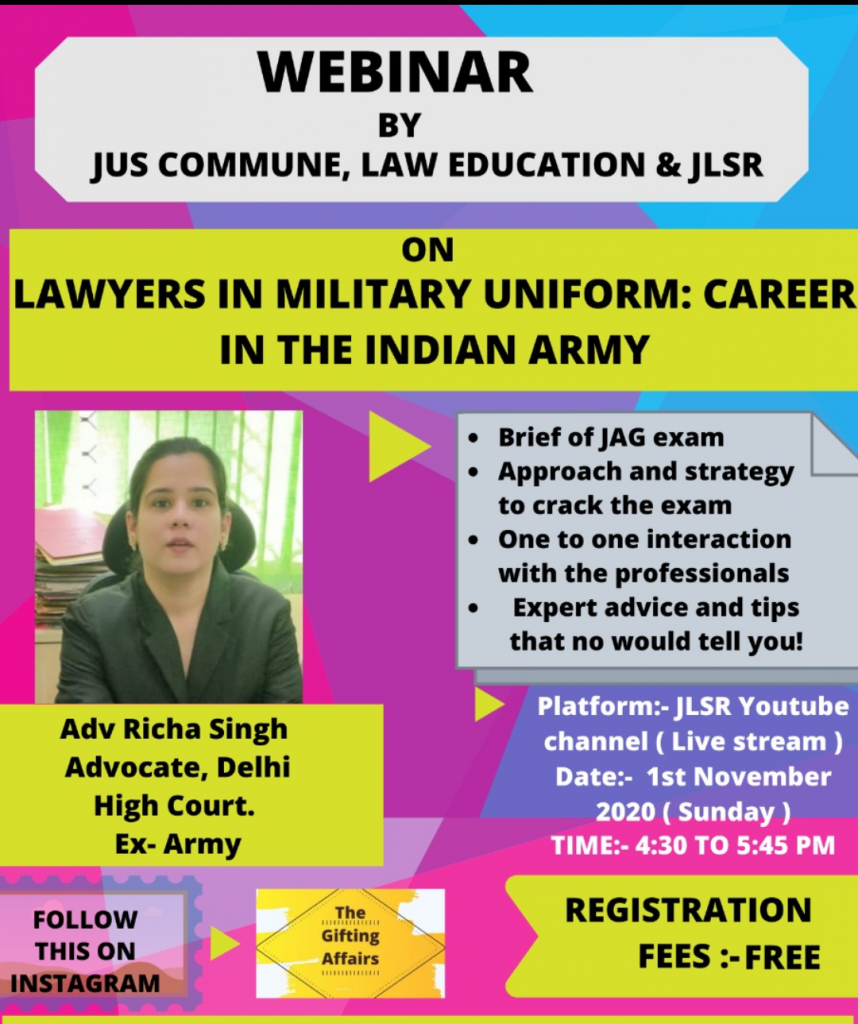
About Webinar:- Workshop on lawyers in military uniform: a career in the Indian army is conducted in association with Jus Commune, Law Education and JLSR.

The workshop entails the following:

  1. One on One interaction with the esteemed speaker
  2. An opportunity to gain insight into JAG exam
  3. Strategy and planning to secure a career
  4. Tips and secret that have been well kept until now!
TOPIC: Lawyers in Military Uniform: Career in the Indian Army
SPEAKER: Adv. Richa Singh ( Delhi High Court )
DATE: 1st November 2020

TIMINGS: 4:30 PM onwards 

NOTE: No Participation Certificate will be provided but the knowledge you will receive would be immense.

REGISTRATION LINK: https://docs.google.com/forms/d/e/1FAIpQLSfeBeAGD3IdRlP7d_ekJYCaX8O-gt2PGZ3ebCq8sSqAe7ZL-w/viewform?usp=sf_link

FOR ANY QUERY

Write to us at- communejus@gmail.com 

About the Organisation

ProBono India is India’s first platform that started in 2016 and which focuses on highlighting all legal aid and awareness activities around the world on one platform. It is a platform which provides free legal aid service to serve the needs of people.

The objective of the organization is to provide legal aid, conduct legal awareness activities, disseminate legal aid, promote legal awareness activities of various organizations of the world and conduct research on all aspects of legal aid and legal awareness.

About the Opportunity

The ProBono India provides opportunities to law students for the Winter (November-December) Virtual Internship Programme to enhance research and drafting skills on different case analysis and research works over socio-legal issues. It seeks interested students with outstanding research works that provide them with finest work in the field of law.

Eligibility

Any law students of a 3 year/5 year programme or any legal scholar may apply.

Tenure

1 months

Stipend

No stipend.

Mode of Internship

Virtual Internship

Perks:

1.      Advance the ability of Case-analysis

2.      Enhance the Research skills

3.      Internship Certificates.

4.      Certificate of Publication

How to Apply?

Please attach your CV, cover letter and Statement of Purpose to the attached linkon or before 11:59 PM, 05 November 2020.

The internship will commence from 15 November 2020.

https://docs.google.com/forms/d/e/1FAIpQLSfzVgOpskIlGd5UmXpBm_t8w6UoiUfywDpdDmb_Oluapi2Lcw/viewform?usp=sf_link

Submission Date

Last date to Apply: 05 November 2020

Contact Details

For any further query, please contact:

Tejasva Pratap Singh: 9140331386, 9580669905

Email: tejasva.law2211@gmail.com