This article is written by Shaunak Parulekar, a student at I.L.S Law College currently in the 2nd Year of the B.A.L.L.B course. My LinkedIn account hyperlink is This article seeks to expound upon the topic of medical negligence i.e. its meaning, various laws and consequences relating to it and liability that can be incurred by the victim of the medical malpractice/negligence. This article provides information about the concept to create as much awareness as possible.

Medical Negligence

Medical negligence is a blend of two words. The subsequent word exclusively depicts the significance, however, the importance of negligence has not been portrayed effectively it is a demonstration wildly done by an individual bringing about predictable harms to others. Negligence is an offence under tort, IPC, Indian Contracts Act, Consumer Protection Act and some more. 

Medical negligence otherwise called medical malpractice is the ill-advised, incompetent, or careless treatment of a patient by a doctor, dental specialist, medical attendant, drug specialist, or other medical care proficient. Clinical negligence happens when a medical services supplier strays from the perceived “standard of care” in the therapy of a patient. The “standard of care” is characterized as what a sensibly judicious clinical supplier would or would not have done under the equivalent or comparative conditions. 

“The important question isn’t how to keep bad physicians from harming patient; it’s how to keep good physicians from harming patients”. – Atul Gawande

It is absurdly compromising practice and it is delegated such because first, the person who commits the act did or ought to have anticipated that it would subject another to a severe degree of distress, and second, the size of the detectable danger was with the end goal that the actor ought to have acted securely. 

For instance, after a serious operation of a patient, he is probably going to get contaminated by numerous infections due to certain reasons such as loss of blood, weakness, high dose of medicines. At the appropriate time, standard consideration is required from the specialist/doctor to give premedication for these irresistible infections. If a specialist neglects to do so and because of which a patient experiences some contamination it can cause a ton of damage or even death in antagonistic cases, the specialist is said to have committed medical negligence or medical malpractice.

Negligence Basics

There are distinct definitions of negligence. It is the omission to do something which a reasonable man, guided by those considerations which ordinarily regulate the conduct of human affairs, would do or doing something which a prudent and reasonable man would not do. It must be determined in all cases by reference to the situation and knowledge of the parties and all the attendant circumstances.

 Think of a driver getting into an accident on the road. In a car accident case where one person caused the crash—by breaching their legal duty to obey traffic laws and drive responsibly under the circumstances—that person may be held responsible for all injuries and other losses (“damages”) suffered by other parties involved in the crash.

Essentials/Prerequisites

Doctor’s obligation to attend the patient with care

Medicine is such a profession where a practitioner is supposed to have requisite knowledge and skill needed for the purpose and has to exercise a reasonable duty of care while dealing with the patient. If the doctor or a specialist doesn’t attend a patient admitted in an emergency or under his surveillance and the patient dies or becomes a victim of consequences which could have been avoided with due care from the doctor, the doctor can be held liable under medical negligence. 

This was held in Sishir Rajan Saha v. The State of Tripura that if a specialist didn’t give enough consideration to the patients in government emergency clinics because of which the patient endures, the specialist can be held subject to pay remuneration to the patient. A specialist or a clinical professional while taking care of his patients owes him a few accompanying obligations of care:

  • An obligation of care in concluding whether to undertake the case 
  • An obligation of care in choosing what treatment to give 
  • An obligation of care in the administration of the treatment 

A doctor acting in a careless way

Res Ipso loquitur, Latin for “the thing speaks for itself,” a doctrine of law that one is presumed to be negligent if he/she/it had exclusive control of whatever caused the injury albeit there’s no specific evidence of an act of negligence, and without negligence, the accident wouldn’t have happened. A doctor isn’t an insurer for the patient; failure to treat the patient wouldn’t add up to carelessness yet thoughtlessness bringing about a serious state of the patient would.

In Gian Chand v. Vinod Kumar Sharma, it had been held that shifting of the patient from one ward to a different, despite the need of instant treatment to tend to the patient by doing so causing damage to his health, then the doctor or administrator of the hospital shall be held liable under negligence.

Likewise in Jagdish Ram v. the State of H.P., it had been held that before performing any surgery the chart revealing information about the quantity of anaesthesia and allergies of the patient should be mentioned so that an anaesthetist can provide ample amount of medicines to the patient. The doctor in the above case neglected to do so and due to the overdose of sedation the patient kicked the bucket(died) and therefore the specialist was held obligated for the same.

Liability

The liability of the individual committing something unacceptable can be of three sorts relying upon the damage or the injury endured by the harmed individual they are:

1. Civil Liability: Civil obligation ordinarily incorporates the case for harms endured as remuneration.  For instance, if there is any breach of an obligation of care while working or while the patient is under the management of the clinic or the clinical expert, they are held to be vicariously liable for such wrong committed. They are at risk to pay damages as payment. On certain occasions, the senior specialists/doctors are held vicariously liable for the wrongs done by the junior doctors.

In Mr M Ramesh Reddy v. State of Andhra Pradesh, the emergency clinic specialists were held to be careless, for not keeping the restroom clean, which brought about the fall of an obstetrics patient in the washroom prompting her passing. A remuneration of Rs. 1 Lac was granted against the hospital.

2. Criminal Liability: There may be an occasion when the patient has died after the treatment and criminal case is filed under Section 304A of the Indian Penal Code for allegedly causing death by rash or negligent act. According to S. 304A of the IPC, whoever causes the death of any person by a rash or negligent act not amounting to culpable homicide shall be punished by imprisonment for up to two years, or by fine, or both.

3. The conduct of medical malpractice was brought under the Consumer Protection Act, 1986, due to the landmark case of the Indian Medical Association vs. V. P. Shantha & others, The judgment, in this case, defined medical care as a “service” that was covered under the Act, and also clarified that a person seeking medical attention may be considered a consumer if certain criteria were met.

  • The service provided was not free of charge or for a nominal registration fee;
  • If free, the charges were waived because of the patient’s inability to pay;
  • The service was at a private hospital that charges all patients; or
  • Any service rendered which was paid for by an insurance firm.

Conclusion

 Medicine which is one of the noblest professions requires setting a realm which can benefit the victims of various diseases. Many doctors even the specialist sometimes neglect certain minor things to be taken care of while practising which may result in damages to the patients that could have been avoided or sometimes even the death of the patients.

 An independent and unique legislature should be set up to govern the malpractice. In our country recently in a case Krishna Iyer v. State of Tamil Nadu and Others the Honorable Supreme Court awarded a compensation of 1.8 crores on July 1, 2015, as she lost her eyes in 1996. This is the highest amount of compensation awarded in the country. Many activists and the victims of medical negligence have been alleging to get redressal against malafide acts of medical practitioners and doctors.

 In my opinion, the law should be made applicable to all the professionals practising in different areas which require a requisite amount of skill and duty of care. People in our country are already victims of many diseases and are dying due to same, let’s make efforts to reduce these deaths and focus on improvising the profession so that people do not die in the place where they come to get cured.

Latest Posts


Archives

This article is written by Akhilandeswari Bonam, a student of Sri Padmavati Mahila Visvavidyalayam.

INTRODUCTION

The Principles of Natural Justice are about protecting the people from abuse of power by government officials. It is an important aspect of Administrative Law. Natural justice means making a sensible and reasonable decision on a matter. Natural justice is like a weapon to secure justice. Its aim is to protect justice and prevent injustice. However, its definition has not yet been definitively given anywhere.

Various judges defined the term principles of natural justice as “universal justice, requirements of substantial justice, fundamental justice, fair play in action, a duty to act fairly, common fairness.” It is a legal system doctrine that protects against arbitrary exercise of power by ensuring fair play.

Object

The main object of principles of natural justice is to prevent the miscarriage of justice and protect the rights of the individuals. 

A common man view these principles in the way as- what is right? Or what is wrong? And what is fair? And what should be the duty?

Constitution on Principles of Natural Justice

The aim of principles is to ensure law with fairness and to secure justice by judicial process. According to article 14 all are equal before the law and equal protection of the laws. When a person deprived of his life and personal liberty, it can be seen into Article 21. Article 311 embodies right to hearing as a basic principle of natural justice.

Delhi Transport Corporation vs.DTC Mazdoor Union case 

Development of Natural Justice

     In earlier years, the rules are applicable only to judicial and quasi-judicial proceedings later, the Supreme Court have specifically held that the principle of natural justice is applicable also in administrative proceedings. The court held that violation of the rules of natural justice amounts to jurisdictional error.

The first case in which the concept of PNJ was introduced was Mohinder Singh vs. Chief Election Commissioner, the concept of fairness should be in every action whether it is judicial or quasi-judicial, administrative or quasi-administrative work.

      The principle of natural justice based on two rules:

            1. Rule against Bias

            2. Rule of Audi alteram partem.

These rules may be the reasons for not giving a standard definition of principles of natural justice.

  1. Rule against Bias: It is rule against bias and based on maxims Nemo debut ease judex no propria causa means no man shall be a judge in his own cause and Nemo judex in causa sua also means no man should be a judge in his own case. This maxim applies where justice must not merely be done, but appear to be done manifestly and undoubtedly. Judges should be above suspicion. Bias should be distinguished from malafide and prejudice.

The doctrine of bias categorised into 3types:

                     * Personal Bias

       BIAS: –  * Pecuniary Bias

                     * Bias as to subject matter                             

  • Personal Bias: It means a judgement or an order passed in the favour of personal feeling or family, friends etc (or) against party, enemies, in the feeling of jealous and hatred. 

Case law: A.K.Kraipak vs. Union of India,1969, in this case the petitioner was a candidate for              the selection of some posts in AIFS. A special selection board was constituted under Indian Forest Service. Here one member of the board was himself a candidate for selection. He had taken part in selection of other candidates including his rival candidates but he didn’t act as member of board while his own selection. The petitioner contended that the selection is based on likelihood bias.

  • Pecuniary Bias: A judgement given due to the financial interest of the judge connected to that case. Pecuniary interest may be a small amount it should be taken as a valid ground. Though the government give permission to continue as a judge to a person in which case he is a party, the judge must serve judgment on the rules of principles of natural justice. If any judge deliver judgement in his or her favour, it should be void.

Case laws: Dimes vs. Grand Junction canal co, 1852 and RC Cooper vs. Union of India, 1970.

  • Bias as to subject matter: When a judge has general interest or negative opinion on any subject matter. It means that a judge is himself a party or has some direct connection with the litigation, so as to constituted a legal interest.

Case law: G.N.Rao vs. AP State Road Ways Transport Corporation.

  1. Rule of Fair Hearing or Audi Alteram Partem: It is based on the maxim Audi Alteram Partem which means, no man should be punished or condemned unheard. This envisages that the right to be heard must be effective and adequate. Before passing any judgement both the parties have the right to be heard. No party should suffer without fair hearing.

The two incidents are well settled in this rule: 

  1. Notice                  
  2. Fair Hearing.           
  3. Notice: It is an essential of right to fair hearing. A notice to be served before taking any charges or proceedings against a person. Any proceedings taken without notice would be against the principles of natural justice. Notice with vague allegation is a defective notice and hence invalid held in S.R.SHARMA VS.STATE OF U.P.
  1. Fair Hearing: It is an essential aspect of administrative and quasi-judicial proceedings. Any order passed without opportunity of being heard is illegal and must be set aside. The opportunity of hearing has two elements:- 
  • opportunity must be given and,
  • Opportunity given must be adequate and reasonable.

The object of fair hearing is to provide opportunity to raise the evidence and authority to receive all relevant evidence.

Exceptions under Article 311(2): 

      This clause says that dismissal or removal or reduces in rank, further that this clause shall not apply;

  • Where a person is dismissed on the ground of any criminal charge, or
  • Where the removal of a person by the authority is satisfied for some reason, to be recorded by that authority in writing, it is not reasonably practicable to hold such inquiry,
  • Where the removal related to the security of the state.

Latest Posts


Archives

In this article T.PREETHI, student of Government Law College, Tirunelveli, Explains about the concept of rule of strict liability and absolute liability. This also highlights the evolution of the same.

The Concept of Strict Liability

The concept of strict liability evolved after Ryland’s vs. fletchers’ case. The principle laid in this case, is that ‘if a person is likely to bring a dangerous thing or any such thing that causes damage if it escapes from his land, then the person will be held liable for the damage caused. The liability is imposed on his part not just because of his negligence, but the substance kept on his premises is hazardous and dangerous.

How did the case go?

Ryland’s vs. Fletcher, 1868.

Fletcher the defendant in this case owns a mill in Answorth, in order to improve water supply to his mill, he employed independent and efficient engineers and constructed a reservoir. During their excavations of the ground beneath, they came across some shafts and passages but chose not to block them. After the construction of the reservoir, when water was filled it leaked through the shafts and passages that were left unlocked during the construction process. As a result, it flowed to the coal mine on the adjoining land owned by Ryland the plaintiff and inundated them completely.

The defendant was not informed about the incident. The engineers also didn’t inform him about this occurrence. When a suit was filed against him in the court, the court ruled negligence on the defendant’s part, yet held him liable under the rule of strict liability. All the precautionary measures that he has taken will not save him, because his liability falls under “no fault liability”.

The House of Lords held that the defendant built the reservoir at his own risk and in the course of it, if any accident happens then the defendant will be held liable for that accident and the escape of the material from that. Based on this judicial pronouncement, the concept of strict liability came into being.

The concept of ‘no fault liability”

The strict liability is also known as ‘no fault liability’. This is in contradiction to the general principles of negligence in torts. A person will be held liable for commission for a tort only when the plaintiff can prove negligence on his part and the defendant is unable to disapprove it on his side. In spite of all the care taken by the defendant, he will be invariably held liable for the damages caused to any person, beyond the boundary of the defendants land by any hazardous thing that he maintained in the same stretch of land i.e., in spite of unintentional fault on his part, the defendant will be held liable hence, explaining the term “no fault liability’.

Essentials of Strict Liability

There are a few essential conditions which should be fulfilled in order to categorize a liability under the head of strict liability.

  1. Dangerous Substance

The defendant will be held strictly liable if any substance that is categorized as a ‘dangerous’ substance escapes from his premises. For this purpose, in order to impose strict liability “dangerous substances” can be defined as any substance which will cause some damage or harm if it escapes from the premises.

Things like explosives, toxic gases, electricity, etc. can be termed as dangerous things.

  1. Escape

Another essential element is that the thing that has caused damages or mischief must ‘escape’ from the area under the occupation and control of the defendant.

This can be better explained by an example in crowhurst vs. amersham burial board, (1878) 4 ex.D.5; cheater vs. cater, (1908)1 KB.247;

The branches of a poisonous tree that is planted on the defendants’ land spreads out to the neighboring plaintiff’s land, this amounts to the escape of that dangerous, poisonous thing from the boundaries or control of the defendant and onto the plaintiffs land.

Now, the issue will be raised, if the cattle’s of the plaintiff nibbles or eats these leaves, then the defendant will be liable under the mentioned rule even when nothing was done intentionally on his part.[2]

  1. Non-natural use of land

The distinction between natural and non-natural use of land can be made possible by its adjustment to the existing social conditions. [2] When the term ‘non-natural is to be considered, it should be kept in mind that there must be some special use which increases the danger to others. [1]

For example:

Growing trees is natural usage of land but if the defendant is found to grow trees which are poisonous in nature on his land, then it is non-natural use of the land. If in case the land has been used naturally and yet a conflict has risen between the defendant and the plaintiff, owing to the natural use of land, the court will not hold the defendant liable. [2]

  1.  Mischief

In order to hold the defendant liable under the doctrine of strict liability, the plaintiff needed to prove that the defendant made non-natural use of his land and escape of the dangerous thing caused mischief/damage to him.

The resultant damage needs to be proven by the plaintiff, after successfully proving that, unnatural use of the land was done by the defendant, he will be held liable.

Exceptions to Rule of Strict Liability

The exceptions are the ones that make absolute liability different from strict liability. The following are the exceptions to the rule of strict liability.

  1. Plaintiff’s fault

 If the plaintiff suffers any damage as a result of his own default, then he shall receive no remedy. In this case the defendant wouldn’t be held liable.

In Ponting vs. Noakes case, the plaintiff’s horse had nibbled on some poisonous leaves by reaching over the boundary of the defendants’ land and had eventually died. The court held that the vegetation on the defendants’ land had not spread over to the plaintiff’s side, but it was the intrusion of the plaintiff’s horse in the defendants’ land when it chewed on the leaves of the plant saved in the defendants plot. It was a case of the plaintiff himself being at the fault, therefore he could not demand any remedy for the loss caused to him.

  1.  Act of god

The phrase ‘act of god’ means that an act that is beyond any human control and that happens exclusively due to nature, and cannot be prevented even while exercising caution and foresight. The defendant wouldn’t be held liable for the loss if the dangerous substance escaped because of some unforeseen and natural event which couldn’t have been controlled in any manner. [1]

  1. Act of third party or stranger

When damage is caused due to a wrongful act committed by a third party or any stranger over whom the defendant had no control, then the defendant will not be held liable under such circumstances. 

In Richards vs. Lothian, (1913) AC 263 case, some stranger blocked the waste  pipe of the wash basin which was otherwise in control of the defendant and left the tap open.

The water overflowed because of the act of the third party and as a result of this, the plaintiffs’ goods were damaged. The defendant was not held liable as this was an act by a stranger who could not be overseen by the defendant.

However, if an act can be foreseen by the defendant and precautions can be taken, then the defendant should definitely do it.

  1. Consent of the Plaintiff

When the plaintiff expressly or impliedly has consented to the presence of the source of danger and also there was no negligence from the defendant’s side, then the defendant will not be held liable. It is basically the defense of ‘volenti non fit injuria ‘taken by the defendant in the court. [2]

For example: 

When the defendant has taken absolute care in order to prevent any mishaps from his side and with all due knowledge if the plaintiff willingly gets his belongings damaged as result of a mishap that occurred in the defendants place, then the defendants is not liable for this. In Peter’s vs. Prince of Wales theater ltd, Birmingham. The defendant owns a theater and has a water tank attached to it douse fire in case of emergency situations.  The plaintiff with all due knowledge about this, rents a shop adjacent. In an occasion due to excessive frost, the container burst and water leaked into the plaintiffs shop and his goods were damaged. The plaintiff sued the defendant yet the defendant was not held liable because the plaintiff was already aware of the danger of water and yet proceeded to rent a shop there. It was impliedly with his consent that he suffered this damage.

The Concept of Absolute Liability

Certain modifications to the existing doctrine of Rylands vs. Fletcher aroused the doctrine of absolute liability which prevented the defendant from taking up any defense against payment of compensation.

If an industry or enterprise is involved in any inherently dangerous activity, then for any damage arising out of the conduct, the owners of the industry will have NO access to any of the defense or exception and will be held absolutely liable to pay compensation to the aggrieved parties.

The element “escape” which is an important element in strict liability may be ignored, as it restricts the applications of the doctrine of absolute liability, as often incidents may arise where escapes of the dangerous thing like poisonous fumes may not take place outside the industry premises but may damage the workers inside. In this instance, the workers right to compensation will not be ignored. Therefore, the extent of this principle is to be applied in a wider content ruling out the element of escape.

The enterprise will be held responsible for all the damages or consequences resulting from the activity. This will make such industries provide safety equipment to its workers to prevent any mishappenings. Therefore, this will safeguard the interests of the workers and will give them a refined sage working atmosphere.

In cases where strict liability is applied, compensations given are according to the nature of quantum of damages caused whereas in cases of absolute liability, compensation or damage to be paid is exemplary in nature. The amount decided upon should be more than the damage caused as industrial hazardous accidents generally causes man death and destruction of property and environment. [2]

In simple words, it can be said that the rule of absolute liability as the rule of strict liability excluding the part of exceptions. In India the rule of absolute liability evolved from M C Mehta vs. union of India case. [1]

How did the case go?

M.C.Mehta vs. Union of India, A.I.R 1987 S.C. 1086

The apex or the supreme court of India was dealing with the claims of leakage of oleum gas on the 4th and 6th December, 1985 from one of the units of shriram foods and fertilizers industries, Delhi. Due to this leakage, an advocate and several others died. An action was brought against the industry through a writ petition under article 32 of the Indian constitution by way of public interest litigation (PIL). The judges in this case did not follow the strict liability principle set by the English laws rather came up with the doctrine of absolute liability. The court then directed the organizations who had filed the petitions to file suits against the industry in appropriate courts to demand compensations for the aggrieved parties within a time span of 2 months. [2]

As per the rule of absolute liability, if a person is engaged in dangerous or hazardous activity and if any harm is caused to any person due to any accident which occurred during the course of time while carrying out an activity, then the person who is carrying out such activity will be held absolutely liable. The exception to the strict liability rule also wouldn’t be considered. [1]

What makes Absolute Liability Different from Strict Liability

  1. In strict liability, the nature and quantum of damages that are payable to the plaintiffs are compensatory in nature I.e., in accordance to the amount of loss suffered by the plaintiff, damages will be paid equivalent to the amount lost. While on the other hand, in absolute liability the nature and quantum of damages that are payable to the plaintiffs are exemplary, the compensation provided to each aggrieved party is much greater in amount i.e., the damages paid are more as in such cases people lose their lives and environmental conditions become life threatening.
  1. The defendants can take the help of several defences like the following: 
  • Consent of the plaintiff
  • Plaintiffs own default
  • Act of stranger
  • Act of god or vis major

If any one of the defences apply to a particular case correctly as decided by the previous judge, then the defendant will not be held liable. While in absolute liability the defendants don’t have the scope of applying any of the defense and they are held liable for payment of damages under all circumstances. [2]

  1. Under the doctrine of absolute liability, the element of escape is not essential. In other words, the rule of absolute liability also applies to those who are injured within the premise and persons outside the premise. However, the same is not the case under the doctrine of strict liability.[3]

CONCLUDING REMARKS

The rule of strict and absolute liability held up a person liable even without his fault. Which is known as the principle of “no fault liability”. A person might not have done any wrong intentionally, yet he will be held liable for the damages caused due to the acts. The concept of absolute liability evolved from the concept of strict liability having its principle as its base and with certain modifications that would adapt to the jurisdiction of India, building a strong concept.

Latest Posts


Archives

This article is written by Madhur Samriti Sharma, a 4th year student of the ICFAI Law School (IFHE), Hyderabad)

Case Number

SLP (C) No. 15436/2009 (CC No. 9255/2009)

Equivalent Citations

Civil Appeal No. 10972 OF 2013

Bench

G.S. Singhvi, S.J Mukhopadhaya

Decided On

11th December, 2013

Relevant Section/Act

  1. Domestic Law: – 
  • Constitution of India 1949: Article 14, 15, 19 and 21
  • Indian Penal Code 1860: Section 375 (Rape), Section 376 (Punishment for rape), Section 377 (Unnatural offences).
  1. International Law: – 
  • Article 12 of the Universal Declaration of Human Rights 1948
  • Article 17 of the International Covenant on Civil and Political Rights 1966
  • European Convention on Human Rights 1950
  • Legal Arguments

Facts and Procedural History

In 2001 the NAZ Foundation – a non-governmental organisation working in the field of HIV/AIDS involvement and anticipation – filed a writ petition before the Delhi High Court seeking a declaration that Section 377, to the extent that it penalised sexual acts in private between consenting adults, violated the India Constitution, specifically, Articles 14 (equality before the law), 15 (non-discrimination), 19(1)(a)-(d) (freedom of speech, assembly, association and movement) and 21 (right to life and personal liberty).2 The Naz Foundation undertrained that section 377 had a dogmatic effect because it was chiefly used against homosexual conduct, thereby criminalising activity practiced more often by homosexual men and women which consequently jeopardised HIV/AIDS prevention methods by driving homosexual men and other sexual minorities underground. In 2004, the High Court dismissed the writ petition and a subsequent review petition on the grounds that only purely academic issues had been submitted which could not be examined by the court and after which the NAZ Foundation challenged both orders and the writ petition was remitted for a fresh decision in 2006. In its 2009 decision, the High Court found in favour of the NAZ Foundation and accepted its arguments that consensual same-sex sexual relations between adults should be decriminalised, holding that such criminalisation was in breach of the Constitutional rights to life and personal liberty, equality before the law and non-discrimination. In its reasoning, the High Court stated that; “Section 377 totally violates homosexual individuals’ right to privacy and liberty embodied in Article 21 insofar as it criminalises consensual acts between adults in private. Section 377 criminalises the acts of sexual minorities, chiefly men who have sex with men. It excessively affects them solely on the basis of their sexual orientation. The provision runs counter to the constitutional values and the notion of human dignity which is considered to be the cornerstone of our Constitution.” 

Later, this decision was appealed to the Supreme Court and the Appellants’ denied that Section 377 was unconstitutional and submitted that the High Court committed a brutal blunder by declaring Section 377 to violate Articles 14, 15 and 21 of the Constitution as it ignored the lack of any foundational facts in the Respondent’s writ as only the documentary suggestion provided was not a basis for finding that homosexuals were singled out for discriminatory treatment by the law, hence do not call for pronouncement of constitutionality of that section. 

It was also submitted that the statistics included in the Respondent’s petition were industrial, duplicitous and inacceptable for finding that Section 377 adversely affected the control and prevention of HIV AIDS and that decriminalisation would trim down the number of such cases. Also, section 377 is entirely gender neutral and as no specific class is under attack by the law, therefore rendering the finding of the High Court that it offended Article 14 to be without rational basis. It was argued that Section 377 does not violate the right to privacy and dignity under Article 21 and this right to privacy does not embrace the right to commit any offence as defined under Section 377 or any other section. The Respondents submitted that Section 377 targets the LGBTQ community by criminalising a very much personal characteristic of sexual orientation and by including within its scope the consensual acts between persons within the isolation and privacy of their homes, is the contravention to the right to equality as well as indirect contravention of right to life with dignity for sexual rights and sexuality are human rights guaranteed under Article 21. 

As Sexual intimacy is a spine feature of human experience and is imperative to mental health, psychological wellbeing and social adjustment. It was argued that by criminalising sexual acts engaged in by homosexual men, they are denied this human experience while the same is allowed to heterosexuals and thus, the Court should take account of altering values and the temporal reasonableness of Section 377 for the Constitution of India is a living document and it should remain flexible to meet newly emerging problems and challenges. 

It was also submitted by the respondents that the difference between explicit acts in private and public is recognised in Section 294 and Section 377 is impermissibly unclear, representatives policy making powers to the police, and results in the harassment and abuse of the rights of LGBTQ persons. Appellants provided evidence of widespread abuse and harassment (citing judicial evidence and NGO reports). And maintained that Section 377 does not lay down any principle or policy for exercising discretion as to which of all the cases falling under the broadly phrased law may be investigated and is silent on whether the offence can be committed within the home. 

Also, criminalisation upturns stigma and discrimination and acts as a wall to HIV prevention programmes as it spoils health services by preventing the collection of HIV data, obstructing distribution of information, averting the supply of condoms; limiting access to health services, driving the community underground, preventing disclosure of symptoms, creating an absence of safe spaces leading to risky sex.

Issues Raised

Whether section 377 was unconstitutional? And if it was, then why and on what grounds?

Ratio Decidendi

  • The High Court did a severe mistake by proclaiming Section 377 as breach of Articles 14, 15 and 21 of the Constitution as it overlooked the non-appearance of any vital realisms in the Respondent’s writ which would be vivacious for enunciating upon the legality of any legal arrangement. The chronicle proof provided in its place was not a cause for finding that homosexual people were singled out for unfair treatment by the law.
  • The measurements joined in the Respondent’s request were scarce for finding that Section 377 unfavourably influenced the control of HIV AIDS and that decriminalization would lessen the quantity of such cases. The Appellants, moreover contended that the information introduced was made and fake.
  • Section 377 is totally unbiased and covers thoughtful acts of physical intercourse irrespective of the sex of people committing the intercourse. As no particular class is focused by the law, no grouping has been made, subsequently rendering the finding of the High Court that it outraged Article 14 to be without base.
  • Section 377 does not breach the right to privacy and dignity under Article 21 and the right to privacy does not contain the right to commit any offence as defined under Section 377 or any other section.
  • If the assertions were approved, India’s social structure and the institution of marriage would be influenced and it would make youngsters become tempted towards homosexual activities.
  • Courts by their very nature should not to attempt the assignment of legislating which should be left to Parliament. The High Court was uncertain whether it was cutting off the law or perusing it down and, as long as the law is on the decree, there is a constitutional assumption in support of it. Regardless of whether a law is good or improper is an issue that ought to be left to Parliament to choose.

Decision of the Court

The panel of two Supreme Court judges determining the case allowed the appeal and upturned the High Court’s previous decision, finding its declaration to be “legally untenable”. The Supreme Court ultimately found that Section 377 IPC does not disrupt the Constitution and terminated the writ petition filed by the Respondents.

Latest Posts


Archives

This article is written by Madhur Samriti Sharma, a 4th year student of the ICFAI Law School (IFHE), Hyderabad.

Case Number

Writ Petition No. 33 of 1997

Equivalent Citations

(2004) 5 SCC 546, AIR 2000 SC 3479

Bench

DR. A.S. Anand (CJI), B.N. Kirpal, K.T. Thomas, Sujata V. Manohar

Decided On

26th May, 2004

Relevant Section/Act

  • Sections 354, 377 IPC

Facts and Procedural History

There is an NGO called Sakshi which gives aid with legal, medical, residential, and many other kinds of help to women primarily to those who were victims of sexual abuse or harassment or any other offences. This case is a PIL filed by the NGO to reconsider the meaning of ‘rape’ under section 375 of Indian Penal Code where penetration is only considered to be penile/vaginal penetration and not the other kinds like penile/oral, penile/anal, finger/vaginal. This was made with special mention of child sexual abuse which has become widespread. The petition also speaks about constitutional rights and international conventions in this regard. Writ Petition filed under Sakshi under article 32 through PIL. The defendants are Union of India, Ministry of Law and Justice and Commissioner of Police, New Delhi. The petition claimed for certain reliefs like to widen the view of the term rape, and issue of direction based on the facts and circumstances of the case.

Issues before the Court

The case was filed in an effort to make the term ‘rape’ include all kinds of forcible and aggressive penetrations. It also indicates about violation of some constitutional rights and convention on rights of child adopted by United Nations General Assembly.

Ratio Decidendi 

The Indian Penal Code, 1860 shelters the sections 354, 375, 376 and 377 which is the chief sections being dealt with in the PIL. Section 354 briefly states about use of criminal force or assault on women with the purpose of infuriating her modesty. Section 375 defines the term rape as a man who has sexual intercourse with a woman under the six conditions which is mentioned in the code. Section 376 is about the penalties for rape. Section 377 is unnatural violations which are against the order of nature. The next set of laws cited are the Fundamental Rights mentioned in Part III of Indian Constitution, which are articles 14, i.e., right to equality; article 15(3) which is about special provisions for women and children; and then article 21 which is about the protection of life and personal liberty. 

Articles 17(e) and 19 of Conventions on the Rights of Child adopted by United Nations General Assembly. Article 17(e) is about providing evidence of all sorts to children, which is required, but also defending it from the harms arising out of it too. Article 19 is about protection by state to children who are victims of violence, injury or abuse of any kind, be it in the presence of guardian, parents or any other person. The state has to take all defensive steps to help the child who is a victim. The concept of stare decisis is also discussed in the judgement of the case. It tells about standing by the decisions of decided cases, it is more or less like following a precedent. Here, this was taken up to emphasize that the law and definition of rape under section 375 were to be followed as it was followed at the time.

Decision of the Court

The judgement regarding the child sex abuse or rape is that a screen or something of the kind is to be provided by the court and the victim must be given intermissions as and when needed. Also, questions of cross examination must be given to the judge. The rest of the matter must be taken by the parliament and a proper legislation must be passed in the regard.

Latest Posts


Archives

About the Company

Trayambak sees teamwork on every project as the key success ingredient and are responsible for creating this environment. The overall project manager is duty-bound in ensuring effective communication to all clients and at all levels. Teams are built by combining the strengths of the individual members and refining skills to meet and exceed the Client’s expectations. We also believe in a hands-on approach on all our projects. This is why a Director of the firm will always be in control of the key functions on a project. Trayambak is equipped with the latest technology and has the necessary staff and resources to ensure the best professional service is provided at all times.

Job Description: Drafting and IPR

No of Vacancy– One

Location -Work from Home

Education LLB Graduate

If Interested please mail at ishasharma1987@gmail.com

Alternative mail id: Team@trayambak.com

Only Available at Lexpeeps

Volvo Group

Position–   Senior Vice President, Legal & Compliance 

PQE– Minimum 7 years of experience 

Location -Bangalore

EducationL.L.B or LLM from a reputed university with a good academic record. Company Secretary certification mandatory. 

If Interested please fill the application form below:

https://xjobs.brassring.com/TGnewUI/Search/home/HomeWithPreLoad?PageType=JobDetails&partnerid=25079&siteid=5171&AReq=106918BR#jobDetails=706363_5171

AU small Finance Bank

Position–  Legal MIS Position

PQE-5-6years of work experience

Location-Jaipur

Salary– 7 to 10 Lacs

If Interested please mail at mohit.sharma15@auban

MAERSK

Position–  Legal Lead Consel

PQE– 10-15years of work experience

Location-Bengluru

If Interested click on link below to Apply

https://jobsearch.maersk.com/jobposting/index.html?id=AP-251668

Disclaimer-Lexpeeps is only providing information, Kindly Verify with recruiters

This case analysis is written by Madhur Samriti Sharma, a 4th year student of ICFAI Law School (IFHE), Hyderabad

Equivalent Citations

1996 AIR 1393, 1996 SCC (2) 384

Bench

Anand, A.S. (J), Ahmad Saghir S. (J)

Decided On

16th January 1996

Relevant Section/Act

  1. Sections 363, 366, 368, 376 IPC.
  2. Section 118 of the Evidence Act, 1872

Facts and Procedural History

  1. A young girl below 16 years of age, was studying in the 10th class at the time in Government High School, Pakhowal. The matriculation examinations were going on. The examination centre of the girl was located in the Boys High School, Pakhowal. On 30th March, 1984 at about 12.30 p.m. after taking her test in Geography, the girl was going to the house of her maternal uncle, Darshan Singh. When she had covered a distance of about 100 karmas from the school, a blue ambassador car being driven by a Sikh youth aged 20/25 years came from behind. In that car Gurmit Singh, Jagjit Singh Bawa and Ranjit Singh were sitting. The car stopped near her. Ranjit Singh came out of the car and caught hold of the girl from her arm and pushed her inside the car. Jagjit Singh Bawa put his hand on the mouth of the girl while Gurmit Singh threatened the girl, that in case she raised an alarm she would die. 
  2. All the three accused (respondents herein) drove her to the tube well of Ranjit Singh. She was taken to the `kotha’ of the Tube well. The driver of the car after leaving the girl and the three accused persons there went away with the car. In the said kotha, Gurmit Singh compelled the girl to take liquor, falsifying to her that it was juice. Her refusal did not have any effect and she unwillingly consumed liquor. Gurmit Singh then got removed her salwar and also opened her shirt. She was made to lie on a cot in the kotha while his companions guarded the kotha from outside. Gurmit Singh committed rape upon her. She raised rule as she was suffering pain but Gurmit Singh threatened to kill her if she continued in raising alarm. Due to that threat, she kept quiet. After Gurmit Singh had committed rape upon her, the other two accused, who were earlier guarding the kotha from outside, came in one by one, and committed rape upon her. 
  3. Each one of the accused committed sexual intercourse with the girl forcibly and against her will. They all subjected her to sexual intercourse once again during the night against her will. Next morning at about 6.00 a.m., the same car arrived at the tube well kotha of Ranjit Singh and the three accused made her to sit in that car and left her near the Boys High School, Pakhowal near about the place from where she had been abducted. The girl had to take her examination in the subject of Hygiene on that date. She, after taking her examination in Hygiene, reached her village Nangal- Kalan, at about noon time and narrated the entire story to her mother, Smt. Gurdev Kaur. Her father Trilok Singh was not present in the house at that time. He returned from his work late in the evening. The mother of the girl, narrated the incident to her husband Trilok Singh on his arrival. Her father straightaway contacted Sarpanch Joginder Singh of the village. A panchayat was convened. 
  4. Matter was brought to the notice of the Sarpanch of village Pakhowal also. Both the Sarpanches, tried to affect a compromise on 1 April 1984 but since the panchayat could not give any justice of relief to the girl, she along with her father proceeded to the police station Raikot to lodge a report about the occurrence with the police. When they reached the bus adda (Bus Stand) of village Pakhowal, the police met them and she made her statement before ASI Raghubir Chand who made an endorsement, and sent the statement of the girl to the police station Raikot for registration of the case on the basis of which formal FIR was registered by SI Malkiat Singh. ASI Raghubir Chand then took the girl and her mother to the primary health centre Pakhowal for medical examination of the girl. She was medically examined by lady doctor DR. Sukhwinder Kaur on 2 April 1984, who found that the hymen of the girl was teared with fine radiate tears, swollen and painful. Her pubic hair were also found mated. 
  5. According to DR. Sukhwinder Kaur, intercourse with the girl could be “one of the reasons for laceration which I found in her hymen”. She went on to say that the possibility could not be eliminated that the girl “was not habitual to intercourse earlier.” During the course of investigation, the police took into possession a sealed parcel handed over by the lady doctor containing the salwar of the girl along with 5 slides of vaginal smears and one sealed phial containing pubic hair of the girl. On the pointing out to the girl, the investigating officer prepared the rough site plan of the place from where she had been abducted. The girl also led the investigating officer to the tube well kotha of Ranjit Singh where she had been wrongfully confined and raped. The investigating officer prepared a rough site plan of the Kotha. A search was made for the accused on 2 April 1984 but they were not found. They were also not traceable on 3 April 1984, in spite of a raid being conducted at their houses by the ASI.
  6. On 5 April 1984 Jagjit Singh Bawa and Ranjit Singh were produced before the investigating officer by Gurbachan Singh and Jagjit Singh on the same day were produced before DR. B.L. Bansal for medical examination. The doctor opined that both the accused were fit to perform sexual intercourse. Gurmit Singh respondent was arrested on 9 April 1984 by SI Malkiat Singh. He was also got medically examined on 9 April 1984 from DR. B.L. Bansal who opined that Gurmit Singh was also fit to perform sexual intercourse. The sealed parcels containing the slides of vaginal smears, the pubic hair and the salwar of the girl were sent to the chemical examiner. The report of the chemical examiner revealed that semen was found on the slides of vaginal smear, though no spermatozoa was found either on the pubic hair or the salwar of the girl. On completion of the investigation, respondents were challenged and were charged for offences under Sections 363, 366, 368, 376 IPC.
  7. With a view to connect the respondents with the crime, the prosecution examined DR. Sukhwinder Kaur, PW1; The Girl, PW2; DR. B.L. Bansal, PW3; Trilok Singh, father of the girl, PW6; Gurdev Kaur, mother of the girl, PW7; Gurbachan Singh, PW8; Malkit Singh, PW9 and SI Raghubir hand PW10, besides, some formal witnesses like the draftsman etc. The prosecution tendered in evidence affidavits of some of the constables, whose evidence was of a formal nature as also the report of the chemical examiner. In their statements recorded under Section 313 Cr. P.C. the respondents denied the prosecution allegations against them. Jagjit Singh respondent stated that it was a false case foisted on him on account of his enmity with the Sarpanch of village Pakhowal. He stated that he had married a Canadian girl in the village Gurdwara, which was not liked to by the Sarpanch and therefore the Sarpanch was intimidating to him and had got him falsely implicated in this case. Gurmit Singh -respondent took the stand that he had been falsely implicated in the case on account of enmity between his father and Trilok Singh, PW6, father of the girl. 
  8. He stated that there was long standing litigation going on between his father and the father of the girl and their family members were not even on speaking terms with each other. He went on to add that on 1 April 1984 he was given beating by Trilok Singh PW6, on grounds of suspicion that he might have instigated some persons to abduct his daughter and in retaliation he and his elder brother on the next day had given beating to Trilok Singh, PW6 and also abused him and on that account Trilok Singh PW, in consultation with the police had got him falsely implicated in the case. Ranjit Singh respondent also alleged false implication but gave no reasons for having been falsely implicated. Jagjit Singh Bawa produced DW-1 Kuldip Singh and DW-2 MHC, Amarjit Singh in defence and tendered in evidence, a Photostat copy of his passport and copy of a certificate of his marriage with the Canadian girl. He also tendered into evidence photographs marked `C’ and `D’, evidencing his marriage with the Canadian girl. The other two accused however did not lead any defence evidence.
  9. The Trial Court hastily acquitted the accused which is under the challenge here. 

Issues before the Court

  • Whether the prosecution’s story stands fortified by any lucid or trustworthy evidence or not and if there’s any need for validating evidence to be brought in court as per the Evidence Act of 1872?

Ratio Decidendi

  • The judge opined that according to the evidence act Corroborative evidence is not a vital element in every case of rape and is only as used as a guidance paradigm and not as substantiate law in judicial proceedings. A prosecutrix of a sexual crime cannot be put on par with an assistant and should remain as a victim of the crime (the evidence of a victim of sexual assault stands almost at par with the evidence of an injured witness, if not more). The evidence act does not state that a victim’s evidence cannot be accepted unless it is corroborated in material particulars and according to the same act it can be stated that the prosecutrix is a competent witness. Under Section 118 her evidence must receive the same credibility.
  • Furthermore, extra care and caution must be provided to evaluate her evidence. The bench stated that the court needs to be conscious of the fact that if it chooses to not trust on the testimony of the prosecutrix it can look for evidence that may lend testimony’s assurance. The nature of this evidence, however, must depend on the essential facts and prerequisites. At the same time if the prosecutrix does not have a strong motive to falsely involve the person charged then the court must not hesitate in accepting her evidence. 

Judgment

There cannot be a deceased consistency in the rule of law and it is to be made stretchy based on different facts and circumstances. Courts cannot adhere to a fossil formula (in this case- insist upon corroboration of evidence) even if the court thinks that the victim is credible and trustworthy.

  • If the court is poised at the prosecutrix’s evidence it must not ask for anything else and if the person is guilty of having committed the felony of rape, the victim will be given compensation.
  • The court needs to be very sensitive in cases involving sexual assault and the testament of the victim must always be respected in the background.
  • The high courts will be directed to consistently hold the trial of rape cases on the camera, rather than in the open court as envisaged by Section 327(2) Cr. P.C. and would be required to ask the presiding officers to do so as well.
  • It is also directed that these kinds of cases will be tried by lady judges as much as possible so that the victim is granted the ease and can make her statement effective. This will also enable courts to preach and effectively discharge their duties.

Latest Posts


Archives

About the Organization:

Jus Commune is an online forum that promotes and seeks to maintain various legal competitions. The contests’ platter shall consist of quizzes, article writing, judgment writing, online debates etc. We strive to stimulate your abilities and encourage you to sharpen your skills. We would showcase the best compositions with pride on Jus Commune. We believe that it’s a competition which ensures the survival of the fittest.

About the Competition:

As Law students, it is our duty to simplify the complexities prevailing within the legal mechanism and convey them to the masses for their better perusal – at Jus Commune we aim to eliminate legal illiteracy in the country and ensure that people exercise their Constitutional Privilege of Freedom of Speech and Expression by the mode of Legal Writing. 

Several reputed Law Colleges and Legal Forums in India invite people for expressing their views and opinions in the form of an Article or Research Paper for Journals, Conferences and Seminars for promoting exchange of ideas and finding a proper solution up on a particular aspect. And for enabling participation and publication, interested persons are expected to submit Abstracts – short write-ups explaining what the Author seeks to convey through their Full Paper is expected to be done meticulously, if an opportunity to suggest measures or highlight discrepancies before dignitaries of the fraternity is to be grabbed. 

Realizing the importance of this, we at Jus Commune invite Creative Abstracts, assuring publication opportunities for the Winners and promoting the importance of Abstract Writing in the country. 

Eligibility:

– Open to all law students from 3 year LLB, 5 year BA/BBA/BCOM LLB, PhD and LLM programs. 

– Law graduates as well as advocates

Topic:

Open theme related to Social issues or Law.

Prizes: 

  1. Top 3 Winners: Certificate of Merit + Free Publication of their research papers in the Journal for Law Students  and Researchers (JLSR) + Certificate of Publication.  
  1. Next 5 Winners shall be assured Certificate of Merit+ Free Publication of their research paper on Jus Commune under an esteemed category of highly recognized ones with their photographs and names.    
  1. Next 10 Winners shall be assured Certificate of Appreciation and their abstracts shall be published in a separate column with their names. 
  1. Certificate of Participation shall be assured for participants who register successfully and submit the Abstract within the deadline 

Guidelines for Contribution: 

  1. All Abstracts must be submitted in English Language only.
  2. The length of the Abstract must not exceed 700 words.
  3. Since it is an Abstract, Footnotes/Endnotes are not required. 
  4. Co-authorship is allowed up to one Co-author (Not more than 2 Authors per Abstract) 
  5. All submissions shall be made in Pdf or Word.doc format.
  6. Details of the author(s) shall be provided in the body of the email while submitting the Abstract or Paper for the Competition. 
  7. The plagiarism level must not exceed 20% for the abstract and the research paper.
  8. All the submissions shall be made to editor.juscommune@gmail.com 

NOTE

Only the top 5 abstract authors shall be asked to produce research papers with universal citations for the purpose of publication in JLSR and Jus Commune.

The length of the research paper shouldn’t exceed 2000 words. This would also include the abstract of 700 words, which implies that one would only have to write 1300 words if one’s abstract is selected in the top 5 category.

Deadlines:

Registration: 20th January 2021

Submissions: 30th January 2021

NOTE

The deadline of 30th January is only for Abstract submission.

After the selection of the top 15 abstracts, a reasonable amount of time will be provided to the top 5 authors for furnishing research papers.

Registration Fees: 

Payment for Single Author: 60 Rupees

Co authorship: (Team Payment) : 100 Rupees

Payment shall be made to Aditi Mishra via Paytm/Google pay: 9861723001

Mode of Registration: 

Participants are required to fill in the Google Form Link for Registering: 

https://docs.google.com/forms/d/1yzTK80MPWef4aZ59-Rd35nyV1cQql6bVItS1i2Mbk_A/prefill

The Screenshot of the Payment of the Registration shall be attached with the Form for successful registration for the Competition. 

Contact Us:

Email ID: communejus@gmail.com

Lavanya Rai: 6307317158

Aditi Mishra: 9861723001

Do Visit:

Website: http://thejuscommune.wordpress.com

Instagram: @jus.commune

LinkedIn: https://www.linkedin.com/in/jus-commune-b7a6021a6

Facebook: https://www.facebook.com/commune.jus.3

About Organizer

Journal for Law Students and Researchers [JLSR]  is an Online Journal with ISSN[O]: 2582-306X and 9 indexings, which is quarterly, Peer-Reviewed, published online and JLSR seeks to provide an interactive platform for the publication of Short Articles, Long Articles, Book Reviews, Case Comments, Research Papers, Essays in the field of Law.

JLSR welcomes contributions from all legal branches, as long as the work is original, unpublished, unplagiarized and is in consonance with the submission guidelines.

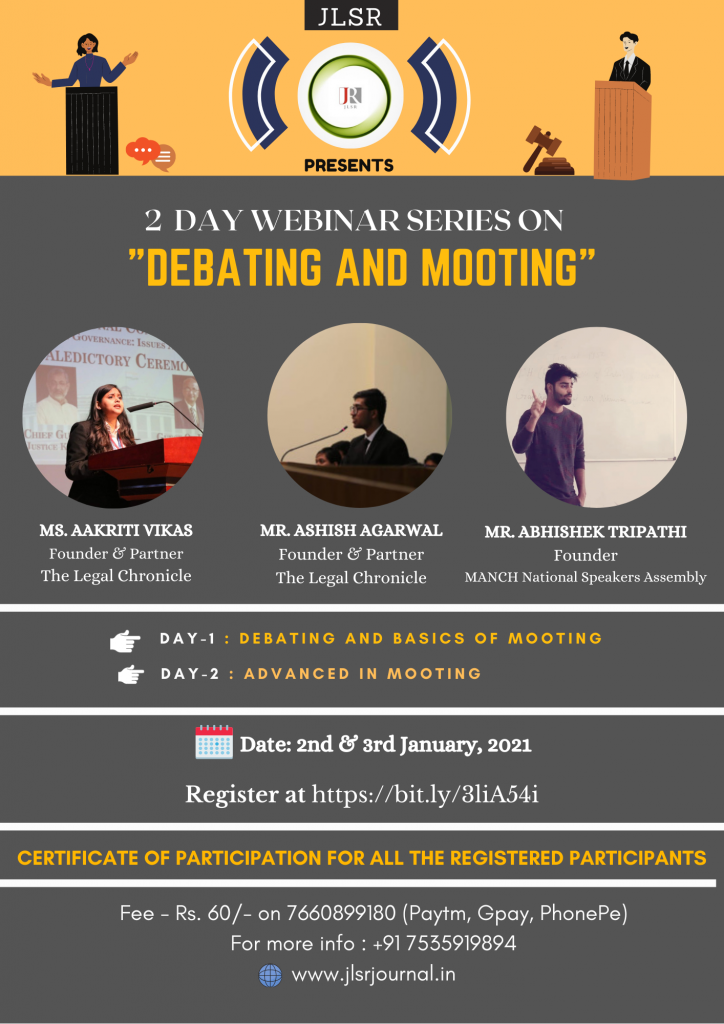
Webinar Series Details

Dates : 2nd January, 2021 & 3rd January, 2021

Day 1 :

Speaker: Abhishek Tripathi, Founder at MANCH National Speakers Assembly.

About :

Abhishek Tripathi is the founder of MANCH National Speakers Assembly. He is a certified Diplomat from American Centre, Embassy of USA, New Delhi.  He is a passionate public speaker and his area of interest includes Mooting, Debating and Legal research. He has excelled in Various Moot court competitions including Runner-Up and 2nd Best Speaker in 3RD TILA International Moot Court Competition on Energy And International Law, 2nd Runner-Up in JINDAL-SURANA Moot Point Series by Jindal Global Law School and Surana & Surana International Attorneys and various Debate Competitions inter alia Best Speaker in Adi Shankaracharya Memorial Debate, TRI-FORMAT Debate, NATIONAL EXTEMPORE COMPETITION etc. He also holds various reputed publications in well known Newspapers and Journals including The Daily Guardian, The Asian Chronicle, Indian Journal on Crime and Criminology, International Journal of Advanced Legal Research, International Journal of Law Management and Humanities etc.

Topics which would be covered :

  • The two Essentials of Law School: Importance of Moots and Debates.
  • Deciphering Types of Debates and Moots.
  • The Art of writing and Delivering a Speech.
  • How to Read and Construe the Moot Proposition.
  • How to Conduct Preliminary Research on a Moot Problem.
  • Basics of Pleading: Moot Court Terminologies.
Day 2 :

Speaker 1 : Ashish Agarwal, Founder & Partner at The Legal Chronicle.

Speaker 2 : Aakriti Vikas, Founder & Partner at The Legal Chronicle.

About Speakers :

Ashish & Aakriti graduated from School of Law, Christ University this year (and were supposed to be practising in Delhi). Ashish & Aakriti have won competitions like NLSIU PIL Moot court Competition, Amity International Moot Court Competition, Al-ameen National Moot Court Competition, etc. They were always passionate about practical aspects of law like Research Papers, Mooting, etc. and wanted to teach these things to students who find it difficult for themselves. So, during pandemic they started anorganization named “The Legal Chronicle” where they assist students learn these practical concepts.

Topics which would be covered :

1. How to draft perfect memorial
2. How to Research for the Memorial
3. How to go about oral rounds and answer questions of judges and
4. How to decide the best Moot court for you.

Registration Form & Payment Details

Fee : 60/- Only

Registration Form : https://bit.ly/3liA54i

Googlepay/Paytm/Phonepe at 7660899180

Highlights Of The Workshop:

  • Participants shall be given an e-Certificate of participation.
  • PPT or Notes made by speakers of the session will be provided.
  • Interactive, practical session.
  • Recording of the session will be provided.
  • Questions and answers round.

Contact

Mail Id : jflsrjournal@gmail.com

Mobile : 7535919894

www.jlsrjournal.in