This article is written by Akhilandeswari Bonam, a student of Sri Padmavati Mahila Visvavidyalayam, Tirupati.

INTRODUCTION

Material Alteration is a party to the negotiable instrument. Material alteration can change the character of the instrument or the rights and obligations of the parties. An original instrument can be called an altered instrument after it is altered.

Material alteration occurs, when the changes have taken place in the instrument without the knowledge of the drawer, and changes made after the cheque has been issued. Where the nature of the instrument has changed by the alteration, it amounts to a material alteration. All material alterations must have the drawer’s approval with his full signature where the alterations are made. Without the permission and consent of the drawer, a blank cheque cannot be enforced. 

Instances of Material Alteration

Alteration of date, name, rate of interest, the sum payable, time of payment, place of payment, the addition of parties, tearing a material part of the instrument, by increasing or affixing stamps, by the erasure of an account payee crossing, an order cheque to a bearer cheque except by or with the consent of the drawer.

Illustrations:- The drawer can change the instrument before issuing a cheque. It is always open to a drawer to voluntarily re-validate a negotiable instrument including a cheque. Veera exports vs. T.Kalavathy, 2002. The alteration may be made on changing the bank at which the bill is payable. He may also change the rate of interest in the instrument. Seth Tulsidas Lalchand vs.Rajagopal-1967.

Alterations which does not Constitute a Material Alteration

Alterations which are made with the consent of the parties and alteration which corrects the mistakes of data or clerical error. The alteration is not apparent and the instrument goes into the hand of the holder.

After alteration made in the instrument, the parties of the old instrument cannot be held liable to the new instrument or altered instrument to which they never consented.
Gaur Chandra vs Prasanna Kumar. The party who consents to the alteration or who alters the instrument is not entitled to complain against such alteration.

A material alteration is one that varies the rights, liabilities, or legal position of the parties as ascertained by the original instrument (Loonkaran Sethiya vs Ivan E. John, 1977). Whether an alteration is prejudicial or beneficial to the parties, the liability of parties is avoided by material alteration. 

Effects of Material Alteration

The material alteration of a cheque renders such instrument void and same cannot be enforced against any person who was a party to such instrument at the time of material alteration and did not give his/her approval to it.

Responsibilities of Banker

The paying banker should not make a payment on a materially altered cheque. If the alteration is confirmed by the drawer with his full signature, the banker should honour it. Material Alteration does not affect the collecting banker. Without the permission and consent of the drawer, a blank cheque cannot be enforced.

The Crossing of Cheques   

The crossing of cheques means drawing two parallel lines on the face of the cheque.  Crossing of the cheque is an instruction to the bank given by the customer on how to give payment and who can give it. Crossed cheque cannot be paid at the counter, it can be endorsed to anyone, payment will be through the bank.

Object: A crossing is a warning to the bank not to make payment of the crossed cheque over the counter. Crossing functions as a caution to the paying banker.

Types of Crossing Cheques

General crossing: When a cheque bears two transverse lines across its face and the addition of words in between those lines.

  • Amount cannot be paid in cash
  • Amount can only be credited to the bank account of either the named payee or an endorsee

Special crossing: When the name of the banker is written on the face of the cheque. When the words “not negotiable” are added to the cheque, then the cheque losses its negotiability..

  • Amount cannot be paid in cash
  • Amount can only be credited to a bank account in the named bank.

Account Payee Crossing: Where the drawer adds the words like account payee, or account payee only to the general or special crossing it gives direction to the collecting banker to collect the cheque and credit the amount to the account of the payee only. This crossing is not statutorily recognized.

Not Negotiable Crossing

  • Cheque can be endorsed
  • Transferees cannot have or give a better title to the cheque than the transferor.

The addition of words takes away the main feature of negotiability that a holder with a defective title can give a good title to the subsequent holder in due course. It is a statutory crossing.

Protection of Paying Banker from Liability in the Following Cases

  • Where a cheque is drawn by the payee with an order of drawer, the banker is not held liable if such payee is a fraud, or the banker is not held responsible for the forged signature of the drawer.
  • The banker is not held liable in a cheque payable to the bearer. In this case, it doesn’t matter whether the apparent holder is the owner of the cheque or not.

The banker must have acted in good faith and without negligence.

  • The banker had received the payment of the crossed cheque.
  • The collection was made by the bank on behalf of the customer.

Double-crossing: When a cheque bears two special crossings is known as double-crossing. In this, the second bank acts as an agent of the first collecting banker. It is made when the banker in whose favour the cheque is crossed does not have a branch where the cheque is paid.

Opening of crossing: The cheque can be cancelled by the drawer by writing the words “pay cash” on the cheque with his full signature. Law does not permit but it has been risen out of custom.

Latest Posts


Archives

This article is written by Akhilandeswari Bonam, a student of Sri Padmavati Mahila Visvavidyalayam, Tirupati.

INTRODUCTION

A treaty or convention is conducted for the protection of the environment when the chemicals, hazardous substances, pollutants have taken place in the environment. The following are the conventions that cover the aspects of pollutants, hazardous wastes, and hazardous chemicals.


Stockholm Convention on Persistent Organic Pollutants

It is an international environmental treaty adopted in 2001 and came into force in May 2004. India approved to ratify the convention on 20th October 2005 and ratified in 2006. The convention aims to protect the environment and human health by eliminating the use of Persistent Organic Pollutants (POPs).

This convention was finalized after the completion of four years of work. UNEP is the leading international environmental entity that supports the agenda and implementation of environmental sustainability for the United Nations.
POPs are kind of chemicals that cause problems to the environment and human health because they are stored in the fatty tissue or organs of animals, where they can have toxic effects. POPs are organic compounds that are resistant to environmental degradation through chemical, biological, and photolytic processes.

POPs can disrupt the endocrine system, cause cancer, cause genetic defects, and weaken the immune system. Human beings mainly consume pops from food, drinking water, air, and also skin through direct contact with the chemicals.

The Persistent Organic Pollutants Review Committee was established to consider additional compounds for regulates the use of these chemicals.  The convention categorizes the 12 toxics into three viz, Pesticides, Industrial chemicals, and By-products.

Conference of Parties (COP) to the Stockholm Convention in Geneva, recommended for the elimination of production and use of endosulfan and its isomers worldwide, subject to certain exemptions. The role of parties is to implement the obligations of the convention. The process of becoming a party begins with a state or regional economic integration organization submitting a means of ratification, acceptance, approval, or accession to the depositary.

Structure of the Stockholm Convention

  1. Reporting obligations
  2. National Implementation Plan
  3. Notification of information to the secretariat
  4. Financial Mechanism (GEF)
  5. Financial and technical assistance
  6. Regional centers
  7. Legal basis for compliance

GEF – Global Environment Facility is a financial mechanism established to address global environmental threats. The convention will enable India to avail of technical and financial assistance for implementing measures to meet the obligations of the convention.

Basel Convention

The Basel Convention on the Control of Trans-boundary Movement of Hazardous Wastes and Their Disposal was adopted in 1989 by the conference of Plenipotentiaries at Basel, Switzerland. It entered into force on May 5th, 1992. Haiti and the United States have signed the convention but not ratified it. It does not, however, address the movement of radioactive wastes.

The Geneva meeting amended the 1989 Basel Convention on the control of hazardous wastes to include plastic wastes in a legally binding framework. The objective is to reduce the transboundary movement of hazardous wastes, minimize the generation of hazardous wastes, and help developing countries with the environmentally sound management of the hazardous and other wastes they generate.

Trans-boundary movement of hazardous wastes means several developed countries, dumped their hazardous wastes in some developing or less developed countries. To overcome this movement the Basel convention was designed. The transferring of wastes from developed countries to less developed countries has been termed as “toxic colonialism” by several authors. The reason for the rise of the movement of wastes from developed countries to developing countries is laxity in environmental laws, regulations, and their enforcement in the less developed countries. Clinical wastes from the hospitals, pharmaceutical products, mineral oils, etc are to be controlled under this convention.

Basel Ban Amendment

The original convention did not prohibit waste exports to any location except Antarctica but merely required a notification and consent system known as Prior Informed Consent.

Many wastes traders wanted to exploit in the name of recycling, so it was felt by many that there should be a full ban on the export of hazardous materials.

Requires certain controls over exports of hazardous and other wastes

  1. Notification and consent:-
  2. Sets the Prior Informed Consent
  3. Without this procedure, it considers as illegal traffic (criminal)
  4. Prohibitions or Bans:-
    1. Countries can ban imports on a national basis
    2. Ban on export to Antarctica
    3. Ban on trade between parties and non-parties

What does the Basel Ban Do and Not Do?

It creates a new Annex VII of developed countries – consisting of member states of the European Union, the Organisation for Economic Cooperation and Development (OECD), and Liechtenstein. It prohibits exports of hazardous wastes from Annex VII countries to Non-Annex VII countries. It does not prohibit trade from Non-Annex VII countries to any other countries. It does not prohibit trade between Annexure-VII countries.

Environmental Impacts

Downstream: Protects the environment and people in developing countries from pollution and exposure.

Upstream: Provides strong new economic and legal incentive for implementing waste prevention or green design at source


Rotterdam Convention

It is an international legally binding instrument that covers certain hazardous chemicals and pesticides in international trade. It is important to understand that the convention itself does not ban chemicals and pesticides but it is only asking for structured information exchange on these substances to protect human health and the environment.

To contribute to the environmentally sound use of those hazardous chemicals. It facilitates information exchange about their characteristics on a very broad range of chemicals. It is formally, the Rotterdam Convention on the Prior Informed Consent procedure for certain Hazardous Chemicals and Pesticides in International Trade.
The convention promotes an open exchange of information and calls on exporters of hazardous chemicals to use proper labeling, include directions on safe handling, and inform purchases of any known restrictions or bans.

Rotterdam Convention contributes to achieving food security through sustainable agriculture.
Global impact: Growing coffee without Endosulfan
Sub-regional impact: Promoting Agroecology through the elimination of hazardous pesticides.
Regional impact: Awareness of pesticide exposure of particularly vulnerable groups, EU-funded partner project in former Soviet Union Countries together with AGPMC.

Latest Posts


Archives

This article is written by T.PREETHI, a student from government law college, Tirunelveli. In this article the student had discussed about climate change, global warming, initiatives by the nations around the world, Kyoto protocol, Doha agreement, and Paris climate agreement and at last, and the present day scenario.

Climate

The variation in temperature, humidity, atmospheric pressure, wind, precipitation, atmospheric particle count and other meteorological variables in a particular region over a period of time is known as climate. The climate of a region is generated by the climate system. A locations climate is affected by its latitude, terrain, altitude, nearby water bodies and the currents.

Climate Change

The variation in the climate in a region over a period is known as climate change. These changes reflect the atmosphere over time scales. They are the results of the natural processes like continental rift, volcanoes, ocean currents, the earth’s tilt, comets, meteorites and also with the contribution of human activities.

Global Warming

It is primarily the problem of excessive amount of carbon dioxide in the atmosphere. The major reason for this condition is burning fossil fuels like coal, oil and natural gas for energy. Not only this, certain waste management and agricultural practices have also aggravated the problem by emitting other gases such as methane and nitrous oxide which are the results of dumping waste, coal mining, using fertilizers etc.

The consequences of global warming are more evident on earth’s physical, chemical and biological processes now days. As a result of climate change we experience the increase in illness, death from heat waves, wild fires, storms, floods etc. at the same time, we also experience shift in season cycle, extreme weather,  melting of ice, increase in sea level, loss in natural habitat, extinction of species etc.

Legal Efforts

In the year 1992, the changes caused by emission of greenhouse gas, was addressed in the United Nations framework convention on climate change. The intergovernmental panel on climate change (IPCC) drew attention in the international forum on climate change with its 1990 assessment report. The report stated that, the increase in greenhouse gas emission has caused considerable warming on earth’s surface beyond its usual level.

In the fourth report on climate change, released in 2007, it was mentioned that, the human activities increased the concentration of GHG.

Initiatives

In the year 1992 an initiative to control GHG emission was introduced in the United Nations framework convention on climate change (UNFCCC). Several principals were established on how the international forum would address the climate change. The parties of the UNFCCC agreed upon developing a national greenhouse gas emission inventories, share scientific research and technology and help in creating measures for climate change adaption. However, none of these agreements were legally binding

In the year 1997, the Kyoto protocol came up.

The Kyoto Protocol

It is an international agreement that aimed at reducing the CO2 emission and the presence of GHG in the atmosphere. The primary ideology of this is to reduce the CO2 emission in industrialized nations. This protocol was adopted in Kyoto, Japan in the year 1997 on December 11 and became a international law on February 16, 2005.

Those countries that ratified the Kyoto protocol were assigned maximum carbon emission and participated in the carbon credit trading. If any ratified country entitled more than the assigned limit, it would be penalized for failing to keep up the emission level below the limit.

Primary Objective

  Under the Kyoto protocol, the developed industrialized countries agreed upon reducing the hydro carbon emission by 5.2% by the year 2012. This would represent around 29% of the world’s total GHG emission. The targeted level for each country varies from one another. The European Union gagged that; they would cut emission by 8% while the United States and Canada said that they would reduce by 7% and 6% respectively by 2012.

The Kyoto protocol placed heavy burden on the developed nations and mandated the 37 industrialized nations to cut their GHG emission. This protocol separated the countries into two groups, annex-1 and non-annex-1. The ones that were listed under annex-1 had limitations on the emission level; while the ones listed under non annex-1 participated by investing in projects, which were designed to reduce emission in their countries. For this initiative, the developing countries earned credits known as “carbon credits” which they use for trading or selling to developed nations allowing a higher level of maximum carbon emission for that period.

In the year when Kyoto protocol became a international law there was still rise in the global emissions. In fact, between 1990 and 2009 there was a increase of about 40% in emission globally.

Doha Agreement

In the year 2012, December the first commitment period ended and the parties of the Kyoto protocol met in Doha, Qatar for the amendment of the original Kyoto agreement. In this Doha amendment new emission reduction targets were added. Second commitment period, it ended up with a short life span when the Paris climate agreement was signed.

The Paris Climate Agreement

In the year 2015, the participants of UNFCCC signed a pact at the sustainable development submit held in Paris. Almost every nation adopted this in order to address climate change and its negative effects. All the major GHG emitting countries agreed upon cutting down their climate-altering pollution and strengthen the commitments over time. This agreement provided a way for the developed nations to assist the developing nations in their efforts to adapt climate control. This created the framework for monitoring and reporting climate goals transparently. 

Climate Change Laws in India

India being an emerging large economy faces challenges relating to energy and climate changes. On one hand people suffer without proper access to electricity and demanding more energy. This will substantially result in high energy usage and emission in the future. With that being said, India is vulnerable to the impact of climatic changes and in particular water stress, agri and susceptibility to weather-related disasters.

Despite being a non-annex 1 country under the Kyoto protocol, it is an active participant in the clean development mechanism (CDM) established by the protocol. It has made some major climate laws like 

  • National action plan on climate change, 2008
  • National electricity paln, 2012
  • Post- Copenhagen domestic actions, 2010
  • Tariff policy, 2006

Kyoto Protocol in Present Day

In the current scenario, it is still alive with tangled complexities of political involvement, money, lack of leadership, consensus and bureaucracy. Almost all that global warming is the result of human actions. An action by them needs a remedy by them only; this remedy should be in the form of behavioral changes.

REFERENCES:

  • CLIMATE CHANGE available @eli.org
  • INDIA: CLIMATE CHANGE- INDIAN LAW AND JUDICIARY available @mondaq.com
  • THE KYOTO PROTOCOL available @ investopedia.com

Latest Posts


Archives

This article is written by Akhilandeswari Bonam, a student of Sri Padmavati Mahila Visvavidyalayam, Tirupati.

INTRODUCTION

Environment means the natural world and the combination of living and non-living organisms. A human being has a very close relationship with the environment. The quality of the environment is reducing due to the changes in the world. There were many conferences, conventions and protocols that had been organized for the protection of the environment. Many countries have incorporated specific provisions relating to environment protection in their own domestic laws. India also enacted such legislations in relation to the environment protection and also made amendments to the existing laws.

National Perspective


The role of the Constitution of India and the Supreme Court is crucial regarding the execution of environmental laws in India. Article 21 of the Indian Constitution defines that “No person shall be deprived of his life or personal liberty except according to procedure established by law.” Meanwhile, the scope of Article 21 got widened by the active role of the judiciary. Article 21 includes not only the right to life, but also the right of a pollution free environment etc. Pollution of environment, ecological, air, water etc, must be considered as violation of Article 21.
    Article 14 guarantees right to equality, it plays a vital role in the protection of the environment because it inquires into the arbitrariness of the discretionary actions done by the State authorities. Article 19 provides the right to freedom but such freedom should not be a cause for the environmental pollution. Article 47 imposes responsibility on states to prohibit intoxicating drugs and drinks which are injurious to health.
      With the result of the Stockholm Declaration,1972, several amendments were made to the Indian Constitution. The principles of the Stockholm Declaration were incorporated in the Constitution through the 42nd amendment. Article 48-A and 51-A(g) were the resultant of the 42nd amendment.
      Article 48-A was included under the Directive Principles of State Policy. It imposes an obligation on the State to protect and improve the environment and safeguard the forests and wildlife. Article 51-A, a fundamental duty imposes responsibility on every citizen to protect and improve the natural environment including forests, lakes, rivers and wildlife and to have compassion for living creatures. The Indian Constitution imposes responsibility on both the Government and the citizens to promote and protect the environment. Under the 42nd amendment, the protection of forest and wildlife were included into the Concurrent List as entries of 17A and 17B. The Supreme Court and the High Court have given new interpretations to the constitutional provisions relating to the environmental pollution.
INTERNATIONAL PERSPECTIVE:
      There are many Conventions that have taken place for the improvement and protection of the environment. Recently, amendments were also made to some conventions and protocols. The nations which have signed and ratified any protocol or convention must be bound to the rules and regulations.

Development of International Environmental Law

The field of International Environmental Law focuses on the relationship and agreements among the nations. Stockholm is regarded as a watershed in the field of environment as it takes the issue of environment with respect to national and international level of policy and law.
     Noordwijk Declaration of Atmospheric Pollution and Climatic Change on November, 7,1989. This declaration made it clear that climate change is a common concern of mankind. It also accepted the “world legal order” is essential to deal with the problems of the environment.
There are some benefits associated with climate change and immense problems, challenges and damages.
*Benefits and damages to agriculture and forestry.
*Changes in the optimal climate for various crops,     * Drought in some regions,
*Water supply changes,
*Increased rainfall and its effect on pollution runoff and flood control,
* Coastal damage,     * Health effects,
*Biodiversity impacts, *Regional effects,
*Shrinking of glaciers.

The IEL respond through the World Climate Conferences in 1979 and 1990, as such:
i. Climate change is not the problem of one nation, it is “common concern of humankind.”
ii. Common but differentiated responsibilities: This responsibility was taken by the individual countries to put restrictions over increasing or reducing the rate of greenhouse gases.
iii. Precautionary Principle: This principle says that in the areas of scientific uncertainty where there is a risk to the environmental resources, the nation or the world should take precautions even if the specific outcomes are not scientific.

Basel Convention on trans-boundary Movement of Hazardous Wastes, 1989

  • The convention came into force in 1992.
  • The objectives of the convention are to reduce trans-boundary movements of hazardous wastes, to minimize the creation of such wastes and to prohibit their shipment from developed countries to the LDCs.*India ratified the convention and enacted Hazardous Wastes Management Rules Act,1989.

Paris Agreement, 2016

  • It is an agreement within the UNFCCC dealing with greenhouse gases emissions mitigation, adaptation and finance starting in the year 2020.
  • Unlike the Kyoto protocol, which sets commitment targets that have legal force, the Paris Agreement, with its emphasis on consensus-building, allows for voluntary and nationally determined targets.

International Perspective on Occupational disease prevention

Occupational Health (OH) is protected in the workplace (local) but guided by policies and regulations (provincial) and motivated by expectations, perceptions and goals (national). Global health is more comprehensive than the relationship between developed and developing countries.
The reason that we protect health at work is, for people having better lives which is the whole reason we produce goods and services to share around the world.

  • Healthy people live better lives when they are working at safe and secured work.
  • Workers are the most economically productive segment of society.
  • Healthy people live and work better.


International Union for Conservation of Nature and Natural Resources

It is to influence, encourage and assist societies all over the world for conserving the integrity and diversity of nature and to ensure that any use of natural resources is equitable and ecologically sustainable. The objective is to find pragmatic solutions to our most pressing environmental and developmental challenges. It advises all the major conventions viz, CITES, CBD, UNFCCC, RAMSAR, UNEP etc.

Latest Posts


Archives

About the Organiser

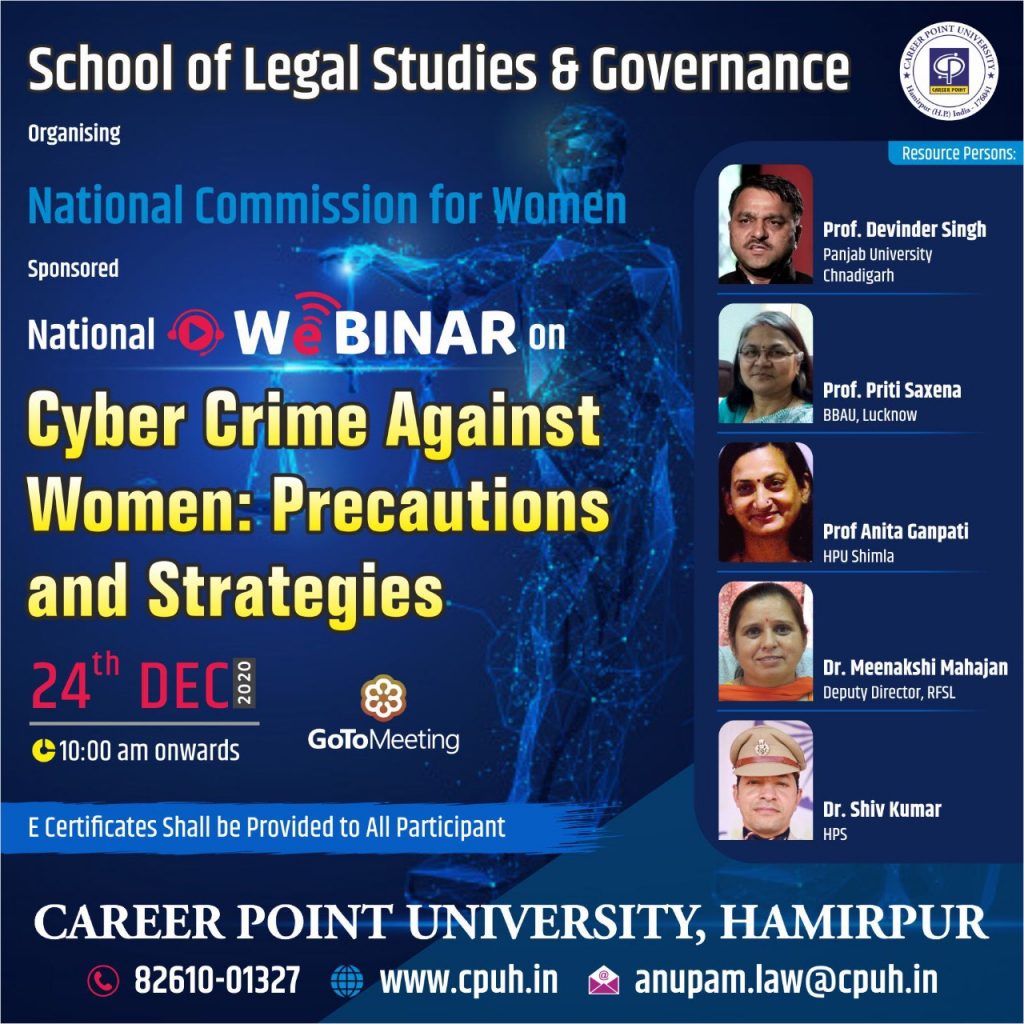
School of legal studies and governance Department of laws Career point university Hamirpur Himachal Pradesh in collaboration with National Commission for Women, New Delhi is organising National Webinar on “Cyber-crime against Women: Precautions and Strategies

Date and Time

24th December  2020 (10 Am– 04:00 PM)

Registration link- 

https://docs.google.com/forms/d/e/1FAIpQLScXIZShfnJvPIuqEofshmBt3LTDluJv8Z5OBau36op7UJKrFQ/viewform?usp=sf_link


WhatsApp group link- https://chat.whatsapp.com/CcHECoTxoq6Idd0XIm1J0b

Organizer:  S. Bhambri & Associates (Advocates), Delhi.

About the Firm: Our multidimensional law office, was a brainchild of our senior-most associate and partner, Mr N.K Bhambri, we believe in providing straight cut solutions to our client’s legal problems. We endevour to coordinate with our associates as well as with our paralegal staff and interns to assist our clients and provide them with maximum satisfaction out of our services. Our Managing Partner Ms Sofia Bhambri, has been a pillar to our firm and provides with empathetic viable solutions to our female clients, who are in extreme distress due to familial issues and who seek a legal way out. Our paralegal staff is equipped with qualifications to assist our lawyers and engage in legal research. Apart from our lawyers, paralegal staff we associate law interns, with us every month.  Our firm deals with legal cases pertaining to Delhi High Court, Punjab & Haryana High Court, District Courts as well as Debt Recovery Tribunal, Motor Accidents Claims Tribunal, Consumer Courts, Hon’ble Supreme Court of India.

Details of the Online Internship Oppurtunity:

For the month of January, 2021

Eligibility:

Only Undergraduate Law Students pursuing Three Year LLB or five year Law Course are eligible to apply. Selected candidates will be intimated through email only.

Registration:

Interested Candidates may send their CV and cover letter at sofiabhambri@gmail.com

Perks:

  1. Certificate of Internship upon successful completion of tasks.
  2. Publication Oppurtunity at our website sbhambriadovcates.com
  3. Future Referrals
  4. Mentorship
  5. Best Intern of the Month Award.

Location:

Briefing would be done on Google meet for the selected candidates

Deadline:

28th December, 2020.

Transfer petitions had been filed for transferring various writ petitions which have been pending in the High Courts of Madras, Calcutta and Kerala. The writ petitions asking to be transferred were seeking the validity of Chapter VI of the Guidelines No.1- CA(7)/02/2008 dated 08.08.2008 issued by the Council of  Institute of Chartered Accountants of India. The aforesaid guideline was said to be violating Article 19 (1) (g) of the Constitution of India. 

“Article 19 (1) (g) guarantees to all citizens the right to practice any profession or to carry on any occupation, trade or business. This freedom is not uncontrolled, for clause (6) of Article 19 authorises legislation which imposes reasonable restrictions on this right in the interest of the general public.”

Chapter VI of the Guidelines actually hold that any member of the institute who is in practice is not allowed to accept in a financial year more than the specified number of tax audit assignments. According to the Income Tax Act of 1961 Section 44AB, the number at present is 60. Also, Section 22 of the Chartered Accountants act of 1949 defines that professional or other misconduct shall include any act or omission which is provided in any of the Schedules to the  Act. Thus Clause 1 of Part II of the Second Schedule to the Act holds that a member of the Institute who is in practice shall be deemed to be guilty of professional misconduct If the individual contravened any of the provisions of the act or the regulations which were made under its guidelines issued by the council of the Institute. Hence if an Institute member contravened the provisions provided in Chapter VI of the Guidelines dated 08.08.2008 would be deemed to be guilty of professional misconduct under the Chartered Accountants Act of 1949.

After the issuance of the guidelines which was dated 08.08.2008. several writ petition has been filed by aggrieved parties in different high courts details of which had been provided in the judgment.

The contention was that the transfer of the writ petitions be allowed as this would help avoid the multiplicity of proceedings, conflicts of decision and also settle the law which was of public importance dealing with the Institute of Chartered Accountants of India which was the regulatory body governing chartered accountants in India. 

However opposing counsel was of the view that there was no such convenience that would be availed by such transfer except the fact that it would avail the convenience of the petitioners and in fact, it would take way the right guaranteed under Article 226 of the Indian Constitution. They also contended that Article 139A of the Constitution is an exception to be exercised only in rare and exceptional circumstances.

Article 139A of the Constitution of India deals with the transfer of certain cases and provides for consideration of the matter by the Supreme Court of India as well as transferring of cases from one High Court to another.

The respondent took precedence from the judgment passed by the Court in, Institute of Chartered Accountants of India versus Southern Petrochemical Industries Corporation Ltd and Anr (2007) 15 SCC 649 where the court had directed all the writ petitions to  Calcutta High Court. They were of the opinion that even in the present case the court should consider transferring all the writ petition to anyone High Court instead.

  • THE SUPREME COURT JUDGMENT 

The Supreme Court however through its 3 judges Bench however held that its judgment in a previous case does not preclude the consideration of the prayer of the petitioner asking for transferring the writ petition to the Supreme Court. Since the issue was a matter of public importance affecting Chartered Accountants as well as the citizens who have to obtain compulsory tax audits they were satisfied to settle the law and to clear the uncertainty among the professionals dealing in tax and the citizens that it was appropriate that the Supreme Court should transfer the writ petition to pronounce the law on the subject in an authoritative manner.

It was therefore decided that the registry should transmit the order to all the respective High courts immediately as the writ petitions mentioned would be withdrawn to the Supreme Court now however the interim orders passed in the writ petitions being transferred to the Supreme Court would continue till any other order is passed by the Supreme Court.

Report By-Alifya

Tap and Join

1. Accenture India

Accenture India is looking to hire for the job post of Associate for Domestic Language

Job Description

Skill required: Domestic Language – Hindi
Designation: Management Level – New Associate
Job Location: Mumbai
Qualifications: Any Graduation
Years of Experience: 0-1 years

Location:

Mumbai

How to apply?

Interested please click on the link given below

https://www.accenture.com/in-en/careers/jobdetails?id=68569_india_2&src=LINKEDINJP

2.Paypal India

PayPal India is inviting applications for the job post of Sanctions Investigator for its office in Chennai.

Employee Type:
Full-Time

Location:
Chennai

Job Type:
Compliance Investigations

Experience:
Not Specified

How to apply?

Interested please click on the link given below

https://jobsearch.paypal-corp.com/en-US/job/sanctions-investigator/J3Q31R76L9PVW2GQPLP

TAP HERE TO RECIEVE AT EARLIEST ON WHATSAPP
About the Opportunity

Azim Premji Foundation invites applications for the Job Post of Teacher Educator in Uttarakhand to work for them.

About the Foundation

Azim Premji Foundation is a not-for-profit organization that has been working since 2000 with the elementary education system in rural government schools. The Foundation
began by implementing various programs to improve educational quality across the Country.

Eligibility
  • Graduation or Post graduation with a minimum of 2 years of teaching experience.
  • Candidates with substantial on-field experience in education NGOs may also apply
  • Willingness to travel within the district/state
PQE:

2 years of experience

Location: Uttarakhand, India

Official Link:

https://careers.azimpremjifoundation.org//#!/custom-apply-page/resource-person-teacher-educator-uttarakhand-india-2018092416490030

The Parliament put an end to all the speculations as it announced that there will be no Winter session for the Parliament due to the outbreak of the Coronavirus pandemic. All political parties have favoured the scrapping down of the session in order to curb Covid spread and would straight away be jumping to the Budget session that takes place in January as per the information received by Parliamentary Affairs Minister Pralhad Joshi. 

The news was confirmed through the means of a letter on Monday which was in response to Congress leader Adhir Ranjan Chaudhary’s demand for a session so that the new farm laws could be discussed owing to its controversial nature as the massive farmer protests have taken over the highways near Delhi. Stress was laid on the need to amend these laws that have been forced through Parliament by the government. 

The justification provided in the letter for not holding the Winter session of the Parliament was said to be in support of the cases of coronavirus which have seen an increase in the winter months and therefore it was crucial to take steps in order to manage the pandemic.

“It would be appropriate to have the Budget Session, 2021 in January, keeping in mind the unprecedented circumstances created by COVID-19 pandemic (sic),” the letter said.

It was decided that since it was the middle of December and the vaccine is supposedly going to come very soon thus all the floor leaders of various political parties were expressing concerns over the increase of the pandemic and they were of the consensus that the Parliament should do away with the Pandemic. 

However, since the Parliament will be now meeting for its Budget session in 2021 which is expected to be held in the last week of January before the budget is announced on the first of February. 

The decision to scrap down the winter session also came forth after the Monsoon Session had to be cut down because many members of Parliament had contracted the Coronavirus disease. Since a large figure of the parliamentarians is elderly it naturally made them more prone to the coronavirus and this is also one of the reasons that had to be considered.

Was The Congress not consulted in making the decision? 

Though the Parliamentary Affairs Minister made it clear through a letter to the Congress that all political parties were in favour of not holding a winter session in order to avoid further Covid spread and would directly beholding the budget session in January however Congress has said that it was never consulted in the first place

Does the scrapping down of the Winter Session have anything to do with the controversial farm laws? 

The monsoon session was held in September after a long delay yet was considered to be one of the most productive sessions as there were 27 bills that were passed in the continuous sittings that were held by the parliament. 3 farm laws which have sparked the current protests were also passed during this session and though the justification given by Parliament for scrapping down the winter session was to curb the spread of the virus however in the opinion of Congress’s Lok Sabha leader Mr Chaudhary the letter addressed to him was actually a way of the government to get away with the mess that has been caused because of the current farmer protests.

Another senior Congress leader Mr Ramesh also tweeted that the government was actually “departing from the truth” and the Leader of Opposition in the Rajya Sabha, Congress Member Ghulam Nabi Azad had actually not been consulted before taking the decision of scrapping down the winter session this year.

Several Congress leaders have demanded that a session be held in the Parliament with necessary precautions at the earliest because they were various concerning issues involving the country that needed to be discussed with included the economy, the situation with China as well as the farmer protests.

Since 17 members of the Lok Sabha and 8 members of the Rajya Sabha had tested positive before the session started and many other members of Parliament who had tested negative initially later contracted the virus during the monsoon session is the reason why the Parliament was of the opinion that it was best to do away with the winter session for this year.

Not being able to hold the winter session owing to the pandemic situation in a time when there is a lot happening in the country that needs to be discussed and addressed can definitely be termed as a crisis that the country is dealing with due to the Covid-19.

Report By- Alifya

Loved It? Join Our Groups to Stay Updated !!!

Click to Join

To join as Our Legal Journalist or for Query/ Compliment/ Criticism write us – Newsstories.lexpeeps@gmail.com