This article has been written by Mansi Tyagi, a student at Symbiosis Law School, Pune. Part III of the Indian Constitution envisages the six fundamental rights for an individual. In this article, she has tried to explain three doctrines applicable to these rights viz. Doctrine of Eclipse, Doctrine of Severability and Doctrine of Waiver.

INTRODUCTION

Part III of the Constitution of India enshrines six fundamental rights for any individual. These fundamental rights are enshrined to give effect to the objectives of the constitution stated in the preamble. They along with the directive principles of state policy, ensure individual dignity. The state is duty-bound to protect these rights, and no provision of the legislature can curtail these rights. What makes these rights unique is Article 32 which provides for constitutional remedies in case of their violation. Article 13 of the Indian Constitution talks about the laws which are inconsistent with or in derogation of the fundamental rights and the after-effect on such laws by the constitution. Article 13(1) renders such laws void, and the two doctrines applicable to such laws are eclipse and severability. Furthermore, the Doctrine of Waiver talks about the individual right to waive their rights.

Doctrine of Eclipse

In simple terms, an eclipse means when one thing overshadows one other thing. Thus, when a law tries to violate or gets inconsistent with a fundamental right, this doctrine is applied to overshadow the inconsistent law by the fundamental right. However, the doctrine is applicable only to pre-constitutional laws which become inconsistent. Through this doctrine, the law is merely declared dormant, thus being unenforceable. But the same cannot be struck down since that can be only done by the authority making them. Also, such law can be subsequently revived through an official gazette if the inconsistency between such law and the fundamental right declines. This is because even when such laws can be held invalid, they never cease to exist. However, such revival is not mandatory to be made. There are two of the many landmark judgments in which the doctrine was applied are discussed below:

1. ‘Keshavan Madhava Menon vs. State of Bombay

The law in question under this case was the Press and Regulation of Books (Act). The foremost section of the statute required prior consent from appropriate authorities before publishing anything. And if such prior consent was not taken, then under a subsequent section, the person was criminally liable. The aggrieved files a suit for violation of Article 19(1)(a), i.e. his right to freedom of speech and expression. Under Article 13(1), the Hon’ble Supreme Court was justified in deciding upon the validity of such law, and thereby by virtue of the doctrine of eclipse the same was held dormant. However, there was no remedy for the person aggrieved since the cause of action arose before the constitution came into being, and it has no retrospective effect.

2. Bhikaji Narain Dhakras vs. State of Madhya Pradesh

In this case, the Central Provinces and Berar motor vehicle (Act) was in question. For commercial transportation, the law allowed licensing only to government vehicles. The case was filed for violation of Article 19(1)(g), the right to practise any profession, or to carry on any occupation, trade or business. The Hon’ble Supreme Court declared the act dormant, unconstitutional and unenforceable by applying the doctrine of eclipse. It held that the act was ‘eclipsed’ by the fundamental right to trade and profession.

3. Gian Kaur vs. State of Punjab

A case where eclipse was removed – this case overruled the judgment given in ‘P. Rathinam vs. Union of India’ that has previously unconstitutionalised the criminal liability of attempt to suicide under section 309 of the Indian Penal Code. The Gian Kaur case instead revived the section which earlier was eclipsed by article 21 of the Indian Constitution. The court in the case held that the attempt to die unnaturally did not come under the purview of right to life and thus section 309 was not violative of it, thereby the reason to eclipse it ceased to exist.

Doctrine of Severability

The next doctrine is called the doctrine of Severability, in simpler terms, that of separation. How it is different from Eclipse is that here, if any of the provisions in any act or statute is contrary to the fundamental rights, then instead of the whole act, only the impugned provision will become void. However, if such impugned provision is the core provision of the act, the whole act will be struck down then under the doctrine. This indicates to the fact that what is separable, only that will be held void, when such separation is impossible, the whole act will be struck down. This doctrine is applicable to both pre and post constitutional laws. Some of the landmark judgments observing this doctrine are mentioned below:

1. State of Bombay vs. R.M.D. Chamarbaugwala

The doctrine of severability was applied to the interpretation and not the Bombay Prize Competitions (Act) 1952 itself, and the whole act was declared void. The Hon’ble Supreme Court held that where the provisions of the act were so mixed up that it was impossible to separate the invalid and valid part, then the whole act would be deemed void. 

2. Shreya Singhal vs. Union of India

The legislature in Information Technology Act, 2000 through section 66A made a person criminally liable if anything he posted or reacted to was found to be offensive. The contention laid down was that the constitutional validity of the section should be checked because otherwise, it gave open-ended power to the enforcing authorities. This was the result of the non-interpretation of the term ‘offensive’. Thus, resulting in India’s most infamous decision, the Hon’ble Supreme Court struck down section 66A solely out of the IT Act, 2000.

3. Supreme Court advocates-on-record association vs. Union of India 

Also known as SCORA II, the Hon’ble Supreme Court in the case struck down the entire National Judicial Appointment Commissions Act, 2014 since the impugned provision was the core provision of the Act.

Doctrine of waiver

A person is mature and enlightened enough about his liberties and thus it is finally his decision to waive the rights which a state confers on him. This is the premise upon which the doctrine of waiver is laid on. In the Indian context too, a person has the liberty to waive his rights, unless the act does not involve public interest. One case where the doctrine of waiver was allowed by the Hon’ble Supreme Court is mentioned below:

1. Krishna Bahadur vs. Purna Theatres and others

The Hon’ble Supreme Court held that when for a person’s benefit conditions were laid down in any statute, such a person could waive his rights unless there is any public interest involved. Also, the party waiving such rights needs to show a contract him waiving his right in consideration of any compromise. However, the conduct of the person waiving his right can also be considered.

However, fundamental rights are not some general rights given to an individual. And thus waiving them is not as easy as waiving any general statutory right. The Landmark judgment regarding the applicability of the doctrine of waiver is discussed below:

2. Basheshar Nath vs. CIT 

P.N. Bhagwati, J. opinionated that the fundamental rights were protected by the Supreme Court through the Indian Constitution and thus allowing people the liberty to waive them will be misusing the sacred rights to such a reduced level. The Hon’ble Supreme Court went ahead to disallow waiver of fundamental rights quoting their reasoning to be: “These fundamental rights have not been put in the Constitution merely for individual benefit, though ultimately they come into operation in considering individual rights. They have been put there as a matter of public policy and the doctrine of waiver can have no application to provisions of law which have been enacted as a matter of constitutional policy”.

Conclusion

Fundamental Rights in India are the striking feature of its Constitution. Dr. BR Ambedkar gave a two-fold objective of such rights; firstly that every individual enjoys them and secondly that it becomes binding on every authority. Thus whenever any act or law goes inconsistent with the fundamental rights of the individual, either the Doctrine of Eclipse or Doctrine of Severability is applied to such impugned law in order to give prominence and preference to the rights over laws. Also, the Doctrine of Waiver doesn’t allow any individual to waive his fundamental right in any condition. Fundamental Rights as the term suggests are undoubtedly treated like one in India and protected well unlike any other democratic or non-democratic state.

Latest Posts


Archives

ABOUT THE ORGANIZATION

“Table to Screen” is an online education portal “By” the student “To” the student, that creates advanced and practical online courses and customized workshop programs. We bridge the gap between theory and practice in the field of education.


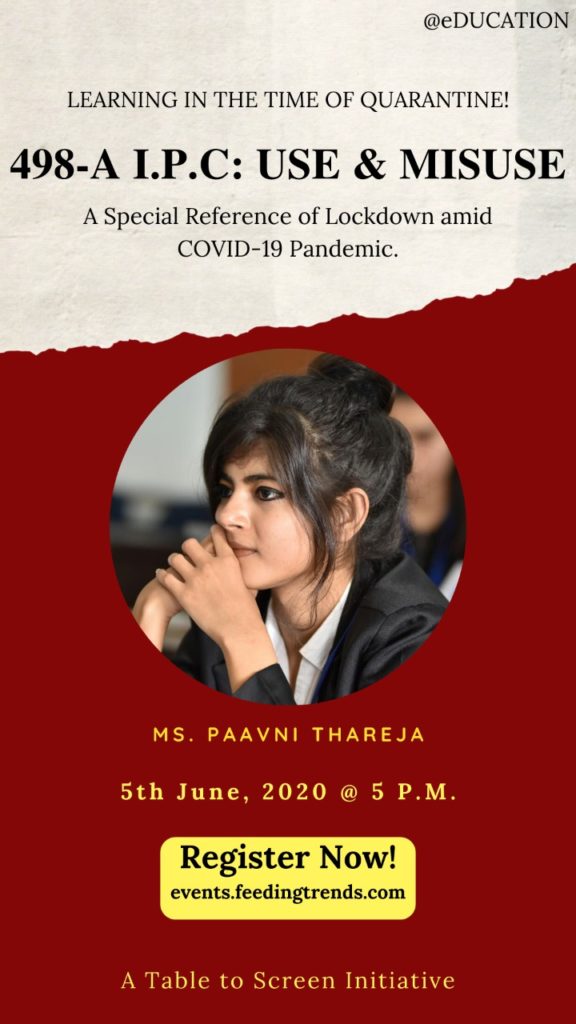
REGISTRATION LINK-

 https://events.feedingtrends.com/webinar-by-ms-paavani-thareja-on-498-a-ipc-online-law/5eb5831f97087748df0b079a

ABOUT THE WEBINAR

2020 is still full of opportunities and possibilities, even though the part of the world you are in has all but “shut down.” Take advantage of the time you have!

 JOIN THE WEBINAR ON

498A I.P.C:  Use & Misuse {A Special Reference of Lockdown amid COVID-19 Pandemic.}”.


ABOUT THE SPEAKER


Ms Paavni Thareja is a Motivational Speaker, Researcher, Youtuber, Blogger & Writer recognized as one of the prominent voices of advocacy & legal-craft. 

WHO CAN APPLY?

Any person who is interested to learn

DATE &TIME

The webinar is scheduled on 5th June 2020 @ 5:00 P.M onward.*
Duration of session:60 Minutes

Add-On-Benefits:


a. ECertificate on completion.
b. Completely online
c. Cost-effective

REGISTER AT

https://bit.ly/ipcwebinaron498a

CONTACT US

tabletoscreen@gmail.com

All registration fee will be donated for feeding poor and migrants in this pandemic crisis.


This article is written by Sharat Gopal, studying BA-LLB at Delhi Metropolitan Education, GGSIPU. In this article, he has discussed about stages of crime and its incoherent forms of offences.

INTRODUCTION

WHAT IS CRIME?

Sir William Blackstone defined crime as an act committed or omitted in violation of a ‘Public Law’ forbidding or commanding it.

Crime can be defined as an act which is against the laws of a country or a region. It is an action or omission of an act which is punishable under the law. In simple terms, it can be understood as a violation of rules made by an authority. Crimes vary from place to place, region to region, country to country. Some acts may be a crime in some countries and it may not be a crime in other countries like eg In India if a person wants to keep firearms with him, he first needs to apply for a licence for it. Keeping fire-arms without a licence is a punishable offence in India. On the other hand, it is completely legal to keep firearms with yourself in the USA. The constitution of the US states that keeping firearms for the safety and protection of oneself is the right of a law-abiding citizen of America.

CRIMINAL LAW IN INDIA

In India, crimes are dealt with the Indian Penal Code of 1860 and Code of Criminal Procedure. The Indian Penal code was drafted by Lord Thomas Babington Macaulay, also called as Lord Macaulay.  IPC was drafted by Lord Macaulay in 1860, under the British Raj. IPC deals with all types of crimes and provides punishment for them on the other hand Crpc specifies the procedures that must be followed by the police, court, etc. Mainly IPC defines the crimes in its various chapters, like chapter II deals with the General Explanations, chapter V deals with Abetment etc.

Section-40 of IPC defines “offences”. It states that anything is an offence, which is made punishable under IPC.

ELEMENTS OF CRIME

For a criminal activity to happen there must be these two elements present-

  1. Mens Rea
  2. Actus Reus

Mens Rea–  it means to have a “guilty mind”. It is a mental element which leads to the crime and where there is no mental element to cause such act/omission, it can’t be held punishable because innocent mind can’t lead to a crime.  There are four phases of mens rea i.e., intention, knowledge, recklessness and negligence.

Actus reus– it means “guilty act”. It is an actual act/omission lead by mens rea for the furtherance of the offence. It is not the process or preparation for the act and it is not even the attempt of the offence but is the actual final committed guilty act which makes the person liable under the law.      

The importance of these two elements can be understood using the Latin maxim “Actus reus non facit reum nisi mens sit rea”, which means that for the conviction of the crime there requires a proof of a criminal act as well as intention behind it, or an act/omission doesn’t make defendant guilty without a guilty mind.

STAGES OF A CRIME

Before discussing incoherent forms of crimes, it is important to discuss the stages of a crime.

  1. INTENTION – The first and foremost important element for constituting a crime is the intention to do any act which will result in a crime. This stage is also known as the mental stage. This is the stage where the person is mentally prepared to commit a crime. This stage is not punishable under the law as it is really difficult to prove, without action, that a person has a guilty mind. eg, A has decided to kill B, but has not taken any step further. Here A has only the intention to kill B and has no act further to constitute the crime and hence his mere intention is not punishable.
  2. PREPARATION – This is the second stage in the process of crime.  This is the stage when the person starts preparing for the crime. He takes all the necessary steps to constitute the crime, eg planning, preparing weapons etc. Generally, mere preparation is also not punishable under law but in certain cases it is made punishable. Eg
  3. Preparing war against Government of India is punishable under section 122 of IPC.
  4. Attacking on any territory of power which is at peace with Government of India, is punishable under section126 of IPC.
  5. Preparing to commit Dacoity is punishable under section 399 of IPC.
  6.  Making preparation for imitating govt coins or stamps is punishable under IPC from section 233-235, 255 and 257.
  7.  ATTEMPT– This is the third stage in the process of crime. This is the stage where the person has acted according to his guilty intention. This is the stage where the person cannot undo his actions. If the offence is completed, then it becomes a crime and if the person misses and the offence is not committed then it becomes an attempt to an offence. Attempt to commit a crime is punishable under IPC. Eg section 308 punishes attempt to commit culpable homicide, section 309 punishes attempt to suicide. In IPC attempt to crime is dealt with differently according to the circumstances, for eg section 121 mentions both completion and attempt of waging war and provides punishment for the crime. But in the case of attempt to suicide or culpable homicide, there are different sections which provide punishments to these attempts to crime. There are some cases where there is no specific section provided for punishing attempts to crime. In these cases section 511 is used for punishing these attempts to a crime.
  8. COMMISSION OF OFFENCE– if the attempt of an offence becomes complete, it becomes a crime. In this stage attempt has being successful and harm has been caused to the victim. This stage is punishable under IPC.

INCOHERENT CRIMES

As above discussed in most of the cases, crime is only punishable when it is complete in nature. There are 4 stages for the commission of a crime. In most of the cases, only completion of a crime is punishable and not the stages above them. But there are certain crimes where the above stages are punished. These crimes are called incoherent crimes or incomplete crimes. These are the crimes which were in their initial stages but were not completed.

TYPES OF INCOHERENT CRIMES-

  1. Attempt to commit a crime– as discussed above, an attempt is trying to commit a crime, but not able to complete it. In an attempt, the person has done his action according to his guilty intention and now that act cannot be undone. In certain cases, an attempt is punishable, like in Murder.

For attempt, 3 essentials are required-

  1. Person must have the intention to commit the crime.
  2. The person takes sufficient steps for completion of the crime.
  3. The crime must not be complete. If the crime is complete it will be dealt with sections that deal with actual crime.

            These 3 essentials are required for punishing a person for Attempt.

  • Aiding and abetting a crime- aiding and abetting means helping for the commission of a crime. In this, the person directly did not commit a crime but helped the commission of a crime by hiding the facts, or helping the person to commit a crime. Aiding and abetting is punishable under IPC,1860. Chapter V of Indian Penal Code discusses about Abetment. Punishment of abetment in provided in different sections of IPC, depending upon the situation.eg section 121 states that if a person abets waging of war, he will be punished with death or imprisonment for life with a fine, section 306 states that if a person abets another person to commit suicide then, the person abetted will be punished for with imprisonment for a term of 10 years with a fine.
  • Criminal Conspiracy – is conspiring for a crime means when 2 or more person agree to do an act which is illegal or to do a legal act in an illegal way. The agreement formed between them is called as a criminal conspiracy. This is the definition provided under section 120A, of the IPC. An important fact to highlight is that, it not necessary that act they conspired must happen. Even without happening or attempting of the crime a person can be punished for conspiracy. Section 120B provides punishment for conspiracy. Rajiv Gandhi Assassination case can be taken as an example of conspiracy where Nalini was punished.
  • Solicitation to crime– it means offering money to another person to persuade him to commit a crime. Eg A offers B 5 lacs to kill C.

DEFENCES TO INCOHERENT CRIMES

  1. Abandonment– a person who accused of incoherent crimes may claim that he abandoned all the efforts to commit the crime. But in order to prove this defence effective, it is necessary to prove that the person voluntarily and he completely abandoned the efforts for committing the offence.
  2. Impossibility– this is the claim where the defendant states that the crime he was about to commit cannot be completed due to unforeseen events. But for using this as a defence, it is necessary that the defendant should have the knowledge of such impossibility beforehand.  

CONCLUSION

From the above-mentioned article it can be concluded that there are many offences which are punishable even before the commission of the crime. In some cases even the preparation of a crime is punishable. It is not always necessary that a crime is only punishable when it is completed. Incoherent forms of crime cover up the loophole which must have been created if only the commission of the crime was punishable and not its other aspects. Otherwise with time offenders must have formed new ways of crime without being involved in it.

NAME OF THE ADVOCATE

Kanchan Pamnani

DURATION

one month

NO. OF INTERNS REQUIRED

2 Research Associates

STIPEND

Rs.2500

ELIGIBILITY

Students in their 3rd,4th and 5th year of the law program at any law school in India

DEADLINES TO APPLY

Before Thursday, 28th May 2020 (05:00 p.m)

send your cv with a short writing sample to shah.maitreya32@gmail.com. The subject is ” Research Internship”

ABOUT THE EVENT

In pursuance of this quest to grow, University School of Law & Legal Studies is conducting the ‘1st All India Online Vimarsh Competition’, an online elocution competition to further the prospect of public speaking among students.

TOPIC

New World order in wake of COVID – 19, Opportunities and encumbrances/कोविड – १९ के उपरांत नयी विश्व-व्यवस्था, अवसर एवं रुकावटें

RULES

  1. Maximum time limit is 3 minutes.
  2. Use of background music or props is prohibited.
  3. Use of unparliamentary language or socially, morally suggestive expressions is prohibited.
  4. Irrelevant content will not be considered.
  5. The medium of language in both English and Hindi.
  6. Use of any kind of unfair or illicit means will straightaway lead to disqualification.
  7. The same will be monitored by the organising committee.
  8. No requests whatsoever shall be entertained thereafter.
  9. By sending the videos, the creator transfers all rights over the video to the University.

JUDGING CRITERIA

60% weightage shall be given by the judges of the event.
The judges shall mark the videos on the basis of
1.Content(10 marks)

3.Conveyance (10 marks)

4.Congnitiveness (10 marks)

Weightage shall be given to the number of likes received on the videos to be uploaded on the Youtube Channel. Depending on the average of “Likes” received on all the videos, the weightage of each like shall be calculated.

REWARDS

Top 2 entries from each category i.e. English and Hindi will be awarded Special Certificate of merit [E-Certificates].


The Overall Winner would be adjudged as the ‘Best Speaker’ [E-certificate] and any other reward as and when possible as per the routine course of the University.

E-certificate to all participants

GUIDELINES

  • Entry is on a first come first serve basis. The confirmed participants will be informed through email about the same.
  • The participants have to send their entries in the form of mp4 format video to our official email account usllscompetitions.ggsipu[at]gmail.com, which would be uploaded on our social media platforms. The size of the video must not be more than 60-70 MB.
  • Participants shall speak on the given topic but it should be understood that politicization of the issue, promoting bias, and not engaging in a healthy exchange of opinions would lead to disqualification.
  • The entry which gets the maximum number of “likes” along with the decision of the organizers shall be the winner. (please refer the judging criteria below).
  • Certificate for all participants [E- Certificates].

REGISTRATION DETAILS

No Registration Fee

Registration link click on the link below

https://docs.google.com/forms/d/e/1FAIpQLSe-PaFthQz1nZqjnLGU1AnnbtPfFa26e512NfflpzpCET0q-A/closedform

DEADLINES

  • Last date for submission: 28th May 2020 (11:59 am i.e. prior to 12 noon)
  • Commencement of polling Date: 29th May 2020, 12 AM Onwards
  • End of polling: 1st June 2020, 12 AM.
  • Declaration of results: on or before 5th June 2020

CONTACT DETAILS

Yashdeep Lakra: 8826552594

Mayank Pratham:  76786 72016

The case analysis is written by Nikhilesh Koundinya, a student of Symbiosis Law School, Pune.

INTRODUCTION 

The case that the article refers to are Lt. Cdr. Annie Nagaraj v Union of India. This was a case instituted in the Delhi high court in the form of six writ petitions under article 226 of the constitution. The case was initiated by 17 women and because the first petitioner under the present case was Lt. Annie hence the case was named as Annie Nagaraj v Union of India. The relief the petitioners sought was for permanent commission in the Indian Navy. The move was instated after the judgement by the Delhi High court in Babita Punya v Union of India where the judge had granted a permanent commission to the women in the Indian army and Indian air force. The air force did not challenge the petition whereas the Indian army went in appeal. The 17 women who had instituted the suit included 6 logistics officers, 9 education officers and 2 Air Traffic Control (ATC) officers. Their grievance was that despite spending 14 years of their career in the Indian navy they weren’t eligible for permanent commission and were discharged from service.  

The Ministry of Defense (MOD) issued a policy letter dated 2008 where they directed permanent commissions to women in all three armed forces in particular sections/departments. This law was to be applied prospectively which meant that the women who had joined after the letter were to avail this rule. The court in the case of Lt. Annie directed that the women who were serving in the armed forces under Short-Service Commission (SSC) on 26th September 2008 will not be discharged from duty until the court order arrives on the present issue of permanent commission. 

The second petition with regards to the permanent commission was instituted by Priya Khurana with the Armed forces Tribunal (AFT). She contended that the benefit of the permanent commission was prospectively applied and this was a clear violation of the right to equality. The AFT also passed an order similar to the Delhi high court stating that the women officers under SSC category will continue under normal circumstances until the court order arrives. 

The Delhi high court ruled in the favor of Lt. Annie and granted a permanent commission to the lady officers. This decision has hence been challenged under special leave petition (SLP) to the Supreme court dated 2020. 

DOCUMENTS INVOLVED IN THE CASE 

For a better assessment of the circumstances judged by the Supreme court we must make an observation of the documents with relation to the appointment of women in the armed forces: 

When the navy bill was being drafted in 1957 there were four members in the drafting committee who spoke about the importance of women in the armed forces. The members also put forward a contention explaining the importance of democratic rights over achieving fighting forces. But in the bill of 1957, there was no provision for including women as part of defence forces. In fact, under section 2 of the bill which speaks about the executive branch of the navy, it has been held that the man being recruited must be single/ unmarried. This has also been reiterated under rule 122(2), 124(2) and 126(2) for engineering and electrical departments of the navy. This embodies the thought process of the people back then and what they thought about the role of women in a man’s life. 

On October 9, 1991 the union government issued a notification in which women were eligible for short service commission under 3 categories and the period for serving in these categories was 5 years. The areas which were allowed included law, logistics and education. 

Pursuant to this notification on July 1, 1992 short service commission was granted for 7 years which was to be increased by 2 years at a time. This meant that when the officer completed 5 years her tenure was increased by another 2 years which totalled to 7 years. The government had also sanctioned the intake of 35 officers into the Indian navy for a period of 5 years under the garb of short service commission. The notification also stated that no permanent commission would be granted to women under the ATC cadre. 

On 15th May 1998 the southern naval command stated that the SSC could be extended to 10 years which included 2 years extension at a time. This was followed by a notification by the government dated 6th November 1998 which stated that a short service commission will be granted under all branches of the Indian navy which included executive, engineering, electrical and education. 

The next notification came in on 25th February 1999 where the government held that grant of permanent commissions will be in accordance with regulation 203 of chapter IX of the 1963 regulations. Regulation 203 of the said provision states: 

Subject to the availability of vacancies in the stabilized cadre of the Navy, Permanent Commission may be granted from time to time to Short Service Commission Officers of the rank of Sub-Lieutenant and above who are considered suitable and are recommended by the Chief of the Naval Staff.

The notification also recognized the fact that women can serve onboard ships during training as well as deployment. This notification was followed by an important one on 27th February 2002 where the government along with the president increased the short service commission to 14 years. 

Then comes an advertisement which was the main contention in the Priya Khurana case. This advertisement was published by the Indian Navy in 2002, July to induct SSC men and women officers for the period of 10 years. The advertisement also stated that if the officers performed, they will be considered for permanent commission. This was followed by a letter which was sent by the government to the three chiefs of the armed forces (navy, army and air force) on 26th September 2008. The essence of the letter can be put together in two points: 

  1. The letter directed the three chiefs to give permanent commission in only specific branches of the forces. With reference to the navy permanent commission was to be given only in the Judge advocate general branch, education branch and naval constructor branch. 
  2. The rule was to apply prospectively and hence the women who were already in force were denied the opportunity of permanent commission. 

There was no mention of the notification dated 25th February 1999 in the present notification. On 3rd December 2008, the court held that permanent commission was only envisaged to be granted to women who had been inducted after 2009 under education, law and naval architecture. The court held that for the grant of permanent commission to women aboard will be constituted under the chairmanship of the Chief of Personnel (COP). The permanent commission will depend upon the vacancies available and the Annual Confidential Report (ACR) of the officers which indicates their performance in that particular year. The Delhi high court in the case of Babita Punya v UOI made the following submissions in its judgement: 

  1. All serving women officers will be granted the option for permanent commission irrespective of whether they have completed 14 years or 20 years. 
  2. The women who have completed 14 years in service but do not want to opt for the permanent commission will be allowed to finish 20 years so that they attain pension. 
  3. The court also noticed that in one of the notifications there was a point made which stated that women will only be placed in “staff appointments”. This was omitted/removed by the court. 
  4. SSC women who are granted permanent commission with the above notification will be eligible for consequential benefits (financial and promotion). But these will only be made available to those women who are in service, who instituted the case or retired during the pendency of these proceedings. 

DELHI HIGH COURT AND AFT JUDGEMENT 

The judgement of the Delhi high court held that SSC officers of the navy who had opted for but were not granted permanent commission should be granted permanent commission within a period of six weeks though they had attained the age of retirement during the pendency of the petitions. The AFT differed from the decision of the high court and stated that since it does not have enough materials to decide the grant of permanent commission this decision will be left to the relevant authorities. But the AFT held that until a decision came about the women were allowed to continue as SSC officers on existing terms and conditions as applicable. 

In the interim pending this order there was a notification passed on 20th November 2015 which made 2 points: 

  1. Those officers who were present in the navy on 26th September 2008 were allowed to continue their tenure. 
  2. Those officers who were discharged after 26th September 2008 due to completion of SSC were reinstated. 

Respondents 2-6 appealed against this order by stating that they were released from service in July and August of 2008. The case put forward by the officers in the Annie case is that they were in service when the policy letter dated 25th February was introduced which spoke about the permanent commission. They also stated that they wrote several letters to the authorities which was backed by letters written by their commanding officers showing their dedication, hard work and merit displayed in their job. Their grievance is that their requests weren’t heard and that the navy kept quiet about the policy letter for a long time before it attracted limelight.

Thus, the officers claimed that they were entitled to permanent commission due to a policy letter dated 25th February 1999. They invoked the principle of actus curiae neminem gravabet by stating that the court while granting relief to one cannot be prejudiced against the other and hence even though they were out of service for many years they asked for being re-instated and undergo fresh 6 months training.

SUPREME COURT FINDINGS 

The court took grievance of the issue and stated that SSC women officers have been aggrieved in the present case due to the naval authorities: 

  1. Failure to abide by the policy letter of February 25th 1999. 
  2. Failure to implement the judgements of the Delhi high court and the AFT which had not been stayed.  

Once the policy decision of the Union Government was communicated on 25 February 1999, the authorities were bound to consider the claims of the SSC officers for the grant of PC in terms of Regulation 203. The naval authorities and the Union Government failed to do so, depriving them of the entitlement to be considered for the grant of PC. By the failure of the authorities to consider the SSC officers for PCs in terms of the policy communication of 25 February 1999, SSC officers lost out on the opportunity to be granted PCs and all the responsibilities and benefits attached to the grant of PC, including promotions and pensionable service. 

The situation which has come to pass is due to the failure of the authorities to implement statutory notifications issued under Section 9(2) the policy statement of 25 February 1999 by which they were bound and as the decisions of the Delhi High Court and the AFT. These SSC officers cannot be left in the lurch and the injustice meted to them by lost years of service and the deprivation of retrial entitlements must be rectified. The injustice is a direct consequence of the authorities having breached their duties under law, as explained above. To deny substantive relief to the SSC officers would result in a situation where a breach of duty on the part of the authorities to comply with binding legal norms would go unattended. This would result in a serious miscarriage of justice to the SSC officers who have served the nation and is unsustainable in law.

The court also made a reference to respondents 2-6 in the present case who were discharged from service before the notification in 2008. Thus, due to the failure of the naval authorities to implement the regulations these women lost the opportunity to continue in service. Thus, the court directed a lump sum payment of 25 lakhs to these women who lost out service and to make up for the injustice meted out to them. 

DIRECTIONS ISSUED BY THE SUPREME COURT 

By and as a result of the policy decision of the Union Government in the Ministry of Defence dated 25 February 1999, the terms and conditions of service of SSC officers, including women in regard to the grant of PCs are governed by Regulation 203, Chapter IX, Part III of the 1963 Regulations. 

The stipulation in the policy letter dated 26 September 2008 making it prospective and restricting its application to specified cadres/branches of the Indian Navy shall not be enforced. 

The provisions of the implementation guidelines dated 3 December 2008, to the extent that they are made prospective and restricted to specified cadres are quashed and set aside

All SSC officers in the Education, Law and Logistics cadres who are presently in service shall be considered for the grant of PCs. The right to be considered for the grant of PCs arises from the policy letter dated 25 February 1999 read with Regulation 203 of Chapter IX Part III of the 1963 Regulations. SSC women officers in the batch of cases before the High Court and the AFT, who are presently in service shall be considered for the grant of PCs on the basis of the vacancy position as on the date of judgments of the Delhi High Court and the AFT or as it presently stands, whichever is higher. 

The period of service after which women SSC officers shall be entitled to submit applications for the grant of PCs shall be the same as their male counterparts

The applications of the serving officers for the grant of PCs shall be considered on the basis of the norms contained in Regulation 203 namely

  1. availability of vacancies in the stabilised cadre at the material time; 
  2. determination of suitability; and 
  3. recommendation of the Chief of the Naval Staff. 

Women SSC officers of the ATC cadre in Annie Nagaraja’s case are not entitled to consideration for the grant of PCs since neither men nor women SSC officers are considered for the grant of PCs and there is no direct induction of men officers to PCs. In exercise of the power conferred by Article 142 of the Constitution, we direct that as a one-time measure, SSC officers in the ATC cadre in Annie Nagaraja’s case shall be entitled to pensionary benefits. SSC officers in the ATC cadre in Priya Khurana’s case, being inducted in pursuance of the specific representation contained in the advertisements pursuant to which they were inducted, shall be considered for the grant of PCs in accordance with directions

All SSC women officers who were denied consideration for the grant of PCs on the ground that they were inducted prior to the issuance of the letter dated 26 September 2008 and who are not presently in service shall be deemed, as a one-time measure, to have completed substantive pensionable service. Their pensionary benefits shall be computed and released on this basis. No arrears of salary shall be payable for the period after release from service; 

As a one-time measure, all SSC women officers who were before the High Court and the AFT who are not granted PCs shall be deemed to have completed substantive qualifying service for the grant of pension and shall be entitled to all consequential benefits

Respondents two to six in the Civil Appeals arising out of Special Leave Petition (C) Nos 30791-96 of 2015, namely Commander R Prasanna, Commander Puja Chhabra, Commander Saroj Kumar, Commander Sumita Balooni and Commander E Prasanna shall be entitled, in addition to the grant of pensionary benefits, as a one-time measure, to compensation quantified at ₹ 25 lakhs each.

Latest Posts


Archives

This article has been submitted by Aaditya Kapoor, a law-aspiring student of Vivekananda Institute of Professional Studies. Through his research, Aaditya strived to shed light upon the admissibility and applicability in courts, of evidence obtained from an accomplice to the crime.

Introduction

While investigating a crime after its commission, there are a number of stages involved in it. In order to trace mens rea and actus reus In any criminal case, the primary objective of an investigation being conducted is to harness evidential data related to the crime. The Indian Evidence Act has not only prescribed ways and procedures to sanction crime-related evidence, but it has also laid down various types of data that can qualify as an admissible record in court.

Who is an Accomplice?

An accomplice means a person who has been involved in committing a crime. If an offence is committed in concert by more than one person each involved in his commission is an accomplice. Conspirators secretly lay their plot; they ruthlessly execute it, and leave no evidence behind. So the police often have to pick one of them for the purpose of converting in his testimony.

He is forgiven on condition that he bears evidence of the crime against his former partners. He is then referred to as an accomplice, a suspect turned over, or an approver. He acts as a witness for prosecuting the convicted person with whom he participated in the commission of the crime together. A problem can be encountered while deciding whether or not evidence by an accomplice can act as a credible source of record or not.

How is the meaning of evidencing a  victim turned into a convicted criminal?

Two sections in the Act touch on this subject. Section-133 declares categorically that an accomplice is a qualified witness and on the basis of such proof the Court may convict, and the conviction will not be unlawful merely because it results from the uncorroborated testimony of an accomplice. The other problem is highlighted in paragraph (b) to section 114, which states that the court may opine that the accomplice does not meet prerequisites for obtaining credit, given his lack of aid in the material process.

S.133 – A compliance shall be a credible witness against a convicted person, and a conviction is not unconstitutional merely because it results from an accomplice’s uncorroborated evidence. 

S.114 – Illustration (B) — Unless corroborated in material details, the court may conclude that an accomplice is uncredited. The apparent contradiction between those two statements should be resolved first.  The uncorroborated testimony of an accomplice can be taken in by court according to Section – 133,  but since such a witness, being a criminal himself, may not always be trustworthy, the court is guided by the illustration attached to Section 114 that the court should presume, if necessary, that he is a criminal considered unreliable; with the only exception that statements made by this person stand as verified.

An individual must engage in the commission of the same crime in order to become an accomplice. This engagement can be achieved in several different ways. The modes of participating in a crime are dealt with under the heading:- 

(1) First and second – degree Principals — The first-degree Principal is the one who directly commits the crime. A second – grade principal is a  person who is present and lays assistance to the commitment of a crime.

(2) Evidence – finding accessories — An accessory before the evidence is one that counsels, incites, connives, promotes or procures the execution of the crime. Of these persons, those who advise, threaten, promote or procure the execution of the crime are certainly accomplices.

(3) Accessories after the fact: Any person is an accessory after a crime, who knows that another person has committed a crime, receives, comforts or supports him in order to avoid punishment; or rescues him from arrest or in the custody of the crime, deliberately and knowingly helps him to avoid or object to his arrest.

IS ACCOMPLICE EVIDENCE RELIABLE?

Section 118 of the Indian Evidence Act prescribes the prerequisites for establishing witness competency. Competency is a precedent condition for examining a person as a witness and the sole test of competency established is that the witness should not be prevented from understanding the questions posed to him or from giving rational answers expected of him by his age, mental and physical state of illness.

Once it is determined that the person who has actually appeared as a witness is an accomplice, the question then arises as to what value is to be attached to his evidence, namely whether it should be acted upon in itself or whether his statements should be considered for some independent verification. As a precautionary rule, which has now become practically a rule or statute, it has been known from the earliest times that an accomplice ‘s evidence will stand the test of scrutiny at least in the key points. This is called corroboration. The reasons why corroboration was deemed necessary are because:- 

(1) He himself was a convict and his evidence would therefore not have the same respect as that of a law-abiding person.
(2) He was unfaithful to his companions, and could be unfaithful to the court because he had reason to shift the blame from himself to his former companions; 
(3) if he is an approver, he has been favoured by the State and, thus, is likely to be in support of the State.

The meaning and type and degree of corroboration was clarified by the  Criminal Appeals court in R v. Baskerville: The case concerned a sexual attack on two young boys with their consent at the accused’s home. Thus the boys were both accomplices. The only way to corroborate one’s proof was by citing the other’s argument.

Eight people were tried for murder in Bhuboni Sahu v. The Emp. four of them have been acquitted. Of the others, one has appealed to the Privy Council. The case against the appellant consisted of: 

  • Case of an accomplice who took part in the murder and became an approver,
  • Testimony of another convicted person and the appellant involved, &
  • The recovery of a cloth worn by the deceased and in circumstances taken to check the accomplice’s proof.

There is no doubt that admission into law is the uncorroborated evidence of an accomplice. But it has long been a common-law practice for the judge to alert the jury of the danger of conviction and to inform them not to convict on such proof in the prisoner of the uncorroborated testimony of an accomplice, and in the judge’s discretion.

In Narayan Chetanram Chaudhary v. Maharashtra State, accused of robbery and murder committed crime. All deaths were caused by A1, the child was killed by A2 except for one boy. Raju PW 2 was personally involved in the crime and supported the tribunal.

Perhaps the murders were done to wash away all signs of theft and done by the accused. Accused have been arrested from different locations. Various witnesses had identified them in the recognition parades. Raju expressed his intention to make a confessional statement after the undertaking but before the start of the trial. The plea was admitted by the trial court. The accused Raju was granted pardon on the condition that, within his knowledge of the crime, he would make a full and accurate declaration of all the circumstances. The Connection was also approved by the High Court.

CONCLUSION

By reading harmoniously Section 114(b) and Section 133, the courts in this country have jointly laid down the guiding principle for accomplice proof which clearly establishes the law without any ambiguity. The theory established by the courts is that while a prosecution based on an accomplice’s uncorroborated evidence is not wrongful or illegal. However, the law of prudence notes that acting on an accomplice’s testimony is dangerous unless it is corroborated with respect to factual factors that include the accused.

Accomplice witness can be a competent witness if certain conditions are met. One prerequisite required to be Accomplice Witness is that he must be involved in the crime. And, unless it is subject to corroboration, the Accomplice Proof can be taken as strong evidence.


Latest Posts

This article is written by Samridhi Sachdeva pursuing BBA LLB from Gitarattan International Business School, GGSIPU. This article talks about the prevention and control of water pollution and describes the functions of central and state boards of pollution control.

INTRODUCTION

The Water (Prevention and Control of Pollution) Act, 1974 was adopted to prevent and control the water pollution in India. It is a brief set of rules and duties for both the National and the State Board of the nation. It suggests some provisions regarding the control measures to prevent and control the water pollution caused by the industries and village areas. The main motive of this act is to restore the aquatic resources of the country. It gives power to the Central and the State Board to prevent the contamination of water by implementing the provisions mentioned under this Act by keeping checks on the State water bodies.

Objectives 

In our day-to-day lives, many such human activities are polluting the water bodies of the nation. Waste waters that enter the sea, rivers or lakes, contain a huge amount of pollutants, which makes the water bodies pollutant causing serious environmental hazards. Excessive organic matter, infecting organisms from industrial and hospital wastes, pollute water to a great extent.

This act aims to control the point source of water pollution. The main objective of this act is to maintain the water bodies in a healthy manner and to prevent any other serious hazards. 

However, preventing water pollution is way better than controlling the problems it has created. 

Relation with Indian Constitution

This Act applies to the whole of Assam, Bihar, Gujarat, Haryana, Himachal Pradesh, Jammu and Kashmir, Karnataka, Kerala, Madhya Pradesh, Rajasthan, Tripura, West Bengal and Union Territories.

It was enacted in pursuance with the clause (1) of Article 252 of the Indian Constitution. According to this article, the Parliament does not have any power to make laws for the State with respect to matters mentioned above, except in articles 249 and 250 of the Indian Constitution.

Salient features of the Act

  1. It describes some important terms such as stream, outlet, sewer, pollution, etc.
  2. It established Central and State boards to control pollution under section 3 and 4. It also gives provisions regarding the joint board consisting of two or more states or union territories.
  3. The consent of the pollution control board(PCB) is required to open new outlets and discharges into streams and wells.
  4. The act also gives qualification, disqualification, terms and conditions of the service of members of the Central and State boards.
  5. It also prohibits the disposal of pollutants in streams and wells.
  6. It gives provisions to appeal against the Central and State board, if their decisions affect any individual.
  7. This act also gives punishment to the offences mentioned herein.

Composition of Central Board

The Central Board consist of the following key members:

  1. A chairman, having knowledge in matters related to environmental protection and experience in institutions like these and shall be appointed by the Central Government.
  2. A secretary, having knowledge and experience in scientific and management aspects of pollution control and shall be appointed by the Central Government.
  3. The Central Government shall also appoint not more than 5 members, to represent the Central Government.
  4. The Central Government shall also appoint not more than 5 members, from members of the State Board.
  5. The Central Government shall also appoint not more than 3 members, representing the agricultural, fishery, industry or any other interest.
  6. Two members representing the corporations owned or managed by the Central Government, shall be appointed by that Government.

Composition of State Board

The State Pollution Control Board consist of the following members:

  1. A chairman, having knowledge in matters related to environmental protection and experience in institutions like these, and shall be appointed by the State Government.
  2. A secretary, having knowledge and experience in scientific and management aspects of pollution control and shall be appointed by the State Government.
  3. The State Government shall also appoint not more than 5 members, representing the State Government.
  4. The State Government shall appoint not more than 5 members, from local authorities within the particular State.
  5. The State Government shall appoint not more than 3 members of interests in agriculture, fishery, industry or any other interest.
  6. Two members representing the Corporations owned or managed by the State Government, shall be appointed by that government.

Joint Pollution Control Board (JPCB)

In some cases, two or more States or Union Territories join together with an integrated mission to form Joint Board, termed as Joint Pollution Control Board. An official petition is required to submit to the Central Government, by Joint Board, to begin with any action.

Functions of the Central Pollution Control Board

  1. The main function of the Central Board is to prevent the well-being and cleanliness in all the water bodies of the nation.
  2. It suggests the Central government on matters related to prevention and control of water pollution.
  3. It collaborates with the activities of the State Board and resolves their disputes.
  4. It provides the State Board with complete technical assistance and conducts investigations and research on the problems of water pollution.
  5. The board may also build up laboratories to test samples of water bodies like streams or wells or samples of any sewage or trade effluents.

Functions of the State Pollution Control Board

  1. The function of the State Board is planning programmes to prevent and control pollution in streams and wells of the State.
  2. It can advise the State Government on the matters related to water pollution.
  3. It encourages the State Government to conduct investigations and research on the reasons behind the water pollution and provide them with the solutions.
  4. It co-ordinates with the Central Government to organise training programmes on the prevention and control measures to completely prevent water pollution.
  5. It evolves with the methods and procedures of utilising sewage and trade effluents in agriculture.

Conclusion

So, basically the act focuses on the prevention and control of the water pollution by forming the Central and State boards. And also, by giving them the provisions regarding the same. It is their duty to follow such provision and look upon the water bodies of the States and make sure that they are not contaminated. This act gives provision regarding the meeting of the Boards, to be held every six months to inspect the water bodies and list some new provisions and measures regarding the same.

It is also the duty of every individual to protect the environment, to make Earth a better place to live. So, no individual should try to pollute any water body. But, if any individual sees anybody polluting the water body by any means, then the concerned State Board should be reported.  

Latest Posts


Archives

This article is written by Deepika, pursuing BA-LLB from IIMT & School of Law, GGSIPU, Delhi. In this article, she has discussed the concept of sovereign immunity along with its evolution through Pre-Constitutional to post-constitutional era.

Introduction

As we know the state is a legal entity and not a living personality, it can’t work by itself, it has to act through human agency, i. e. through its servants. When we discuss the tortious liability of the state, it is really the liability of the state for the tortious acts of its servants that have to be considered. Vicarious liability refers to a situation where one person can be held liable for the wrongs committed by its servants or employees. Usually, the master may be held liable for the torts committed by his servants in the course of employment. But what about the liability of government in case of a tort committed by its servants? Here the doctrine of sovereign immunity is applied.

Doctrine of Sovereign immunity

Sovereign immunity is a legal doctrine by which the sovereign or state is given immunity from civil suit, criminal prosecution and legal wrong committed by it. This doctrine gives protection to the state. It is justification for wrongs committed by the state or its servants.  This principle is derived from the  legal maxim “rex non potest peccare,” meaning “the king can do no wrong.” The doctrine of sovereign immunity is based on the Common Law principle that the King can’t commit any wrong and that he cannot be guilty of personal negligence or misconduct, and as such cannot be responsible for the negligence or misconduct of his servants.

Position in England

At common law, initially, the position was that the Crown could not be sued in tort either for wrong authorized by it or committed by its servants, in the course of their employment. This position has been entirety changed after passing of the Crown Proceedings Act, 1947. Now the crown is liable for the tort committed by its servant, just like a private individual.

Position in India

Unlike the Crown proceedings Act, 1947(England),  we don’t have any statutory provision mentioning the liability of the state in India.  The Law Commission of India in its very first report recommended the abolition of this outdated doctrine. But for various reasons, the draft bill for the abolition of this doctrine was never passed, and thus it was left to the courts to decide on the compatibility of this doctrine in accordance with the Constitution of India. The position of state liability as stated Article 300 of the constitution of India is as under :

300. (1) The Government of India may sue or be sued by the name of the Union of India and the Government of a State may sue or be sued by the name of the State and may, subject to any provisions which may be made by Act of Parliament or of the Legislature of such State enacted by virtue of powers conferred by this Constitution, sue or be sued in relation to their respective affairs in the like cases as the Dominion of India and the corresponding Provinces or the corresponding Indian States might have sued or been sued if this Constitution had not been enacted.

(2) If at the commencement of this Constitution-

  • any legal proceedings are pending to which the Dominion of India is a party, the Union of India shall be deemed to be substituted for the Dominion in those proceedings; and
  • any legal proceedings are pending to which a Province or an Indian State is a party, the corresponding State shall be deemed to be substituted for the Province or the Indian State in those proceedings

So, Article 300 only provides that that Union of India and the State are juristic persons for the purpose of suit or Proceedings but the circumstances under which they can sue or be sued have not been mentioned.

To know the present position as regards the liability of the State for tortious acts, we have to go back to pre-constitution days

Evolution of the doctrine of Sovereign immunity

Pre-Constitutional era

Peninsular and oriental steam Navigation Company v. Secretary of State for India– This was the first case in which the Sovereign immunity of the state was debated. There was a  heavy piece of iron made which was being carried by some workers on a Government’s steamer, which in its way hit plaintiff’s horse-driven carriage as a result plaintiff’s horse was injured. The plaintiff filed a suit against the government for damages due to negligence on the part of the servants employed by the government.

Held-  If the act was done in exercise of sovereign functions, the East India Company would not have been liable, but if the function was a non-sovereign one, the company would have been liable. Maintenance of the dockyard was considered to be a non-sovereign function and, as such the government was made liable.

So, there was a distinction in liability, depending upon the sovereign and non-sovereign functions of the East India company.

In Nobin Chander Dey  v. Secretary Of State For India, the date was exempted from liability when the function was considered to be a sovereign one. There the plaintiff filed a suit contending that the Government had made a contract with him for the issue of license for the sale of ganja, and had made a breach of the same. On the evidence, it was held that there was no contract. Relying on P. & O. S. N. Co ‘ s case, it was further held that assuming that there was a contract, the action couldn’t lie as the act was done in exercise of sovereign function.

In The Sec. of State For India In Council v. Hari Bhanji, a suit was filed to recover the excess duty collected by the state on a consignment of salt. The Madras High court rejected the plea of immunity and held that no immunity attaches to actions done other the colour of municipal laws and the immunity of East India company extended only to acts of state.

So, in the P. & O. S. N. Co’ s for considering sovereign immunity the court took the view of sovereign and non-sovereign function while in Hari Bhanji case court held immunity is available to state in only ‘Act of State’.

So from the above discussion, the principle which emerges is that if the function involved is a ‘sovereign function’, the state can’t be held liable in tort, but if it is a’ non-sovereign function’, the state will be liable. But the difficulty lies in devising a certain criterion or other parameters to decide to which category the act belongs. In fact, in a welfare state, it is very difficult to draw a distinction between the two.

Post-Constitutional Era

The Supreme Court gave one of the earliest decisions in the post-constitutional era in the case of State of Rajasthan v. Vidhyawati on the issue of the liability of the state for the acts of government servants. In this case, the driver of a jeep for the official purpose of Collector drove negligently and rashly while taking the jeep from to the collector’s bungalow for collector’s use injured a plaintiff’s husband,  who suffered injuries. The Supreme Court held that like any private employer, the government of Rajasthan will be liable for the negligent act of its servant. According to Dave J. State should not be treated differently from other ordinary employers when it is engaging itself in activities in which any private person can engage himself.

In spite of the decision of the Supreme court in Vidyawati’s case, the position is not very certain and satisfactory. In the case of Kasturi Lal v. State of U. P, the police constable misappropriated the property kept in government malkhana and fled to Pakistan, the Supreme court held that state was not liable as police authorities were exercising sovereign functions. In this case, the court has again stated that if the act of the government servant was one which could be considered to be in the delegation of sovereign powers, the state would be exempt from liability.

Sovereign immunity is subject to Fundamental Rights

In peoples Union For Democratic Rights v. State of Bihar, around 600 to 700  peasants and landless persons had collected for a peaceful meeting without any previous warning by the police or provocation on the part of those collected, the SP surrounded the gathering with the help of police force and opened fire, as a result of which at least 21 persons including children died any many more were injured. The peoples Union Of Democratic Rights filed an application before the Supreme court under Article 32 of the constitution, claiming compensation for the victims of the firing. It was held by the Supreme court that the State should pay compensation of rupees 20000 for every case of death and rupees  5000 for every injured person.

In Sebastian M. Hongray v. Union Of India, Bhim Singh v. State of J & K, Rudal Sah v. State Of Bihar and Saheli v. Commissioner Of Police, Delhi, the Supreme court recognized the liability of State to pay compensation, when the right to life and personal liberty as guaranteed under Article 21 of the constitution had been violated by the officials of the state.

In Sebastian M. Hongray, the army authorities took two persons in custody at Manipur.  The army authorities failed to produce those two persons in before the court on the writ of habeas corpus. They were supposed to have met unnatural death while in army custody. The wives of two missing persons were awarded exemplary costs of RS. 1 lakh each.

In Bhim Singh, the petitioner, who was an M. L. A was wrongfully detained by police and thus prevented from attending the assembly session. The Supreme court ordered the payment of RS. 50000 by way of compensation to the petitioner.

In the State of A. P. V. Challa Ramkrishna Reddy,  the High court held that the state was liable to pay damages of Rs. 40000 to the claimant for injury caused to him by police fire where negligence on the part of the police was established.

In Saheli v. Commissioner Of Police Delhi, the death of a 9-year-old boy was caused as a result of beating and assault by a police officer. In the writ petition filed by the Women’s Civil Rights Organisation, known as Saheli, the Supreme court allowed damages to the boy’s mother.

Fundamental Rights under Article 21 available to foreign nationals also

In Chairman, Railway Board v. Chandrima Das, a Bangladeshi woman was gang-raped by railway employees in a railway building,  at the Howrah railway station. It was held by the Supreme court that the right to life contained in Article 21 is available not only to every citizen of the country, but also to every person, who may not be a citizen of the country. The Central Government was, therefore, held liable to pay damages to the person wronged by railway employees.

In Maneka Gandhi v. Union Of India,  the  Supreme Court stated the following –  The Maxim that King can do no wrong or that the Crown is not answerable in tort has no place in Indian because the sovereignty now vests in the people, who elect their representatives to run the Government. The representative has to act in accordance with the provisions of the Constitution and would be answerable to the people if they act contrary to the provisions of the constitution.

In N. Nagendra Rao & Co. V. State of A. P., the Supreme court considered the question of vicarious liability of the government for the negligence of its servants. It noted the earlier Supreme court decisions in Vidyawati’s and Kasturi Lal’s cases, recommendations of the law commission in its first report for statutorily recognizing the liability of the state as had been done in England through crown proceedings Act, 1947 and in U. S. A through the Federal Torts Claims Act, 1946. It, therefore, held that the doctrine of sovereign immunity has very less relevance in the present day. If we see in the context of India we don’t have any law like England and the US.

It is unfortunate that yet no effect has been given to the recommendation of the law commission made long back in 1956, and suggestions made by the Supreme court in various cases. The unsatisfactory position of this doctrine is against social justice in a welfare state. It is hoped that the Act regarding the state liability will be passed without much further delay.

Conclusion

The recent judicial trend regarding the liability of state I’d undoubtedly, in favour of holding the state liable in respect of tortious acts committed by its servants. In case of wrongful arrest and detention, police atrocities,  keeping the undertrial prisoners in jail for long periods, committing assault or beating up prisoners, etc. the courts have awarded compensation to victims or to their heirs and legal representatives of the deceased. We can’t stick to the old concept of sovereign and non-sovereign functions of the state for determining state immunity in modern age world where the functions of the government in a welfare state are manifold, all of which cannot be said to be the activities relating to the exercise of sovereign powers. With changed condition and concept of the welfare state, the doctrine of sovereign immunity in its old form has very less relevance in the modern age where the concept of sovereignty itself has undergone a drastic change.  We need an Act regarding state liability which can fulfil the needs of modern age India.

References

  • Dr R. K. Bangia, 24th edition
  • C. K. Takwani, 6th edition
  • Dr J. N. Pandey, 56th edition
  • Law commission of India: first report

Latest Posts

About the Organization 

Jus Commune is an online forum that promotes and seeks to maintain various legal competitions. The contests’ platter shall consist of quizzes, article writing, judgment writing, online debates etc. We strive to stimulate your abilities and encourage you to sharpen your skills. We would showcase the best compositions with pride on Jus Commune. We believe that it’s a competition which ensures the survival of the fittest.

About the Competition:

As Law students, it is our duty to simplify the complexities prevailing within the legal mechanism and convey them to the masses for their better perusal – at Jus Commune, we aim to eliminate legal illiteracy in the country and ensure that people exercise their Constitutional Privilege of Freedom of Speech and Expression by the mode of Legal Writing. 

Several reputed Law Colleges and Legal Forums in India invite people for expressing their views and opinions in the form of an Article or Research Paper for Journals, Conferences and Seminars for promoting the exchange of ideas and finding a proper solution upon a particular aspect. And for enabling participation and publication, interested persons are expected to submit Abstracts – short write-ups explaining what the author seeks to convey through their Full Paper is expected to be done meticulously, if an opportunity to suggest measures or highlight discrepancies before dignitaries of the fraternity is to be grabbed. 

Realizing the importance of this, we at Jus Commune invite Creative Abstracts, assuring publication opportunities for the Winners and promoting the importance of Abstract Writing in the country. 

Eligibility:

– Open to all law students from 3 year LLB, 5 years BA/BBA/BCOM LLB, PhD and LLM programs. 

– Law graduates as well as advocates

Topic:

Open theme related to Social issues or Law.

Prizes: 

  1. Top 2 contestants:- A Free Publication of their research papers in the acclaimed Journal for Students and Legal Researchers (JSLR) + 15% off in a Certified Course of Katcheri + Certificate of Excellence
  1. Next 3 contestants:- Free Publication of their research paper on Jus Commune under an esteemed category of highly recognized ones with their photographs and names + 40% off in a Publication in JLSR + 15% off in a Certified Course of Katcheri + Certificate of Excellence 
  1. Top 10 Participants (Excluding the Top 5):- 40% off in a Publication in JLSR + 15% off in a Certified Course of Katcheri+Certificates of Merit + Publication of their abstracts shall be in a separate column in the honorable Jus Commune with their names
  1. Next 20 Participants:- 40% off in a Publication in JLSR + 15% off in a Certified Course of Katcheri+ Certificates of Appreciation
  1. Certificate of Participation shall be assured for participants who register successfully and submit the Article within the deadline.

Guidelines for Contribution: 

  1. All Abstracts must be submitted in English Language only.
  2. The length of the Abstract must not exceed 700 words.
  3. Since it is an Abstract, Footnotes/Endnotes are not required. 
  4. The abstracts are allowed up to one Co-author (Not more than 2 Authors per Abstract) 
  5. All submissions shall be made in Pdf or Word.doc format.
  6. Details of the author(s) shall be provided in the body of the email while submitting the Abstract or Paper for the Competition. 
  7. The plagiarism level must not exceed 20% for the abstract and the research paper.
  8. All the submissions shall be made to editor.juscommune@gmail.com

NOTE

Only the top 5 abstract authors shall be asked to produce research papers with universal citations for the purpose of publication in JLSR and Jus Commune.

The length of the research paper shouldn’t exceed 2000 words. This would also include the abstract of 700 words, which implies that one would only have to write 1300 words if one’s abstract is selected in the top 5 categories.

Deadlines:

Registration: 24th June 2020

Submissions: 30th June 2020

NOTE

The deadline of 30th June is only for Abstract submission.

After the selection of the top 15 abstracts, a reasonable amount of time will be provided to the top 5 authors for furnishing research papers.

Registration Fees: 

Payment for Single Author: 60 Rupees

Co-authorship: (Team Payment) : 80 Rupees

Payment shall be made to Aditi Mishra via Paytm/Google pay: 9861723001

Mode of Registration: 

Participants are required to fill in the Google Form Link for Registering: 

https://docs.google.com/forms/d/e/1FAIpQLScoLnMjWQQYLQAw5Ofvp81AZ2kRMpgjfH9ZDpLbli0PYHv2og/viewform?usp=sf_link

The Screenshot of the Payment of the Registration shall be attached with the Form for successful registration for the Competition. 

Contact Us:

Email ID: communejus@gmail.com

Lavanya Rai:6307317158

Aditi Mishra: 9861723001

Do Visit:

Website: http://thejuscommune.wordpress.com

Instagram: @juscommune

Click on the link for the brochure